
Key takeaways
- The primer under textured clay plaster will decide how the finish keys, dries and holds. Compare the six compatible primers for a natural finish sample board.
As an Amazon Associate I earn from qualifying purchases. This post may contain affiliate links at no extra cost to you.
A natural finish sample board is the small surface where a textured clay finish either holds or lets go, and the primer underneath decides which one happens. Which primer is compatible before you create textured clay plaster finishes on a natural finish sample board is the question to settle before any clay touches the board, because a textured finish is heavy, coarse and full of water, and a board with no key or the wrong suction shows the failure within a day: curling edges, a hollow sound under the palm, patches that dry pale in one corner and dark in another. A sample board exists to catch those failures at small scale, and the primer is the layer that makes the sample honest. If the primer suits the board and the finish, the sample board tells the truth about the full wall. If the primer is wrong, the sample board tells a lie, and the wall that follows repeats the same failure at full size.
Clay plaster behaves differently from paint and from gypsum plaster, and that difference is the reason the primer choice matters so much. A clay finish goes on wet, holds a large amount of water, and dries by giving that water back to the air and to the board beneath. A board that drinks too fast pulls water out of the first millimetre of clay before the clay has bonded, and the surface dries pale and dusty. A board that drinks nothing at all leaves the clay sitting on a slick face with no grip, and the coat can shear away in a sheet once it dries. A primer sits between those two failures. It gives the board a fine grain to grip, it evens out the suction across the face, and it leaves the clay free to dry at its own pace. The right primer does all three at once. The wrong primer does one of them and misses the others, and the sample board is where that gap becomes visible.
The six primers in this guide cover the range of boards a natural finish sample board can be. Three come from the clay trade itself: two grained Claytec primers and one bonding clay from Tierrafino, each one matched to a grain size and a finish type. Three come from the wider primer shelf: a masonry primer-sealer, a water-based primer-sealer, and a mineral micro-aggregate primer, each one useful where the board itself needs sealing or extra grip before any clay goes on. None of the six is the answer for every board. The answer depends on the board material, the grain of the finish, and whether the board is bare, painted or already coated. The sections that follow work through that match in order, so the primer on the sample board is the primer the full wall needs.
Quick answer
For a bare board that takes a coarse textured clay finish, Claytec Primer DIE ROTE (RED) is the direct match: coarse grain from 0 to 1.8 mm, a 10 litre bucket covering about 30 square metres, and a surface that accepts plaster up to 10 mm thick. For a bare board that takes a fine textured finish or YOSIMA clay design plaster, Claytec Primer DIE GELBE (YELLOW) is the direct match: fine grain from 0 to 1 mm, a 10 litre bucket covering about 50 square metres, and a coat that evens suction and protects plasterboard from moisture. For a smooth board that needs a bonding layer before the clay, Tierrafino Tierracol is the direct match: a bonding clay applied at 2 to 3 mm, mixed at 0.32 to 0.38 litres of water per kilogram, and dry enough for the next coat in 6 hours to 2 days. For a painted or glossy board that needs sealing, Sherwin-Williams Loxon Concrete and Masonry Primer-Sealer and Zinsser Bulls Eye 1-2-3 Primer-Sealer both bond and seal, with Loxon covering 200 to 320 square feet per gallon and Zinsser covering about 400 to 450 square feet per gallon. For a board that takes a clay colour coat or a YOSIMA surfacer and needs a clean, grain-free base, Claytec Primer WHITE is the direct match: no granulation, a 10 litre bucket covering about 100 square metres, and a base that keeps the clay plaster from dissolving into the paint. Every one of the six needs a fully dry coat before the clay goes on, and the Claytec primers list the earliest safe point at 48 hours.
| Item | What it does | When to use it |
|---|---|---|
| Claytec Primer DIE ROTE (RED) | Coarse-grain liquid primer that gives grip on smooth and poorly absorbent boards | Before coarse clay plaster mortars on a bare sample board |
| Claytec Primer DIE GELBE (YELLOW) | Fine-grain liquid primer that evens suction and protects plasterboard | Under fine clay topcoat plaster and YOSIMA design plaster |
| Tierrafino Tierracol | Bonding clay that builds a grip layer on smooth substrates | Where a smooth board needs a clay bonding coat first |
| Sherwin-Williams Loxon Concrete and Masonry Primer-Sealer | Acrylic primer-sealer that bonds and seals masonry and coated boards | On painted, glossy or porous boards that need sealing |
| Zinsser Bulls Eye 1-2-3 Primer-Sealer | Water-based primer-sealer that bonds glossy faces without scuffing | On glossy or sealed boards where a fast topcoat matters |
| Claytec Primer WHITE | Grain-free liquid primer that keeps clay colour from mixing with the plaster | Before ClayFix clay colour and YOSIMA surfacer coats |
Step by step
1. Read the board before choosing the primer
The board decides the primer, so the first step is to read the board rather than the paint shelf. A natural finish sample board is usually a piece of plasterboard, a fibre board, a plywood offcut or a slice of masonry board, and each one drinks differently. Hold a damp sponge against a corner and watch what happens. A board that darkens at once and dries within minutes is thirsty, and a thirsty board needs a primer that evens suction before the clay goes on. A board that stays pale and lets the water sit in beads is sealed or glossy, and a sealed board needs a primer that builds grip rather than one that soaks in. A board that has an old coat of paint, a smear of filler or a patch of adhesive needs the same reading in each zone, because a board with two different faces dries a clay coat in two different ways. Note the board material, the zones, and whether the face is bare or coated, and keep those notes beside the primer list. The primer choice follows from those notes, not from habit.
2. Clean the board and let it dry
A primer cannot bond to dust, and a clay finish cannot bond to a primer that sits on dust, so the second step is cleaning. Brush the whole face with a stiff dry brush, working from the centre toward the edges so loose particles fall away from the board rather than across it. Wipe the face with a barely damp cloth and look at the cloth after each pass: grey dust means the board still sheds, and the brushing continues until the cloth comes away clean. Vacuum the edges and the back of the board as well, because dust on the back finds its way onto the face while the board is handled. Leave the board to dry fully in still air at room temperature. A board that feels dry to the palm can still hold moisture inside, so allow a full day after any damp wiping before priming. The data sheets for the Claytec primers list a substrate temperature range of 5 to 25 degrees Celsius, and fresh gypsum, lime or cement plaster must be at least 10 days old and dry before priming, so a board that carries a fresh skim needs that waiting time as well.
3. Match the primer grain to the finish grain
Grain is the match that matters most. A coarse textured clay finish needs a coarse key, and a fine finish needs a fine key, and a primer with the wrong grain gives the wrong bond. For a coarse finish, Claytec Primer DIE ROTE (RED) is the match: its grain runs from 0 to 1.8 mm, and the maker lists it before coarse clay plaster mortars, with plaster up to 10 mm thick on a RED-prepared surface. For a fine finish or YOSIMA clay design plaster, Claytec Primer DIE GELBE (YELLOW) is the match: its grain runs from 0 to 1 mm, and the maker lists it under fine clay topcoat plaster and YOSIMA, where it gives fine-grained grip, reduces and equalizes absorbency, and protects plasterboard from moisture. For a clay colour coat or a YOSIMA surfacer, Claytec Primer WHITE is the match: it has no granulation at all, and the maker lists it before ClayFix clay colour and YOSIMA surfacer, where it keeps the clay plaster from dissolving and mixing with the paint and gives a firm basis for later repeat coats. Where the board is smooth and needs a bonding layer rather than a liquid primer, Tierrafino Tierracol takes the role: a bonding clay applied at 2 to 3 mm that gives the clay finish something to hold. Write the match down before opening any container, because a primer chosen by grain is a primer chosen correctly, and a primer chosen by what happens to be open on the shelf is a guess.
4. Apply the primer in one even coat
Stir the primer well before use, and keep stirring at intervals while working, because the grain and the solids settle to the bottom of the container and a coat taken from the top of an unstirred bucket has less grip than a coat taken from the bottom. The Claytec primers go on with a short pile roller, with RED applied by foam roller, or with a brush for edges and small boards. Work the primer in one even coat across the whole face, keeping a wet edge and avoiding puddles in the corners and along the edges. A puddle dries as a glossy patch with no grain, and a glossy patch is a weak spot under the clay. The Claytec data sheet allows water addition of up to 5 percent for the primers, and no more, so thin the primer only when the maker allows it and only by that small amount. For Tierracol, mix 0.32 to 0.38 litres of water per kilogram, let the mix rest for about 20 minutes, and apply the bonding clay at 2 to 3 mm with a trowel, keeping the coat even and free of ridges. For Loxon, Zinsser 1-2-3 and BioGrip, follow the container directions for roller or brush, and keep the coat thin and even rather than thick. A primer coat that is thick in one place and thin in another dries unevenly, and an uneven primer gives an uneven clay finish.
5. Wait for the primer to dry completely
Drying is the step most often rushed, and it is the step that decides whether the clay bonds or slides. The Claytec data sheet states the rule plainly: a subsequent application is only possible after complete drying, at the earliest after 48 hours, and drying depends on temperature and humidity. That means 48 hours is the floor, not the target, and a cold or damp room needs longer. Tierracol dries in 6 hours to 2 days, and the next coat waits until the bonding clay is dry through, not merely dry on the surface. Loxon lists touch dry at 4 hours and recoat at 24 hours at 77 degrees Fahrenheit and 50 percent relative humidity, with new surfaces cured at least 7 days before priming. Zinsser 1-2-3 lists touch dry at about 30 minutes and topcoat at 1 hour, with full adhesion at 7 days. BioGrip lists drying at 8 to 12 hours between its two coats. Do not judge dryness by colour alone: a primer can look dry while the centre of the coat still holds moisture, so press a fingertip to an edge and check for any coolness or tack, and wait another day when there is doubt. A sample board costs little and a day of waiting costs less than a wall of failed clay.
6. Run a work sample, then start the finish
Before the full sample board coat, work a small sample patch on a corner of the primed board. The Claytec data sheet asks for a sufficiently large work sample to check the whole layer structure of primer and plaster, and that sample is the last check before committing. Apply the textured finish to the patch at the planned thickness, watch how it keys, and leave it to dry fully. A patch that holds firm, dries even in colour, and sounds solid under a light tap means the primer match is right. A patch that curls at the edges, powders under the palm or shows pale and dark zones means the primer, the thickness or the drying needs another look before the full board is coated. When the patch passes, coat the full board in the same way, at the same thickness, with the same tools, and let the board dry at its own pace in still air. The sample board then shows the true texture, the true colour and the true drying behaviour of the finish, and the wall that follows can repeat it with confidence.
Tools and materials
Claytec Primer DIE ROTE (RED)
- Liquid primer with coarse grain, 0 to 1.8 mm
- Item 13.435: 10 litre bucket for about 30 square metres; Item 13.430: 5 litre bucket for about 15 square metres
- Listed before coarse clay plaster mortars; plaster up to 10 mm thick on a RED-prepared surface
- Apply with foam roller or brush; water addition up to 5 percent
- Substrate temperature 5 to 25 degrees Celsius; earliest recoat after 48 hours
The RED primer is the coarse-grain member of the Claytec primer range, and it is the one to reach for when the finish itself is coarse. Its grain gives a board that is smooth or poorly absorbent something the clay can hold, and the maker lists it for substrates such as high-insulation bricks, KS elements, concrete, lime and gypsum plasters, old dispersion coatings and old synthetic resin plasters. A 10 litre bucket covers about 30 square metres, so a single bucket goes a long way on sample boards, and the 5 litre bucket covers about 15 square metres for smaller runs. The coat needs a full 48 hours at the earliest before the clay goes on, and the plaster on top can run up to 10 mm thick, which suits the heavy textured finishes that need depth to hold their pattern.
Pros: coarse grain gives strong key for coarse finishes; wide substrate range; large coverage per bucket.
Cons: grain too coarse for fine finishes; needs a full 48 hours of drying; foam roller only for best results.
Tierrafino Tierracol
- Bonding clay for smooth substrates
- Consumption 2.5 to 3.75 kilograms per square metre at 2 to 3 mm
- Mix 0.32 to 0.38 litres of water per kilogram; rest about 20 minutes
- Use within 2 days of mixing; shelf life 3 years dry
- Drying 6 hours to 2 days; VOC 0 grams per litre
Tierracol is a bonding clay rather than a liquid primer, and that difference is its strength on a smooth sample board. Where a liquid primer would sit on the surface, Tierracol builds a thin clay layer of its own, 2 to 3 mm thick, and the finish coat bonds to clay rather than to a sealed face. The maker lists a consumption of 2.5 to 3.75 kilograms per square metre, a mix of 0.32 to 0.38 litres of water per kilogram, and a rest of about 20 minutes before application. The mixed material stays usable for 2 days, and the dry powder keeps for 3 years, so a bag bought for one board stays good for the next. Drying runs from 6 hours to 2 days, which is faster than the 48 hour floor of the Claytec liquid primers, and the zero VOC figure suits indoor sample work.
Pros: builds a real clay key on smooth boards; fast drying range; long shelf life dry.
Cons: needs mixing and resting time; only 2 days of use once mixed; heavier per square metre than a liquid primer.
Sherwin-Williams Loxon Concrete and Masonry Primer-Sealer
- Acrylic primer-sealer, white
- pH range 6 to 13
- Coverage 200 to 320 square feet per gallon; about 80 square feet per gallon on porous rough stucco
- Touch dry 4 hours; recoat 24 hours at 77 degrees Fahrenheit and 50 percent relative humidity
- Minimum application temperature 40 degrees Fahrenheit; new surfaces cure at least 7 days; VOC under 50 grams per litre; shelf life 36 months unopened
Loxon is the primer-sealer to use when the sample board itself needs sealing before any clay goes on. A board that has been painted, or a board with patchy suction where one zone drinks and another does not, needs a sealer that evens the face, and Loxon does that while also bonding to masonry and coated surfaces. The data sheet lists a pH range of 6 to 13, which covers fresh alkaline surfaces, and a coverage of 200 to 320 square feet per gallon on normal surfaces, dropping to about 80 square feet per gallon on porous rough stucco. Touch dry comes at 4 hours and recoat at 24 hours, and the maker asks for new surfaces to cure at least 7 days before priming and for topcoats to go on within 14 days outdoors. On a sample board the Loxon coat is the sealing layer, and the clay finish goes on top of a face that is even, bonded and dry.
Pros: seals patchy and painted boards; wide pH range; long shelf life unopened.
Cons: coverage drops sharply on porous rough surfaces; needs 24 hours before recoat; acrylic film is not a clay product.
Zinsser Bulls Eye 1-2-3 Primer-Sealer
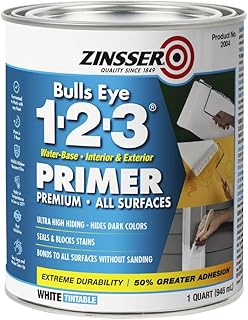
- Water-based styrenated acrylic primer-sealer
- pH up to 12.5
- Touch dry about 30 minutes; topcoat 1 hour; full adhesion 7 days
- Coverage about 400 to 450 square feet per gallon
- Apply at 35 to 90 degrees Fahrenheit; relative humidity under 85 percent; sizes 1 quart, 1 gallon, 5 gallon
Zinsser Bulls Eye 1-2-3 is the fast primer-sealer in this set, and its value on a sample board is speed without losing bond. The maker lists a water-based styrenated acrylic that bonds glossy surfaces without scuff sanding, which suits a board that has a sealed or painted face and cannot be sanded back to bare material. Touch dry comes at about 30 minutes and topcoat at 1 hour, so a board primed in the morning can take its clay coat the same day, though full adhesion takes 7 days and the clay coat should be left undisturbed while that bond builds. Coverage runs at about 400 to 450 square feet per gallon, which is generous for sample work, and the application range of 35 to 90 degrees Fahrenheit with relative humidity under 85 percent covers most indoor rooms. The quart size suits a run of sample boards without opening a gallon that then sits unused.
Pros: bonds glossy faces without sanding; fast topcoat time; high coverage per gallon.
Cons: full adhesion takes 7 days; needs low humidity during application; thin film needs an even coat.
Romabio BioGrip Micro Primer
- Mineral primer with micro-fine aggregate
- 1 litre covers 65 to 85 square feet; 2.5 litres cover 165 to 215 square feet; 15 litres cover 1000 to 1300 square feet
- Two coats; dry 8 to 12 hours between coats; dilution 20 to 30 percent
- Suits unabsorbent and glossy brick, Hardie board, concrete, stucco, painted drywall, brick and stone
BioGrip is a mineral primer with a micro-fine aggregate, and the aggregate is what gives it its place on a sample board. A smooth board that a liquid primer would slide across gets a fine tooth from the aggregate, and the clay finish keys into that tooth. The maker lists coverage of 65 to 85 square feet per litre, with larger packs covering 165 to 215 square feet at 2.5 litres and 1000 to 1300 square feet at 15 litres, and the primer goes on in two coats with 8 to 12 hours of drying between them and a dilution of 20 to 30 percent. The listed substrates run from unabsorbent and glossy brick through Hardie board, concrete, stucco and painted drywall, brick and stone, which covers the range of board materials a sample board can be. Two coats take longer than a single-coat primer, and the drying time between coats needs planning, but the grip the aggregate gives is the reason to choose it on a slick face.
Pros: micro-fine aggregate gives real key on slick boards; mineral base; wide substrate list.
Cons: needs two coats with 8 to 12 hours between them; dilution range needs care; slower than single-coat primers.
Claytec Primer WHITE
- Liquid primer without granulation
- Item 13.415: 10 litre bucket for about 100 square metres; Item 13.410: 5 litre bucket for about 50 square metres
- Listed before ClayFix clay colour and YOSIMA surfacer
- Keeps clay plaster from dissolving and mixing with the paint; firm basis for later repeat coats
- Composition: limestone powder, water, water glass, clay, dispersion under 5 percent, perlite, cellulose fibres, methyl cellulose, xanthan
- Apply with short pile roller or brush; water addition up to 5 percent; earliest recoat after 48 hours
The WHITE primer is the grain-free member of the Claytec range, and it exists for one job: giving a clay colour coat or a YOSIMA surfacer a clean base that does not dissolve into the paint. Where RED and YELLOW build grip with grain, WHITE builds a firm, even film that keeps the clay plaster from mixing with the colour coat above it, and the maker lists it before ClayFix clay colour and YOSIMA surfacer for that reason. A 10 litre bucket covers about 100 square metres, which is more than three times the coverage of RED, because a grain-free primer goes further than a grained one. The coat needs the same 48 hour floor before the next application, and the same substrate temperature range of 5 to 25 degrees Celsius. On a natural finish sample board that carries a colour coat rather than a plaster coat, WHITE is the primer that keeps the colour true.
Pros: grain-free base keeps colour coats clean; very high coverage per bucket; firm basis for repeat coats.
Cons: no grain, so no key for heavy plaster coats; needs the full 48 hour drying floor; wrong choice under a coarse finish.
Common mistakes
Choosing the primer by brand habit instead of by grain
The most common mistake is reaching for the primer that happens to be open on the shelf. Grain is the match, not habit: coarse finishes need RED, fine finishes need YELLOW, colour coats need WHITE, and a smooth board needs Tierracol. A primer chosen by habit gives a bond that looks fine on the day and fails when the clay dries.
Priming over dust
A board that has not been brushed and wiped clean sheds dust under the primer, and the primer bonds to the dust rather than to the board. Brush until a dry cloth comes away clean, vacuum the edges, and only then open the primer container.
Rushing the drying time
The Claytec primers list 48 hours as the earliest safe point, and that floor assumes warm, dry air. A cold room, a damp room or a thick coat needs longer. A clay coat laid on a primer that still holds moisture slides, blisters or dries in patches, and the sample board has to be stripped and started again.
Laying the primer on too thick
A thick primer coat dries unevenly, and puddles in the corners dry as glossy patches with no grain. One even coat, kept thin and worked with a wet edge, gives a better bond than a heavy coat that pools. Tierracol is the exception in thickness, because it is a bonding clay applied at 2 to 3 mm, and even there the coat must stay even and free of ridges.
Skipping the work sample
The data sheet asks for a sufficiently large work sample to check the whole layer structure, and skipping that sample means the first full board is the check. A small patch on a corner of the primed board shows whether the primer, the thickness and the drying all work together, and it costs a fraction of a full coat.
FAQ
Can one primer suit every textured clay finish on a sample board?
No. Grain decides the match: RED suits coarse finishes, YELLOW suits fine finishes and YOSIMA, WHITE suits colour coats and surfacer coats, and Tierracol suits smooth boards that need a bonding layer. A single primer across all four cases gives the right bond in one case and the wrong bond in the other three.
How long must a Claytec primer dry before the clay coat?
The data sheet lists complete drying with the earliest safe point at 48 hours, and drying depends on temperature and humidity. A warm, dry room meets the floor; a cold or damp room needs longer. The coat should feel dry through, with no coolness or tack at the edges, before the clay goes on.
Does a sample board need a primer at all?
A bare board with even suction and a light finish can sometimes take clay without a primer, but a textured finish is heavy and wet, and the primer is what evens suction and builds key. A sample board without primer hides the suction differences that the full wall will show, so the sample tells less than it should. Priming the board makes the sample honest.
Which primer suits a board that has old paint on it?
A painted board needs a sealer that bonds to the paint and evens the face. Loxon and Zinsser 1-2-3 both bond glossy and painted faces, with Loxon sealing masonry and coated boards and Zinsser bonding glossy faces without scuff sanding. The clay finish then goes on a face that is even, bonded and dry, rather than on paint that may or may not hold.
Can Tierracol replace a liquid primer on every board?
No. Tierracol is a bonding clay for smooth substrates, and it suits boards that need a clay key. On a thirsty board that needs its suction evened, a liquid primer such as YELLOW does the job better, and on a board that takes a colour coat, WHITE does the job better. Tierracol is the right primer for a smooth board, not a universal primer for all boards.
Conclusion
A natural finish sample board earns its keep when the primer underneath matches the board and the finish, and the match comes down to grain, suction and drying. RED gives a coarse finish its key, YELLOW gives a fine finish its even suction, WHITE gives a colour coat its clean base, Tierracol gives a smooth board its clay bond, and Loxon, Zinsser 1-2-3 and BioGrip give painted, glossy and slick boards the seal and the tooth they need. Every one of the six needs a dry coat before the clay goes on, and the Claytec primers ask for 48 hours at the earliest. Choose by grain, apply one even coat, wait the full drying time, and run a work sample on a corner before coating the full board. The sample board then shows the true texture, the true colour and the true drying of the finish, and the wall that follows can repeat it without surprise.
Related guides
More from Amazon
Programs that pair well with the guide above. Offers and eligibility are set by Amazon and may change.
Free shipping on eligible items, Prime Video and more. Eligible new members can start with a free trial.
Start a Prime free trialAudiobooks and podcasts to listen to on the go. Eligible new members can start with a free trial.
Try Audible freeAd-free music streaming. Eligible new subscribers can start with a free trial.
Try Music Unlimited freeA free business account with business pricing and bulk-buying tools for work, shop or home office.
Create a business accountAs an Amazon Associate we earn from qualifying purchases.
More ways to save on your next finish
Programs that pair well with the guide above. Offers and eligibility are set by Amazon and may change.
A free business account with business pricing and bulk-buying tools for work, shop or home office.
Create a business accountFast, free shipping on eligible items, plus Prime Video and more. Eligible new members can start with a free trial.
Start a Prime free trialRead from a huge library of eBooks, including how-to guides and cookbooks. Eligible new members can start with a free trial.
Try Kindle UnlimitedAudiobooks and podcasts for the commute, the garage or the kitchen. Eligible new members can start with a free trial.
Try Audible freeAs an Amazon Associate we earn from qualifying purchases. Using these links costs you nothing extra.










Write Your Review
No reviews yet. Be the first to share your experience!