
Key takeaways
- Seven rust resistant notched trowels for plaster bonding compared on blade steel, notch size, grip comfort, shank strength and groove depth for base coats.
What's inside
As an Amazon Associate I earn from qualifying purchases. This post may contain affiliate links at no extra cost to you.
Our top picks at a glance
3 products from this guide, in the order reviewed below.


As an Amazon Associate we earn from qualifying purchases. Prices and availability can change.
A base coat only bonds as well as the grooves cut into it. The bonding mortar needs ridges of even height pressed into the surface, and those ridges need a trowel whose blade keeps its edge through wet, alkaline work. Choosing among the best notched trowels for plaster bonding with rust resistant blades for creating adhesion grooves on base coats is therefore a question of blade steel first and everything else second: a blade that resists rust keeps its notches sharp, its face clean and its grooves true, coat after coat, while a blade that corrodes leaves a ragged edge and a stained surface.
Rust on a notched trowel is not a cosmetic problem. The notches are the measuring tool of the job, and corrosion eats their edges first, so a rusted trowel lays ridges that vary in height along the wall. On a base coat that variation shows up later as uneven adhesion, because the next coat or the board pressed onto the bed meets thick adhesive in one place and thin adhesive in the next. Stainless steel blades resist that decay because the steel itself resists the rust that wet cement and lime mortars encourage, and that resistance is what the seven trowels below were chosen for.
This guide compares seven notched trowels with rust-resistant blades, all listed by their makers or retailers for spreading bonding mortar and cutting adhesion grooves on base coats. Each entry records the blade steel, the notch size, the handle and the shank from the product page, and the buying guide at the end explains how to match notch depth to the coat, how to keep a stainless blade in good order, and when a second notch size is worth having in the bucket.
Quick verdict
For most base coats, the QEP 49915 is the natural lead pick: its rust-resistant stainless blade measures 11 by 4.5 inches, its 1/4 inch square notch cuts the standard bonding groove, and its cushioned comfort grip and nine-rivet shank keep the tool rigid and comfortable through long combing sessions. If the work runs to larger tile, the QEP 49916 carries the same stainless blade and shank in a model listed for tile up to 16 by 16 inches. The Tile Tools three-piece set answers with three notch depths in one buy, the Faithfull 6 millimetre trowel gives the most controlled shallow groove, the Kraft Tool Tiger Claw covers large-format beds with a hardened stainless blade, the M-D Building Products economy trowel offers a compact stainless option, and the Tile Tools 24 inch trowel combs wide beds in long, even passes.
At a glance
| Product | Key spec | Best for |
|---|---|---|
| QEP 49915 Comfort Grip Stainless Steel Square-Notch Trowel 1/4 x 1/4 x 1/4 | Stainless blade 11 x 4.5 in, 1/4 in square notch | Rust-proof grooves on base coats with a cushioned grip |
| QEP 49916 Comfort Grip Stainless Steel Square-Notch Trowel | Stainless blade 11 x 4.5 in, comfort grip | Rust-proof bonding beds for larger tile and board work |
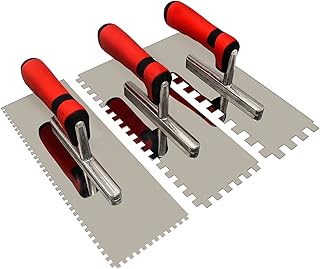
| Tile Tools Stainless Steel Square Notched Trowel Set 3 PC | Stainless blades 11 x 4 in, notches 4, 8 and 12 mm | Three notch depths for changing bonding beds |
| Faithfull Soft Grip Stainless Steel Notched Trowel 6 mm | Stainless blade 11 x 4.5 in, 6 mm square notch | Controlled 6 mm grooves with a soft grip |
| Tile Tools 24 in Large Tile Trowel 2/5 in Square Notch | Stainless blade 24 in, 2/5 in square notch | Wide bonding beds combed in long, even passes |
| Kraft Tool Tiger Claw Adhesive Tile Trowel | Hardened stainless blade, Tiger Claw notch | Large-format bonding with deep adhesive coverage |
| M-D Building Products Economy Square Notch Trowel 1/4 in | Stainless blade 9 x 4 in, 1/4 in square notch | Compact rust-proof notching for standard beds |
How we chose
The shortlist started from blade steel. Every trowel here has a stainless steel blade listed as rust-resistant or rustproof by its maker or retailer, because a bonding trowel lives in wet mortar and the blade has to survive that environment without corroding. Tempered and alloy steel trowels were left out of this list even when their notch patterns were attractive, since their blades need more care to stay rust-free and the keyword asks specifically for rust resistance.
Notch size was the second filter. The seven trowels cover the useful range for base-coat grooves: the 1/4 inch square notch of the QEP 49915 and the M-D economy trowel for standard beds, the 6 millimetre notch of the Faithfull for controlled shallow grooves, the 4, 8 and 12 millimetre set from Tile Tools for changing bed depths, the 2/5 inch notch of the 24 inch Tile Tools trowel for wide beds, and the specialized Tiger Claw notch from Kraft Tool for large-format coverage. Each notch size was taken from the product page, and where a page did not state a figure, the entry says so.
Handle, shank and blade size were recorded alongside the steel, because a rust-resistant blade still has to be comfortable to hold and rigid under pressure. The QEP models bring a 230 millimetre die-cast shank with nine rivets, the Tile Tools set uses welded shanks with no rivets at all, and the grips range from cushioned comfort handles to a full-size soft grip and a slip-resistant ABS handle. Blade lengths run from the compact 9 inch M-D trowel to the 24 inch Tile Tools trowel, so the list covers small repairs and wide open walls alike.
The trowels in detail
QEP 49915 Comfort Grip Stainless Steel Square-Notch Trowel 1/4 x 1/4 x 1/4
- Blade: rust-resistant stainless steel, 11 x 4.5 in
- Notch: 1/4 x 1/4 x 1/4 in square notch
- Shank: 230 mm aluminum die-cast shank with 9 rivets, first and last reinforced and welded
- Handle: large, contoured and cushioned comfort grip
- Listed use: thinset application for ceramic tile up to 8 x 8 in
The 49915 earns its place through the combination of a rust-resistant stainless blade and a grip built for long sessions. Stainless steel matters on bonding work because the blade spends its day in wet, alkaline mortar, and a blade that resists rust keeps its notches clean and its face free of the staining that a corroded edge can leave on a pale base coat. The 1/4 inch square notch cuts ridges of a depth that suits standard bonding beds, and the square profile holds its shape as the mortar is combed, so each pass leaves ridges of the same height.
The shank is where this trowel shows its working character. A 230 millimetre aluminum die-cast shank with nine rivets, the first and last reinforced and welded, keeps the blade rigid under the pressure of spreading stiff bonding mortar, and the extra clearance between handle and shank lets the hand rotate fully while the trowel is held at its working angle. That clearance matters when the applicator needs to change direction across a base coat without lifting the blade, because a steady angle is what keeps ridge height even from one edge of the wall to the other.
Pros:
- Rust-resistant stainless blade suits wet alkaline mortar
- Nine-rivet die-cast shank keeps the blade rigid
- Cushioned grip with clearance for full hand rotation
Cons:
- The 1/4 inch notch suits standard beds, not deep large-format beds
- The 11 inch blade is less handy in very tight corners
QEP 49916 Comfort Grip Stainless Steel Square-Notch Trowel
- Blade: rust-resistant stainless steel, 11 x 4.5 in
- Notch: square notch; notch size listed on the product page
- Shank: 230 mm aluminum die-cast shank with 9 rivets, first and last reinforced and welded
- Handle: large, contoured and cushioned comfort grip
- Listed use: thinset application for tile from 8 x 8 in to 16 x 16 in
The 49916 is the larger-format sibling of the 49915, built on the same rust-resistant stainless blade and the same nine-rivet die-cast shank, but listed by the retailer for tile from 8 by 8 inches up to 16 by 16 inches. That wider tile range makes it the more useful of the two when the bonding bed has to carry heavier units, because a deeper or wider notch pattern lays down more adhesive per pass and the stainless blade keeps its edge through repeated scraping across cement board and masonry. The cushioned grip is the same large contoured shape, so the hand position learned on the smaller model carries straight across.
What the listing does not state is the exact notch size, and that gap is worth noting rather than guessing around it. The buyer should check the product page for the notch dimensions before ordering, and match them to the adhesive coverage the bonding mortar maker calls for. In use, the same rules apply as for any stainless notched trowel: rinse the blade before mortar hardens in the notches, dry it before storage, and check the notch edges for wear, because a worn notch lays a shallower ridge and a shallower ridge holds less adhesive.
Pros:
- Rust-resistant stainless blade for wet bonding work
- Listed for tile up to 16 x 16 in
- Sturdy nine-rivet shank with cushioned grip
Cons:
- Notch size is not stated in the listing consulted
- The 11 inch blade still needs a smaller partner for tight spots
Tile Tools Stainless Steel Square Notched Trowel Set 3 PC
- Blades: polished stainless steel, 11 x 4 in each
- Notches: square notches of 4 mm, 8 mm and 12 mm across the set
- Shanks: welded aluminum shanks, no rivets
- Handles: ergonomic plastic and rubber handles
- Set: three trowels covering three mortar depths
This three-piece set answers the most common problem in bonding work, which is that one notch depth rarely suits every coat. A base coat that needs a shallow key takes the 4 millimetre trowel, a standard bonding bed takes the 8 millimetre, and a heavy bed on uneven masonry takes the 12 millimetre, and because all three share the same 11 by 4 inch polished stainless blade, the hand feel stays constant while the adhesive depth changes. The stainless blades resist rust through repeated wet work, and the welded aluminum shanks have no rivets to catch mortar or to work loose over time.
The ergonomic plastic and rubber handles keep the set comfortable through a full day of combing, and the three sizes let the applicator match the notch to the coat instead of forcing one trowel to do work it was not cut for. The trade is storage and discipline: three trowels take more room in the bucket than one, and the applicator has to pick the right one for each coat rather than reaching for the nearest. Used with that discipline, the set covers more bonding situations than any single trowel in this list.
Pros:
- Three notch depths cover shallow keys and heavy beds
- Polished stainless blades resist rust
- Welded shanks have no rivets to loosen
Cons:
- Three trowels take more storage space than one
- Plastic and rubber handles may wear faster than metal ones under daily use
Faithfull Soft Grip Stainless Steel Notched Trowel 6 mm
- Blade: stainless steel, 11 x 4.5 in
- Notch: 6 mm square notches
- Edges: two straight edges for finishing and cutting off excess adhesive
- Handle: full-size soft grip handle
- Listed use: wall tiles and mosaic work where controlled adhesive depth matters
The Faithfull 6 millimetre trowel is built around control. A 6 millimetre square notch lays a measured bed that suits wall tiles and mosaic work, where too much adhesive squeezes into joints and too little leaves hollow spots behind the tile. The stainless steel blade brings corrosion resistance to the job, which matters when the trowel is used day after day in wet mortar, and the full-size soft grip handle keeps the hand comfortable through the long, repetitive combing passes that bonding work demands.
Two straight edges add a practical second function: the same tool that combs the ridges can finish a flat edge and cut off excess adhesive without a tool change. That matters on a base coat, where the applicator moves between combing grooves and cleaning up edges in the same pass. The single notch size is the limit of the design, so it suits applicators who have settled on 6 millimetre beds and want that depth repeated exactly, coat after coat.
Pros:
- Stainless blade resists corrosion through wet work
- 6 mm notch gives controlled adhesive depth
- Two straight edges finish and trim without a tool change
Cons:
- A single notch size cannot cover deep bonding beds
- The 11 inch blade may feel large for small repair areas
Tile Tools 24 in Large Tile Trowel 2/5 in Square Notch
- Blade length: 24 in
- Notch: 2/5 x 2/5 in square notch
- Blade: stainless steel
- Frame: aluminum alloy frame
- Handle: ergonomic handle; frame folds for storage
- Design: baffle design keeps mortar from spilling over
A 24 inch blade changes the rhythm of bonding work. Instead of many short passes, the applicator combs a wide bed in long, steady strokes, and the 2/5 inch square notch lays ridges of even height across the full width of the blade. The stainless steel blade resists rust, the aluminum alloy frame keeps the long tool light enough to control, and the baffle design holds mortar on the blade instead of letting it spill over the edges during a pass. For large, open base coats and cement board runs, that width is a genuine time saver.
The folding frame is the practical detail that makes a 24 inch tool livable: it packs down for transport and storage instead of demanding a long slot in the van. The size is also the limit, because a 24 inch blade cannot turn inside a small room or around fittings, and the 2/5 inch notch suits medium to large tile rather than fine mosaic work. On open walls and floors, though, few tools in this list cover ground as fast while keeping ridge height as even.
Pros:
- Wide blade covers large bonding beds in fewer passes
- Stainless blade resists rust
- Folding frame packs down for transport
Cons:
- Too long to turn in small rooms or around fittings
- The 2/5 inch notch suits medium to large tile, not fine work
Kraft Tool Tiger Claw Adhesive Tile Trowel
- Blade: hardened stainless steel
- Notch: specialized Tiger Claw notch shape
- Size: larger than standard trowels
- Listed use: tiles 12 x 24 in or larger
- Coverage: the listing describes adhesive coverage of 95 to 100 percent for large tiles
The Tiger Claw is the heavy lifter of this list. Its specialized notch shape is cut so that the ridges of adhesive collapse more easily when the tile is set, which pushes air out from under large-format units instead of trapping it in lines between the ridges. The hardened stainless steel blade resists wear from spreading large volumes of mortar and resists rust through wet work, and the larger-than-standard size covers more area with each pass, which matters when the mortar has a limited open time and the applicator is working against the clock.
Large-format bonding is where coverage failures show up first, because a hollow spot under a 12 by 24 inch unit can crack the tile when it is loaded. The Tiger Claw addresses that risk directly: the notch geometry, the stiff hardened blade and the wide coverage all serve the same goal of full contact between tile and bed. It is a specialist rather than an everyday trowel, and its size and notch shape are wasted on small tile, but for large-format bonding beds it is the most purposeful tool here.
Pros:
- Hardened stainless blade resists wear and rust
- Claw notch shape helps ridges collapse for full contact
- Sized for large-format tile and fast coverage
Cons:
- Larger size is less suited to small areas
- Specialized notch pattern is not a general square notch
M-D Building Products Economy Square Notch Trowel 1/4 in
- Blade: stainless steel, 9 x 4 in
- Notch: 1/4 in square notch
- Handle: black ABS slip-resistant handle
- Listed use: backsplash and general mortar applications
The M-D Building Products economy trowel proves that a rust-resistant blade does not need a large frame. Its 9 by 4 inch stainless steel blade resists bending and rusting through repeated wet work, and the 1/4 inch square notch combs even ridges for standard bonding beds. The compact size suits applicators who work in smaller areas or who want a lighter tool for overhead and vertical passes, where a full 11 inch blade can feel unwieldy.
The black ABS handle is shaped for a slip-resistant grip, which helps the applicator hold a steady angle through long combing sessions. The listing notes that the handle can feel slippery when wet, so drying the grip during use is worth the habit. Rinsing the blade after use keeps mortar out of the notches and the stainless face clean, and the simple square-notch pattern does exactly what it promises: even ridges, repeated pass after pass, without fuss.
Pros:
- Stainless blade resists rust in a compact size
- Even 1/4 inch square notch for standard beds
- Slip-resistant ABS handle aids control
Cons:
- The ABS handle can feel slippery when wet
- A single basic notch pattern cannot cover deep beds
Buying guide
Start with the steel, and read the product page rather than the colour of the blade. Stainless steel is the reliable marker of rust resistance on a notched trowel, and the listings for the trowels here state it plainly: rust-resistant or rustproof stainless blades that clean easily after wet work. A blade described only as tempered or alloy steel may serve well for years with careful drying, but it does not meet the rust-resistant requirement of this list, and it will show surface rust sooner if it is left wet in a bucket overnight.
Match the notch to the depth of the bonding bed. A 1/4 inch square notch suits a standard base coat on a flat substrate, laying ridges that collapse into an even layer when the next coat or board is pressed on. A 6 millimetre notch gives a shallower, more controlled bed for wall work and fine coats, while the 12 millimetre trowel in the Tile Tools set carries the volume a heavy bed on uneven masonry needs. The wrong depth in either direction causes trouble: too shallow and the bond is starved, too deep and adhesive squeezes out at the edges and wastes material.
Blade length decides how fast the work goes and how even it stays. A 24 inch blade combs a wide bed in a few long passes, which keeps ridge height consistent across the wall, but it cannot turn in a small room. A 9 or 11 inch blade is the everyday compromise: long enough to lay straight ridges, short enough to work around openings and fittings. Keep a margin trowel nearby for the edges, because the field trowel cannot finish the perimeter of a bonding bed on its own.
Look closely at the shank and the way the handle is fixed. A die-cast shank with nine rivets, as on the QEP models, spreads the load across the blade and keeps it flat under pressure, while a welded shank, as on the Tile Tools set, has no rivets to trap mortar. Either construction works well if it is solid; what matters is that the blade does not flex or twist when it is loaded with stiff bonding mortar, because a twisting blade lays ridges of uneven height.
Handle comfort decides how long the applicator can hold a steady angle. Cushioned comfort grips, soft grip handles and slip-resistant ABS all serve the same purpose, which is to keep the hand relaxed while the trowel is held at 45 to 60 degrees through hundreds of passes. A handle that slips when wet or digs into the palm will change the applicator angle without them noticing, and a changed angle changes ridge height. Try the grip with wet hands before committing to a full day of work.
Care for a stainless blade is simple but not optional. Rinse mortar off before it hardens in the notches, using water and a stiff brush, then dry the blade before storage rather than leaving it in a damp bucket. Check the notch edges from time to time against a straightedge: a nicked or worn notch lays a shallower ridge, and the only fix is to retire the trowel or reserve it for rough work. Finally, follow the bonding mortar maker guidance on bed depth and open time, because the trowel is only as good as the mortar it spreads, and a sample board combed with the chosen trowel is the cheapest way to prove the groove before the real wall is started.
FAQ
What makes a notched trowel blade rust resistant?
The blade steel does. Stainless steel resists the rust that wet cement and lime mortars encourage, because the steel itself carries the corrosion resistance rather than relying on a coating that can wear off. The trowels in this list are all described by their makers or retailers as having rust-resistant or rustproof stainless blades, and that description is the filter to check on the product page before buying.
What notch size cuts the best adhesion grooves on a base coat?
A 1/4 inch square notch is the standard starting point for a base coat on a flat substrate, because it lays ridges deep enough to key the next coat without wasting adhesive. Shallower grooves, such as the 6 millimetre notch on the Faithfull, suit fine coats and wall work, while deeper notches up to 12 millimetres suit heavy beds on uneven masonry. Match the notch to the bed depth the bonding mortar maker calls for, not to the size of the trowel.
Can a stainless trowel be left wet after use?
It should not be. Stainless steel resists rust far better than tempered or alloy steel, but dried mortar in the notches still damages the cutting edges and changes ridge height. Rinse the blade with water and a stiff brush before the mortar hardens, dry it fully, and store it where the edges cannot be nicked by other tools. That habit keeps the notches sharp and the grooves even.
Do I need more than one notch size for bonding work?
One size covers most base coats, but a second size helps when the work changes. The Tile Tools three-piece set covers shallow keys, standard beds and heavy beds in one buy, and many applicators keep a 1/4 inch trowel for everyday work plus a deeper notch for uneven masonry. If the budget allows only one trowel, choose the notch size that matches the most common coat in the work at hand.
How do I keep the notches sharp and even?
Clean the blade after every session, before mortar hardens in the notches, and dry it before storage. Check the notch edges against a straightedge from time to time, and retire a trowel whose notches have worn unevenly to rough work. Hold a consistent angle, usually 45 to 60 degrees, and even pressure while combing, because the applicator technique shapes the ridges as much as the tool does.
Conclusion
A rust-resistant blade is the foundation of reliable bonding grooves, and the QEP 49915 leads this list because it pairs a rust-resistant stainless blade with a standard 1/4 inch square notch, a cushioned grip and a rigid nine-rivet shank. The QEP 49916 extends the same construction to larger tile, the Tile Tools set covers three bed depths, the Faithfull gives controlled 6 millimetre grooves, the Kraft Tool Tiger Claw handles large-format beds, the M-D economy trowel offers a compact stainless option, and the Tile Tools 24 inch trowel combs wide beds in long passes. Pick the notch depth that matches the coat, rinse and dry the blade after every session, and prove the groove on a sample board before the real wall is started.
Related guides
More from Amazon
Programs that pair well with the guide above. Offers and eligibility are set by Amazon and may change.
Free shipping on eligible items, Prime Video and more. Eligible new members can start with a free trial.
Start a Prime free trialAudiobooks and podcasts to listen to on the go. Eligible new members can start with a free trial.
Try Audible freeAd-free music streaming. Eligible new subscribers can start with a free trial.
Try Music Unlimited freeA free business account with business pricing and bulk-buying tools for work, shop or home office.
Create a business accountAs an Amazon Associate we earn from qualifying purchases.
More ways to save on your next finish
Programs that pair well with the guide above. Offers and eligibility are set by Amazon and may change.
A free business account with business pricing and bulk-buying tools for work, shop or home office.
Create a business accountFast, free shipping on eligible items, plus Prime Video and more. Eligible new members can start with a free trial.
Start a Prime free trialRead from a huge library of eBooks, including how-to guides and cookbooks. Eligible new members can start with a free trial.
Try Kindle UnlimitedAudiobooks and podcasts for the commute, the garage or the kitchen. Eligible new members can start with a free trial.
Try Audible freeAs an Amazon Associate we earn from qualifying purchases. Using these links costs you nothing extra.










Write Your Review
No reviews yet. Be the first to share your experience!