
Key takeaways
- Compare seven plaster sample board tool kits under one hundred fifty dollars for learning marmorino texture combinations, from trapezoid trowels to knife sets.
What's inside
As an Amazon Associate I earn from qualifying purchases. This post may contain affiliate links at no extra cost to you.
Marmorino rewards patience more than any other decorative plaster. Its texture comes from thin coats laid over one another, each pass changing the surface a little, until the board shows the soft movement and depth that clients recognise as stone. Learning those combinations takes practice, and practice takes boards: board after board, each one a small experiment in pressure, angle, coat thickness and drying time. A plasterer who is learning marmorino needs tools that forgive a heavy hand on the first board and reward a lighter touch on the tenth, and a kit that contains several blade shapes makes that learning faster, because each shape teaches a different lesson. Choosing best plaster sample board tool kits under one hundred fifty dollars for learning marmorino texture combinations is therefore a decision about how quickly a craftsperson can build skill, and the right kit shortens the road from first attempt to confident finish.
Texture combinations are the heart of the subject. Marmorino can be smooth and polished, or it can carry a soft clouded movement, or a fine combed pattern, or a stone-like grain that catches the light. Each of those effects comes from a combination of the tool, the pressure and the number of coats, and the only way to learn a combination is to try it on a board, look at the result, and try again with one thing changed. A kit with several trowels lets the learner change the tool while keeping everything else the same, which isolates the effect of the blade. A kit with knives and a mud pan as well lets the learner practise the whole sequence, from loading the knife to laying the coat to closing the surface, without stopping to fetch another tool.
The higher cap in this guide, one hundred fifty dollars, opens up kits that the seventy-five-dollar range cannot reach. Full knife sets with five or eight pieces, a two-piece Venetian set in two useful sizes, and a trapezoid trowel set with wooden handles all sit inside it. Those kits are still inexpensive beside the cost of a training course or a wasted wall, and they are the tools a learner will keep using long after the learning phase, because the same blades that teach texture on a board also lay the finish on a wall. The guide below compares seven of them, explains what each one teaches, and shows how to build a small practice routine around them.
A word on how to use this guide: read the product sections in order, then pick the kit that matches the texture you want to learn first. If polished stone is the goal, start with a trapezoid trowel set. If broad, soft movement is the goal, start with a knife set that covers large areas quickly. If the goal is to understand how size changes a finish, start with a set that offers three sizes. Whichever you choose, keep a notebook beside the boards and write down what you changed on each one. That record turns practice into learning, and learning into a finish you can repeat for a client.
Quick verdict
For learning marmorino texture combinations, the KIWDZFU Trapezoid Trowel Set is the strongest starting point. Its three stainless trowels, with 0.03 inch trapezoid blades and wooden handles, are made for the exact motions marmorino needs: laying thin coats, pressing the surface flat, and burnishing the final pass to a soft sheen. The trapezoid shape gives more coverage than a rectangle of the same length, and the wooden handle suits the firm grip that burnishing requires. A learner who starts here will understand, within a few boards, how blade angle and pressure change the texture.
The LUNAO QUE 2-Piece Venetian Trowel Set is the natural second choice, because its two sizes, small at around 200 by 80 millimetres and medium at around 240 by 100 millimetres, teach the lesson that size changes everything. The small trowel gives control on detail and edges; the medium trowel covers a board quickly and shows how a broader blade softens a texture. The xinyoec 5-Piece Drywall Knife Set and the ENVEL 8-Piece Drywall Knife Set take a different approach: they teach the learner to work with knives and pans, laying coats with a taping knife and finishing with a putty knife, which is the sequence many plasterers use on larger walls. The Goldblatt, YIMITEE and Japanese three-piece sets, shared with the client-sample guide, round out the list as low-cost ways to practise the same motions with polished Venetian blades. A learner who wants one kit should buy the KIWDZFU set; a learner who wants a full practice bench should add the xinyoec knife set beside it.
| Product | Key spec | Best for |
|---|---|---|
| KIWDZFU Trapezoid Trowel Set | 3 stainless trowels, 0.03 in trapezoid blades | Learning polished marmorino texture |
| LUNAO QUE Stainless Steel Venetian Plaster Trowel Set 2 Piece | Small 200×80 mm and medium 240×100 mm trowels | Learning how trowel size changes texture |
| xinyoec 5-Piece Drywall Knife Set | 3 tape knives and 2 putty knives, 431 and 3Cr13 steel | Practising the full coat sequence |
| ENVEL 8-Piece Stainless Steel Drywall Knife Set | 8 pieces with trowel, scoop and 12 in pan | A complete practice bench in one box |
| Goldblatt 3 Pieces Venetian Plaster Trowel Set | 3 polished stainless trapezoid blades, 0.03 in thick | Polished finishes on a low budget |
| YIMITEE 3 Pack Venetian Plaster Trowel Set | 3 mirror polished trowels, 200×80 to 234×110 mm | Broad texture boards with wood handles |
| 3-Pack Stainless Steel Venetian Plaster Japanese Finishing Trowels | 3-pack stainless finishing trowels | Low-cost repetition practice |
How we chose
The seven kits in this guide were chosen for learning, which is a different test from choosing for production. A production kit must be fast and durable above all. A learning kit must also be forgiving, varied and clear in what it teaches. Each kit here was judged on four points. First, does it offer more than one blade shape or size, so the learner can compare results? A single trowel teaches one motion; a set teaches the difference between motions. Second, are the blades suited to marmorino? That means thin, flexible steel, a polished face, and rounded or beveled edges that do not score a thin coat. Third, does the kit sit under the one hundred fifty dollar cap, with the price listed by the maker or retailer? Fourth, does the kit include enough of the supporting tools, such as a pan or a scoop, to let the learner practise the whole sequence without stopping?
Blade shape received the most attention. Trapezoid blades dominate the top of this guide because their shape suits marmorino: the wider end covers ground quickly, the narrower end works detail, and the angled edge lets the plasterer change the contact patch by tilting the trowel. Knife sets earned their place because taping knives and putty knives teach a different skill, which is loading and laying a coat with a straight edge, and that skill transfers directly to wall work. The guide also looked at handle material, because a learner will hold these tools for hours: wooden handles on the KIWDZFU and YIMITEE sets, soft-grip handles on the Goldblatt and LUNAO QUE sets, and rubber handles on the xinyoec set all give a secure grip when hands are damp with plaster.
Price was checked against the cap for every kit, and the guide notes where a kit sits well under the cap and where it approaches it. The three-piece Venetian sets sit far under the cap, which leaves room in the budget for a second kit, while the eight-piece ENVEL set uses more of the budget but replaces several separate purchases. Finally, the guide favoured kits whose makers list real dimensions and materials, because a learner who cannot see the blade size before buying cannot plan which texture to practise first. Every kit below lists its contents, and the product sections repeat those lists so the reader can compare them directly.
KIWDZFU Trapezoid Trowel Set
- 3 stainless steel trowels in different sizes
- 0.03 in thick trapezoid blades, polished surface
- Wooden handles for a firm grip
- For Venetian plaster, art and concrete finishing
- Model A421PH522279
The KIWDZFU set leads this guide because the trapezoid blade is the most instructive shape a marmorino learner can hold. A trapezoid trowel changes its contact patch as the plasterer tilts it, so a single tool can lay a broad coat with its wide edge, press a narrow band with its tip, and burnish a small area with its corner. That versatility turns one board into several lessons: the same trowel, held three ways, gives three textures, and the learner sees the difference immediately. The maker lists three trowels in different sizes, all in stainless steel with a polished surface, so the lesson scales up and down as well.
The blade thickness of 0.03 inches is the thin, flexible range that suits marmorino, and the maker lists a polished surface that resists scratching and fading over time. On a practice board, that polish matters because the learner will make many passes over the same area, and a rough blade would drag the coat and confuse the result. The wooden handle gives a firm grip that suits the pressure burnishing needs, and it stays comfortable through the long sessions that learning requires. A learner who works through ten boards with this set will have a clear sense of how angle, pressure and blade size combine, and that sense is the foundation of every marmorino texture.
Pros: Trapezoid shape teaches several motions with one tool; thin polished blades suit marmorino; wooden handles suit firm burnishing pressure.
Cons: No pan or scoop included; three sizes may feel similar to a beginner at first.
LUNAO QUE Stainless Steel Venetian Plaster Trowel Set 2 Piece
- Small trowel approx 200×80 mm, medium trowel approx 240×100 mm
- Stainless steel blades for smooth, consistent application
- For Venetian plaster, skim coats and burnishing
- Total weight about 1.014 lb
- Model DJEHHF32
Two sizes teach a lesson that a single trowel cannot: size changes texture. The small trowel in this set, at around 200 by 80 millimetres, gives the learner control over detail, edges and tight areas, and it shows how a narrow blade leaves a finer, more directional mark. The medium trowel, at around 240 by 100 millimetres, covers a board in fewer passes and shows how a broader blade softens a texture into a calmer surface. Working the same plaster with both trowels, one board after another, makes that difference visible in a way that reading about it never will.
The maker lists stainless steel blades designed for smooth, consistent application on walls and ceilings, and describes the set as suited to detailed plastering and finishing work, including burnishing. At about 1.014 pounds for the pair, the set is light enough for long practice sessions, and the two sizes fit easily in a practice bag beside the boards. For a learner, the set is also a good way to discover which size suits their hand: some plasterers prefer the control of the small trowel, others the coverage of the medium one, and knowing that preference early saves money later, when the learner buys a full set in their preferred size.
Pros: Two sizes teach how size changes texture; light at about 1.014 lb; stainless blades suit burnishing.
Cons: Only two trowels, so less variety than a three-piece set; no pan or scoop.
xinyoec 5-Piece Drywall Knife Set
- 3 tape knives: 8, 10 and 12 in, in 431 stainless steel
- 2 putty knives: 6 and 8 in, in 3Cr13 stainless steel, 48-52 HRC
- PP rubber handles with anti-fingerprint grip
- Metal hammer end
- Model be46281-Z
The xinyoec set teaches the sequence, not just the finish. Marmorino on a wall is usually laid with a knife before it is worked with a trowel, and a learner who only practises with trowels misses the first half of the job. This set covers that half: three tape knives in 8, 10 and 12 inches for laying coats, and two putty knives in 6 and 8 inches for detail and edges. The tape knives are made from 431 stainless steel with flexible blades, which the maker lists as suited to applying plaster and cement, while the putty knives are 3Cr13 stainless steel at 48 to 52 HRC, a hardness the maker lists for long-term durability.
On a sample board, the set lets the learner practise loading the knife, laying an even coat, and feathering the edge, then switching to a smaller knife for the corners. The PP rubber handles are wear resistant and insulated, with an anti-fingerprint design that the maker lists as helping grip when hands are damp. The metal hammer end is a practical extra for the workshop, though it has no role on the board itself. Paired with a trapezoid trowel set, this knife set completes the practice bench: knives for laying, trowels for finishing, and the learner can move between them on the same board.
Pros: Five sizes cover laying and detail; flexible tape knives suit thin coats; hard putty knives last through heavy practice.
Cons: Knives alone do not burnish a finish; the set is heavier than a trowel-only kit.
ENVEL 8-Piece Stainless Steel Drywall Knife Set
- 8 pieces: taping and putty knives, trowel, mud scoop and 12 in pan
- 3CR13 stainless steel with mirror polish finish
- Heli-arc welded end caps and triple-riveted joints
- Arc-shaped bucket scoop for scraping bucket sides
- For drywall taping, finishing, smoothing and decorative walls
The ENVEL set is the complete practice bench in one box, and it earns its place by removing excuses. It contains taping and putty knives, a lightweight trowel, a mud scoop and a 12 inch pan, so the learner can move from the bucket to the board without fetching another tool. The maker lists 3CR13 stainless steel with a mirror polish finish, which resists rust and cleans easily, and precision ground blade edges for longer use. The heli-arc welded end caps and triple-riveted joints give the knives a solid feel that survives repeated practice.
For learning marmorino texture combinations, the value of the set is in its range. The learner can lay a coat with a taping knife, smooth it with the trowel, test a texture with a putty knife, and carry the next batch in the pan, all in one session. The arc-shaped scoop follows the curve of the bucket, so small batches come out cleanly and the mix stays consistent from board to board. That consistency matters when the learner is comparing textures, because a change in the mix can look like a change in the technique. The set costs more than the three-piece trowel sets, but it replaces several separate purchases, and it is the closest thing in this guide to a ready-made learning station.
Pros: Eight pieces cover the whole sequence; pan and scoop keep batches consistent; solid welded and riveted construction.
Cons: Costs more than a trowel-only set; the trowel is light, so it suits smoothing more than heavy pressing.
Goldblatt 3 Pieces Venetian Plaster Trowel Set
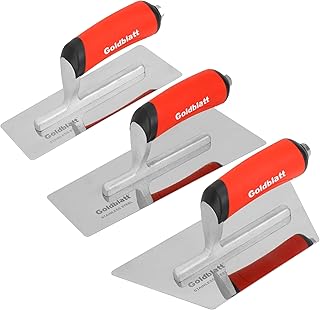
- 3 trowels: 7-7/8 in, 9-29/64 in and 9-1/4 in
- Polished stainless steel trapezoid blades, 0.03 in (0.7 mm) thick
- Beveled edges and rounded corners
- Aluminium shank with ergonomic soft-grip handle
- For Venetian plaster, Marmorino, microcement and stucco
The Goldblatt set appears in this guide as the low-cost way to practise polished marmorino textures, and it is here because its price leaves room in the budget for a second kit. Its three sizes cover large areas, tight corners and curved details, and the polished stainless trapezoid blades at 0.03 inches thick are the right specification for thin coats and firm pressure. The maker lists beveled edges that help prevent aggregate popping and rounded corners that keep the blade from scoring the finish, both of which matter when a learner is still finding the right pressure and needs a blade that forgives a heavy pass.
For a learner, the set has a second advantage: it is the same set many plasterers use on walls, so the skill learned on the board transfers directly. The aluminium shank keeps the tool light, and the ergonomic soft-grip handle suits the short, repeated strokes of practice work. A learner who starts with this set and adds the xinyoec knife set later will have a bench that covers laying, smoothing and polishing for well under the cap, and will have learned each step on tools that are good enough to keep using on real work.
Pros: Three useful sizes at a low cost; thin polished blades forgive a heavy hand; same set works on walls later.
Cons: No pan or scoop; smallest trowel may feel large on very small practice boards.
YIMITEE 3 Pack Venetian Plaster Trowel Set
- 3 trowels: 200×80 mm, 240×100 mm and 234×110 mm
- Mirror polished stainless steel blades, 0.7 mm thick
- Precision-ground beveled edges with rounded corners
- Wooden handles
- For plaster, stucco, drywall compound and wood filler
The YIMITEE set is the wood-handled practice option, and its broad middle trowel is the feature that makes it useful for learning texture. At 240 by 100 millimetres, the middle trowel covers a standard practice board in a few passes, and its width shows the learner how a broad blade softens a texture into a calm, even surface. The largest trowel, at 234 by 110 millimetres, is broader still, which suits boards where the learner wants to press a wide area flat in one motion. The smallest, at 200 by 80 millimetres, handles detail and edges.
Mirror polished blades slide over a setting coat without dragging, which helps a learner who is still learning how much pressure to use, because the blade gives clear feedback: too much pressure shows as a line, too little shows as a rough patch. The maker lists precision-ground beveled edges and rounded corners, which protect the surface from scratches. Wooden handles give a firm, traditional grip that suits plasterers who steer with the wrist, and they stay pleasant to hold when hands are damp, though they should be dried after washing.
Pros: Broad middle trowel teaches how width softens texture; mirror polish gives clear feedback on pressure; wooden handles suit wrist steering.
Cons: Wood handles need drying after washing; largest trowel is wide for narrow practice boards.
3-Pack Stainless Steel Venetian Plaster Japanese Finishing Trowels

- 3-pack of stainless steel Venetian plaster finishing trowels
- For smooth, polished walls and art paint plastering
- Stainless steel construction throughout
- Compact sizes for detail and finish work
- For Venetian plaster and decorative plaster finishes
This three-pack is the repetition kit: the set a learner buys when the goal is to make many boards, quickly, without worrying about the cost of the tools. Its compact Japanese-style blades are shaped for control rather than for covering large areas, which suits practice work, where the learner moves slowly and watches the surface. Making the same texture ten times on ten boards is how a combination becomes a skill, and a low-cost set removes the hesitation that comes with using an expensive tool for repetition.
The maker lists these trowels for smooth polished walls and art paint plastering, which covers the two textures most learners start with. A polished Venetian sample and a smooth art-paint sample can both be made with this set, and the compact size keeps the blade on the board. Because the set is inexpensive, a learner can keep one set for practice boards and another for client boards, or can lend a set to a colleague who is learning alongside them. That sharing is a practical benefit in a workshop where two people learn together, and it costs less than a single premium trowel.
Pros: Lowest cost in this guide; compact blades suit slow, careful practice; easy to keep a spare set.
Cons: Fewer listed dimensions than the leading sets; compact size is slow on broad boards.
Buying guide
Start with one texture, not with every texture
Marmorino offers many combinations, and the temptation is to try them all at once. That slows learning, because when a board fails, the learner cannot tell which change caused it. Pick one texture first, for example a smooth polished finish, and make five boards of that texture before moving on. Change only one thing per board: the pressure, the angle, or the number of coats. When the five boards look consistent, move to the next texture. The kits in this guide support that method, because each one is simple enough to learn in a few boards.
Learn the trapezoid blade first
The trapezoid blade is the most versatile shape for marmorino, and the KIWDZFU set is the best place to learn it. Its wide end covers ground, its narrow end works detail, and tilting it changes the contact patch. Spend the first practice sessions on that one shape, and notice how the texture changes as the angle changes. Once the trapezoid feels natural, the other shapes in the guide will make sense quickly, because they are variations on the same idea.
Pair a trowel set with a knife set
Laying coats and finishing coats are different skills, and they need different tools. A trowel-only practice bench teaches finishing but not laying, and a knife-only bench teaches laying but not polishing. The most effective learning setup in this guide is a pair: the KIWDZFU trapezoid set for finishing, plus the xinyoec five-piece knife set for laying. Together they cost well under the cap, and they let the learner practise the whole sequence on every board, which is how the skill becomes smooth.
Keep a practice notebook beside the boards
Memory is unreliable when textures look similar. After each board, write down the plaster, the colourant, the number of coats, the tool used for each coat, and the drying time between coats. Number the boards and keep them in order, so the learner can look back and see the progression. A notebook turns a pile of boards into a course of study, and it lets the learner repeat a good result exactly when a client asks for it.
Practise on the same board size you will show clients
Boards of different sizes need different tools and different motions, so practising on one size and showing another creates a gap. Choose the board size you will use for client samples, and do all your learning on that size. The trowels in this guide suit boards around the size of a sheet of paper up to a larger panel, and the three-piece sets give the range to cover that span. When the board size stays constant, the only variables are the tool and the hand, and the learning is faster.
Judge a kit by its blade face and edge
When comparing kits, look at the blade face first and the handle second. A mirror polished face slides cleanly and shows the learner exactly what the pressure is doing, while a rough face drags and hides mistakes. A beveled edge meets the plaster at a clean angle, and rounded corners protect the surface from scoring. The kits in this guide list these details, and the product sections repeat them, so the reader can compare face and edge across kits before choosing.
FAQ
How many practice boards does it take to learn a marmorino texture?
There is no fixed number, because it depends on the texture and on how carefully the learner records each attempt. A simple smooth polish may feel steady after five or six boards, while a complex clouded texture may take fifteen or more. The useful measure is consistency: when three boards in a row look the same, the combination is learned well enough to show a client.
Should I practise with the same plaster I will use on walls?
Yes, whenever possible. Different plasters behave differently under the trowel, and a texture learned on one plaster may not transfer to another. Practise with the plaster you plan to sell, in the colours you plan to offer, so the boards you make while learning can become the first boards in your client set. That saves material and keeps the learning honest.
What is the best first texture to learn?
A smooth, lightly polished finish is the best starting point, because it teaches the core skills of laying thin coats, closing the surface and controlling pressure, without the extra variables that patterned textures add. Once the smooth finish is consistent, the learner can add movement and pattern, and the earlier skill carries over. The KIWDZFU trapezoid set is well suited to that first texture.
Do I need a pan and a scoop for practice boards?
A pan helps, because it keeps the mixed plaster close to the board and lets the learner load the knife cleanly. A scoop helps when batches are small, because it gets the plaster out of the bucket without waste. The ENVEL eight-piece set includes both, which is one reason it leads the complete-bench options in this guide. A learner who buys a trowel-only set can add a pan later, but the practice sessions will be smoother with one from the start.
How do I know when a practice board is good enough to show a client?
A board is ready when it matches the finish you intend to sell, when it has the same number of coats as the wall will receive, and when you can repeat it. Make the board twice: if the second copy matches the first, the texture is repeatable and the board can go into the client set. If the copies differ, keep practising, and use the notebook to find what changed between them.
Can I learn marmorino texture combinations from boards alone?
Boards teach the hand, which is the largest part of the skill, but they do not teach everything. Working on a wall adds the variables of scale, gravity and drying time across a large surface, so the learner should move from boards to a small wall or a large panel once the boards are consistent. The kits in this guide work on both, which is why they are worth buying for the learning phase and keeping for the work that follows.
Conclusion
Learning marmorino texture combinations is a matter of boards, notes and repetition, and the right kit makes each of those easier. The seven kits in this guide all sit under the one hundred fifty dollar cap, and each one teaches something: the KIWDZFU trapezoid set teaches how angle and pressure shape a finish, the LUNAO QUE two-piece set teaches how size changes texture, the xinyoec and ENVEL knife sets teach the full sequence from laying to polishing, and the three-piece Venetian sets offer low-cost repetition with polished blades. Buying a trowel set and a knife set together covers the whole workflow, keeping a notebook turns practice into learning, and practising on client-sized boards keeps the skill honest.
Start with one texture, make five boards, write down what changed on each one, and keep going until three boards in a row look the same. That is the point at which a texture is learned, and the point at which a board can move from the practice pile to the client set. The tools in this guide will carry a learner that far and further, because they are the same tools that lay the finish on a wall, and the skill they teach is the skill the work needs.
Related guides
More from Amazon
Programs that pair well with the guide above. Offers and eligibility are set by Amazon and may change.
Free shipping on eligible items, Prime Video and more. Eligible new members can start with a free trial.
Start a Prime free trialAudiobooks and podcasts to listen to on the go. Eligible new members can start with a free trial.
Try Audible freeAd-free music streaming. Eligible new subscribers can start with a free trial.
Try Music Unlimited freeA free business account with business pricing and bulk-buying tools for work, shop or home office.
Create a business accountAs an Amazon Associate we earn from qualifying purchases.
More ways to save on your next finish
Programs that pair well with the guide above. Offers and eligibility are set by Amazon and may change.
A free business account with business pricing and bulk-buying tools for work, shop or home office.
Create a business accountFast, free shipping on eligible items, plus Prime Video and more. Eligible new members can start with a free trial.
Start a Prime free trialRead from a huge library of eBooks, including how-to guides and cookbooks. Eligible new members can start with a free trial.
Try Kindle UnlimitedAudiobooks and podcasts for the commute, the garage or the kitchen. Eligible new members can start with a free trial.
Try Audible freeAs an Amazon Associate we earn from qualifying purchases. Using these links costs you nothing extra.










Write Your Review
No reviews yet. Be the first to share your experience!