
Key takeaways
- Seven plaster sample board tool kits with finishing trowels compared for Venetian plaster burnishing practice: blade sizes, thickness, handles and board setup.
As an Amazon Associate I earn from qualifying purchases. This post may contain affiliate links at no extra cost to you.
Our top picks at a glance
3 products from this guide, in the order reviewed below.


As an Amazon Associate we earn from qualifying purchases. Prices and availability can change.
Learning to burnish Venetian plaster on a full wall is a costly way to practise. A wall gives you one chance per coat, the material sets while you are still thinking, and every mistake stays visible until the next coat covers it. A sample board changes that bargain completely. A small board takes a thin coat, dries fast, and lets you repeat the same motion twenty times in an afternoon until your hand knows what your eye wants. That is why so many plasterers keep a stack of boards near the bench, and why the search for the best plaster sample board tool kits with small finishing trowels for practicing Venetian plaster burnishing keeps growing among beginners and working plasterers alike.
A good kit for this job is not the same as a good kit for a whole room. On a board that measures roughly the size of a sheet of paper, a long finishing trowel is a liability: the blade overhangs the edges, the corners dig in, and the pressure lands unevenly. Small finishing trowels, roughly 200 to 240 millimetres long, fit the board, keep the blade flat, and let you feel the plaster through the handle. The kits below were picked for that scale of work. Each one brings at least one small trowel, a blade thin enough to flex slightly under pressure, and a shape that suits the tight turns of burnishing a small panel. The comparison covers blade thickness, handle material, piece count, and the shapes included, so you can match the kit to the way you practise.
Burnishing is the stage where a Venetian plaster surface turns from a flat coat into a polished, stone-like face. It happens when the final coat is firm but not fully set, and the trowel presses the surface with flat, overlapping passes. The blade must be clean, the edge must be smooth, and the pressure must stay even from one edge of the board to the other. Practising on boards lets you learn the timing without risking a wall, and the right small trowel makes the timing easier to read, because a short blade tells you sooner when the plaster is ready to take pressure and when it is still too soft.
Quick verdict
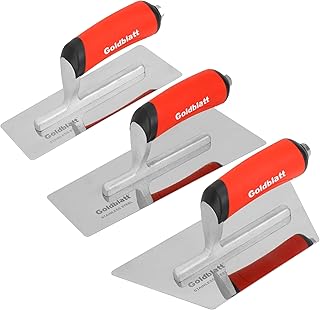
If you want one kit to start with, the Goldblatt 3-Piece Venetian Plaster Trowel Set is the lead pick here. Its three trapezoid blades run from a small size that fits the tightest boards up to a larger blade that covers a board in fewer passes, all at 0.7 millimetres thick with rounded corners and a mirror finish. The set gives a beginner the two things that matter most on a sample board: a blade small enough to control and a blade large enough to practise the long, flat burnishing stroke.
The LECEHIVO 6-Piece set is the pick for anyone who wants the widest range of sizes in one purchase. Six trowels across three sizes, with both trapezoid and rectangular forms, let you compare how blade shape changes the finish on the same board, which is exactly the kind of comparison a practice session is for. The UpJiaflarish 3-Piece set suits hands that prefer a lighter touch, with 0.5 millimetre plates and a mix of square and trapezoid shapes that handle corners and open areas differently. The EVERSOLID 2-Piece set is the simplest starting point, with just two sizes and polished edges, while the Fumusae 3-Piece set adds a longer handle length for people who like more reach across the board. The YIMITEE 3-Pack brings a mirror-polished flat blade for the final pass, and the Lasnten 3-Piece set rounds out the group with wooden handles and three trapezoid sizes for steady, repeated practice.
Choose by board size first and by handle second. Boards near 200 millimetres across pair well with the smallest blades in these kits, while boards closer to 300 millimetres across reward the medium sizes. Wooden handles feel warm and give a firm grip when the plaster is wet, rubber handles stay grippy when your hands are damp, and plastic and rubber combinations split the difference. Every kit in this guide uses stainless steel blades, so rust resistance is a shared strength rather than a deciding factor.
| Product | Key spec | Best for |
|---|---|---|
| Goldblatt 3-Piece Venetian Plaster Trowel Set | 3 trapezoid blades, 0.7 mm, mirror finish | All-round burnishing practice on small boards |
| LECEHIVO 6-Piece Venetian Plaster Trowel Set PMS574 | 6 pieces, 3 sizes, 0.7 mm, wooden handles | Comparing blade shapes on the same board |
| UpJiaflarish 3-Piece Stainless Venetian Plaster Trowel Set | 3 pieces, 0.5 mm plates, square and trapezoid | Light-touch burnishing and corner work |
| EVERSOLID Stainless Steel Venetian Plaster Trowel 2-Piece Set | 2 pieces, 0.7 mm, 200 x 80 and 240 x 100 mm | Simple two-size starting kit |
| Fumusae 3-Piece Plaster Finishing Trowel Set | 3 pieces, 0.03 in blades, three sizes | Longer reach across wider boards |
| YIMITEE 3-Pack Venetian Plaster Trowel Set | 3 pieces, mirror-polished flat blades | Final burnishing passes |
| Lasnten 3-Piece Venetian Art Paint Plaster Trowel Set | 3 pieces, polished stainless, wooden handles | Steady repeated practice sessions |
How we chose
The kits in this guide were picked against the realities of sample board work rather than wall work. First, every kit had to include at least one trowel short enough to sit fully on a small board, because a blade that overhangs the board edge cannot press evenly. Second, blade thickness had to fall in the range that burnishing rewards: thin enough to flex a little under hand pressure, thick enough to stay flat. The sets here list 0.5 to 0.7 millimetres, which is the band where most Venetian plaster trowels sit. Third, the blade edge had to be polished, beveled, or both, since a rough edge drags lines across a surface that is meant to turn glossy. Fourth, the kit had to be a real, named product with listed specifications from the maker or the retailer, not a generic bundle with no stated blade size.
Handle material was treated as a comfort question, not a quality question, so wooden, rubber, and plastic-and-rubber handles all appear. Piece count mattered only in how it served practice: a two-piece set can be enough when the two sizes cover your boards, while a six-piece set earns its place by letting you run side-by-side comparisons. Price was not compared, because the guide focuses on fit and listed specifications. Each product section below lists the specifications the maker or retailer publishes, followed by how those specifications play out on a sample board.
Goldblatt 3-Piece Venetian Plaster Trowel Set
- Pieces: 3 trapezoid trowels in three sizes
- Blade material: premium stainless steel with mirror finish
- Blade thickness: 0.03 inch (0.7 mm)
- Blade sizes: 2-3/4 x 3-5/32 in, 3-5/32 x 3-15/16 in, 4-59/64 x 5-5/16 in
- Blade shape: beveled trapezoid with rounded corners
- Handle: soft-grip ergonomic with aluminium shank
The Goldblatt set earns the lead position because its size range maps so neatly onto sample board work. The smallest blade, at roughly 70 millimetres across, sits comfortably on a board the size of a postcard and lets you work the corners and edges where a larger trowel would catch. The middle blade covers most practice boards in a few overlapping passes, and the largest blade, at just over 125 millimetres long, handles the wider boards that people use when they want to practise a full two-coat sequence on one panel. All three blades share the same 0.7 millimetre thickness, so the feel under your hand stays consistent as you switch sizes, and the only thing that changes is the coverage per pass. That consistency matters during practice, because it lets you isolate the variable you are learning: pressure, angle, or timing, rather than fighting a different blade flex with each size.
The mirror finish and rounded corners are the details that protect a burnishing session. A mirror finish wipes clean with a damp cloth between coats, so dried plaster does not build up on the blade face and drag across the next pass. Rounded corners mean the blade can turn at the edge of a board without leaving a crescent mark, which is the most common flaw beginners see on their first polished panels. The soft-grip handles stay comfortable through a long afternoon of repetition, and the aluminium shank keeps the mounting rigid, so the blade does not wobble when you press it flat. For a first kit, this set covers the widest range of practice situations with the fewest compromises.
Pros: three useful sizes for boards of different widths; consistent 0.7 mm blade thickness across the set; mirror finish cleans easily; rounded corners reduce edge marks.
Cons: no rectangular blade for straight-edge work; no storage case listed; the largest blade may still feel small on very wide boards.
LECEHIVO 6-Piece Venetian Plaster Trowel Set PMS574
- Pieces: 6 trowels in three sizes
- Blade material: stainless steel, corrosion resistant
- Blade thickness: 0.03 inch (0.7 mm)
- Blade sizes: 200 x 80 mm, 240 x 100 mm, 234 x 110 mm
- Blade forms: trapezoid and rectangular
- Handle: wooden comfort grip
- Item weight: 3.64 pounds
Six trowels sounds like a lot for a practice bench, and in a way it is the point. The LECEHIVO set gives you two of each size, which means you can keep one trowel clean and dry for the burnishing pass while the other is still carrying plaster from the application pass. On a sample board, where coats follow each other quickly, that pairing saves the constant wiping that interrupts your rhythm. The three sizes run from 200 millimetres up to 240 millimetres long, so the set spans the full range of common practice boards, and the mix of trapezoid and rectangular forms lets you feel how shape changes the finish. A trapezoid blade covers ground quickly and turns neatly at the board edge, while a rectangular blade holds a straighter line along the board border and gives a more even press across the middle.
The wooden handles are a genuine comfort feature during long sessions. Wood warms to the hand, absorbs a little moisture, and gives a firm grip even when your palms are damp from washing plaster off your hands between coats. The 0.7 millimetre blades carry the same polished, beveled edges and rounded corners as the better-known sets, so the finish quality is comparable while the piece count is double. The main trade-off is weight and bulk: six trowels take up more bench space, and the set weighs more in the hand than a three-piece kit. For a dedicated practice station, where the tools live on the bench rather than in a bag, that trade is easy to accept, and the extra trowels let you run the kind of side-by-side comparison that turns practice into learning.
Pros: six pieces allow a clean trowel for burnishing while another applies; three sizes plus two blade forms; wooden handles stay comfortable over long sessions; 0.7 mm blades flex well under pressure.
Cons: heavier and bulkier than smaller sets; two of each size may be more than a casual learner needs; rectangular blades need care at board corners.
UpJiaflarish 3-Piece Stainless Venetian Plaster Trowel Set
- Pieces: 3 trowels
- Blade material: high-quality stainless steel plates
- Blade thickness: 0.5 mm
- Blade shapes: small square, big square, trapezoid
- Handle: rubber
- Item weight: 1.59 pounds
- Listed uses: Venetian plaster, marmorino, microcement, art paint
The UpJiaflarish set is the thinnest-bladed kit in this guide, and that thinness is its defining trait. At 0.5 millimetres, the plates flex more under hand pressure than the 0.7 millimetre blades, which gives a softer, more forgiving press on a board that is still firming up. Beginners often press too hard during the first burnishing attempts, and a thinner blade absorbs some of that excess force instead of transferring it straight into the plaster as a ridge or a dull patch. The set mixes two square blades with one trapezoid, which is a useful combination on a sample board: the square blades lay down a coat with straight, predictable edges, and the trapezoid blade takes over for the burnishing pass, where its angled sides reach into corners and along the board border without catching.
Rubber handles suit practice sessions where hands get wet repeatedly. Plaster work means rinsing, wiping, and re-wetting your hands, and rubber keeps its grip when damp, where a smooth wooden handle can slip. The set is also light, at 1.59 pounds for all three trowels, so fatigue builds slowly over a long afternoon of repetition. The thinner blades do need a little more care in storage, because a 0.5 millimetre plate bends more easily if it is dropped or stacked under heavy tools, so keep the set in its own spot on the bench. For learners who want feedback from the blade rather than force from the arm, this set teaches a gentle hand.
Pros: 0.5 mm blades flex gently and forgive heavy pressure; square plus trapezoid shapes cover application and burnishing; rubber handles grip well when damp; light overall weight.
Cons: thin blades need careful storage to avoid bending; only one trapezoid blade in the set; no small size under the square shapes for very tight boards.
EVERSOLID Stainless Steel Venetian Plaster Trowel 2-Piece Set
- Pieces: 2 trowels
- Blade material: stainless steel
- Blade thickness: 0.7 mm
- Blade sizes: small 200 x 80 mm, medium 240 x 100 mm
- Handle: plastic and rubber
- Edges: 90-degree polished edges with round corners
Two trowels can be enough, and the EVERSOLID set proves it by covering the two sizes that matter most on a sample board. The small 200 by 80 millimetre blade handles the tightest boards and the detail work along the edges, while the medium 240 by 100 millimetre blade covers the standard practice board in broad, overlapping passes. There is no third size to confuse the choice, which suits a learner who wants to focus on hand and timing rather than on picking tools. Both blades share the same 0.7 millimetre thickness and the same polished, 90-degree edges with round corners, so the only difference between them is coverage, and switching from one to the other feels natural.
The plastic and rubber handles give a firm, slightly soft grip that works well when hands are damp, and the two-piece format keeps the bench tidy and the cost of entry low. What you give up is range: there is no large blade for wide boards and no second shape for comparing finishes, so a plasterer who moves on to bigger sample panels will eventually want a third trowel. But as a starting kit for Venetian plaster burnishing practice, the pair is honest and complete. It also makes a good travel companion to a larger set, since the two sizes slip into a tool roll without taking much room, and they cover the boards most people actually practise on.
Pros: simple two-size choice keeps practice focused; both sizes suit common sample boards; polished edges with round corners protect the finish; compact and easy to carry.
Cons: no large blade for wide boards; no trapezoid or rhombus shape for corner work; limited range for side-by-side shape comparison.
Fumusae 3-Piece Plaster Finishing Trowel Set
- Pieces: 3 trowels
- Blade material: high-strength stainless steel
- Blade thickness: 0.03 inch
- Blade sizes: 2-3/4 x 3-5/32 x 7-7/8 in, 3-5/32 x 3-15/16 x 9-29/64 in, 4-59/64 x 5-5/16 x 9-1/4 in
- Handle: see product page
The Fumusae set stands out for the length of its handles relative to its blade sizes. The listed dimensions run longer than the other three-piece sets here, with the largest trowel reaching 9-1/4 inches overall, which gives your hand more reach across a wide board without shifting your stance. On a practice bench, that reach matters more than it sounds: burnishing works best when the stroke runs the full width of the board in one smooth pass, and a longer tool lets you finish the stroke instead of stopping halfway to reposition. The three blades step up in size in the same proportions as the Goldblatt set, so the progression from detail work to broad coverage feels familiar, and the 0.03 inch blade thickness keeps the flex in the same range as the other sets in this guide.
High-strength stainless steel is the listed blade material, which points to a blade that holds its edge and resists bending when you lean into the final pass. The set does not list a handle material on the page consulted, so treat the handle as a detail to confirm on the product page before ordering, and judge it by the grip when it arrives. For practice, the set suits people who work on the wider end of sample boards, around 240 to 300 millimetres, and who want the extra reach for long, flat strokes. It also suits a second-kit role: if you already own a small set for detail work, the Fumusae sizes add the larger blades that complete a practice bench.
Pros: longer overall lengths give more reach across wide boards; three stepped sizes cover detail to broad coverage; high-strength stainless blades hold their shape; 0.03 inch thickness suits burnishing pressure.
Cons: handle material not listed on the page consulted; no rectangular blade in the set; largest blade may overhang very small boards.
YIMITEE 3-Pack Venetian Plaster Trowel Set
- Pieces: 3 trowels
- Blade finish: mirror-polished
- Blade shape: flat
- Handle: ergonomic
- Listed uses: construction walls, floors, stucco and plastering
The YIMITEE 3-Pack is the flat-blade entry in this guide, and flat blades deserve a place in any burnishing practice kit. Where a trapezoid blade angles away from the surface, a flat blade sits parallel to it, which spreads pressure across the full width of the blade and produces a very even press. On a sample board, that even press is exactly what the final burnishing pass needs: the blade moves across the surface like a plane, compressing the plaster uniformly instead of concentrating force along one edge. The mirror-polished finish helps here too, because a polished flat blade slides with little friction, and the plaster surface stays free of the fine drag lines that a rougher blade leaves behind.
The ergonomic handles are shaped for a long session, and the three-pack format means you can dedicate one trowel to the final pass and keep it clean, while the other two handle the earlier coats. The listed uses cover walls, floors, stucco, and plastering, which tells you the blades are built for general finishing work rather than a single narrow task, and that breadth suits a practice bench where you may try more than one finish on the same boards. The set does not list blade thickness or exact dimensions on the page consulted, so check those details on the product page and compare them with the 0.5 to 0.7 millimetre range of the other sets here. For the final pass on a small board, a flat mirror-polished blade is hard to beat.
Pros: flat blades press evenly across the full blade width; mirror-polished finish slides with little friction; three pieces allow a dedicated finishing trowel; ergonomic handles suit long sessions.
Cons: blade thickness and exact sizes not listed on the page consulted; flat shape is less handy in tight corners; no trapezoid blade for edge work.
Lasnten 3-Piece Venetian Art Paint Plaster Trowel Set
- Pieces: 3 trowels in three sizes
- Blade material: polished stainless steel
- Blade shape: trapezoid
- Handle: wooden
- Listed uses: concrete and drywall, art paint, Venetian plaster
The Lasnten 3-Piece set closes this guide with a straightforward combination: three trapezoid trowels, polished stainless steel blades, and wooden handles. Trapezoid blades are the workhorse shape for Venetian plaster, because the angled sides let the blade turn at the board edge and reach into the corners without the corner of the blade digging a mark. Three sizes give you a small blade for detail and edge work, a medium blade for the main burnishing pass, and a larger blade for the wider boards you graduate to as your confidence grows. The wooden handles bring the warm, firm grip that many plasterers prefer for fine work, and they stay comfortable through the repeated passes that a practice session demands.
Polished stainless steel is the right blade material for burnishing, because it resists rust, wipes clean between coats, and holds a smooth edge that will not scratch a surface you are trying to polish. The set lists concrete and drywall among its uses alongside art paint and Venetian plaster, which signals a blade built for real finishing work rather than decoration alone. The listed specifications do not include blade thickness or exact dimensions, so confirm those on the product page and compare them with the 0.7 millimetre blades in the other sets. As a practice kit, the Lasnten set is simple, honest, and complete: three sizes, one useful shape, and handles that feel good in the hand.
Pros: three trapezoid sizes cover the full practice range; wooden handles feel warm and firm; polished stainless blades clean easily; trapezoid shape turns neatly at board edges.
Cons: blade thickness and exact sizes not listed on the page consulted; no second blade shape for comparison; no large blade for very wide boards.
Buying guide
Start with the board, not the trowel. Measure the boards you practise on, or decide on a board size before you buy a kit. Boards around 200 by 150 millimetres suit the smallest blades in these kits, while boards around 300 by 200 millimetres suit the medium sizes. A blade longer than the board is not useful, because the overhanging ends cannot press the plaster, and the blade will rock on the board edge. A blade much shorter than the board is not useless, but it means more passes to cover the surface, and more passes mean more chances to leave a line. Match the middle blade of the kit to the width of your most-used board, and the rest of the set will fall into place around it.
Blade thickness is the second decision, and it is simpler than it looks. Thinner blades, around 0.5 millimetres, flex more and forgive a heavy hand, which suits a beginner who is still learning how much pressure the final coat can take. Thicker blades, around 0.7 millimetres, flex less and give a firmer, more direct feel, which suits a plasterer who already knows the timing and wants precise control. Both thicknesses appear in this guide, and neither is wrong for sample board work. If you are buying your first kit, the 0.7 millimetre band is a safe middle ground. If you already own a 0.7 millimetre set and find yourself pressing too hard, a 0.5 millimetre set like the UpJiaflarish will teach a lighter touch.
Blade shape changes the finish more than most beginners expect, so practise with more than one shape if you can. A trapezoid blade covers ground quickly and turns well at the edges, which makes it the default shape for burnishing. A rectangular blade holds a straight line and presses evenly across its width, which suits the middle of a board. A square blade lays down a coat with clean, predictable edges. A flat blade presses the most evenly of all and suits the final pass. The six-piece LECEHIVO set is the easiest way to compare shapes on the same board, because it includes trapezoid and rectangular forms in three sizes, and running the same coat with two shapes side by side shows the difference faster than any description.
Handle material is a comfort choice, and comfort matters because practice means repetition. Wooden handles feel warm, absorb a little moisture, and give a firm grip that many plasterers prefer for fine work. Rubber handles stay grippy when wet, which suits sessions where you rinse your hands often. Plastic and rubber combinations split the difference, with a firm core and a soft grip surface. Try to hold the trowel the way you will use it, with the blade flat and your wrist relaxed, and notice whether the handle forces your wrist into an awkward angle. A handle that fights your wrist will tire your hand before the plaster tires, and tired hands leave uneven finishes.
Care for the blades between sessions, and they will reward you. Wipe each blade clean with a damp cloth as soon as a coat is finished, and dry it before putting it away, because dried plaster on the blade face becomes a scratch tool on the next board. Store the trowels flat or hanging, with the blades separated, so the edges do not knock against each other. A thin blade bends if it is dropped on a hard floor or buried under heavy tools, so give the set its own place on the bench. Check the blade edge before each session by running a fingertip lightly along it; a nick or a burr will show up on the board as a line, and it is better to find it with your finger than with your finish.
Set up the practice bench so the board stays still. A board that slides while you burnish will ruin a pass and teach you nothing. A non-slip mat, a damp cloth under the board, or a simple clamp all work, and the choice depends on the board size. Keep a bucket of clean water and a cloth within reach, because the blade needs wiping between passes, and the board needs a light mist if the surface starts to dry before you finish the pass. Work in a room with steady light, and look at the board from a low angle as you burnish, because the gloss shows up best when the light rakes across the surface. A board that looks flat from above can still show dull patches from the side, and the low angle is how you catch them.
Practise in a sequence, not at random. Start with the application coat, using the largest blade in the kit to lay the plaster thin and even. Let it firm up, then use the medium blade for the second coat, pressing a little harder and keeping the passes overlapping by half a blade width. For the burnishing pass, switch to the smallest blade that still covers the board comfortably, keep the blade almost flat, and press with steady, even force. Repeat the same sequence on the next board, and change only one thing at a time: the pressure, the angle, or the timing. Changing one variable at a time is how you learn what each one does, and a sample board is the cheapest place in the trade to run that experiment.
FAQ
How many sample boards should I prepare for a practice session?
Prepare at least six boards for a session, because the first two are usually warm-ups and the learning starts on the third. Six boards let you repeat the same sequence several times and compare the results side by side, which is the fastest way to see what changes when you alter pressure or timing. Label each board on the back with the coat count, the trowel used, and the timing, so you can look back at the set a week later and still know what you did.
What board material works best under Venetian plaster?
A rigid, smooth board that does not warp when wet is the safest choice, and many plasterers use primed MDF or cement board cut to a comfortable size. Prime the board first, because raw board absorbs water from the plaster and changes the drying time, which changes the burnishing window. A board that stays flat and holds its prime lets you focus on the trowel work instead of fighting the substrate.
When is a Venetian plaster coat ready to burnish?
The coat is ready when it feels firm under a light fingertip touch and no plaster transfers to your finger, yet the surface still looks slightly damp and cool. If the blade slides without resistance and the surface stays dull, the coat is still too wet, so wait and check again in a few minutes. If the blade skips and the surface feels dry and hard, the window has passed, and the next coat is the place to try again. Sample boards teach this timing faster than walls, because you can run several boards at staggered intervals and compare them.
Should I use the same trowel for application and burnishing?
You can, but keeping one trowel clean for the burnishing pass gives a better finish, because any dried plaster on the blade face will mark the polished surface. A multi-piece kit makes this easy: use one trowel for the coats and a clean one for the final pass. If you own only two trowels, wipe the burnishing trowel carefully between stages and check the blade edge with your fingertip before the final pass.
How do I keep the blade edge from marking the board?
Keep the blade clean, keep the corners rounded, and keep the blade almost flat during the pass. A clean blade with rounded corners glides, while a blade with dried plaster on the face or a nicked corner drags a line. Wipe the blade after every few passes, and check the edge by touch before the final pass. If a line appears, stop, clean the blade, and rework the area while the coat is still workable.
Can I practise burnishing with a trowel that is too large for the board?
A trowel longer than the board makes even pressure hard to achieve, because the ends overhang and the middle takes all the force. It is better to use the smallest blade that still covers the board in a few passes, and to save the large blade for wider boards. If the kit you own has only large blades, cut smaller practice boards to match them, or pick up a two-piece set with a small blade for detail work.
Conclusion
A sample board is the cheapest classroom in the plaster trade, and a small finishing trowel is the tool that makes the lesson work. The kits in this guide all bring stainless steel blades, polished edges, and sizes that fit the boards people actually practise on, and the differences between them come down to piece count, blade thickness, shape, and handle. The Goldblatt 3-Piece set leads because its three trapezoid sizes cover the full range of practice boards with a consistent 0.7 millimetre blade, and its mirror finish and rounded corners protect the surface you are trying to polish. The LECEHIVO 6-Piece set is the choice for comparison, the UpJiaflarish set is the choice for a lighter touch, and the remaining sets fill the gaps for flat blades, longer reach, and simple two-size starting points.
Pick the kit that matches your boards, set up the bench so the board stays still, and practise one variable at a time. Run the same sequence on six boards, label them, and compare the results in raking light. The gloss will come, and when it does, you will know which pressure, which angle, and which moment produced it, because the board will show you. That knowledge carries straight onto the wall, which is the whole point of practising on a board in the first place.
Related guides
More from Amazon
Programs that pair well with the guide above. Offers and eligibility are set by Amazon and may change.
Free shipping on eligible items, Prime Video and more. Eligible new members can start with a free trial.
Start a Prime free trialAudiobooks and podcasts to listen to on the go. Eligible new members can start with a free trial.
Try Audible freeAd-free music streaming. Eligible new subscribers can start with a free trial.
Try Music Unlimited freeA free business account with business pricing and bulk-buying tools for work, shop or home office.
Create a business accountAs an Amazon Associate we earn from qualifying purchases.
More ways to save on your next finish
Programs that pair well with the guide above. Offers and eligibility are set by Amazon and may change.
A free business account with business pricing and bulk-buying tools for work, shop or home office.
Create a business accountFast, free shipping on eligible items, plus Prime Video and more. Eligible new members can start with a free trial.
Start a Prime free trialRead from a huge library of eBooks, including how-to guides and cookbooks. Eligible new members can start with a free trial.
Try Kindle UnlimitedAudiobooks and podcasts for the commute, the garage or the kitchen. Eligible new members can start with a free trial.
Try Audible freeAs an Amazon Associate we earn from qualifying purchases. Using these links costs you nothing extra.










Write Your Review
No reviews yet. Be the first to share your experience!