
Key takeaways
- Compare the best bonding primers for Venetian plaster with stated drying times, so sealed old paint gets a firm, lasting base before mineral finishes go on.
As an Amazon Associate I earn from qualifying purchases. This post may contain affiliate links at no extra cost to you.
Our top picks at a glance
3 products from this guide, in the order reviewed below.


As an Amazon Associate we earn from qualifying purchases. Prices and availability can change.
Sealed old paint is one of the least forgiving surfaces a Venetian plaster job can meet. The old coat looks sound, it feels smooth under the hand, and it gives no sign that a heavy lime or acrylic plaster will slide, bubble, or peel away from it within weeks. A bonding primer changes that meeting entirely, because it creates a mechanical and chemical bridge between a closed, glossy film and a fresh mineral finish that needs something to hold. The best bonding primers for Venetian plaster with stated drying time for preparing sealed old paint for mineral finishes are the ones that publish a clear drying window on their data sheet, so the applicator knows exactly how long to wait before the first trowel of plaster goes on, instead of guessing and paying for the guess later.
Drying time matters more here than it does on bare drywall or fresh plaster. On a sealed surface, the primer film cannot sink into the substrate, so it dries from the outside in, and a coat that looks dry on the surface can still be soft underneath. Plaster laid over that soft film can drag, leave trowel marks that never close, or lose its grip in patches that only show up after the finish has cured. A stated drying time removes that uncertainty. When the maker says 30 minutes to touch dry, or one hour to topcoat, the schedule for the whole room can be planned around a real number, and the second coat of primer, the first coat of plaster, and the working day all fall into place.
This roundup compares six bonding primers that suit sealed old paint under Venetian plaster and mineral finishes. Each one is a real product with published data, and each one is judged on the same points: what it is made of, how it grips a closed surface, how long it needs to dry, how much wall one container covers, and where it works hardest. The list leans toward primers with a stated drying time, because that is what the keyword asks for, and every entry below carries its drying window in plain view.
Best products
Novacolor Decofix
- Micronized water-based fixative with high penetration
- Touch dry in 30 to 40 minutes; finish after two hours
- Yield of 8 to 18 square metres per litre
- Made for gypsum plaster and plasterboard
- Dilution and pack sizes: see product page
Novacolor Decofix is the fixative in this roundup, and it earns its place through penetration and speed. It is a micronized water-based fixative, which means its particles are fine enough to soak into gypsum plaster and plasterboard rather than sitting on the surface, and that penetration is what a Venetian plaster base needs on a sealed wall: a film that is anchored in the substrate instead of floating on it. The maker describes it as a high penetration fixative for gypsum plaster and plasterboard, and that description fits the sealed old paint problem, because the primer has to give the plaster a base that holds even where the old coat is slick.
The drying numbers are fast and clear. The film is touch dry in 30 to 40 minutes, and the finish goes on after two hours, which keeps a one-day schedule moving and still leaves a firm base under the first plaster coat. Yield runs 8 to 18 square metres per litre, so the quantity for a wall depends on how thirsty the surface is, and a sealed wall will sit at the generous end of that range. Dilution and pack sizes are not stated on the page used for this guide, so check the product page before ordering. For a Venetian plaster job on sealed old paint where the base is gypsum plaster or plasterboard, Decofix offers a penetrating fixative with a clear two-hour window before the finish goes on.
San Marco Marcotherm Primer
- Water-soluble sealer and primer with quartz sand grains for interior and exterior mineral surfaces
- Quartz grains give the dried film a texture that anchors later coats of plaster
- Available in one litre, five litre, and fifteen litre sizes
- High penetration formula made to impregnate and consolidate mineral substrates
- Dries white, which helps reveal damp or problem areas in the substrate
San Marco Marcotherm Primer takes a different route to the same goal. Instead of a thick textured coat, it is a high penetration sealer that soaks into the mineral surface and carries fine quartz grains with it, leaving a lightly textured film that later coats can lock onto. On sealed old paint, that penetration matters less than the grain, because a sealed film does not absorb much, but the grain still does its job on the surface, giving the plaster a mechanical key that a flat primer cannot offer. The maker describes it as suitable for the impregnation and consolidation of interior and exterior mineral surfaces, which fits the mineral finishes in this keyword, since lime and silicate finishes need a base that shares their mineral character rather than fighting it.
The practical case for Marcotherm is a wall where the old paint is sound but glossy, and the finish going over it is a mineral plaster that needs a compatible base. The primer dries white, and that white film is useful in a way that has nothing to do with color: it shows up damp patches and weak spots in the substrate that a clear sealer would hide. An applicator who sees a dark patch in the white film knows where the wall still holds moisture and can wait or treat that area before plastering, instead of discovering the problem after the finish is on. The product comes in one litre, five litre, and fifteen litre sizes, so a small accent wall and a full room can both be covered without buying far more material than the job needs.
Polar Clear Binding Primer
- High-adhesion primer for drywall, plaster, cement, stucco and wood
- Interior and exterior use
- Available in a 33 fluid ounce pack
- Drying time and coverage: see product page
Polar Clear Binding Primer is the general-purpose adhesion primer in this roundup, and it earns its place through range. The maker describes it as a high-adhesion primer for drywall, plaster, cement, stucco and wood, for interior and exterior use, which covers every surface that can sit under sealed old paint on a Venetian plaster job. On a sealed paint film, the adhesion claim is what matters: the primer is made to grip surfaces that other primers walk away from, and a closed paint film is one of them.
The product comes in a 33 fluid ounce pack, which suits a small wall or a repair rather than a whole room, so the quantity should be checked before ordering for a large job. Drying time and coverage are not stated on the page used for this guide, so check the product page and plan the schedule around the stated numbers before the first coat goes on. For a Venetian plaster job where the wall mixes drywall, plaster and older painted surfaces, Polar offers one primer that claims to hold them all.
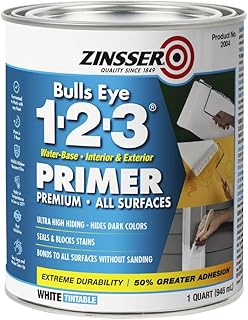
Zinsser Bulls Eye 1-2-3
- Water-based styrenated acrylic primer, sealer, and stain blocker
- Bonds to glossy surfaces without scuff sanding in most cases
- Dry to the touch in about 30 minutes; topcoat in one hour
- Available in quart, gallon, and five gallon sizes
- Sticks to wood, plaster, concrete, gloss enamels, hardboard, glass, and tile
Zinsser Bulls Eye 1-2-3 is the general-purpose bonding primer in this roundup, and it earns its place through speed and grip. The data sheet states that it bonds to glossy surfaces without scuff sanding, which is exactly the problem sealed old paint presents. A full sanding pass over a whole room is slow, dusty work, and a primer that grips a clean, sound glossy film without it saves a day of preparation. The primer is a water-based styrenated acrylic, and it doubles as a stain blocker, so old marks, tannin, and smoke stains that sit under the old paint stay locked in the primer film instead of bleeding into the plaster.
Speed is the other half of the case. The film dries to the touch in about 30 minutes and accepts a topcoat in one hour, which is the fastest stated window in this list. That pace suits a tight schedule, but it also demands discipline: the applicator must still let the full hour pass before plastering, because a film that feels dry on the surface can still be soft at the bond line on a sealed substrate. Coverage runs about 400 to 450 square feet per gallon for the gray version, and the white version sits in the same range on smooth surfaces. The primer works on interior and exterior walls, ceilings, doors, trim, and related paintable surfaces, and it can be tinted toward the topcoat color with a small amount of universal colorant. For a Venetian plaster job, the white base keeps the plaster color true, and the stain-blocking resin keeps old discoloration out of the finish.
KILZ Adhesion Primer
- Water-base modified acrylic bonding primer made for hard-to-paint surfaces
- Dry to the touch in 30 minutes; ready to recoat in one hour
- Coverage of 300 to 400 square feet per gallon, depending on surface texture and porosity
- VOC content under 100 grams per litre
- Bonds to Kynar, PVC, vinyl, Formica, glass, tile, glazed brick, chalky paint, glossy finishes, fiberglass, and metals
KILZ Adhesion Primer is built for the surfaces other primers walk away from, and sealed old paint is one of them. The resin is a modified acrylic, and the maker formulates it to bond to dense, glossy surfaces while reducing or removing the need for sanding. That claim is backed by a long list of substrates in the data sheet: Kynar, PVC, vinyl, Formica, glass, tile, glazed brick, chalky paint, glossy finishes, fiberglass, and metals. A sealed paint film sits comfortably inside that range, and the primer gives Venetian plaster a base that holds even where the old coat is slick.
The drying numbers are clear and quick. The film dries to the touch in 30 minutes and is ready to recoat in one hour, which keeps a plaster schedule moving. Coverage runs 300 to 400 square feet per gallon, and the maker notes that the exact figure depends on surface texture, porosity, and application method, which is honest guidance for a sealed wall that will take less primer than a thirsty one. The product goes on by brush, roller, or sprayer, and it cleans up with soap and water. One caution from the data sheet is worth carrying into the job: while the primer is made to bond without sanding, the maker still recommends a small adhesion check on an inconspicuous area before the full coat goes on. That check costs a few minutes and settles the one question that matters on a sealed surface, which is whether this particular old paint film will hold.
Benjamin Moore INSL-X STIX SXA-110
- Waterborne acrylic urethane bonding primer and sealer
- Volume solids of 40 percent, plus or minus two percent
- Coverage of 300 to 400 square feet per gallon
- Dry to the touch in 30 minutes; recoat in three to four hours
- Works at temperatures as low as 35 degrees Fahrenheit
Benjamin Moore INSL-X STIX, product code SXA-110, is the urethane-modified option in this list, and the urethane part is what gives it its grip. The resin is a urethane modified acrylic, and the maker describes its adhesion as strong on the most challenging surfaces, including PVC, vinyl, glass, tile, glazed block, glossy paints, precoated siding, fiberglass, and galvanized metals. On sealed old paint, that adhesion is the whole job, and the primer brings a hard film when cured, which resists the scraping and burnishing that Venetian plaster work puts on a base coat.
The drying schedule is slower than the fast primers here, and the slowness is honest. The film dries to the touch in 30 minutes, but the recoat window runs three to four hours, and full cure takes three to four days. An applicator who plans around the three to four hour recoat window gets a base that has started to harden properly, and the plaster laid after that window sits on a film that will not move under the trowel. Coverage runs 300 to 400 square feet per gallon, and the product can be tinted with up to two fluid ounces of colorant per gallon. It also works at temperatures as low as 35 degrees Fahrenheit, which matters for a cool room or a shoulder-season job where other primers would stay soft. Cleanup is warm soapy water, and the film levels to a smooth surface, which helps the first plaster coat go on evenly.
| Primer | Binder type | Stated dry time | Coverage per gallon | Pack sizes |
|---|---|---|---|---|
| Novacolor Decofix | Micronized water-based fixative | Touch 30 to 40 minutes, finish after two hours | 8 to 18 square metres per litre | See product page |
| San Marco Marcotherm Primer | Water-soluble sealer, quartz grains | See product page | See product page | One litre, five litre, fifteen litre |
| Polar Clear Binding Primer | High-adhesion primer | See product page | See product page | 33 fluid ounces |
| Zinsser Bulls Eye 1-2-3 | Styrenated acrylic | Touch 30 minutes, topcoat one hour | About 400 square feet | Quart, gallon, five gallon |
| KILZ Adhesion Primer | Modified acrylic | Touch 30 minutes, recoat one hour | 300 to 400 square feet | Quart, gallon |
| Benjamin Moore INSL-X STIX SXA-110 | Acrylic urethane | Touch 30 minutes, recoat three to four hours | 300 to 400 square feet | Quart, gallon, five gallon |
How to choose
Read the stated drying time first
The drying time on the data sheet is the single most useful number in this roundup, and it should be read before anything else. A primer that states touch dry in 30 to 40 minutes with the finish after two hours, like Novacolor Decofix, fits a schedule where plastering starts the same day. A primer that states one hour to topcoat, like Zinsser Bulls Eye 1-2-3, fits a schedule where priming happens in the morning and plastering starts the same afternoon. Neither window is better in itself; the right one is the one that matches the working day. What matters is that the number is stated at all. A primer with no stated drying time leaves the applicator guessing, and guessing on a sealed surface is how plaster ends up over a soft film. Compare the stated windows side by side, pick the one that fits the calendar, and then honor it in full, even when the surface feels dry sooner.
Match the binder to the finish
Mineral finishes bond best to mineral bases, and acrylic plasters accept acrylic bases, so the binder in the primer should match the plaster going over it. A high-adhesion primer like Polar Clear Binding Primer grips drywall, plaster, cement, stucco and wood, and it suits a wall that mixes several surfaces under the old paint. A quartz acrylic primer like San Marco Marcotherm Primer suits acrylic and lime plasters alike, because the quartz texture gives a mechanical key that does not depend on chemistry alone. A general-purpose acrylic bonding primer like Zinsser Bulls Eye 1-2-3 or KILZ Adhesion Primer suits a job where the old paint film is the main problem and the plaster is a standard Venetian product. Read the plaster maker's base-coat guidance before choosing, and when the plaster maker names a primer of its own, that primer usually deserves the first look.
Check the surface before the primer
No primer can fix a failing paint film. Before any primer goes on, the old paint should be checked for adhesion by pressing masking tape firmly onto the surface and pulling it away sharply; if paint comes off on the tape, that area needs scraping and patching, not priming. Loose, peeling, or flaking paint must come off, and the edges of sound paint should be feathered smooth. Glossy areas need a light sanding and dusting, even under a primer that claims to bond without it, because a quick scuff costs little and removes the one variable that can undo the whole job. Chalky or powdery paint needs a consolidating fixative first, or a primer made to bind chalk, because a bonding primer laid over loose chalk will hold the chalk and nothing else. Clean the wall of grease, wax, dust, and mildew, let it dry fully, and only then open the primer can.
Plan the quantity from coverage, not from habit
Coverage figures in this roundup vary widely, from about 300 square feet per gallon for the acrylic bonding primers to 8 to 18 square metres per litre for the Decofix fixative, and that spread is large enough to change the order by a whole container. A sealed wall takes less primer than a porous one, because the film sits on the surface instead of soaking in, so the high end of the stated range is the realistic figure on old paint. Measure the wall, multiply length by height, subtract large openings, and divide by the coverage figure for the chosen primer. Buy one extra quart beyond the calculation for a first-time applicator, because a thin spot found halfway across a wall is cheaper to fix with material on hand than with a second trip to the store. Keep the container count in mind too: a quart covers a small accent wall, a gallon covers a medium room, and a four or five gallon size suits a whole floor.
Common mistakes
The most common mistake on sealed old paint is plastering before the primer has cured. The surface feels dry, the schedule is tight, and the trowel is ready, so the first coat goes on an hour early. On a porous wall that shortcut sometimes passes unnoticed, but on a sealed wall the primer film is still soft at the bond line, and the plaster drags it, leaves trowel lines that will not close, or peels in sheets days later. The fix is simple and costs nothing: wait the full stated drying time, and add time when the room is cool or damp.
The second mistake is skipping the adhesion check. A bonding primer is not a repair for failing paint, and a wall that looks sound can hide a weak bond between the old paint and the plaster beneath it. A tape check over several areas of the wall takes five minutes and finds the weak spots before they become a failure. Any area that fails the tape check gets scraped, patched, and primed again, instead of being covered and forgotten.
The third mistake is choosing a primer by habit instead of by surface. A PVA primer made for new drywall has no place on sealed old paint, because it is made to seal a porous surface, not to grip a closed one. A stain-blocking primer made for smoke damage is the wrong tool when the problem is gloss, not stains. Match the primer to the surface in front of the applicator, not to the primer that happened to be left over from the last job.
The fourth mistake is applying the primer too thick. A bonding primer works as a thin, even film, and a thick coat can skin over while staying soft underneath, which is the same failure as plastering too soon. One even coat, applied at the maker's stated coverage, does the job. A second coat belongs only where the data sheet calls for it, or where the first coat shows thin spots after drying.
The fifth mistake is ignoring temperature and humidity. Most primers in this list need air and surface temperatures above 35 or 50 degrees Fahrenheit, and high humidity stretches every drying time on the data sheet. A cold room in winter or a damp room after rain needs longer waits and, where the maker allows it, gentle ventilation. Priming a cold wall and plastering on schedule anyway is how a finish fails in the first week.
FAQ
How long should I wait after priming sealed old paint before applying Venetian plaster?
Wait the full stated drying time on the primer data sheet, and no less. Novacolor Decofix states touch dry in 30 to 40 minutes with the finish after two hours, and fast primers like Zinsser Bulls Eye 1-2-3 and KILZ Adhesion Primer state one hour to topcoat. Add time when the room is cool or damp, because drying times on data sheets assume moderate temperature and humidity. A film that feels dry on the surface can still be soft at the bond line on a sealed substrate, so the clock on the data sheet matters more than the feel of the surface.
Do I need to sand sealed old paint before priming?
A light sanding helps in almost every case, even under primers that claim to bond without it. Sanding dulls the gloss, gives the primer a slight texture to grip, and reveals weak paint that would otherwise fail under plaster. Use fine sandpaper, sand lightly and evenly, then dust the wall thoroughly before priming. The exception is a paint film that is already failing: sanding will not save it, and loose paint must be scraped off and the area patched before any primer goes on.
Can I use a regular drywall primer under Venetian plaster on old paint?
A regular drywall primer is the wrong product for this surface. Drywall primers are made to seal porous paper and joint compound, and they have little grip on a closed paint film. A bonding primer is made for the opposite problem: gripping a slick, sealed surface so a heavy plaster can hold. Use a bonding primer from this roundup, or the primer the plaster maker recommends, and keep drywall primer for new drywall.
What happens if Venetian plaster is applied over primer that is still wet?
Wet primer under plaster causes dragging, trowel marks that will not close, and poor adhesion that can show up as peeling or bubbling days after the finish dries. The plaster also dries unevenly, because the wet primer changes how the plaster dries from below. If the mistake is caught while the plaster is still wet, the affected area should be removed, the primer allowed to dry fully, and the area re-primed and re-plastered. Prevention costs far less than repair.
Is one coat of bonding primer enough on sealed old paint?
One even coat is enough in most cases, provided the old paint is sound, clean, and dull after preparation. A second coat helps where the first coat shows thin spots, where the old paint has patches of different sheen, or where the primer maker calls for two coats on glossy surfaces. Let the first coat dry fully before judging whether a second is needed, and do not apply a second coat to fix a first coat that was applied too thick.
Which primer in this roundup dries fastest?
Zinsser Bulls Eye 1-2-3 and KILZ Adhesion Primer are the fastest here, with a stated topcoat or recoat time of one hour and a touch-dry time of about 30 minutes. Sherwin-Williams Extreme Bond Primer, which appears in the companion roundups in this series, also states one hour to recoat. Fast drying suits a tight schedule, but it still requires the full stated wait before plastering, and a cool or damp room stretches every drying time in this list.
Conclusion
Sealed old paint asks one question of a bonding primer, and it asks it plainly: will you hold a heavy mineral finish to a surface that offers nothing to grip. The six primers in this roundup answer that question in different ways, and the best choice depends on the schedule and the finish. Novacolor Decofix leads for a Venetian plaster job on gypsum plaster or plasterboard that needs a penetrating fixative with a clear two-hour window before the finish. Polar Clear Binding Primer leads where one high-adhesion primer is wanted across drywall, plaster, cement, stucco and wood, indoors and out. Zinsser Bulls Eye 1-2-3 and KILZ Adhesion Primer lead for a fast schedule where grip and speed matter most. San Marco Marcotherm Primer and Benjamin Moore INSL-X STIX cover the middle ground, one with quartz grain and mineral character, the other with urethane-modified adhesion and cold-weather curing.
Whatever primer is chosen, the working rules stay the same. Check the old paint with tape, sand the gloss, clean the wall, apply one even coat, and wait the full stated drying time before the first trowel of plaster goes on. A bonding primer is a small part of the cost of a Venetian plaster job and a large part of its success, because every coat above it depends on the bond it makes. Choose by the data sheet, honor the drying window, and the finish will have the base it needs to last.
Related guides
More from Amazon
Programs that pair well with the guide above. Offers and eligibility are set by Amazon and may change.
Free shipping on eligible items, Prime Video and more. Eligible new members can start with a free trial.
Start a Prime free trialAudiobooks and podcasts to listen to on the go. Eligible new members can start with a free trial.
Try Audible freeAd-free music streaming. Eligible new subscribers can start with a free trial.
Try Music Unlimited freeA free business account with business pricing and bulk-buying tools for work, shop or home office.
Create a business accountAs an Amazon Associate we earn from qualifying purchases.
More ways to save on your next finish
Programs that pair well with the guide above. Offers and eligibility are set by Amazon and may change.
A free business account with business pricing and bulk-buying tools for work, shop or home office.
Create a business accountFast, free shipping on eligible items, plus Prime Video and more. Eligible new members can start with a free trial.
Start a Prime free trialRead from a huge library of eBooks, including how-to guides and cookbooks. Eligible new members can start with a free trial.
Try Kindle UnlimitedAudiobooks and podcasts for the commute, the garage or the kitchen. Eligible new members can start with a free trial.
Try Audible freeAs an Amazon Associate we earn from qualifying purchases. Using these links costs you nothing extra.



Write Your Review
No reviews yet. Be the first to share your experience!