
Key takeaways
- Compare the best stucco patch repair mixes with exterior rated repair material for filling small cracks on exterior walls, with durability and drying times.
As an Amazon Associate I earn from qualifying purchases. This post may contain affiliate links at no extra cost to you.
Our top picks at a glance
3 products from this guide, in the order reviewed below.


As an Amazon Associate we earn from qualifying purchases. Prices and availability can change.
Small cracks on an exterior stucco wall look harmless, and that is exactly why they cause so much damage. A hairline crack lets rainwater in behind the finish coat, and once water sits behind stucco it does not dry out quickly. Freeze and thaw widen the crack, the bond behind the finish loosens, and a repair that would have taken ten minutes with a tube of caulk turns into a patch the size of a dinner plate. The material that fills the crack has to be rated for exterior use, because an interior filler will soften in rain, chalk in sun, and fall out of the crack within a season. The best stucco patch repair mixes with exterior rated repair material for filling small cracks on exterior walls are the products that stay in the crack through rain, sun and frost, and this roundup compares seven of them.
An exterior crack is a different job from an interior one for several reasons. The filler has to resist water, not just cover a line. It has to move a little with the wall as temperatures change, because a rigid filler in a moving crack will crack again along the same line. It has to accept paint, or at least match the wall color closely enough to disappear. And it has to be applied in weather that cooperates, because most exterior patch materials should not be applied in rain or below a stated temperature. The products below are chosen because their makers state exterior use on the data sheet, with published numbers for thickness, setting time, and coverage, so the choice can be made from facts rather than from a guess.
This roundup compares seven mixes that suit small exterior cracks. Some are textured caulks made only for cracks, which suit a hairline that runs across a wall. Some are fast-setting cement patches, which suit a crack that has opened wide enough to need body. Some are flexible compounds, which suit a crack that opens and closes with the seasons. Each entry below carries the same points: what it is made of, how wide a crack it can fill, how long it takes to set, how much wall one container covers, and where it works hardest.
Best products
QUIKRETE FastSet Stucco Patch 1139
- Portland cement-based patch in a 20 pound bag
- Paintable after 90 minutes, with final set in 45 to 90 minutes
- Working time of 20 to 30 minutes after mixing
- Mix 3.5 pints of water per 20 pound bag, with a yield of about 0.2 cubic feet
- Covers about 10 square feet at 1/4 inch thickness
- Meets ASTM C 926 for portland cement plaster
QUIKRETE FastSet Stucco Patch 1139 leads this roundup because it is the fastest cement-based patch here that still meets a published standard, and speed matters on an exterior wall where the weather can change in an afternoon. The product is a Portland cement-based stucco patch in a 20 pound bag, made for repairing cracks, spalls and surface defects in stucco. It meets ASTM C 926, the standard specification for application of Portland cement-based plaster, which gives the repair a documented basis rather than a maker's promise alone. The patch is paintable after 90 minutes, so a crack repaired in the morning can be painted the same day, and the final set runs 45 to 90 minutes after mixing.
The working method is simple but the timing is tight. Mix 3.5 pints of water per 20 pound bag, work the mix for 20 to 30 minutes, and apply with a trowel or float. One bag yields about 0.2 cubic feet and covers about 10 square feet at 1/4 inch thickness, which is a generous amount for crack work and leaves material for the next job. The patch should be applied to a clean, sound surface, with loose material brushed away and the crack dampened lightly so the dry base does not pull water out of the mix too fast. The fast set is a benefit on an exterior wall, because the patch is less exposed to a sudden shower, but it also means the work should be organized before mixing, with all tools in place and the crack already cleaned.
QUIKRETE Pre-Mixed Stucco Patch 8650
- Ready-to-use sanded acrylic patch in a 1 quart pail
- Repairs cracks, holes and minor defects up to 1/4 inch thick in one application
- Coverage of about 3.25 square feet at 1/8 inch thickness per quart pail
- Forms a surface skin in about 20 to 40 minutes and hardens in about 2 hours
- Allow the top layer to harden for at least 24 hours before painting, latex paint only
- Apply when air and surface temperatures sit above 50 degrees Fahrenheit
QUIKRETE Pre-Mixed Stucco Patch 8650 is the ready-to-use option in this roundup, and it suits the shallow exterior crack that needs a sanded texture rather than a smooth fill. The mix is a sanded acrylic formula that blends with the texture of the surrounding stucco, and the data sheet states that it repairs cracks, holes and minor defects up to 1/4 inch thick. Around an exterior wall, most small cracks are shallow, and a quart pail, a putty knife, and a rubber stucco float are enough for that kind of repair, with no mixing and no dust.
The application is straightforward. Stir thoroughly with a margin trowel, apply with a putty knife, broad knife or margin trowel, then spread and texture the patch to match the surrounding stucco, with a rubber stucco float recommended for the best result. Cracks or holes deeper than 1/4 inch need multiple layers of no more than 1/4 inch per layer, with 24 hours between layers. The surface must be clean, dry and free of loose material, grease and dirt, and scaling paint should be removed with a wire brush before the patch goes on. The patch begins to form a surface skin in about 20 to 40 minutes and becomes hard in about 2 hours, depending on temperature, humidity and patch depth, with additional curing continuing for up to 3 days. Do not apply if rain is expected within 12 hours, and protect the material from freezing.
Rapid Set Stucco Mix
- One-coat and three-coat base stucco in a 50 pound bag
- Working time of 45 minutes, with color ready in 1 hour after moist curing
- Mix 2.0 to 3.5 quarts of water per 50 pound bag
- Covers about 7 square feet at 3/4 inch thickness, with a yield of 0.45 cubic feet
- Meets ASTM C1328 and holds ESR-2671
- Shelf life of 12 months in unopened bags
Rapid Set Stucco Mix earns its place here as the base-coat option for an exterior crack that has gone deeper than the finish. The product is a one-coat and three-coat base stucco in a 50 pound bag, made for scratch and brown coats or as a one-coat base, and it is the material for a crack where the damage runs past the finish coat into the coats underneath. A crack that has opened wide enough to show the base coat needs a proper base before any finish goes on, and this mix builds that base in a single product.
The working window is generous for a fast-setting material. Working time runs 45 minutes, and the surface is ready for color in 1 hour after moist curing, which means a deep crack can be based, finished and colored in a single working session. Mixing takes 2.0 to 3.5 quarts of water per 50 pound bag, and one bag covers about 7 square feet at 3/4 inch thickness, with a yield of 0.45 cubic feet. The product meets ASTM C1328 and holds ESR-2671, an evaluation report that documents its performance for code purposes. Shelf life runs 12 months in unopened bags, so a bag bought for one crack stays usable for the next one if it is stored dry.
Rapid Set Patch Compound
- Fast-setting patch compound in 25 pound sacks and boxes
- Working time of 20 minutes, made for scratch, brown and finish coats
- Gray color, paintable once set
- Made for patching stucco and for general concrete and masonry repair
- Mix with clean water to a uniform, lump-free consistency
- Do not retemper once the mix has started to set
Rapid Set Patch Compound is the general-purpose fast patch in this roundup, and it suits an exterior crack where the repair needs to span more than one coat. The product is a fast-setting compound in 25 pound sacks and boxes, made for scratch, brown and finish coats, and it works for stucco patching as well as for general concrete and masonry repair. The gray color and paintable finish suit an exterior wall that will be painted after the repair, and the 20 minute working time keeps the repair moving on a day when the weather window is short.
The method follows the usual fast-set routine. Mix with clean water to a uniform, lump-free consistency, apply with a trowel or float, and work the surface to match the surrounding texture while the material is still workable. The compound should not be retempered once it has started to set, because adding water to a setting mix weakens the cured patch. The crack should be cleaned out first, with loose material brushed away and the edges dampened, so the new material keys into the wall rather than bridging over a void. For a crack that has opened into a shallow spall, this compound fills and finishes in one material, without a separate base and finish.
DAP ElastoPatch Textured
- Flexible patching compound in a 10.1 ounce tube
- Made for recurring cracks and for flexible joints that move with the wall
- Available in smooth and textured finishes, with the textured version matching stucco
- Easy to apply from the tube, with a tool for matching the surrounding texture
- Paintable once dry, for interior and exterior use
- Suited to cracks that open and close with temperature changes
DAP ElastoPatch Textured is the flexible option in this roundup, and it is here because some exterior cracks are not defects in the stucco at all. They are movement joints in disguise, cracks that open in summer and close in winter as the wall expands and contracts, and a rigid cement patch in that kind of crack will crack again along the same line within a season. The product is a flexible patching compound in a 10.1 ounce tube, made for recurring cracks and for flexible joints, and the textured version carries a finish that matches stucco rather than reading as a smooth bead of sealant.
The application is the simplest in this list. Clean the crack, cut the tip, squeeze the compound in, and tool it to match the surrounding texture. The flexible body stays in the crack as the wall moves, which is the whole point of the product: a rigid filler would fail at the first temperature swing, while a flexible one absorbs the movement and holds its seal. The tube suits a long, fine crack that runs across a wall, where a trowel-applied patch would be slow and wasteful. Paint once the compound is dry, using a paint that suits exterior stucco, and the repair disappears into the wall.
Sikacryl Ready-Mix Stucco Patch
- Acrylic-based, textured ready-mix patch in 1 quart and 1 gallon containers
- Off white color that blends with stucco finishes
- Tack free in 2 to 4 hours, with full cure in a minimum of 1 day at 1/4 inch depth
- Coverage of about 20 square feet per quart at 1/32 inch thickness
- Shelf life of 24 months in original, unopened containers
- Apply at 40 to 90 degrees Fahrenheit, with a maximum of 1/4 inch per application
Sikacryl Ready-Mix Stucco Patch is the data-sheet option in this roundup, with more published numbers than any other ready-to-use patch here. The product is an acrylic-based, textured stucco patch for repairing spalls and cracks in stucco, and it sets to a tough and durable finish. The maker states that it is easy to tool, textured to blend with stucco finish, easy to clean up with water, and that it will not shrink or crack. It is paintable, moisture resistant, and suited to interior and exterior use, which covers the full range of places where a small exterior crack appears.
The numbers make planning simple. One quart covers about 20 square feet at 1/32 inch thickness, and one gallon covers about 80 square feet, so the quantity for a crack repair can be worked out before the tub is opened. The patch is tack free in 2 to 4 hours, and full cure takes a minimum of 1 day at 1/4 inch depth, depending on temperature. Areas deeper than 1/4 inch need two or more applications, with drying time allowed between them, and the material should not be applied thicker than 1/4 inch in one lift. The substrate must be dry before application, for a minimum of 48 hours, and the patch should be protected from freezing and from rain before full cure. Storage sits between 40 and 90 degrees Fahrenheit, and the shelf life runs 24 months in original, unopened containers.
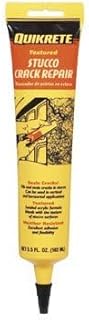
QUIKRETE Stucco Crack Repair
- Textured repair caulk in a 10 ounce tube
- Seals cracks up to 1/2 inch wide, made for cracks only
- Easy to use, with a cut tip applied at an angle
- Texture matched with a trowel, float, sponge, or similar technique
- Prepare cracks by opening them up and removing loose debris first
- Squeeze material on generously, then match the existing texture
QUIKRETE Stucco Crack Repair is the narrowest tool in this roundup, and it is here because most small exterior cracks are exactly that: cracks, not holes. The product is a textured caulk that seals cracks up to 1/2 inch wide, and it is made for cracks only. It comes in a 10 ounce tube, and it is the fastest way to close a fine, straight crack that runs across an exterior wall, before rain gets in behind the finish coat.
The method is simple, but the preparation is not optional. Cracks should be opened up, or chased, and loose debris and particles removed before the caulk goes in. Cut the tip at an angle, squeeze the material on generously, and match the existing texture using a trowel, float, sponge, or similar technique. The caulk is textured to match the rough appearance of stucco, so it reads as part of the wall rather than as a smooth bead of sealant. It should not be used as a patch for holes or spalls, because it has no body for filling a void, and a crack filled with caulk where a patch was needed will sink and reopen. For the fine cracks on an exterior wall, though, it is the right product, and it takes minutes rather than hours.
| Product | Main specification | Best suited for |
|---|---|---|
| QUIKRETE FastSet Stucco Patch 1139 | Paintable after 90 minutes, ASTM C 926 | Fast exterior crack repairs |
| QUIKRETE Pre-Mixed Stucco Patch 8650 | Sanded acrylic, repairs up to 1/4 inch thick | Shallow textured cracks |
| Rapid Set Stucco Mix | 45 minute working time, ready for color in 1 hour | Deep cracks needing a base coat |
| Rapid Set Patch Compound | 20 minute working time, scratch to finish coats | General fast patching |
| DAP ElastoPatch Textured | Flexible compound, 10.1 ounce tube | Cracks that move with the seasons |
| Sikacryl Ready-Mix Stucco Patch | Acrylic-based, tack free 2 to 4 hours | Spalls with stated coverage |
| QUIKRETE Stucco Crack Repair | Textured caulk, seals cracks up to 1/2 inch | Fine straight cracks |
How to choose
Check whether the crack moves before choosing a filler
Not every exterior crack is the same, and the first question is whether the crack moves. A crack that opens in summer and closes in winter is a movement crack, and it needs a flexible filler such as DAP ElastoPatch Textured, because a rigid cement patch will crack again along the same line. A crack that stays the same width all year is a stable crack, and it takes a rigid patch or a caulk without trouble. Mark the ends of the crack with a pencil and check the width across the seasons, or watch it through a hot week and a cold week. The answer decides the product, and guessing wrong means doing the repair twice.
Match the filler to the crack width
Crack width should decide the product as surely as movement does. A hairline crack under 1/16 inch is a caulk job, and the textured caulk in this list closes it in minutes. A crack up to 1/2 inch wide is still a caulk job, but it needs the tube applied generously and tooled to match the texture. A crack that has opened wider than 1/2 inch, or one that has broken into a shallow spall, needs body, and the cement patches in this list fill it properly. A crack filled with caulk where a patch was needed will sink and reopen, and a patch forced into a hairline crack will sit proud of the wall and read as a scar.
Check the weather window before starting
Exterior crack repairs live or die by the forecast. Most products in this list should not be applied if rain is expected within 12 hours, and several should not be applied below 40 or 50 degrees Fahrenheit. A fast-setting mix like QUIKRETE FastSet Stucco Patch 1139, paintable after 90 minutes, gives the repair a short exposure to the weather, which matters on a day when the forecast is uncertain. A slow-curing patch needs a clear run of dry weather, and the wall should be dry before application, for a minimum of 48 hours in the case of Sikacryl. Plan the repair for a dry spell, and keep a cover ready in case the weather turns.
Match the texture so the repair disappears
A crack repair on an exterior wall is seen from the street, so the texture match matters as much as the bond. Run a hand over the wall beside the crack and look at the grain: a fine float finish has a close, even grain, a standard sand float shows a clear sand pattern, and a coarse dash finish has a heavy, open texture. A patch mixed with fine sand will look smooth against a coarse wall, and a coarse patch will look rough against a fine wall, and neither error can be fixed by paint. The products in this roundup state their sand grade where the maker publishes it. Where the aggregate is not stated, the only honest check is a small sample patch on a hidden part of the wall, left to dry fully before the real repair is started.
Common mistakes
The most common mistake on an exterior crack is patching over a dirty crack. The crack collects dust, loose paint flakes, and fragments of broken stucco, and a filler laid over that debris bonds to the dirt instead of to the wall. The repair looks sound for a week, then the whole patch pops out in one piece. The fix costs nothing: chase the crack open, brush out every loose fragment, and dampen the surface lightly before the filler goes on, so the dry base does not pull water out of the mix too fast.
The second mistake is using an interior filler on an exterior wall. An interior filler will soften in rain, chalk in sun, and fall out of the crack within a season, and the repair will have to be done again. Check the data sheet for exterior use before buying, and use only products that state it. Every product in this roundup states exterior use, which is why they are here.
The third mistake is filling a moving crack with a rigid patch. A crack that opens and closes with temperature changes will crack a rigid cement patch along the same line within a season, and the repair will look worse than the original crack. Check whether the crack moves before choosing a filler, and use a flexible compound for a crack that does.
The fourth mistake is filling a deep crack in one thick lift. Every product in this roundup states a maximum thickness per application, usually 1/4 inch for premixed patches, and going past it invites shrinkage cracks as the patch dries. Build deep damage in layers, allow the stated drying time between them, and keep each lift inside the published limit. The Rapid Set Stucco Mix in this list is the exception for base work, with a stated working time of 45 minutes and a ready-for-color time of 1 hour after moist curing.
The fifth mistake is painting too soon. A patch that looks dry on the surface can still hold moisture underneath, and paint laid over it will bubble, peel, or flash a different sheen. Wait the full stated curing time, and longer in cool or damp weather. A patch that has cured fully takes paint evenly, and the repair disappears instead of drawing the eye to a fresh rectangle of paint on the wall.
FAQ
How do I know if an exterior crack is serious?
A hairline crack under 1/16 inch wide, with no displacement across it, is usually a surface crack in the finish coat, and it can be filled with a textured caulk. A crack wider than 1/4 inch, a crack with one side higher than the other, a crack that runs in a stair-step pattern through the wall, or a crack with water staining around it, should be checked by a professional before any filler goes in, because it may point to movement in the structure behind the stucco.
Can I fill an exterior crack in cold weather?
Most products in this list should not be applied below 40 or 50 degrees Fahrenheit, and none should be applied if rain is expected within 12 hours. A fast-setting mix gives the repair a shorter exposure to the weather, but it does not change the minimum temperature. Plan the repair for a dry spell with temperatures above the stated minimum, and protect the fresh patch from freezing.
What should I use for a crack that keeps coming back?
A crack that keeps coming back is usually a movement crack, and it needs a flexible filler such as DAP ElastoPatch Textured, which stays in the crack as the wall moves. A rigid cement patch in a moving crack will crack again along the same line. If the crack keeps widening year after year, have the wall checked by a professional, because the movement may point to a problem behind the stucco.
How wide a crack can a caulk fill?
QUIKRETE Stucco Crack Repair seals cracks up to 1/2 inch wide, and it is made for cracks only. A crack wider than 1/2 inch, or a crack that has broken into a shallow spall, needs a patch with body, such as one of the cement mixes in this roundup. A crack filled with caulk where a patch was needed will sink and reopen.
Should I paint over an exterior crack repair?
Yes, once the patch has cured fully. Paint protects the patch from water and sun, and it hides the repair in the wall. Use a high-quality exterior masonry grade breathable acrylic latex paint, and wait the full stated curing time before painting. A patch that has cured fully takes paint evenly, and the repair disappears instead of drawing the eye to a fresh rectangle of paint.
Conclusion
Small cracks on an exterior stucco wall are the cheapest repairs a house will ever need, and the most expensive ones to ignore. A hairline crack lets water in behind the finish coat, and water behind stucco does not dry out quickly. The seven mixes in this roundup cover the range of ways to close a crack properly: fast-setting cement patches for a crack that needs body, ready-to-use tubs for a shallow textured crack, flexible compounds for a crack that moves with the seasons, and textured caulk for the fine straight cracks that appear on every exterior wall. QUIKRETE FastSet Stucco Patch 1139 leads for a fast exterior repair, with a 90 minute paint time and a published ASTM C 926 standard. DAP ElastoPatch Textured leads for a crack that moves, with a flexible body that stays in the joint. QUIKRETE Stucco Crack Repair leads for the fine straight cracks, with a textured caulk that seals up to 1/2 inch wide.
Whatever mix is chosen, the working rules stay the same. Check whether the crack moves, match the filler to the crack width, clean the crack out properly, keep each lift inside the stated thickness, and wait the full curing time before paint. An exterior crack repaired on those rules reads as one surface again, and it keeps water out of the wall for years. Choose by the data sheet, honor the weather window, and the repair will last as long as the wall around it.
Related guides
More from Amazon
Programs that pair well with the guide above. Offers and eligibility are set by Amazon and may change.
Free shipping on eligible items, Prime Video and more. Eligible new members can start with a free trial.
Start a Prime free trialAudiobooks and podcasts to listen to on the go. Eligible new members can start with a free trial.
Try Audible freeAd-free music streaming. Eligible new subscribers can start with a free trial.
Try Music Unlimited freeA free business account with business pricing and bulk-buying tools for work, shop or home office.
Create a business accountAs an Amazon Associate we earn from qualifying purchases.
More ways to save on your next finish
Programs that pair well with the guide above. Offers and eligibility are set by Amazon and may change.
A free business account with business pricing and bulk-buying tools for work, shop or home office.
Create a business accountFast, free shipping on eligible items, plus Prime Video and more. Eligible new members can start with a free trial.
Start a Prime free trialRead from a huge library of eBooks, including how-to guides and cookbooks. Eligible new members can start with a free trial.
Try Kindle UnlimitedAudiobooks and podcasts for the commute, the garage or the kitchen. Eligible new members can start with a free trial.
Try Audible freeAs an Amazon Associate we earn from qualifying purchases. Using these links costs you nothing extra.



Write Your Review
No reviews yet. Be the first to share your experience!