
Key takeaways
- Seven olive soap sealers for refreshing soap-treated decorative lime surfaces, from jasmine and rose pastes to a tadelakt care soap, with refresh guidance.
As an Amazon Associate I earn from qualifying purchases. This post may contain affiliate links at no extra cost to you.
Our top picks at a glance
5 products from this guide, in the order reviewed below.



As an Amazon Associate we earn from qualifying purchases. Prices and availability can change.
A soap-treated lime surface does not stay new on its own. It is washed, touched, leaned on, and left in sun and steam, and over months the soap finish that once made it shed water grows thin. The surface turns a little duller, water stops beading quite so smartly, and a hand passed across it feels drier than it used to. None of that means the plaster has failed. It means the surface is asking for what it was given at the start: another wash of olive soap, spread thin, pressed in, and polished to a shine. This guide looks at best tadelakt olive soap sealers for refreshing soap treated decorative lime surfaces with that renewal in mind, choosing soaps that re-feed the lime, restore the sheen, and suit the colours and textures of decorative lime work.
Refreshing a surface is different from finishing a fresh one. A fresh panel meets soap while its lime is still reactive, and the reaction forms the water-repellent layer for the first time. A surface being refreshed already holds that layer, worn thin in places, and the new wash must join it evenly rather than sit on top of it in patches. That is why dilution and method matter more than brand here: a wash that is too strong leaves cloudy marks, a wash left to dry without being worked in leaves pale clouds, and a wash applied to a dirty surface seals the dirt in place. The soaps in this guide are all olive-oil soaps at their core, and each one is judged on how it behaves as a refresh wash: how thin it spreads, how it suits the surface colour, and how it leaves the finish looking once it has dried.
Decorative lime surfaces also vary more than a single tadelakt panel. Some are polished to a gloss, some are matt, some are tinted in deep colours, and some are pale washes of lime paint. A refresh wash for a glossy surface can be pressed with a trowel and polished with a stone, while a wash for a matt surface must be applied thinly and rubbed only very gently, since pressure on a matt finish can leave glossy spots. A scented paste suits a living room where the scent becomes part of the room, while a plain paste suits a pale lime wash where any tint would show. The seven products below cover that range, led by a jasmine-scented paste for living spaces, and each one is presented with the surface it suits best.
Quick verdict
For refreshing a soap-treated decorative lime surface in a living space, the BioProGreen Moroccan Beldi Black Soap Jasmine Oriental is the most pleasant choice. Its jasmine scent suits a room where people sit and talk, its paste is a traditional black olive soap with a full ingredient list behind it, and it comes in retail sizes from 100 grams to 500 grams as well as bulk sizes for larger work. A dilute wash of this paste, spread thin and polished, restores the sheen to a dull surface without changing its colour.
If the surface is pale, or if the room should carry no scent at all, the EasyTadelakt Olive Black Soap is the safer pick, since it is a plain Moroccan black soap made by a tadelakt specialist for tadelakt surfaces, with a clear method: dilute a small amount in warm water and wipe gently with a soft cloth. For coloured surfaces, the Fatima's Garden range fills the remaining roles: the rose version for soft, warm rooms, the blue nila version for cool, deep colours, the aker fassi version for rich reds, and the argan and eucalyptus versions for surfaces that want a richer or fresher wash. Read the product sections for the detail behind each pick, then use the buying guide to set the dilution, the method, and the refresh cycle for the surface in front of you.
| Product | Key spec | Best for |
|---|---|---|
| BioProGreen Moroccan Beldi Black Soap Jasmine Oriental | Black olive paste with jasmine; 100 g to 500 g retail | Living spaces, refreshing dull surfaces |
| Fatima's Garden Black Soap with Rose | Olive paste with Damask rose; 150 g to 1 kg | Soft warm rooms, gentle scent |
| Fatima's Garden Black Soap with Blue Nila | Olive paste with natural indigo; 150 g to 1 kg | Cool deep colours |
| Fatima's Garden Black Soap with Aker Fassi | Olive paste with poppy and pomegranate; 150 g to 1 kg | Rich red surfaces |
| EasyTadelakt Olive Black Soap | Moroccan black soap paste; 200 g and 400 g jars | Pale surfaces, plain refresh |
| Fatima's Garden Black Soap with Argan Oil | Olive paste with argan oil; 150 g to 1 kg | Dry rooms, richer refresh |
| Fatima's Garden Black Soap with Eucalyptus | Olive paste with eucalyptus; 150 g to 1 kg | Fresh scent, mid-tone surfaces |
How we chose
The first rule was the same as for any tadelakt soap: the product had to be an olive-oil soap at its core, because only olive fatty acids renew the reaction that keeps lime plaster water-repellent. That rule kept every traditional Moroccan beldi soap in the running and removed Marseille soap, synthetic sealers, and foaming cleaners. A tadelakt specialist warns plainly that Marseille soap can damage tadelakt and leave it dull, so no Marseille soap appears anywhere in this guide.
The second rule was about the refresh itself. A refresh wash must spread thin, dissolve fully in warm water, and dry without cloudy marks, so every product here is a soft paste that dissolves in water, and none of them is a hard bar. Pastes allow the strength of the wash to be adjusted to the surface, which matters when a wall has both a dull patch that needs a stronger wash and a pale area that needs a lighter one. The Kreidezeit concentrate, which leads the companion guide for fresh panels, is the reference point here: its maker states a dilution of one part soap to six parts water, warns that tinted lime surfaces can show a deepening of colour or whitish clouds, and advises a sample application on a spare surface first. That advice applies to every refresh wash in this guide.
The third rule was colour and scent, because a decorative surface keeps what the soap leaves behind. Plain and unscented versions lead for pale lime washes, while scented versions were kept for rooms where the scent becomes part of the room's character. Each scented product is labelled as such in its section, so the reader can weigh scent against colour. The fourth rule was size: a refresh wash uses little soap, so the shortlist favours jars from 100 grams to a kilo, with bulk sizes for readers refreshing whole rooms. The result is a shortlist of seven pastes, each with a distinct scent or recipe, and each one able to refresh a soap-treated lime surface without asking it to endure a cleaner it was not made for.
BioProGreen Moroccan Beldi Black Soap Jasmine Oriental
The BioProGreen Moroccan Beldi Black Soap Jasmine Oriental is the lead product for refreshing decorative lime surfaces because it suits the rooms where those surfaces live. It is a traditional Moroccan beldi black soap, crafted from black olive paste and infused with the delicate fragrance of jasmine, and the maker presents it as a soap that deeply cleanses, softens, and nourishes, leaving the skin radiant and smooth. That language is written for skin, but the paste is the same paste a lime surface wants: olive oil saponified with potash, in a soft, dark form that dissolves in warm water and spreads thin.
The ingredient list is short and plain: water, potassium olivate, glycerin, sodium benzoate, potassium sorbate, potassium hydroxide in trace amounts, and jasmine extract. The maker states that the soap is free from mineral oil, parabens, silicones, and synthetic colorants, and that it is vegan, not used on animals, made in Morocco to a traditional formula. The sizes run from 100 grams to 500 grams for retail, and from one kilo to a 200 kilo drum for bulk and professional use, so a reader refreshing a single wall can buy a small jar while a reader refreshing a whole house can buy by the kilo.
For a decorative lime surface, the jasmine version suits a living room, a bedroom, or a hallway where the scent becomes part of the room after the wash. The method is the usual one for a refresh: wash the surface first with a dilute soap solution and a soft cloth, wipe it dry, then apply a fresh dilute wash thinly and evenly, and polish it in where the surface is glossy. On a matt surface, apply the wash thinly from bottom to top and rub only very gently, since pressure can leave glossy spots. The jasmine scent is delicate rather than strong, and it fades as the surface dries, leaving the room smelling faintly floral for a day. On a pale lime wash, keep to a plain unscented paste, since any added scent deserves care on light colours, but on a warm or mid-tone surface the jasmine version is a pleasure to use.
Pros: delicate jasmine scent suits living spaces; full ingredient list and sizes stated; retail and bulk sizes; vegan and made in Morocco.
Cons: scented, so it needs care on pale lime washes; the jasmine note is a matter of taste and not every room wants it.
Fatima's Garden Black Soap with Rose
The Fatima's Garden Black Soap with Rose takes the same olive paste and adds Damask rose, which the maker calls the gentlest of the scented versions. The base is unchanged: olive oil and macerated olives saponified with potash, a soft dark paste, in sizes from 150 grams to a kilo, with a three-year shelf life and no synthetic detergent, preservative, dye, or silicone. The maker advises following the rose version with rose water and a light oil for skin, which is the hammam language for the same paste, and the rose note in the soap is soft rather than sharp.
For a decorative lime surface, the rose version suits soft, warm rooms: a bedroom, a reading corner, or a hallway painted in warm whites, soft pinks, or pale terracotta. The rose scent is gentle enough that it does not dominate the room, and it pairs naturally with warm colours, since the scent and the colour both lean warm. The refresh method is the same as for any beldi paste: clean the surface first with a dilute wash and a soft cloth, let it dry, then apply a fresh dilute wash thinly, press or polish it in on glossy areas, and wipe away the excess. On a matt surface, apply thinly and rub only very gently.
The rose version also suits a reader who wants the refresh wash to feel like care rather than maintenance. A wall that is washed with a rose-scented soap becomes part of the room's character, and the routine is easier to keep when it smells pleasant. Keep the plain olive version for the palest lime washes, where any added scent is one more variable to manage, and keep the rose version for warm, mid-tone surfaces where the scent can be enjoyed without worry.
Pros: gentlest scent in the range; same trusted olive base; sizes up to a kilo; three-year shelf life.
Cons: scented, so it needs care on pale lime washes; the rose note is a matter of taste.
Fatima's Garden Black Soap with Blue Nila
The Fatima's Garden Black Soap with Blue Nila takes the same olive paste and mills natural indigo into it. The maker describes the blue nila version as a paste coloured by natural indigo, and notes that it colours the soap, not the skin. The base is unchanged: olive oil and macerated olives saponified with potash, a soft dark paste, in sizes from 150 grams to a kilo, with a three-year shelf life and no synthetic detergent, preservative, dye, or silicone. The indigo is the only addition, and it gives the paste a deep blue-black tone in the jar.
For a decorative lime surface, the blue nila version suits cool, deep colours: slate blue, deep grey, charcoal, and dark green. On such surfaces, a faint blue note in the wash raises no concern, and the paste can be used exactly like the plain version, diluted well in warm water and spread thin. On a pale surface, the blue nila version should not be used at all, since any tinted paste can mark a light colour, and the maker is clear that the indigo colours the soap itself. The refresh method is the same: clean first, let the surface dry, apply a fresh dilute wash, press or polish it in, and wipe away the excess.
The blue nila version is the most colour-specific soap in this guide, and that specificity is its strength. A reader with a deep blue or charcoal lime wall has a soap that matches the room's mood, and the wash becomes part of the wall's character rather than a neutral chore. Keep it for dark, cool surfaces only, and keep a plain paste beside it for any pale work.
Pros: natural indigo suits deep cool colours; same trusted olive base; sizes up to a kilo; three-year shelf life.
Cons: tinted paste, so it must never be used on pale surfaces; the indigo note is a matter of taste.
Fatima's Garden Black Soap with Aker Fassi
The Fatima's Garden Black Soap with Aker Fassi takes the same olive paste and adds the red powder of Fez, made from poppy flower and pomegranate rind. The maker presents it as the red version of the range, and the base is unchanged: olive oil and macerated olives saponified with potash, a soft dark paste, in sizes from 150 grams to a kilo, with a three-year shelf life and no synthetic detergent, preservative, dye, or silicone. The aker fassi gives the paste a warm red note, both in colour and in scent, and it suits rooms where red is already the dominant tone.
For a decorative lime surface, the aker fassi version belongs on rich red surfaces: deep terracotta, oxblood, dark rose, and warm red ochre. On such walls, a faint red note in the wash raises no concern, and the paste can be used like the plain version, diluted well and spread thin. On a pale or cool surface, it should not be used, since any tinted paste can mark a light colour. The refresh method is the same as for the other pastes: clean the surface first with a dilute wash, let it dry, apply a fresh dilute wash thinly and evenly, press or polish it in on glossy areas, and wipe away the excess with a dry soft cloth.
The aker fassi version also suits a reader who wants the refresh wash to match a Moroccan-inspired room, since the red powder of Fez is part of the same tradition as the tadelakt finish itself. A deep red wall washed with aker fassi soap keeps its warmth, and the room smells faintly of the spice after the wash. Keep it for rich red surfaces only, and keep a plain paste beside it for any pale work.
Pros: warm red note suits rich red surfaces; same trusted olive base; sizes up to a kilo; three-year shelf life.
Cons: tinted paste, so it must never be used on pale or cool surfaces; the red note is a matter of taste.
EasyTadelakt Olive Black Soap
The EasyTadelakt Olive Black Soap is the plain care soap of this guide, and it is here because a refresh routine needs one soap with no variables at all. It is a Moroccan black soap in 200 gram and 400 gram jars, described by its maker as an entirely natural, olive-based paste enriched with potash, with a creamy texture and a deep olive-green or black hue. The maker states that it is the soap applied during the final stage of tadelakt work to make the lime finish water-repellent, and that routine cleaning and maintenance should always employ authentic Moroccan black soap. The same page gives the method plainly: dilute a small amount of black soap in warm water, wipe the surface gently with a soft cloth, rinse if needed, and pat dry.
For a decorative lime surface being refreshed, the plain version is the safest wash for pale lime paint and pale plaster. A white or pale grey surface shows every tint a soap leaves behind, and a paste with no added scent or colour removes that risk entirely, leaving only dilution to manage. The maker also warns that Marseille soap can damage tadelakt and should never be used on it, which is a useful reminder when choosing a soap for a refresh: the two soaps may look similar in the jar, but only the Moroccan black soap is recommended for tadelakt surfaces.
The small jar sizes suit a refresh routine: a 200 gram jar covers minor surface maintenance, while the 400 gram jar suits larger projects or ongoing treatments. Both formats arrive sealed for freshness and are delivered from Morocco. For a reader refreshing a pale wall, or a room that should carry no scent at all, this is the jar to reach for first, and it can be kept beside the scented pastes for the days when the pale surfaces need their wash.
Pros: made by a tadelakt specialist for tadelakt surfaces; plain recipe with no synthetic additions; clear dilution and wiping method.
Cons: the jars are small for refreshing whole rooms; the paste must be diluted before use.
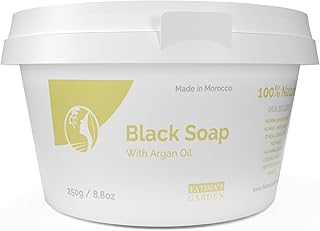
Fatima's Garden Black Soap with Argan Oil
The Fatima's Garden Black Soap with Argan Oil starts from the same olive paste as the plain version, with argan oil worked into it. The maker describes it as a little richer, for dry skin and for winter, and that richer character carries over to surface work in a straightforward way: the paste feels slightly more unctuous under the brush, and it spreads with a little more slip. The base remains the same three-ingredient recipe, olives, potash, and water, with argan oil as the single addition, and the same sizes apply, from 150 grams to a kilo, with the same three-year shelf life and the same absence of synthetic detergent, preservative, dye, and silicone.
For a decorative lime surface, the argan version suits rooms where the air runs dry. A wall in a heated room, or a surface in strong sun, can lose surface moisture faster than a wall in a cool bathroom, and a slightly richer refresh wash leaves the surface feeling fed rather than stripped. The difference is one of feel rather than chemistry: the olive fatty acids still do the renewing work, and the argan oil simply joins them. On a mid-tone or warm-coloured surface, the argan version is an easy choice; on the palest lime washes, the plain olive version remains the safer pick, since any added oil can deepen a light colour a shade if the wash is too strong.
The refresh method is the same as for the plain version: clean the surface first with a dilute wash, let it dry, apply a fresh dilute wash thinly, press or polish it in on glossy areas, and wipe away the excess. The argan version is not a different method, only a slightly richer material, and that makes it a good second jar for a reader who already keeps the plain version on the shelf.
Pros: same trusted olive base with argan oil added; richer feel under the brush; sizes up to a kilo; no synthetic additions.
Cons: the added oil can deepen very pale colours if the wash is too strong; costs more attention on light surfaces than the plain version.
Fatima's Garden Black Soap with Eucalyptus
The Fatima's Garden Black Soap with Eucalyptus takes the same olive paste and adds eucalyptus for scent, which the maker says fills the room the moment the steam rises. The base is unchanged: olive oil and macerated olives saponified with potash, a soft dark paste, in sizes from 150 grams to a kilo, with a three-year shelf life and no synthetic detergent, preservative, dye, or silicone. The eucalyptus is the only change, and it changes the experience of the work rather than the chemistry of the refresh: the room smells fresh while the wash is spread, and the scent fades as the surface dries.
For a decorative lime surface, the eucalyptus version belongs on mid-tone and darker colours. The maker's own guidance for the range is that the soap smells of olives before it smells of anything else, and on a pale lime wash any added scent is one more variable to manage. On a deep green, charcoal, or dark ochre wall, that variable disappears, and the eucalyptus version becomes a pleasant way to refresh a room, since the scent lingers after the wash and makes the maintenance feel like part of the room's character. The method stays the same: clean first, let the surface dry, apply a fresh dilute wash thinly with a soft brush, press or polish it in, and wipe away the excess.
A retail listing for the eucalyptus version in a one-kilo size describes a gel and paste consistency made from olive oil, macerated olives, and natural eucalyptus, which matches the maker's account of the recipe. For a reader refreshing a bathroom wall or a hallway that is used daily, the eucalyptus version has a small extra benefit: the scent makes the refresh wash feel like part of the room rather than a chore, which makes it more likely the surface gets refreshed on schedule. Choose it for colour and scent together, never for scent alone, and keep the plain version for the palest work.
Pros: same olive base with a fresh eucalyptus scent; sizes up to a kilo; three-year shelf life; no synthetic additions.
Cons: scented, so it needs care on pale lime washes; the scent is a matter of taste and not every room wants it.
Buying guide
Start with the surface, not the jar. A glossy surface wants a refresh wash that can be pressed with a trowel and polished with a stone, while a matt surface wants a wash applied thinly and rubbed only very gently, since pressure on a matt finish can leave glossy spots. A tinted surface wants a wash tried first on a spare panel or a hidden corner, since the maker of the plaster-specific concentrate warns that tinted lime surfaces can show a deepening of colour or whitish clouds typical for lime soap. A pale lime wash wants a plain unscented paste, and the EasyTadelakt jar is the safest choice there. A deep red wall wants the aker fassi version, a deep blue or charcoal wall wants the blue nila version, and a living room where scent matters wants the jasmine or rose version.
Dilution is the habit that decides the result. Dissolve a small amount of paste in warm water and stir until the wash is even. The wash should feel slippery between the fingers without looking dark in the bowl; if it looks like the paste itself, it is too strong. Clean the surface first with a dilute wash and a soft cloth, wipe it dry, and only then apply the fresh wash. On glossy surfaces, spread the wash with a soft brush and press it with the trowel at once or after a short absorption period, or polish it with the stone until a uniform shine appears. On matt surfaces, apply the wash thinly and evenly from bottom to top with a soft brush, and rub only very gently with a soft cloth to remove brush marks. Never let a wash dry on the surface without being worked in, since dried soap leaves cloudy patches that are hard to remove.
The refresh cycle is a habit, not a single event. A surface in a bathroom or near water benefits from a light soap wash every few weeks, while a surface in a dry living room can be refreshed every few months. The habit matters more than the schedule: regular light washes keep feeding the lime with fresh fatty acids, while long dry spells followed by a heavy wash are harder to make even. If a surface starts to look dull, or if water stops beading on it, a slightly stronger wash followed by a gentle polish usually restores the sheen. If whitish clouds appear, they are often the lime soap itself showing on the surface, and a lighter wash, applied more thinly, usually avoids them next time.
What never belongs near a soap-treated lime surface is as important as what does. Never use an acidic cleaner or bleach, since acids attack lime and bleach strips the soap finish. Never use a scouring pad, a stiff brush, or any abrasive, since the surface scratches easily and a scratched wall holds dirt. Never use Marseille soap, since a tadelakt specialist warns that its fatty acid profile can leave the surface dull. Never apply soap undiluted, and never use a foaming shower gel or a general cleaner as a substitute for the soap wash, since those products bring surfactants and fragrances the lime never asked for. If a mark resists a dilute soap wash, repeat the wash rather than reaching for a stronger cleaner, and ask a plaster specialist before trying anything else.
Storage matters when soap is bought by the kilo. Keep the jar with the lid closed, out of shower spray, and take the soap out with a dry spoon so moisture does not creep into the jar. The Fatima's Garden pastes keep for three years, and the BioProGreen pastes come in sizes from 100 grams to 500 grams for retail and up to a 200 kilo drum for bulk use. Buy the size that matches the work: a small jar for one wall, a kilo for a whole room, and a bulk size only if several rooms are refreshed every season. A soap that sits open for years is a soap that has lost its freshness, and a fresh paste always washes more evenly than an old one.
FAQ
How do I know a lime surface needs refreshing?
The signs are gentle and easy to read. The surface looks a little duller than it did when it was finished, water stops beading on it and soaks in instead, and a hand passed across it feels drier than it used to. None of that means the plaster has failed; it means the soap finish has worn thin and the surface is asking for another wash. A light refresh wash, applied thinly and polished in, usually restores the sheen.
Should I clean the surface before applying a refresh wash?
Yes, always. Wash the surface first with a dilute soap solution and a soft cloth, wipe it dry, and only then apply the fresh wash. A refresh wash applied to a dirty surface seals the dirt in place, and the result looks patchy. Cleaning first also shows the true state of the surface, so the refresh wash can be mixed to the right strength for what the wall actually needs.
Can I refresh a matt lime surface with soap?
Yes, with a light hand. Apply the wash thinly and evenly from bottom to top with a soft brush, and rub only very gently with a soft cloth to remove brush marks. Do not polish a matt surface, since pressure can leave glossy spots, and do not press the wash in with a trowel the way a glossy finish asks for. A matt surface refreshed lightly keeps its matt character and gains water resistance at the same time.
Why do whitish clouds appear after a soap wash?
Whitish clouds are typical for lime soap on tinted surfaces, and they usually mean the wash was too strong or was left to dry without being worked in. A lighter wash, applied more thinly and pressed or polished in promptly, usually avoids them. The maker of the plaster-specific concentrate advises a sample application on a spare surface first, so that colour changes and interactions with the substrate can be seen early, before the whole wall is washed.
How often should a decorative lime surface be refreshed?
A surface in a bathroom or near water benefits from a light wash every few weeks, while a surface in a dry living room can be refreshed every few months. The habit matters more than the schedule: regular light washes keep feeding the lime with fresh fatty acids, while long dry spells followed by a heavy wash are harder to make even. Judge the surface by how it looks and how water behaves on it, rather than by the calendar alone.
Can scented soap be used on a pale lime wash?
It is better not to. A pale lime wash shows every tint a soap leaves behind, and any added scent or colour is one more variable to manage. Keep a plain unscented paste, such as the EasyTadelakt jar, for pale surfaces, and keep the scented pastes, jasmine, rose, eucalyptus, blue nila, and aker fassi, for mid-tone and dark surfaces where the scent and colour become part of the room rather than a risk to it.
Conclusion
A soap-treated decorative lime surface does not ask for much to stay beautiful: warm water, a spoonful of olive soap paste, a soft cloth, and a wash applied thinly and worked in before it dries. The BioProGreen jasmine paste leads this guide because it suits the living spaces where decorative lime is most often seen, and the Fatima's Garden range fills the rest of the room: rose for warm rooms, blue nila for deep cool colours, aker fassi for rich reds, argan for dry air, and eucalyptus for a fresh scent. The EasyTadelakt jar stands behind them all as the plain staple for the palest washes. Choose by colour first and by scent second, clean before refreshing, dilute well, and never let an acidic cleaner near the lime. Done that way, the refresh wash will do what it has done for generations: return the sheen to a dull wall, renew the water resistance of the surface, and keep a decorative lime finish looking as it did the day it was first soaped.
Related guides
More from Amazon
Programs that pair well with the guide above. Offers and eligibility are set by Amazon and may change.
Free shipping on eligible items, Prime Video and more. Eligible new members can start with a free trial.
Start a Prime free trialAudiobooks and podcasts to listen to on the go. Eligible new members can start with a free trial.
Try Audible freeAd-free music streaming. Eligible new subscribers can start with a free trial.
Try Music Unlimited freeA free business account with business pricing and bulk-buying tools for work, shop or home office.
Create a business accountAs an Amazon Associate we earn from qualifying purchases.
More ways to save on your next finish
Programs that pair well with the guide above. Offers and eligibility are set by Amazon and may change.
A free business account with business pricing and bulk-buying tools for work, shop or home office.
Create a business accountFast, free shipping on eligible items, plus Prime Video and more. Eligible new members can start with a free trial.
Start a Prime free trialRead from a huge library of eBooks, including how-to guides and cookbooks. Eligible new members can start with a free trial.
Try Kindle UnlimitedAudiobooks and podcasts for the commute, the garage or the kitchen. Eligible new members can start with a free trial.
Try Audible freeAs an Amazon Associate we earn from qualifying purchases. Using these links costs you nothing extra.










Write Your Review
No reviews yet. Be the first to share your experience!