
Key takeaways
- Compare seven olive soap sealers for polished tadelakt wall panels, from a plaster-specific concentrate to Moroccan black soap pastes, and choose the right one.
As an Amazon Associate I earn from qualifying purchases. This post may contain affiliate links at no extra cost to you.
Our top picks at a glance
3 products from this guide, in the order reviewed below.


As an Amazon Associate we earn from qualifying purchases. Prices and availability can change.
A polished tadelakt wall panel earns its shine twice: once from the stone that burnishes the lime, and once from the soap that seals it. The soap stage is easy to rush and hard to undo, because the wash you brush on reacts with the lime itself, turning part of the surface into a water-repelling layer rather than sitting on top of it like a coat of varnish. Pick the wrong soap and a pale panel can pick up a tint it was never meant to carry; pick the right one and the same panel gains a soft glow, a surface that sheds splashes, and a finish that can be refreshed again and again with nothing more than a fresh wash. That is why this guide looks at best tadelakt olive soap sealers for soap finishing polished tadelakt wall panels through the lens of the panel itself: what the soap is made from, how thin it can be spread, how it behaves on light colours, and how much wall one container can cover.
Tadelakt panels differ from ordinary painted walls in one decisive way. The surface is still chemically active when the soap goes on. Fresh lime plaster holds free calcium hydroxide, and the fatty acids in an olive soap meet that lime and form insoluble calcium soaps inside the pores. The reaction is the finish. A soap that is mostly olive oil, saponified with potash into a soft paste, brings the right fatty acids to that meeting. A soap built on other oils, or one loaded with added fragrance, colour, or foaming agents, brings compounds the lime never asked for. The seven products below were chosen with that chemistry in mind: one plaster-specific concentrate made for this exact job, and six traditional Moroccan black soaps whose olive-paste composition matches the soap tadelakt makers have used for generations.
Wall panels add their own demands. A panel is usually finished flat, in one session, under steady light, so every uneven patch of soap shows. The soap must spread thin, stay workable long enough to be pressed with a trowel or polished with a stone, and dry without leaving cloudy marks. Panels also tend to be pale, since the plaster is often tinted in soft whites, sands, and pale greys, and dark olive soap can tint those colours if it is applied too strong or left to dry in place. Dilution, a soft brush, and a dry cloth for excess soap matter as much as the brand in the jar. This guide covers all of that: the products, the dilution habits that keep pale panels pale, and the repeat coats that build water resistance on panels that will see steam, splashes, or daily handling.
Quick verdict
If the panel in front of you is a fresh, polished tadelakt surface and you want the most direct route to a sound soap finish, start with the Kreidezeit Polishing Soap Concentrate. It is the only product here made specifically for lime plaster, it states its dilution as one part soap to six parts water, and its maker gives tadelakt its own application paragraph, including the timing: apply shortly after polishing the second layer, while the plaster is strong against impact but not yet fully dry. For a panel that will live in a bathroom or near a basin, that specificity is worth a great deal, because it removes guesswork from the one stage where guesswork shows.
If the panel is already finished and you want a soap for routine care and occasional refreshing, the EasyTadelakt Olive Black Soap is the natural companion. It is a Moroccan black soap in small jars, made for the same tadelakt surfaces, and its maker describes the daily habit plainly: dilute a small amount in warm water, wipe gently with a soft cloth, and let the soap keep feeding the lime. For larger panels, or for a workshop that finishes panels in batches, the Fatima's Garden Black Soap with Olive Oil is the practical bulk choice, since the same paste is sold from small jars up to a kilo, and the plain olive version carries no added scent that could mark a pale surface.
The remaining three products fill clear roles. The Fatima's Garden argan version suits panels in dry rooms where a slightly richer paste is welcome, and the Zakia's Morocco argan tub offers the same richer paste in a known 16 ounce size. The eucalyptus soap from Fatima's Garden suits panels where a fresh scent in the room is welcome and the colour is mid-tone or dark enough that a scented paste raises no concern. For the palest panels, the plain olive paste from Fatima's Garden is the pick, since it brings olive soap with no added fragrance at all. Read the product sections for the detail behind each pick, then use the buying guide to match dilution and timing to the panel in front of you.
| Product | Key spec | Best for |
|---|---|---|
| Kreidezeit Polishing Soap Concentrate 3502 | Corfu olive soap concentrate; dilute 1:6; 500 ml covers 35 sq m | Fresh polished panels, first soap finish |
| EasyTadelakt Olive Black Soap | Moroccan black soap paste; 200 g and 400 g jars | Routine care of finished panels |
| Fatima's Garden Black Soap with Olive Oil | Olive paste, potash saponified; 150 g to 1 kg | Large panels and batch work |
| Fatima's Garden Black Soap with Argan Oil | Olive paste with argan oil; 150 g to 1 kg | Dry rooms, richer paste feel |
| Fatima's Garden Black Soap with Eucalyptus | Olive paste with eucalyptus; 150 g to 1 kg | Mid-tone panels, fresh scent |
| Zakia's Morocco Moroccan Black Soap with Argan Oil 16 oz | Black soap with argan oil; 16 oz value size | Dry rooms, richer paste |
| Elbahya Moroccan Black Soap with Eucalyptus and Olive 1 kg | Rich black paste, eucalyptus and olive oils; 1 kg tub | Batch panel work, fresh scent |
How we chose
The shortlist started from the chemistry of the soap finish itself. Tadelakt becomes water-repellent when the fatty acids in olive soap react with free lime in the plaster, so every product here had to be an olive-oil soap at its core. That single rule removed a whole shelf of general cleaners and modern synthetic sealers from consideration, and it also removed Marseille soap, which a tadelakt specialist warns against by name: its fatty acid profile differs from Moroccan black soap, and it can leave a tadelakt surface dull. The products that remained were either made for lime plaster or made as traditional Moroccan beldi soap from olives and potash.
Form mattered next. A soft paste or a liquid concentrate spreads thin across a flat panel and can be diluted to the strength the colour demands. A hard bar cannot be spread at all, and a foaming shower gel brings surfactants the plaster does not need. Every product in the table is a paste or a concentrate that dissolves in water, and every one can be brushed on and pressed with a trowel or polished with a stone, which is how the soap finish is actually applied.
Dilution guidance was the third filter. Panels are unforgiving of soap applied too strong, especially pale ones, so products whose makers state a dilution, a coverage figure, or a clear method earned their place. The Kreidezeit concentrate states one part soap to six parts water and a coverage of 35 square metres from a 500 ml container. The black soap pastes are used diluted in warm water, a small amount at a time, and the Fatima's Garden range adds a three-year shelf life and sizes up to a kilo, which matters when a workshop buys soap by the panel rather than by the jar.
Scent and colour were the fourth filter, because a wall panel keeps what the soap leaves behind. Unscented and plain olive versions sit at the top of the list for pale panels. Scented versions, eucalyptus and rose among them, were kept for panels where the colour is deep enough that a tinted paste raises no worry, and each scented product is labelled as such in its section so the reader can weigh scent against colour. Finally, the list was balanced across formats and sizes: a plaster-specific concentrate, a tadelakt specialist's jarred soap, a bulk-friendly range with several formulas, a one-kilo eucalyptus tub from Elbahya for batch work, and a 16 ounce argan tub from Zakia's Morocco. Seven products, each with a distinct reason to be on the wall.
Kreidezeit Polishing Soap Concentrate 3502
The Kreidezeit Polishing Soap Concentrate is the lead product here because it is the only one made for the job of finishing lime plaster. Its most important component, the maker lists, is Corfu soap, a pure olive soap produced on the Greek island of Corfu, with no added colouring, preservatives, or fragrances. Dissolved in water and applied to an alkaline lime surface, part of the natural soap turns into lime soaps that give the wall moisture and dirt-repellent properties. The full composition is short enough to quote in full: water, olive oil sodium soap, and lime sinter water. That plainness is the point. Nothing in the jar competes with the lime for attention, and nothing in it can tint a pale panel.
The maker's application notes read like a checklist for panel work. Dilute one part polishing soap with six parts water, and never use the product undiluted. On tadelakt, apply the soap shortly after finishing the polishing of the second layer, while the plaster is strong against impact but not yet completely dry. Spread it evenly with a soft brush, let it set a short while, then polish with the stone until a uniform shine appears. On larger surfaces, work in sections of about one square metre and press the soap with the trowel at once or after a short absorption period, and do not let the smoothing soap dry without further treatment. For panels that will take heavy use, repeat the treatment after the first layer has dried fully, but no later than after two days, and polish the second coat with a plastic foil bale.
Coverage is stated plainly: about 100 ml of diluted soap per square metre, which works out to roughly 0.014 litres of concentrate per square metre, and a 500 ml container covers 35 square metres. A single container therefore covers a run of panels rather than one wall, which makes it easy to budget for a batch. The product keeps for at least one year when stored airtight, cool, and protected from frost, and its VOC content sits at a maximum of 1 gram per litre against a limit of 200 grams per litre. The maker also advises a sample application on a spare surface before large-area work, so that colour changes and interactions with the substrate can be seen early, and warns that on tinted lime surfaces a deepening of colour or whitish clouds typical for lime soap can occur. That warning is honest and useful: it tells the reader to soap a spare panel first, in the same light the finished panel will hang in.
Pros: made specifically for tadelakt and other lime finishes; stated dilution and coverage; no added colouring, preservatives, or fragrances; very low VOC content.
Cons: must be diluted and never used neat, so the mixing step cannot be skipped; the concentrate format asks the user to measure rather than scoop from a jar.
EasyTadelakt Olive Black Soap
The EasyTadelakt Olive Black Soap is a Moroccan black soap sold in 200 gram and 400 gram jars, and it earns its place as the care soap of this shortlist. The maker describes it as an entirely natural, olive-based paste enriched with potash, with a creamy texture and a deep olive-green or black hue, and notes that it is the soap applied during the final stage of tadelakt work to make the lime finish water-repellent. The same page explains the routine that follows: dilute a small amount of black soap in warm water, wipe the surface gently with a soft cloth, rinse if needed, and pat dry. No scrubbing and no harsh cleaners are needed, and the maker is direct about what to avoid, warning that Marseille soap can damage tadelakt and should never be used on it.
For a finished wall panel, that guidance translates into a simple habit. A panel that is wiped now and then with a dilute black soap solution keeps receiving fresh fatty acids, which keep feeding the reaction that made the surface water-repellent in the first place. The small jar sizes suit that habit: a 200 gram jar covers personal care and minor surface maintenance, while the 400 gram jar suits larger projects or ongoing treatments. Both formats arrive sealed for freshness and are delivered from Morocco, which is a point of authenticity for a finish whose tradition is Moroccan through and through.
The paste form matters on a panel. A paste can be diluted to whatever strength the panel needs, and a small amount goes a long way once it is dissolved in warm water. On a pale panel, that control is the difference between a clean refresh and a tinted patch. The maker's page also notes that the soap is 100 percent plant-based and free from synthetic perfumes, colourings, and preservatives, which keeps the ingredient list close to the traditional recipe of crushed black olives, olive oil, and potash. For panels that are already sealed and simply need keeping, this is the jar to reach for first.
Pros: made by a tadelakt specialist for tadelakt surfaces; small jars suit routine care; clear dilution and wiping method; plain olive recipe with no synthetic additions.
Cons: the jars are small for a workshop finishing many panels at once; the paste must be diluted before use, so it is not a ready-to-brush liquid.
Fatima's Garden Black Soap with Olive Oil
The Fatima's Garden Black Soap with Olive Oil is the plainest version of a traditional beldi soap, and the maker says so directly: olives and nothing else, the one a hammam actually uses, and the one to buy by the kilo. The soap is a soft, dark paste of olive oil and macerated olives, saponified with potash, and the maker lists three ingredients, the same three for centuries: olives, potash, and water. It is not a bar and it does not foam, and the maker is clear that a bar sold under the name is something else. That plainness is exactly what a polished panel wants, because every extra ingredient is one more compound that can sit on the surface or tint it.
The practical case for this soap is size. Every formula in the range comes in four sizes, from 150 grams to a kilo, so a workshop can buy a small jar to learn the soap and a kilo tub once the method is settled. The paste keeps for three years in the jar, and the maker advises keeping the lid closed and out of shower spray, taking the soap out with a dry hand or a spoon rather than wet fingers. The ingredient list runs three lines: the base is Olea Europaea, olive oil and macerated olives, saponified with potash, with no residual potassium hydroxide left in the jar. The maker also lists what the soap does not contain: no synthetic detergent, no preservative, no synthetic dye, no silicone, no petrochemical, and the soap is fully plant-based and vegan.
On a panel, the plain olive version is the safest of the scented range to use on light colours, because there is no added fragrance or colouring to leave a mark. Diluted well in warm water, it behaves like the traditional soap wash: spread thin, pressed or polished, excess wiped away. The maker notes that the soap smells of olives before it smells of anything else, which is a useful check when buying: a beldi soap that smells of perfume first is not the plain article. For panels finished in batches, or for a reader who wants one soap that can both seal a fresh panel and maintain it for years, the kilo tub of the plain olive version is the most economical way to keep that habit going.
Pros: plainest recipe in the range, olives and potash only; sizes from 150 grams to a kilo; three-year shelf life; no synthetic additions of any kind.
Cons: a paste that needs diluting and a little practice to spread thin; the dark colour demands careful dilution on the palest panels.
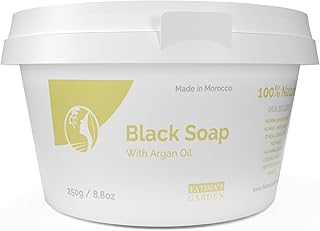
Fatima's Garden Black Soap with Argan Oil
The Fatima's Garden Black Soap with Argan Oil starts from the same olive paste as the plain version, with argan oil worked into it. The maker describes it as a little richer, for dry skin and for winter, and that richer character carries over to panel work in a straightforward way: the paste feels slightly more unctuous under the brush, and it spreads with a little more slip. The base remains the same three-ingredient recipe, olives, potash, and water, with argan oil as the single addition, and the same sizes apply, from 150 grams to a kilo, with the same three-year shelf life and the same absence of synthetic detergent, preservative, dye, and silicone.
For a wall panel, the argan version suits rooms where the air runs dry. A panel in a heated room or a space with strong sun can lose surface moisture faster than a panel in a cool bathroom, and a slightly richer soap wash leaves the surface feeling fed rather than stripped. The difference is one of feel rather than chemistry: the olive fatty acids still do the sealing work, and the argan oil simply joins them. On a mid-tone or warm-coloured panel, the argan version is an easy choice; on the palest panels, the plain olive version remains the safer pick, since any added oil can deepen a light colour a shade if it is applied too strong.
The listing for this soap on a retail roundup describes a butter-soft gel texture that glides on and resists drying, with an argan oil boost that helps lock in moisture, which matches the maker's own description of a richer paste. For the reader finishing panels at home, the practical advice is the same as for the plain version: dilute a small amount in warm water, spread thin, and wipe away what the surface does not take. The argan version is not a different method, only a slightly richer material, and that makes it a good second jar for a workshop that already keeps the plain version on the shelf.
Pros: same trusted olive base with argan oil added; richer feel under the brush; sizes up to a kilo; no synthetic additions.
Cons: the added oil can deepen very pale colours if applied too strong; costs more attention on light panels than the plain version.
Fatima's Garden Black Soap with Eucalyptus
The Fatima's Garden Black Soap with Eucalyptus takes the same olive paste and adds eucalyptus for scent, which the maker says fills the room the moment the steam rises. The base is unchanged: olive oil and macerated olives saponified with potash, a soft dark paste, in sizes from 150 grams to a kilo, with a three-year shelf life and no synthetic detergent, preservative, dye, or silicone. The eucalyptus is the only change, and it changes the experience of the work rather than the chemistry of the seal: the room smells fresh while the soap is spread, and the scent fades as the surface dries.
For a wall panel, the eucalyptus version belongs on mid-tone and darker colours. The maker's own guidance for the range is that the soap smells of olives before it smells of anything else, and on a pale panel any added scent is one more variable to manage. On a deep red, ochre, charcoal, or dark green panel, that variable disappears, and the eucalyptus version becomes a pleasant way to finish a bathroom panel, since the room will carry the scent every time the panel is wiped down. The method stays the same: dilute a small amount in warm water, spread thin with a soft brush, press or polish, and wipe away the excess.
A retail listing for the eucalyptus version in a one-kilo size describes a gel and paste consistency made from olive oil, macerated olives, and natural eucalyptus, which matches the maker's account of the recipe. For a reader who finishes panels in a bathroom that will be used daily, the eucalyptus version has a small extra benefit: the scent makes the maintenance wash feel like part of the room's character rather than a chore, which makes it more likely the panel gets wiped on schedule. Choose it for colour and scent together, never for scent alone, and keep the plain version for the palest work.
Pros: same olive base with a fresh eucalyptus scent; sizes up to a kilo; three-year shelf life; no synthetic additions.
Cons: scented, so it needs care on pale panels; the scent is a matter of taste and not every room wants it.
Zakia's Morocco Moroccan Black Soap with Argan Oil 16 oz
The Zakia's Morocco Moroccan Black Soap with Argan Oil comes in a 16 ounce value size, and it is the argan choice for readers who want a known quantity on a panel. The listing presents it as a Moroccan black soap with argan oil in a 16 ounce tub, the same size as the maker's unscented version, and the same 100 percent natural recipe behind it. A 16 ounce tub is a generous middle size for panel work: larger than the small jars, smaller than a kilo, and enough to finish several panels and maintain them afterwards without running short.
For a wall panel, the argan version has two roles. First, it feeds a panel that will live in dry air, since the argan oil joins the olive fatty acids in the wash and leaves the surface feeling supple rather than stripped. A panel in a heated room or a space with strong sun loses surface moisture faster than a panel in a cool bathroom, and a slightly richer wash suits that room. Second, it suits a reader who wants a richer paste without a strong scent, since argan oil carries only a faint nutty note compared with eucalyptus. The wash is made the usual way, a small amount dissolved in warm water, spread thin with a soft brush, pressed with the trowel or polished with the stone, and wiped of excess with a dry soft cloth.
On a pale panel, the same caution applies as with any added oil: dilute well, spread thin, and wipe away what the surface does not take. The 16 ounce size also makes this soap easy to budget, since the tub holds a known amount and the reader can work out how many panels it will cover before ordering more. For a reader who wants a richer paste in a known size, with no guesswork about how much soap is in the jar, this is the tub to choose, and it pairs naturally with the plain unscented tub from the same maker for the palest work.
Pros: 16 ounce value size, easy to budget; argan oil gives a richer wash; faint scent suits quiet rooms.
Cons: added oil needs care on the palest panels; the tub is wide, so it needs a dry shelf away from shower spray.
Elbahya Moroccan Black Soap with Eucalyptus and Olive 1 kg
The Elbahya Moroccan Black Soap with Eucalyptus and Olive is the bulk choice for panel work, and it earns its place here because a workshop finishing panels in batches uses soap steadily. The tub holds one kilo, which is 2.20 pounds, of rich black paste made with eucalyptus and olive oils, and it is listed for hammam use, which is the same tradition the tadelakt soap finish comes from. A panel finished with a soap wash uses only a small amount of paste per coat, dissolved in warm water, so a kilo tub covers a run of panels rather than a single wall, and the reader never has to ration the wash or stop halfway through a batch because the jar is empty.
The eucalyptus in the recipe suits a workshop where panels are finished one after another. The scent rises with the steam from the warm water, the room smells fresh while the work goes on, and the paste itself is described as rich and black, made for consistent, gentle cleansing, with eucalyptus and olive oils that soothe while they clean. For a panel, that gentleness is the point: the wash should spread thin, press in evenly, and leave the surface with a soft glow, and a soft paste dissolved in warm water does that with a brush and a trowel alone, no scrubbing needed.
On a panel, the method is the same as for any beldi paste, with one difference of scale. Dissolve a small amount of paste in warm water, spread it evenly with a soft brush in sections of about a square metre, press it with the trowel or polish it with the stone, and wipe away what the surface does not take with a dry soft cloth. The eucalyptus version suits mid-tone and darker panels best, since any scented paste deserves care on the palest work, and a reader with a white panel should pair this tub with a plain unscented paste for the pale coats and keep the eucalyptus wash for the darker ones. For a workshop finishing a run of panels, or a household with several tadelakt walls to maintain, the kilo tub is the most practical buy in this guide.
Pros: one-kilo tub suits batch panel work; eucalyptus leaves the room smelling fresh; rich black paste dissolves easily in warm water.
Cons: scented, so it needs care on the palest panels; the large tub is more soap than a single small panel needs.
Buying guide
Start with the panel, not the jar. A fresh panel that has just been polished wants the soap finish applied while the plaster is strong against impact but not yet fully dry, and it wants a soap whose maker states the dilution. The Kreidezeit concentrate is the clear choice there, because its dilution of one part soap to six parts water and its coverage of 35 square metres from 500 ml remove the two biggest unknowns. A finished panel that is already sealed wants a different soap: a beldi paste for routine wiping, diluted a small amount at a time in warm water, spread with a soft cloth, and wiped dry. The EasyTadelakt jar and the Fatima's Garden range both serve that second job.
Colour decides the formula. Pale panels, whites, pale greys, and pale sands, want unscented and uncoloured soap, diluted well. The Kreidezeit concentrate and the Fatima's Garden plain olive version are the safest choices for pale work, and they should be tried first on a spare panel or a hidden corner. Mid-tone panels, warm ochres, terracottas, and soft greens, can take the argan version without worry. Dark panels, deep reds, charcoals, and dark greens, can take the eucalyptus versions, where the scent becomes a feature of the room rather than a risk to the colour. Never use a scented or tinted paste on a pale panel simply because the jar was already open; the cost of a second jar is far lower than the cost of reworking a panel.
Dilution is a habit, not a guess. Measure the soap, add the water, and stir until the wash is even. The Kreidezeit dilution is one to six. For the pastes, a small amount dissolved in warm water is the working rule, and the wash should feel slippery between the fingers without looking dark in the bowl. If the wash looks like the paste itself, it is too strong. Spread the wash with a soft brush in sections of about a square metre, press it with the trowel or polish it with the stone, and wipe away what the surface does not take with a dry soft cloth. Let the panel dry fully before judging the result, and judge it in the light the panel will live in, since a finish that looks even in workshop light can show patches in daylight.
Repeat coats build the finish. A panel that will see steam or splashes benefits from a second soap treatment after the first layer has dried fully, and the Kreidezeit maker puts a limit on that timing: no later than two days after the first coat. Later washes, for maintenance, can be lighter and less frequent. A bathroom panel wiped weekly with a dilute wash keeps receiving fresh fatty acids, and that steady habit is what keeps the surface water-repellent over years. A panel that is left dry for a long time can be refreshed with a slightly stronger wash, followed by a polish, and the surface will usually recover its sheen.
Storage and shelf life matter when soap is bought by the kilo. The Fatima's Garden pastes keep for three years with the lid closed, and the Kreidezeit concentrate keeps for at least a year airtight, cool, and protected from frost. Keep jars out of shower spray, take soap out with a dry spoon, and keep the rim clean so moisture does not creep into the jar. A paste that has thickened can often be softened with a few drops of clean water, but a jar that has taken in dirty water should be replaced. Buy the size that matches the work: a small jar for one panel, a kilo for a run of panels, and a concentrate for a workshop that finishes panels every week.
What to avoid is as important as what to buy. Never use Marseille soap on tadelakt, since a tadelakt specialist warns that its fatty acid profile can leave the surface dull. Never use a soap wash that contains added foaming agents, synthetic colour, or strong perfume on a pale panel. Never apply soap undiluted, and never let a soap wash dry on the surface without pressing or polishing it in, since dried soap leaves cloudy marks that are hard to remove. Never use acidic cleaners or bleach on a soaped panel, since acids attack lime, and never scrub a soaped surface with anything harder than a soft cloth. The soap finish is a chemical finish, not a coating, and it rewards a light hand and a steady routine.
FAQ
How soon after polishing should soap go on a fresh panel?
Apply the soap shortly after the second layer has been polished, while the plaster is strong against impact but not yet fully dry. That timing lets the soap meet lime that is still reactive, which is what forms the water-repellent layer. If the panel has already dried fully, a soap wash can still be applied, but the maker of the plaster-specific concentrate advises a sample application first, since the result can differ from a wash applied to fresh plaster.
Can I use black soap paste on a white tadelakt panel?
Yes, with care. Choose an unscented, uncoloured paste, dilute it well in warm water, and spread it thin. The Kreidezeit concentrate and the plain olive pastes are the safest choices, and a check on a spare panel or a hidden corner should come first. The dark colour of the paste is not a problem when the wash is dilute and the excess is wiped away; it becomes a problem only when the wash is strong or left to dry in place.
How much soap does one panel need?
Very little. The Kreidezeit concentrate covers about 35 square metres from a 500 ml container at a dilution of one part soap to six parts water, which is roughly 0.014 litres of concentrate per square metre. A paste goes further still, since each wash uses only a small amount dissolved in warm water. A 200 gram jar covers a single panel and its routine care for a long while, and a kilo tub covers a run of panels.
Should the soap wash be pressed in or left to sit?
It should be pressed or polished in, not left to sit. On glossy finishes, spread the wash with a soft brush and press it with the trowel at once or after a short absorption period. On tadelakt, polish with the stone until a uniform shine appears. On matt surfaces, apply thinly and evenly, and rub gently with a soft cloth to remove brush marks. Soap that dries without being worked in can leave cloudy patches.
How often should a finished panel be wiped with soap?
A panel in a bathroom or near water benefits from a weekly wipe with a dilute soap solution and a soft cloth. A panel in a dry room can be wiped less often. The habit matters more than the schedule: regular light washes keep feeding the lime with fresh fatty acids, while long dry spells followed by a heavy wash are harder to make even. If a panel starts to look dull, a slightly stronger wash followed by a polish usually restores the sheen.
Why is Marseille soap not recommended for tadelakt?
A tadelakt specialist warns that Marseille soap has a different fatty acid profile from Moroccan black soap, and that it can damage tadelakt, leaving the surface dull. Moroccan black soap is made from olives and potash, and its fatty acids match the chemistry that makes tadelakt water-repellent. The two soaps may look similar in the jar, but they are different products, and only the Moroccan black soap is recommended for tadelakt surfaces.
Conclusion
A polished tadelakt wall panel asks for very little from its soap: olive oil, potash, water, and a careful hand. The Kreidezeit Polishing Soap Concentrate gives the most direct route to that finish on a fresh panel, with a stated dilution, a stated coverage, and application notes written for tadelakt itself. The EasyTadelakt Olive Black Soap and the Fatima's Garden range carry the same tradition forward into routine care, with plain and scented pastes in sizes from a small jar to a kilo. The plain olive paste keeps the palest panels safe, and the eucalyptus versions bring a fresh scent to darker rooms. Choose by colour first and by size second, dilute well, spread thin, press the wash in, and wipe away the excess. Done that way, the soap finish will do what it has done for generations: turn a polished lime surface into a wall that sheds water, holds its shine, and can be refreshed with nothing more than a bowl of warm water and a spoonful of olive soap.
Related guides
More from Amazon
Programs that pair well with the guide above. Offers and eligibility are set by Amazon and may change.
Free shipping on eligible items, Prime Video and more. Eligible new members can start with a free trial.
Start a Prime free trialAudiobooks and podcasts to listen to on the go. Eligible new members can start with a free trial.
Try Audible freeAd-free music streaming. Eligible new subscribers can start with a free trial.
Try Music Unlimited freeA free business account with business pricing and bulk-buying tools for work, shop or home office.
Create a business accountAs an Amazon Associate we earn from qualifying purchases.
More ways to save on your next finish
Programs that pair well with the guide above. Offers and eligibility are set by Amazon and may change.
A free business account with business pricing and bulk-buying tools for work, shop or home office.
Create a business accountFast, free shipping on eligible items, plus Prime Video and more. Eligible new members can start with a free trial.
Start a Prime free trialRead from a huge library of eBooks, including how-to guides and cookbooks. Eligible new members can start with a free trial.
Try Kindle UnlimitedAudiobooks and podcasts for the commute, the garage or the kitchen. Eligible new members can start with a free trial.
Try Audible freeAs an Amazon Associate we earn from qualifying purchases. Using these links costs you nothing extra.










Write Your Review
No reviews yet. Be the first to share your experience!