
Key takeaways
- Compare pneumatic hopper texture sprayers with adjustable air inlets for matching existing wall knockdown patterns on repairs, patches and blended touch-ups.
As an Amazon Associate I earn from qualifying purchases. This post may contain affiliate links at no extra cost to you.
Our top picks at a glance
4 products from this guide, in the order reviewed below.



As an Amazon Associate we earn from qualifying purchases. Prices and availability can change.
Matching an existing knockdown pattern is the hardest job a hopper gun ever does. The wall already has a texture, and the repair has to disappear into it: the same spatter size, the same flattening, the same spacing between the knocked-down peaks. The air inlet is the part of the gun that decides the match, because the air pressure at the inlet sets how hard the mix is thrown, how far the spatter spreads, and how much of it stays on the wall. An adjustable air inlet lets the user dial the pressure up and down until the new spatter lands the same way the old one did, and that adjustment is the difference between a repair that vanishes and a repair that shows. The best pneumatic hopper texture sprayers with adjustable air inlet for matching existing wall knockdown patterns are the ones whose air inlet can be set finely, hold the setting through the pass, and work with the orifice and the mix to reproduce the pattern on the wall.
Knockdown is a two-step finish. First the gun sprays a spatter of texture onto the wall, and then, after a short wait, a knockdown knife flattens the tops of the spatter into the familiar pattern. The spatter step is where the air inlet matters: too much air, and the spatter is fine and flat; too little air, and the spatter is heavy and lumpy. The existing wall was sprayed at a particular pressure with a particular orifice, and the repair has to be sprayed at the same combination. An adjustable inlet gives the user that control, and the practice board gives the user the place to find the setting before touching the wall.
The seven sprayers below were picked for knockdown matching first. Every model here is a pneumatic hopper gun or an electric texture sprayer with an air control described in the maker documents, and the figures in the sections below come from the maker documents or the maker product pages, with missing figures marked as such instead of guessed. Air inlet sizes, air consumption, and working pressures are given exactly as the maker states them.
Best products
Central Pneumatic 1-1/2 Gallon Texture Spray Gun
- Hopper capacity of 1-1/2 gallons
- Three nozzle sizes: 3/16 inch, 1/4 inch and 5/16 inch
- Air inlet size of 1/4-18 NPS
- Air consumption of 8 CFM at 90 psi
- Working pressure of 90 psi
- Gravity feed with a polypropylene hopper
- Cast aluminum gun body, 2.1 pounds
The Central Pneumatic 1-1/2 Gallon Texture Spray Gun leads this roundup because its air inlet is stated plainly and its air demand is a figure the user can work with. The 1/4-18 NPS air inlet is a standard fitting that takes a normal compressor hose, and the air consumption of 8 CFM at 90 psi tells the user exactly what compressor the gun needs. For knockdown matching, that clarity matters: the user sets the regulator to the pressure the pattern needs, checks the inlet fitting, and sprays a practice board knowing the air supply will hold.
The three nozzle sizes from 3/16 inch to 5/16 inch cover the knockdown range: the small nozzle for a fine spatter, the middle nozzle for a standard knockdown, and the large nozzle for a heavy spatter that needs a wide flattening pass. The gravity feed keeps the mix moving into the gun, and the polypropylene hopper is light enough to carry up a ladder. At 2.1 pounds the cast aluminum gun body is the lightest in this roundup, which helps when the gun is held overhead for a ceiling knockdown. For a repair where the air inlet setting has to be found by spraying practice boards, the Central Pneumatic gun is a fair choice that keeps the setup simple and the figures honest.
Wal-Pro Hopper Gun
- Heavy duty large capacity hopper
- Three material orifices: small, medium and large
- Air shut-off valve
- Quick disconnect fitting
- Requires a compressor that produces 7 CFM at 25 psi
- Fill the hopper two-thirds to three-quarters full
The Wal-Pro Hopper Gun is the pick for a knockdown repair where the air shut-off valve does the adjusting. The air shut-off valve sits on the gun, so the user can open and close the air supply without walking back to the compressor, and the quick disconnect fitting makes it easy to swap the air hose between the gun and another tool. The three material orifices run small, medium, and large, and the manual gives a full texture table: light splatter with the small orifice at 23 to 25 psi, orange peel with the medium orifice at 20 to 23 psi, medium splatter with the medium orifice at 17 to 20 psi, and heavy splatter with the large orifice at 10 to 15 psi.
The compressor requirement of 7 CFM at 25 psi is a figure the user can check before starting, and the range of pressures in the texture table is exactly what knockdown matching needs: a low pressure for a heavy spatter, a higher pressure for a fine one. The heavy duty large capacity hopper holds enough mix for a repair and its blend zone, and the fill guidance of two-thirds to three-quarters full keeps the mix feeding evenly. For a knockdown repair where the pressure has to be changed between practice passes, the air shut-off valve on the gun is the control that makes the job practical.
Marshalltown SharpShooter I Hopper Gun
- Seven orifice sizes with a tubular design for reduced overspray
- Knurled knobs adjust the orifice plate without wrenches
- Tight sealing flow shutoff keeps the gun from leaking
- Angled hopper adapter allows the hopper to remain level on floors and ceilings
- Air control valve allows flow control at the gun instead of at the pump
- Easy pull swing trigger stop for consistency of pattern
- Plastic hopper capacity of approximately 2 gallons (7.57 litres)
The Marshalltown SharpShooter I Hopper Gun is the pick for a knockdown repair where the orifice plate does the fine work. The seven orifice sizes on a tubular plate give the user a step for every knockdown weight, and the knurled knobs let the plate be adjusted without wrenches, so the user can change the orifice between practice passes without putting the gun down. The air control valve sits on the gun, which means the flow can be adjusted at the gun instead of at the pump, and that is the control that matters when the pattern needs a small change in the middle of a session.
The tight sealing flow shutoff stops the gun from leaking between passes, so the pattern starts clean each time, and the easy pull swing trigger stop keeps the pattern consistent from one pass to the next. The angled hopper adapter keeps the hopper level on floors and ceilings, so the mix feeds evenly when the gun is pointed up. The plastic hopper holds approximately 2 gallons, which is enough for a repair and its blend zone. For a knockdown match where the orifice and the air have to be adjusted together, the SharpShooter I gives the user both controls on the gun itself.
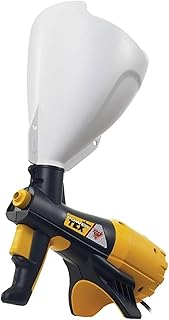
Wagner Power Tex Texture Sprayer
- Hopper capacity of 1 gallon, two-position for ceilings or walls
- Three nozzles: small, medium and large
- Built-in air turbine, 120 volts and 3.7 amps
- Variable-flow trigger
- Three-point stand stabilizes the hopper for filling
- Built-in arm rest
- Sprays popcorn, knockdown, and orange peel textures
The Wagner Power Tex Texture Sprayer is the pick for a knockdown repair where there is no compressor on site. The built-in air turbine runs from a standard wall outlet, so the user plugs the gun in and sprays, and the variable-flow trigger controls the material flow the way an air inlet valve would on a pneumatic gun. The three nozzles cover small, medium, and large textures, and the two-position hopper flips between a ceiling setting and a wall setting without an adapter.
The 1-gallon hopper is smaller than the pneumatic guns in this roundup, but it is enough for a patch and its blend zone, and the three-point stand holds the hopper steady while it is filled. The built-in arm rest keeps the hand comfortable through a session, and the turbine is rated at 120 volts and 3.7 amps, which is a figure any household circuit can supply. For a knockdown repair in a home where a compressor would be more trouble than it is worth, the Power Tex is a practical choice that trades hopper size for the freedom of a plug-in tool.
InoKraft TexCraft Drywall Texture Spray Gun
- Hopper capacity of 1.32 gallons
- Three nozzles included
- Self-locking trigger
- Easy to disassemble for cleaning
- Pneumatic, needs a separate air compressor
The InoKraft TexCraft Drywall Texture Spray Gun is the starter pick for a knockdown repair where the user wants three nozzles and a trigger that can be locked open. The 1.32-gallon hopper holds a useful batch of mix, and the three nozzles cover the fine, medium, and heavy textures that a knockdown match needs. The self-locking trigger holds the gun open for a long pass, so the user does not have to squeeze through the whole repair, and the gun comes apart easily for cleaning, which matters when sand and texture mix dry fast inside a gun.
A knockdown match is found by spraying practice boards, and the TexCraft gun suits that routine: the user sprays a board, checks it against the wall, changes the nozzle or the pressure, and sprays again. The easy disassembly means the gun can be cleaned between practice sessions without a long strip-down, and the self-locking trigger keeps the hand fresh through a session of repeated passes. For a homeowner matching a knockdown pattern for the first time, the TexCraft gun is a fair choice that keeps the tool simple and the learning curve short.
HWYPSJ Drywall Texture Spray Gun Kit
- Hopper capacity of 1.45 gallons
- Three nozzles included
- 45-degree elbow hose
- Self-locking trigger
- Pneumatic, needs a separate air compressor
The HWYPSJ Drywall Texture Spray Gun Kit is the pick for a knockdown repair on a ceiling, where the angle of the gun decides the match. The 45-degree elbow hose keeps the hopper at a usable angle when the gun is pointed straight up, so the mix feeds evenly instead of pooling at the back of the hopper. The 1.45-gallon hopper holds enough mix for a ceiling patch and its blend zone, and the three nozzles cover the fine, medium, and heavy textures.
The self-locking trigger holds the gun open for a long overhead pass, which is the hardest part of ceiling work: the arm tires fast, and a trigger that has to be squeezed the whole time will show in the pattern as the hand weakens. The elbow hose is a small part that makes a real difference, because a hopper that feeds evenly gives a steady pattern, and a hopper that starves the gun gives a patchy one. For a knockdown repair on a ceiling, where the gun is held overhead and the mix has to feed against gravity, the HWYPSJ kit is a practical choice.
Aflybltol Drywall Texture Sprayer
- Hopper capacity of 1.5 gallons
- Three nozzle sizes: 4.0 mm, 6.0 mm and 8.0 mm
- Recommended air pressure of approximately 50 psi
- Aluminum alloy gun body with a transparent plastic hopper
- Weight of approximately 2.68 pounds
- Flow control valve and air valve
- Spare O-rings included
The Aflybltol Drywall Texture Sprayer is the pick for a knockdown repair where the user wants to see the mix level and control the air at the gun. The transparent plastic hopper shows how much mix is left, so the user can see when the next batch is due without opening the hopper, and the flow control valve and the air valve sit on the gun where the hand can reach them. The three nozzle sizes from 4.0 mm to 8.0 mm cover fine, medium, and heavy knockdown, and the recommended air pressure of approximately 50 psi is a standard setting that most compressors can hold.
At approximately 2.68 pounds the aluminum alloy gun body is light enough to hold overhead, and the spare O-rings in the kit keep the gun sealed when the originals wear. The flow control valve regulates the amount of material, and the air valve controls the air flow, so the user has both adjustments on the gun for finding the knockdown match. For a repair where the air and the material have to be tuned together on a practice board, the Aflybltol sprayer is a fair choice that puts both controls in the hand.
| Sprayer | Hopper | Air control | Best for |
|---|---|---|---|
| Central Pneumatic 66103 | 1.5 gal | 1/4-18 NPS inlet, 8 CFM at 90 psi | Stated air figures, light gun |
| Wal-Pro Hopper Gun | Large capacity | Air shut-off valve on gun | Pressure table for matching |
| Marshalltown SharpShooter I | 2 gal | Air control valve at gun | Orifice plate, no-wrench adjust |
| Wagner Power Tex | 1 gal | Variable-flow trigger, turbine | No compressor on site |
| InoKraft TexCraft | 1.32 gal | Self-locking trigger | Starter knockdown matching |
| HWYPSJ Texture Spray Gun Kit | 1.45 gal | Self-locking trigger, elbow hose | Ceiling knockdown work |
| Aflybltol Drywall Sprayer | 1.5 gal | Flow valve and air valve | Seeing the mix level |
How to choose
Set the air at the inlet, not at the wall
The air pressure that matters is the pressure at the gun, and the inlet is where it is set. A regulator at the compressor sets the line pressure, but the inlet valve on the gun is what the user adjusts during the job. The Central Pneumatic gun states a 1/4-18 NPS inlet and an air consumption of 8 CFM at 90 psi, and the Wal-Pro manual gives a pressure table for each texture. The user should set the regulator first, then fine-tune at the gun, and check the setting on a practice board before touching the wall. A pressure that is right at the compressor can still be wrong at the gun if the hose is long or the fittings are small, so the practice board is the real test.
Match the orifice to the old spatter
The old knockdown pattern was sprayed through an orifice of a particular size, and the repair has to use the same size or the spatter will not match. Look at the old wall and measure the spatter: a fine knockdown has small, tight peaks, and a heavy knockdown has large, wide ones. The Sharpshooter I gives seven orifice sizes, the three-nozzle guns give a fine, a medium, and a heavy option, and the Wal-Pro gives small, medium, and large. Pick the orifice that makes the same size spatter on a practice board, then set the air pressure to match the spread. The orifice sets the size, and the air sets the spread, and both have to be right.
Mind the wait before the knockdown pass
Knockdown is a two-step finish, and the wait between the spray and the flattening is part of the pattern. Spray the spatter, wait until the peaks have set enough to hold their shape but are still soft enough to flatten, and then draw the knockdown knife across them in one smooth pass. Too soon, and the knife smears the texture flat; too late, and the peaks break instead of flattening. The wait depends on the mix, the air, and the room, so the user should test it on the practice board: spray, wait, flatten, and look. The gun's job ends at the spray, but the match is made in the wait.
Check the compressor against the gun
A knockdown match needs steady air, and a compressor that cannot hold the flow will let the pattern change in the middle of a pass. The Central Pneumatic gun uses 8 CFM at 90 psi, the Wal-Pro needs 7 CFM at 25 psi, and the SharpShooter I needs a steady supply for its air control valve to work. Check the maker figure for the gun in hand and compare it with the compressor rating. For a repair, the compressor should be rated above the gun's demand, because the gun draws air continuously while the trigger is open, and a tank that runs down will show as a fading pattern on the wall.
Common mistakes
The most common mistake with a knockdown match is spraying the wall before spraying a practice board. The existing pattern was made with a particular orifice, a particular pressure, and a particular mix, and the only way to find that combination is to spray it on a scrap of drywall and compare it with the old wall. Spray a board, let it dry, flatten it with the knockdown knife, and hold it next to the wall in the same light. Change one thing at a time: the orifice for the spatter size, the pressure for the spread, and the mix for the density. When the board matches, spray the patch with the same settings.
A second mistake is flattening the knockdown too soon or too late. The spatter needs time to set, and the knife needs to meet it at the right moment. If the knife is drawn too early, the texture smears into a flat smear with no peaks left. If it is drawn too late, the peaks have hardened and the knife breaks them off, leaving a rough surface. The right moment is found on the practice board: spray, wait, and flatten at intervals until the result matches the old wall, then use that wait on the patch.
A third mistake is spraying the patch in one heavy pass. A heavy pass lays the spatter thick, and the knockdown knife cannot flatten it evenly, so the repair shows a heavy centre and a light edge. Build the spatter in light passes, letting each pass set for a moment before the next one, and keep the gun moving at a steady distance. A light build gives the knife a surface it can flatten evenly, and the repair blends into the old wall.
A fourth mistake is using the wrong mix thickness. A thin mix sprays fine and dries flat, so the knockdown peaks are too small to match the old wall. A thick mix sprays heavy and clogs the orifice, so the pattern is patchy. Mix to a thick paint or thin pancake batter feel, and check the mix by spraying a practice board: the spatter should stand proud of the board and hold its shape until the knife meets it.
A fifth mistake is forgetting the blend zone. A knockdown repair does not end at the edge of the patch: the new texture has to feather into the old texture around it, or the eye will find the edge. Spray past the patch edge with a lighter hand, and feather the gun away from the patch while the material is still wet, so the new spatter thins out into the old pattern instead of stopping in a hard line. The blend zone is where the repair disappears.
FAQ
How do I match an existing knockdown pattern?
Spray a practice board first. Pick the orifice that makes the same size spatter as the old wall, set the air pressure to match the spread, and spray a scrap of drywall. Let it dry, flatten it with the knockdown knife, and hold it next to the old wall in the same light. Change one thing at a time until the board matches, then spray the patch with the same settings and feather the edges into the old texture.
What air pressure should I use for knockdown?
It depends on the orifice and the mix. The Wal-Pro manual gives a guide: light splatter with the small orifice at 23 to 25 psi, orange peel with the medium orifice at 20 to 23 psi, medium splatter with the medium orifice at 17 to 20 psi, and heavy splatter with the large orifice at 10 to 15 psi. The Sharpshooter 2.1 manual puts knockdown at 20 psi or more with the middle opening. Use those figures as a starting point, then adjust on a practice board until the spatter matches.
How long should I wait before flattening knockdown?
Long enough for the peaks to set and hold their shape, but not so long that they harden. The wait depends on the mix, the air, and the room, so it has to be found on a practice board: spray, wait, and flatten at intervals until the result matches the old wall. A mix that is thin will set faster than a mix that is thick, and a warm room will set the texture faster than a cold one.
Can I match knockdown without a compressor?
Yes, with a plug-in sprayer such as the Wagner Power Tex, which has a built-in air turbine and a variable-flow trigger. The turbine supplies the air, and the trigger controls the material flow. The hopper is smaller than a pneumatic gun, so the user should plan on refilling for a large patch, but for a single repair the plug-in tool is a practical choice.
Why does my knockdown look different from the old wall?
The usual causes are a different orifice size, a different air pressure, or a different wait before flattening. Check the spatter size first: if the new peaks are smaller than the old ones, the orifice is too small. Then check the pressure: high pressure spreads the spatter fine, low pressure leaves heavy clumps. Then check the wait: too soon smears the texture, too late breaks the peaks. Change one thing at a time on a practice board.
What nozzle size should I use for a heavy knockdown?
Use the largest nozzle the gun offers, or the middle opening on an orifice plate. The Aflybltol and Hiltex guns give an 8.0 mm nozzle for heavy textures, the Central Pneumatic gun gives a 5/16 inch nozzle, and the Sharpshooter plate gives a middle opening of 0.315 inch for knockdown. A heavy knockdown needs a large orifice and a low pressure, so the spatter lands heavy and the knife has something to flatten.
Conclusion
Matching an existing knockdown pattern is a matter of setting the air, the orifice, and the wait, and the seven sprayers in this roundup cover that job from a single patch to a ceiling repair. The Central Pneumatic gun leads with its stated air inlet and air consumption, and the Wal-Pro follows with its air shut-off valve and its pressure table. The Marshalltown SharpShooter I gives seven orifice sizes with no-wrench adjustment, the Wagner Power Tex covers repairs without a compressor, and the InoKraft, HWYPSJ, and Aflybltol guns cover starter work, ceiling work, and fine air control. Spray a practice board, match the orifice to the old spatter, set the air at the inlet, and wait for the right moment before the knife. That is all a knockdown match needs, and a gun that is set up right will give it every time.
Related guides
More from Amazon
Programs that pair well with the guide above. Offers and eligibility are set by Amazon and may change.
Free shipping on eligible items, Prime Video and more. Eligible new members can start with a free trial.
Start a Prime free trialAudiobooks and podcasts to listen to on the go. Eligible new members can start with a free trial.
Try Audible freeAd-free music streaming. Eligible new subscribers can start with a free trial.
Try Music Unlimited freeA free business account with business pricing and bulk-buying tools for work, shop or home office.
Create a business accountAs an Amazon Associate we earn from qualifying purchases.



Write Your Review
No reviews yet. Be the first to share your experience!