
Key takeaways
- What drives the cost of a stucco finish coat on a smooth garden wall: wall area, bag counts, color, bonding, tools and labor time, explained in plain words.
As an Amazon Associate I earn from qualifying purchases. This post may contain affiliate links at no extra cost to you.
A smooth garden wall asks a fair question before any material is ordered, and the honest answer starts with area rather than with a figure. The wall itself sets the largest share of the outlay, because every bag of finish coat covers a fixed number of square feet, and a wall twice as long needs twice the material. The finish chosen sets the next share, because a factory color coat that covers 135 to 180 square feet per bag stretches further than a plain finish coat that covers about 70 square feet per bag at the same thickness. The condition of the wall sets the third share, because a sound, smooth base takes a bonding coat and a finish coat, while a base that needs patching, lath, or a fresh brown coat adds bags and days before the finish coat even starts. Labor sets the last share, and it varies more than any material line, because a short garden wall takes a morning while a long wall with corners, caps, and a gate opening takes a full day or more.
The question this guide answers is direct: how much does it cost to apply a stucco finish coat on a smooth garden wall. The answer in plain words runs like this: a short smooth garden wall of modest length takes a small outlay, a few bags of finish coat, one bottle of color or one bag of color coat, a small quantity of bonding agent, and half a day of steady work; a long garden wall takes a moderate outlay, several bags, and a full day or two of work; and hiring the work out adds a labor share that grows with the wall area and with the number of corners and openings. The sections below break that answer into its parts, with bag counts worked from the coverage figures on the manufacturers' data sheets, so the estimate for any wall follows from measuring the wall and choosing the finish.
A smooth garden wall is the kindest case for a finish coat estimate. The base is already flat, so the finish coat goes on thin and even, close to one eighth of an inch, and the coverage figures on the data sheets hold true. A rough or wavy wall drinks more material and needs more labor, but a smooth wall lets the arithmetic stay simple: measure the face, divide by the coverage per bag, round up to whole bags, and add color, bonding agent, and tools. The worked example in this guide uses a wall 8 feet high and 20 feet long, which measures 160 square feet, and shows the bag counts for three different finish coats side by side, so the effect of the finish choice on the total outlay is plain to see.
Quick answer
A smooth garden wall 8 feet high and 20 feet long, measuring 160 square feet, takes one bag of LaHabra Exterior Stucco Color Coat 16/20 Tint Base at float finish coverage of 135 to 180 square feet per bag, or three bags of QUIKRETE Finish Coat Stucco No. 1201 at about 70 square feet per bag, or three bags of Tech-Mix Finish Coat Stucco at the same coverage. Add one 10-ounce bottle of QUIKRETE Stucco and Mortar Color No. 1319 per bag when the plain finish coats need integral color, one quart of SAKRETE Concrete Bonder and Fortifier for the bonding coat at 125 to 200 square feet per quart, and a hawk and a sponge float that serve for many walls after the first. The material outlay for the short wall stays small, the work takes about half a day for an experienced hand and a full day for a first attempt, and hiring the work out adds a labor share roughly equal to the material share on a wall of this size. Longer walls scale the material share in direct proportion to area, while the labor share grows more slowly, because setup, mixing, and cleanup stay nearly the same.
| Finish coat choice | Coverage per bag | Bags for a 160 sq ft wall | What the choice adds |
|---|---|---|---|
| LaHabra Color Coat 16/20, float finish | 135 to 180 sq ft per 90 lb bag | 1 bag | Integral color, 30 standard colors |
| QUIKRETE Finish Coat Stucco No. 1201 | About 70 sq ft per 80 lb bag at 1/8 in | 3 bags | Needs color bottle for tinted work |
| Tech-Mix Finish Coat Stucco | About 70 sq ft per 80 lb bag at 1/8 in | 3 bags | White Portland cement base, same coverage |
| SAKRETE Concrete Bonder and Fortifier | 125 to 200 sq ft per qt paint-on | 1 qt | Bonding coat under the finish |
| Tools: hawk and sponge float | Reused across many walls | 1 each | One-time outlay, long service life |
Step by step
1. Measure the wall face and count the square feet
Measure the length of the garden wall in feet and the height in feet, then multiply the two figures to get the face area in square feet. A wall 8 feet high and 20 feet long measures 160 square feet, and a wall 6 feet high and 30 feet long measures 180 square feet. Measure each run of wall separately when the garden wall turns a corner or steps down a slope, and add the runs together for the total. Subtract the area of any gate opening or large pier that will not receive a finish coat, and add about one tenth extra for waste, spillage, and the thicker coat that corners and caps always take. Write the total on a scrap of board near the work area, because every bag count that follows divides this one number.
2. Choose the finish and read its coverage
Pick the finish coat before counting bags, because the coverage per bag decides the bag count. LaHabra Exterior Stucco Color Coat 16/20 Tint Base covers 135 to 180 square feet per 90-pound bag at float finish, 90 to 135 square feet at light Spanish finish, and 72 to 108 square feet at machine dash finish, all at about one eighth of an inch. QUIKRETE Finish Coat Stucco No. 1201 covers about 70 square feet per 80-pound bag at one eighth of an inch, and Tech-Mix Finish Coat Stucco covers the same area at the same thickness from an 80-pound bag. The color coat stretches about twice as far per bag as the plain finish coats, which makes it the lower material outlay for a plain wall, while the plain coats suit a wall that needs a custom color mixed on site. Note that the LaHabra color coat does not suit a smooth trowel finish, and the maker points to the Santa Barbara Mission Finish for that look, so the finish choice and the texture choice go together.
3. Divide the area by the coverage and round up
Divide the wall area by the coverage per bag and round the result up to the next whole bag, because a part bag cannot be bought and a shortfall in the middle of a wall leaves a visible joint. A 160-square-foot wall divided by 135 to 180 square feet per bag takes one bag of LaHabra color coat, while the same wall divided by about 70 square feet per bag takes three bags of QUIKRETE 1201 or Tech-Mix, since two bags cover only about 140 square feet. A wall of 320 square feet takes two bags of color coat or five bags of plain finish coat, and the gap between the choices widens as the wall grows. Buy the full count before starting, because a batch mixed from a second delivery may differ in shade, and a wall finished from two deliveries can show a faint line where the deliveries change.
4. Add color, bonding agent, and water
When the finish coat is a plain white or gray blend, add one 10-ounce bottle of QUIKRETE Stucco and Mortar Color No. 1319 per bag for integral color, mixed into the water before the powder goes in. A three-bag wall takes three bottles, and a one-bag wall takes one bottle, which keeps the color arithmetic simple. Add bonding agent next: SAKRETE Concrete Bonder and Fortifier covers 125 to 200 square feet per quart as a paint-on bonder, so a 160-square-foot wall takes one quart with room to spare, and a gallon covers 500 to 800 square feet for a long wall. Water costs nothing to count but matters to the finish: the LaHabra color coat takes about 3 gallons of cool water per 90-pound bag, the QUIKRETE 1201 takes about 2 gallons per 80-pound bag, and the Tech-Mix data sheet leaves the water figure to the mixer, so measure the water for the first batch and repeat it exactly for every batch after.
5. Count the tools as a one-time outlay
A Marshalltown Aluminium Plasterer's Hawk M1D, 13 by 13 inches with a DuraSoft handle, carries the mix from the bucket to the trowel and serves for many walls after the first, so its share of a single wall is small. A Refina Medium Sponge Float shapes the final texture and likewise serves for many walls, with only the sponge face wearing over time. A mixing paddle, a clean bucket, a straightedge, and a sprayer for misting complete the kit, and all of them carry over to the next wall. A first-time wall therefore carries a higher tool share than a second wall, and a homeowner who already owns the tools pays only for material and labor. Keep the tools clean between walls, because dried stucco on a hawk or a float ruins the next finish.
6. Estimate the labor time in hours
A smooth garden wall of 160 square feet takes an experienced hand about half a day from the first dampening to the last floating pass, including mixing, application, and cleanup. A first attempt takes a full day, because the mixing rhythm, the trowel pressure, and the floating timing all take practice, and the wall cannot wait while the rhythm is learned. A long wall of 320 square feet takes a full day for an experienced hand and two days for a first attempt, while corners, piers, and a wall cap each add time that a flat run does not need. Hiring the work out adds a labor share that runs roughly equal to the material share on a short wall and grows with area, corners, and access, while doing the work by hand trades that share for time and effort. Plan the work for a cool, overcast day, because hot sun shortens the working time and forces faster passes that show in the finish.
7. Add the hidden shares before ordering
Allow for a base repair share when the wall face carries cracks, hollow render, or soft joints, because the finish coat cannot hide a failing base and the repair adds bags and hours before the finish coat starts. Allow for a protection share when the wall stands near planting, paving, or a pool, because masking and cleanup take time and material. Allow for a waste share of about one tenth of the bag count, because corners, caps, and the bottom of the bucket always take more than the arithmetic says. Allow for a curing share when the weather turns hot or windy, because misting the wall through the first days takes visits that a cool week does not need. A wall with a sound base, a simple shape, and cool weather carries none of these shares, while a wall with all of them can add a visible amount to the total.
8. Compare the total across the three finishes
Set the three finish choices side by side for the same wall and the same texture, and the differences stand out. The LaHabra color coat takes one bag for a 160-square-foot wall and carries its color inside the bag, so the material share stays low and the color stays even across the wall. The QUIKRETE 1201 and the Tech-Mix finish coats take three bags each for the same wall and need a color bottle per bag when the wall is tinted, so the material share runs higher and the color depends on measuring the same water and the same bottle fraction in every batch. The labor share stays nearly the same across all three, because the trowel work, the floating, and the misting do not change with the bag. Choose the color coat when the wall is long and the color is standard, choose a plain finish coat when the color is custom or the wall is short, and let the bag count rather than habit make the choice.
Tools and materials
LaHabra Exterior Stucco Color Coat 16/20 Tint Base
- Exterior color coat for use over LaHabra Fastwall or a brown coat; 16/20 aggregate
- Tint Base 100 in white and Tint Base 200 in gray; 30 standard colors plus 12 Lifestyle colors
- 90 lb bag; coverage per bag of 135 to 180 sq ft at float finish, 90 to 135 sq ft at light Spanish finish, 72 to 108 sq ft at machine dash finish
- Thickness of about 1/8 in; about 3 gal of cool water per bag; machine mix for at least 20 minutes after the last bag
- Apply at 40 degrees Fahrenheit or above; sets within the day; allow 28 days for full curing
- Not suited to a smooth trowel finish; the maker points to Santa Barbara Mission Finish for that look
The LaHabra color coat is the low material share choice for a smooth garden wall, because a single 90-pound bag covers 135 to 180 square feet at float finish, which is about twice the coverage of a plain 80-pound finish coat. The color comes inside the bag, so the wall needs no separate color bottle and no measuring of bottle fractions across batches, which keeps the color even from one end of the wall to the other. The 30 standard colors plus 12 Lifestyle colors cover most garden walls without a custom order. Mix with about 3 gallons of cool water per bag and machine mix for at least 20 minutes after the last bag goes in, because a short mix leaves streaks that show in sunlight. Apply only when the air stays at or above 40 degrees Fahrenheit, and allow 28 days for full curing before judging the final color.
Pros: Highest coverage per bag of the three finishes; integral color with no separate bottle; wide color range; even color across long walls.
Cons: Not suited to a smooth trowel finish; needs a 20-minute machine mix; color still shifts with water content; a 90-pound bag is heavy to lift.
QUIKRETE Finish Coat Stucco No. 1201
- Portland cement finishing plaster for a decorative coat over a base coat or over QUIKRETE One Coat FRS No. 1200
- Available in white and gray; colors with QUIKRETE Stucco and Mortar Color No. 1319
- Bag sizes of 50 lb, 80 lb, and 3000 lb bulk; an 80 lb bag yields about 0.75 cu ft
- Coverage of about 70 sq ft at 1/8 in per 80 lb bag
- About 2 gal of water per 80 lb bag; about 1.25 gal per 50 lb bag; mix 2 to 3 minutes
- Compressive strength of 900 psi at 7 days and 1200 psi at 28 days under ASTM C109; ASTM C926 Type F
The 1201 finish coat is the plain-coat option for a garden wall that needs a custom color or a texture the color coat cannot give. Three 80-pound bags cover a 160-square-foot wall at one eighth of an inch, and each bag takes about 2 gallons of water and 2 to 3 minutes of mixing, so the rhythm of the work stays simple across the whole wall. The white version takes integral color cleanly, which suits a wall that must match an existing house face, while the gray version suits a wall left plain. The material share runs higher than the color coat because the coverage per bag is lower, but the coat is widely stocked and the data sheet states every figure the estimate needs. Keep the water measurement exact across batches, because a small change in water changes the final color more than any other single factor.
Pros: Full data sheet figures for water, coverage, and strength; white and gray versions; takes integral color well; widely stocked.
Cons: Lower coverage per bag than the color coat; needs a color bottle per bag for tinted work; color shifts with water changes.
Tech-Mix Finish Coat Stucco
- White Portland cement-based finish coat stucco; 80 lb bag, 36.3 kg, BOM number 112146
- Yield of about 0.75 cu ft, about 20 liters, per bag
- Coverage of about 70 sq ft at 1/8 in, about 3 mm, per 80 lb bag
- Compressive strength above 900 psi at 7 days and above 1200 psi at 28 days under ASTM C109
The Tech-Mix finish coat matches the QUIKRETE 1201 on coverage and strength, at about 70 square feet per 80-pound bag and above 900 psi at 7 days, so the bag count for any wall is the same as for the 1201. Its white Portland cement base gives a bright, clean tone that takes integral color well and suits a garden wall that must read light and fresh against planting. The data sheet states the yield at about 0.75 cubic feet per bag, which helps when the wall has piers or a cap that take extra material beyond the flat face. The water figure is left to the mixer rather than stated on the data sheet, so measure the water for the first batch and repeat it exactly, because the color and the working time both follow the water.
Pros: Same coverage as the 1201 for a simple estimate; bright white base; strong stated curing figures; yield stated per bag.
Cons: Water quantity not stated on the data sheet; needs a color bottle per bag for tinted work; three bags for a 160-square-foot wall.
SAKRETE Concrete Bonder and Fortifier
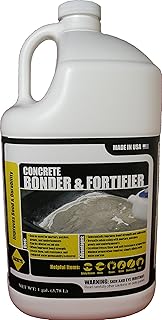
- Acrylic liquid, high solids, for use as a paint-on bonder or as an admixture
- 1 gal bottle, BOM number 120036
- Coverage as a paint-on bonder of 125 to 200 sq ft per qt and 500 to 800 sq ft per gal
- As an admixture, mix 1 part bonder with 1 part water; as a slurry, mix 2 parts bonder with 1 part Portland cement
- Drying time of 2 to 4 hours at 70 degrees Fahrenheit; density of 8.9 lb per gal; VOC under 10 grams per liter
- Store between 40 and 80 degrees Fahrenheit
The SAKRETE bonder is the bonding share of the estimate, and it stays small on a smooth wall. A quart covers 125 to 200 square feet as a paint-on bonder, so a 160-square-foot wall takes one quart, and a gallon covers 500 to 800 square feet for a long wall. Brush it on undiluted as a paint-on coat and let it dry for 2 to 4 hours at 70 degrees Fahrenheit before the finish coat goes on, or mix it 1 to 1 with water as an admixture when the finish coat needs extra bond and flexibility. The bonder also serves as a slurry coat mixed 2 parts bonder to 1 part Portland cement for rough or patched spots. Keep the bottle stored between 40 and 80 degrees Fahrenheit, because heat thickens the liquid and cold can damage it.
Pros: A quart covers a whole short wall; serves as bonder, admixture, and slurry; low VOC; clear drying time stated.
Cons: Needs 2 to 4 hours of drying before the coat; a quart is more than a very short wall needs; storage temperature matters.
Marshalltown Aluminium Plasterer's Hawk M1D
- Aluminium plasterer's hawk, 13 x 13 in, 325 x 325 mm
- Heavy gauge, hard-rolled aluminium board with straight edges and rounded corners
- Flange of 95 mm, 3.75 in, with a threaded hub
- Detachable DuraSoft handle of 125 mm, 5 in, with a sponge rubber callus preventer
The M1D hawk is the carrying tool for the finish coat, and its 13 by 13 inch board holds enough mix for a steady run along a garden wall without constant trips to the bucket. The hard-rolled aluminium board stays flat and light, the rounded corners keep the board from digging into the coat, and the detachable DuraSoft handle with its sponge rubber callus preventer keeps the hand comfortable through a full day of carrying. The hawk serves for many walls after the first, so its share of any single wall is small, and a clean hawk lasts for years. Wipe the board clean between batches, because dried stucco on the board flakes into the fresh mix and leaves hard spots in the finish.
Pros: Large board carries a good load; light aluminium stays flat; comfortable handle for long sessions; serves many walls.
Cons: A 13-inch board is wide for tight corners; needs cleaning between batches; the handle must stay tight in its hub.
Refina Medium Sponge Float
- Medium grade sponge float for a light, open-cell texture
- Medium grade suits a lightweight backing coat and a standard render
- 20 mm natural rubber sponge bonded to an ABS plastic backing plate
- Dampen before use; work in circular or figure-of-eight passes
The Refina Medium Sponge Float shapes the final texture of the garden wall, and the medium grade is the right choice when the target finish is a standard sand texture rather than a smooth skim. The open-cell sponge holds water and releases it slowly, which keeps the face workable while the float moves in circular passes, and the ABS plate keeps the face flat so the texture stays even from one end of the wall to the other. Rinse the sponge often in clean water and wring it out well, because a sponge loaded with fines drags lines across the coat. The float serves for many walls, with only the sponge face wearing over time, so its share of the first wall is the whole outlay and its share of later walls is nearly nothing.
Pros: Even medium texture on finish coats; holds water without dripping when wrung out; flat plate keeps the face true; long service life.
Cons: Needs frequent rinsing; a dry, stiff sponge can tear a green coat; medium grade is wrong for a smooth trowel finish.
Common mistakes
The most common mistake in a finish coat estimate is measuring the wall wrong, usually by forgetting the waste share, so the order falls one bag short and the last stretch of wall waits for a second delivery that may differ in shade. A second mistake is choosing the finish by habit instead of by coverage, which can double the bag count on a long wall for no benefit. A third mistake is skipping the bonding agent on a smooth wall, on the theory that a smooth base needs no help, while a thin finish coat has too little body to grip a slick face without it. A fourth mistake is mixing the color into dry powder instead of into the water, which leaves streaks that no amount of floating removes. A fifth mistake is adding water to a stiffening batch, which weakens the coat and lightens the color in patches. A sixth mistake is working in hot sun, which shortens the floating window and leaves trowel lines that show in raking light. A seventh mistake is judging the color on the day of application, before the 28-day curing period has passed, because a finish coat darkens and settles as it hardens, and a wall judged too soon leads to a wrong color choice on the next wall.
FAQ
How many bags does a 160-square-foot garden wall need?
One bag of LaHabra Exterior Stucco Color Coat 16/20 Tint Base at float finish, or three bags of QUIKRETE Finish Coat Stucco No. 1201 or Tech-Mix Finish Coat Stucco at about 70 square feet per bag. Add about one tenth extra for waste, corners, and caps, and round up to whole bags.
Does the bonding agent add much to the total outlay?
Very little on a smooth wall. SAKRETE Concrete Bonder and Fortifier covers 125 to 200 square feet per quart as a paint-on bonder, so a 160-square-foot wall takes one quart, and a gallon covers 500 to 800 square feet. The bonding share stays small while the protection it gives the finish coat is large.
How long does a smooth garden wall take to finish coat?
About half a day for an experienced hand and a full day for a first attempt on a wall of 160 square feet, including mixing, application, floating, and cleanup. A wall of 320 square feet takes a full day for an experienced hand and two days for a first attempt, while corners, piers, and a wall cap each add time.
Is a color coat or a plain finish coat the lower outlay?
The color coat, on a wall of any length, because one 90-pound bag covers 135 to 180 square feet at float finish and carries its color inside the bag. A plain finish coat covers about 70 square feet per bag and needs a color bottle per bag for tinted work, so the material share runs higher. Choose the plain coat when the color is custom or the wall is short.
What drives the labor share up on a garden wall?
Area, corners, piers, caps, gate openings, poor access, and hot weather. A flat run of wall goes fast, while each corner and pier needs extra passes, and hot sun shortens the working time. Hiring the work out adds a labor share roughly equal to the material share on a short wall.
Can a smooth garden wall be finished in a single day?
Yes, when the wall is short, the base is sound, and the weather is cool and overcast. Dampen and bond the base in the morning, mix and lay the finish coat by midday, float the surface in the afternoon, and mist the wall through the first days of curing. A long wall or a hot day splits the work across two days.
Conclusion
The cost of a stucco finish coat on a smooth garden wall follows from three numbers: the wall area, the coverage per bag of the finish chosen, and the labor time the wall demands. A wall of 160 square feet takes one bag of LaHabra color coat or three bags of a plain finish coat, one quart of bonding agent, a color bottle per bag when the plain coats are tinted, and tools that serve for many walls after the first. The material share stays small on a short wall and grows in direct proportion to area on a long wall, while the labor share runs about half a day for an experienced hand and a full day for a first attempt. Measure the wall, choose the finish by coverage rather than by habit, add the waste share, and order whole bags before starting, and the estimate will hold from the first trowel load to the last floating pass.
Related guides
More from Amazon
Programs that pair well with the guide above. Offers and eligibility are set by Amazon and may change.
Free shipping on eligible items, Prime Video and more. Eligible new members can start with a free trial.
Start a Prime free trialAudiobooks and podcasts to listen to on the go. Eligible new members can start with a free trial.
Try Audible freeAd-free music streaming. Eligible new subscribers can start with a free trial.
Try Music Unlimited freeA free business account with business pricing and bulk-buying tools for work, shop or home office.
Create a business accountAs an Amazon Associate we earn from qualifying purchases.
More ways to save on your next finish
Programs that pair well with the guide above. Offers and eligibility are set by Amazon and may change.
A free business account with business pricing and bulk-buying tools for work, shop or home office.
Create a business accountFast, free shipping on eligible items, plus Prime Video and more. Eligible new members can start with a free trial.
Start a Prime free trialRead from a huge library of eBooks, including how-to guides and cookbooks. Eligible new members can start with a free trial.
Try Kindle UnlimitedAudiobooks and podcasts for the commute, the garage or the kitchen. Eligible new members can start with a free trial.
Try Audible freeAs an Amazon Associate we earn from qualifying purchases. Using these links costs you nothing extra.










Write Your Review
No reviews yet. Be the first to share your experience!