
Key takeaways
- Estimate the labor for a small living room Venetian plaster accent wall by wall size, coat count, drying time, and the prep work the surface demands in full.
As an Amazon Associate I earn from qualifying purchases. This post may contain affiliate links at no extra cost to you.
A small living room accent wall looks like a one-day job until the estimate is written down, and then the drying times start adding up. Venetian plaster is not a paint job: it is two or three coats, each with its own drying window, plus prep, plus a sealer, and the wall cannot be rushed through any of those stages. This guide to how to estimate labor when you apply Venetian plaster on a small living room accent wall breaks the work into the pieces that actually take time, so the estimate reflects the real job instead of the wishful one.
The honest way to estimate is to count the work in order: measure the wall, read the surface, count the coats, add the drying windows, and then add the finishing steps. Each piece has a time attached to it, and the pieces do not overlap the way they do in a paint job, because a plaster coat cannot be laid over a wet coat. A small accent wall, roughly one wall of a living room, still needs the same sequence as a whole room, just on a smaller area, and the drying times do not shrink with the wall.
The products in this guide give the estimate its numbers. Coverage figures tell how much plaster the wall needs, drying times tell how the days stack up, and the wax and compound figures tell how much time the prep and the finish add. None of the figures here are money figures: the estimate is about labour time, drying time, and material quantity, which are the inputs any honest comparison needs before money enters the picture.
Tools and materials
The five products below are the working set for the estimate: three plasters that span the satin, high-gloss, and multi-colour routes, plus the patching compound and the wax that bookend the job. The table lines them up by coverage and drying time, which are the two numbers the estimate runs on.
San Marco Marmorino Classico
- Lime and marble dust plaster, Series 947, zero VOC, ready to use
- Two coats; 1 kg covers 3 to 4 sq ft, 5 kg covers 15 to 20 sq ft, 20 kg covers 60 to 80 sq ft
- Touch dry in 2 to 3 hours; ready for the next coat after 12 hours
This is the baseline plaster for the labor estimate, because its two-coat build and 12-hour recoat window set the rhythm of the job. Marmorino Classico is the San Marco lime plaster that many plasterers reach for first, because it is forgiving on the trowel and the tool marks tend to disappear as the coat is worked. The maker describes it as an authentic Italian lime and marble dust plaster with a satin polished finish, zero VOC, and ready to use with no mixing. The data sheet lists two coats, applied with a plastic trowel, a stainless steel trowel, or a sponge trowel, and the surface can take a polished marble-like route or a coloured roughcast route with a sponge trowel. Coverage runs 3 to 4 square feet per kilogram in two coats, so a 5 kg pail covers 15 to 20 square feet and a 20 kg pail covers 60 to 80. At 25 degrees Celsius and 65 percent relative humidity the coat is touch dry in 2 to 3 hours and ready for the next coat after 12 hours. It suits new and old hydraulic-binder plasters, old mineral paints that are dry and cohesive, and absorbent mineral surfaces.
Meoded Renaissance Marbleized
- Acrylic Venetian plaster for high-gloss marble effects
- Quart covers 26 to 36 sq ft, gallon covers 130 to 180 sq ft in two coats
- Sold in quart, gallon, and 4-gallon sizes; tinted to Meoded colours
This high-gloss plaster changes the labor math, because the layered marble effect needs more passes and more drying time than a flat finish. Meoded Renaissance Marbleized is a premium acrylic Venetian plaster made to create a high-gloss marbleized finish through layered applications. The maker lists it as an acrylic-based plaster for marble effects, dramatic veining, soft stone movement, and custom multi-colour finishes, with sizes in quart, gallon, and 4-gallon buckets. Coverage runs 26 to 36 square feet per quart and 130 to 180 square feet per gallon in a two-coat application, with a 20 kg bucket covering 520 to 720 square feet, and the maker notes that coverage moves with surface porosity and texture. The surface should be smooth, clean, and dust-free, and the maker recommends a Level 5 wall. Where a job needs a mirror-like marble read instead of a soft matte plaster, this is the product in the Meoded range that is built for it.
Faux Effects Venetian Gem
- Acrylic and marble dust plaster for multi-sheen decorative finishes
- Covers up to 200 sq ft per gallon; sold in gallon sizes
- Tinted with FauxCreme Color; topcoat with UV AquaThane in harsh sun
This is the multi-colour option in the estimate, and its layered application adds a full round of trowel work that a single-colour job does not need. Faux Effects Venetian Gem is an acrylic and marble dust plaster built for multi-sheen, multi-coloured decorative finishes. The maker lists it as an easy-to-trowel material with durable wear, high hiding power, and chemical resistance, and it can be burnished to bring out deep colour and soft sheens. It is tinted with FauxCreme Color and comes in old world colours, jewel tones, and a tinting base, in gallon sizes, covering up to 200 square feet per gallon. The maker lists it for interior and exterior use, with a UV AquaThane topcoat in extreme weather and sun. The related Venetian Gem Bellissimo is a lighter, creamier tint base for smoother marble-like surfaces, covering about 100 to 200 square feet per gallon, which shows how the Gem line scales from textured work to fine polished work.
USG Sheetrock All Purpose Joint Compound
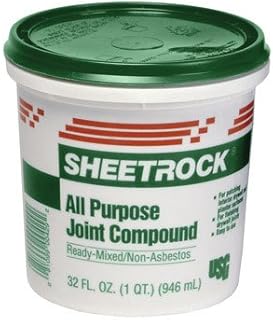
- Air-drying ready-mixed compound for taping, topping, and finishing
- Drying time up to 24 hours before recoating or sanding
- 4.5-gallon pail covers 450 sq ft; complies with ASTM C475
This is the prep material in the estimate, and its 24-hour drying time is often the longest single wait in the whole job. USG Sheetrock All Purpose Joint Compound is the original conventional-weight, ready-mixed compound for all phases of drywall finishing, and it is the right filler for the prep stage of a Venetian plaster job. The maker lists it as suitable for taping, topping, and finishing coats on plasterboard joints, angles, and fastener heads, and it complies with ASTM C475. It is an air-drying compound, so it must be allowed to dry thoroughly, up to 24 hours depending on temperature and humidity, before recoating or sanding. The 4.5-gallon pail covers 450 square feet, the 3.5-quart pail covers 88 square feet, and the 1.75-pint pail covers 22 square feet, so small patch work does not need a full pail. The compound should not be applied below 10 degrees Celsius, and an opened pail should be used within 48 hours. Its long open time and easy sanding are what make it the standard choice for flattening a wall before plaster.
Novacolor Cera Wax
- Polyethylene wax in water dispersion for mineral finishes
- Touch dry in 30 minutes; recoatable after 4 hours; fully dry after 12 hours
- Yield of 7 to 20 square metres per litre per layer; shades Gold, Silver, Bronze, Plus
This wax is the final step in the estimate, and its two-coat option adds a half day that many first estimates forget. Novacolor Cera Wax is a decorative interior wax in an aqueous dispersion, made from polyethylene and paraffinic waxes in emulsion, for treating mineral decorative finishes indoors. The maker lists it in three pearlescent shades, Gold, Silver, and Bronze, plus a neutral Plus version, and it gives surfaces light water repellency while lifting the visual finish of the plaster below. The data sheet lists a bulk density of 1.00 grams per millilitre for the metallic shades and 0.93 for the Plus version, a thixotropic paste form, and drying of 30 minutes to touch, 4 hours to recoat, and 12 hours to fully dry at 25 degrees Celsius and 65 percent relative humidity. Yield runs 7 to 20 square metres per litre per layer, depending on the substrate and its absorption. It goes on with a microfibre cloth or glove in circular movements, or with a sponge pad, and a second coat of Cera Wax Plus can follow after at least 2 hours for greater protection.
The table below compares the three plasters by coverage and drying time, and the compound and wax by their own drying windows. Read the drying column as a calendar: every hour listed is an hour the wall cannot be worked, and the estimate has to carry those hours.
| Item | Key spec | Best for |
|---|---|---|
| San Marco Marmorino Classico | Lime plaster, 2 coats, 1 kg covers 3-4 sq ft | Forgiving satin finish, historic look |
| Meoded Renaissance Marbleized | Acrylic plaster, high gloss, 130-180 sq ft per gallon | Dramatic marble veining |
| Faux Effects Venetian Gem | Acrylic marble dust plaster, up to 200 sq ft per gallon | Layered multi-color effects |
| USG Sheetrock All Purpose | Ready-mixed compound, dries in up to 24 hours | Patching and smoothing drywall |
| Novacolor Cera Wax | Polyethylene wax, 7-20 sq m per litre | Light water repellency and sheen |
Step by step
Step 1: Measure the wall and count the coats
Measure the accent wall in feet, height by width, and write the area down before anything else. A small living room accent wall is often about 10 to 12 feet wide and 8 to 9 feet high, which gives an area of roughly 80 to 110 square feet, but measure the real wall, because a fireplace, a doorway, or a built-in shelf changes the number. Count the coats next: a satin lime plaster needs two coats, a high-gloss marble plaster needs two coats plus layering passes, and a multi-colour plaster needs a base coat plus colour layers. Multiply the wall area by the coat count to get the total coated area, then check the coverage figure on the plaster: a 5 kg pail of the lime plaster covers 15 to 20 square feet in two coats, so a 100 square foot wall needs several pails, and the estimate has to carry that quantity.
Step 2: Read the surface and price the prep time
Read the wall the way the plaster will see it. Note every crack, hole, and rough patch, and note whether the wall is drywall, old plaster, or painted. Each repair takes time: a crack is opened, filled with joint compound, left to dry up to 24 hours, sanded, and wiped, and a wall with many repairs can add a full day before any primer goes on. Count the outlets, trim, and edges that need taping, and count the furniture that has to move and be covered. A living room has more furniture than a bedroom, and moving it, covering it, and putting it back is real labour that belongs in the estimate. If the wall needs a primer coat, add the primer drying time as well, because the plaster cannot start until the primer is dry.
Step 3: Lay out the coat schedule day by day
Turn the coat count and the drying times into a day-by-day schedule. Day one is prep and primer: repairs, sanding, taping, and the primer coat, with the primer drying overnight where the maker lists a long window. Day two is the first plaster coat, laid thin and even, and then the wait for the recoat window, 12 hours for the lime plaster in this guide. Day three is the second coat and the burnish, and then the drying time before the sealer, which can run 8 to 24 hours depending on the finish. If the job uses a wax sealer, add the wax day: the wax is touch dry in 30 minutes and recoatable after 4 hours, but a second coat needs its own window. Write the schedule down and check it against the room: the living room cannot be used normally while coats dry, and that matters to the household.
Step 4: Add the finishing and clean-up time
Add the finishing steps that estimates often forget. Sanding between coats, wiping dust, burnishing the final coat, and laying the wax or topcoat each take time, and each one needs the wall to be dry first. Clean-up takes time too: trowels must be washed before the plaster hardens on the blade, drop cloths must be folded and stored, tape must come off while the finish is still fresh enough to release cleanly, and the furniture must go back. A small wall still needs a full clean-up, and the clean-up is part of the labour, not an afterthought. Add an hour for clean-up and an hour for the final inspection with a low-angle light, because the inspection is where the last ridges and thin spots are found and fixed. Wash the trowels before the plaster hardens on the blades, fold the drop cloths so the plaster dust stays inside the fold, and pull the tape while the finish is still fresh enough to release cleanly. Move the furniture back only after the sealer is dry, and check the wall once more after the furniture is in place, because a sofa against the wall can hide a flaw that the room light would have shown.
Step 5: Check the estimate against the real wall
Before the estimate is final, walk the wall with the schedule in hand and check every assumption. Re-measure the area, re-count the repairs, and re-check the coverage figures against the plaster chosen. If the wall is rougher than first thought, add a prep day. If the finish is a high-gloss marble effect, add a layering pass and its drying time. If the room must be usable by a certain day, work backwards from that day and see whether the schedule fits; if it does not fit, the finish choice or the start date has to change, not the drying times. An estimate that survives this walk-through is an estimate that will hold when the work starts.
Common mistakes
Counting only the trowel time
The trowel time is the smallest part of a plaster job. Prep, drying, sanding, burnishing, sealing, and clean-up take more hours than the trowel does, and an estimate that counts only the trowel will run short by days. Count every stage, including the waits, and the estimate will hold.
Forgetting the drying windows between coats
A coat that needs 12 hours before the next coat cannot be rushed, and a schedule that pretends otherwise will fail on day two. Write the drying times into the schedule as blocks, not as notes, and treat them as fixed. The plaster sets the pace, not the calendar.
Underestimating the prep on an old wall
An old living room wall hides cracks, patches, and old paint that only shows up when the light rakes across it. Budget a full prep day for an old wall, and add a second day if the tape test shows the old finish letting go. Prep found late is prep paid for twice.
Leaving the sealer out of the estimate
The wax or topcoat is not optional on a living room accent wall, where hands, dust, and light touch the surface every day. A wax coat takes a few hours and needs its own drying window, and leaving it out of the estimate means the job ends unfinished. Put the sealer in the schedule from the start.
Estimating from a photo instead of the wall
A photo hides the cracks, the patches, and the rough spots that decide the prep time. Always estimate from the real wall, with a hand on the surface and a light raked across it. A photo estimate is a guess, and the wall will charge for the difference.
FAQ
How many days does a small Venetian plaster accent wall take?
A small accent wall usually takes three to four days from prep to finish, depending on the plaster and the wall condition. Day one is prep and primer, day two is the first coat, day three is the second coat and burnish, and the sealer adds part of another day. A wall that needs heavy repair or a high-gloss layered finish can take longer, because each extra coat and each extra repair adds its own drying window.
What slows a Venetian plaster job down the most?
Drying time slows the job more than anything else. A lime plaster that needs 12 hours between coats sets the pace of the whole schedule, and a patching compound that needs up to 24 hours can add a full day before the plaster even starts. Cool air and high humidity stretch every drying time, so the season and the room matter as much as the wall size.
Does a bigger wall take much longer than a small accent wall?
A bigger wall takes longer to trowel, but the drying times stay the same, so the job grows in hours, not in days. The prep grows too, because a bigger wall has more cracks and more edges to tape. The schedule shape stays the same: prep, primer, coats with waits, burnish, sealer, clean-up.
How much plaster does a small accent wall need?
Work from the coverage figure on the plaster and the wall area. A 5 kg pail of the lime plaster in this guide covers 15 to 20 square feet in two coats, so a 100 square foot wall needs several pails, and a gallon of the acrylic marble plaster covers 130 to 180 square feet in two coats. Always buy a little extra for samples and waste, and keep the extra sealed for touch-ups.
Can the living room be used while the plaster dries?
The room can be used lightly while coats dry, but the wall should not be touched, and furniture should stay off the wall until the finish is fully dry and sealed. Dust is the enemy of a wet coat, so keep the room closed and calm while the plaster sets. Plan the household around the schedule, not the other way around.
What if the wall needs a third coat?
A third coat is sometimes needed when the first two coats dry patchy or the colour reads uneven under the room light. A third coat adds a full recoat window to the schedule, plus its own drying time before the sealer, so it can add a day to the job. Lay the third coat thinner than the second, with the same trowel and the same angles, and burnish it the same way. Budget for a possible third coat in the estimate, so the schedule holds even if the wall asks for one more pass.
Conclusion
Estimating labour for a small Venetian plaster accent wall is a matter of counting the whole job, not just the trowel time. Measure the wall, read the surface, count the coats, lay out the drying windows day by day, and add the finishing and clean-up time that estimates so often forget. The coverage and drying figures in this guide give the estimate its shape: a satin lime plaster runs on a 12-hour recoat window, a patching compound can add a full day, and a wax sealer adds its own half day. Keep a small reserve in the estimate for a possible third coat, because a wall that dries patchy will ask for one more pass, and a schedule with no reserve will break on that day. Write the schedule down, walk the wall with it in hand, and the estimate will hold when the work starts.
Related guides
More from Amazon
Programs that pair well with the guide above. Offers and eligibility are set by Amazon and may change.
Free shipping on eligible items, Prime Video and more. Eligible new members can start with a free trial.
Start a Prime free trialAudiobooks and podcasts to listen to on the go. Eligible new members can start with a free trial.
Try Audible freeAd-free music streaming. Eligible new subscribers can start with a free trial.
Try Music Unlimited freeA free business account with business pricing and bulk-buying tools for work, shop or home office.
Create a business accountAs an Amazon Associate we earn from qualifying purchases.
More ways to save on your next finish
Programs that pair well with the guide above. Offers and eligibility are set by Amazon and may change.
A free business account with business pricing and bulk-buying tools for work, shop or home office.
Create a business accountFast, free shipping on eligible items, plus Prime Video and more. Eligible new members can start with a free trial.
Start a Prime free trialRead from a huge library of eBooks, including how-to guides and cookbooks. Eligible new members can start with a free trial.
Try Kindle UnlimitedAudiobooks and podcasts for the commute, the garage or the kitchen. Eligible new members can start with a free trial.
Try Audible freeAs an Amazon Associate we earn from qualifying purchases. Using these links costs you nothing extra.










Write Your Review
No reviews yet. Be the first to share your experience!