
Key takeaways
- Color stucco repair mortar for a gray masonry garden wall with stucco color packs, dry pigment and charcoal oxide pigment. Learn dose rates and sample panels.
As an Amazon Associate I earn from qualifying purchases. This post may contain affiliate links at no extra cost to you.
Gray is the hardest stucco color to match, and the reason is simple: gray is what cement looks like when nothing is added, so a gray patch has nowhere to hide. A pale sand patch can miss by a little and still read as sand. A gray patch that misses by a little reads as a different wall. Learning how to color stucco repair mortar for a gray masonry garden wall means learning to control a tone that lives in the narrow space between the gray of the cement and the charcoal of the pigment, and to keep that tone even across the whole patch.
A gray garden wall also varies more than it seems. The base color of the cement, the color of the sand, the amount of water in the mix, and the way the surface was finished all shift the final tone. Two bags of the same mortar mixed with different amounts of water will dry to different grays. The work therefore rewards fixed numbers: the same cement, the same sand, the same water, the same pigment weight, and the same finish. A sample panel mixed at those numbers and dried fully is the only honest way to judge the match.
This guide covers the whole job for a repair on a gray masonry garden wall: reading the existing tone, choosing between stucco color packs, dry integral pigment, and charcoal oxide, working out a weighed dose, mixing a sample panel, applying the colored mortar, and finishing the surface so the texture and the tone both blend. The products below are real materials with published data sheets, and the dose rates come from those sheets.
Quick answer
Color stucco repair mortar for a gray masonry garden wall by adding a gray colorant at a weighed dose, then checking the result on a fully dried sample panel. For a single repair, a SAKRETE Stucco Color Pack in Spalding Gray is the simplest route: one 14 oz pack colors one 80 lb bag of stucco finish. For a closer match, blend Davis Colors Silversmoke at a dry dose inside the 0.5 to 7 lb per 94 lb sack range, or add SAKRETE Cement Color in Charcoal at 1 lb per 80 lb bag. Keep the water fixed from batch to batch, because extra water lightens gray more than any other tone. Always mix a sample panel first and let it dry for at least 24 hours.
| Item | What it does | When to use it |
|---|---|---|
| SAKRETE Stucco Color Pack Spalding Gray | Powdered color pack for stucco finishes | Single repair with a ready dose |
| Davis Colors Silversmoke | Dry integral pigment dosed per sack | Larger repair needing a repeatable dose |
| SAKRETE Cement Color Charcoal | Dry oxide powder for gray and charcoal | Deepening a gray that reads too light |
| SAKRETE Stucco Finish Coat | Finish coat that carries the color | The final coat over the patch |
| Marshalltown PermaShape PB7GSD | Finishing trowel with a broken-in shape | Laying the finish coat flat and true |
| Refina Medium Sponge Float | Evens the surface and blends the edge | Final float pass on the finish coat |
Step by step
1. Read the existing gray in daylight
Look at the wall at midday and again in late afternoon. Gray shifts with the light more than a warm tone does: a wall that looks pale silver at noon can look dark slate at dusk, and a patch matched under one light will drift under the other. Note the lightest and the darkest areas, and note where the wall has weathered. Old gray stucco often darkens where it stays damp and lightens where the sun hits it, so pick a middle tone as the target rather than the lightest or the darkest patch. Clean the repair area with a stiff brush and water so dust and loose grains do not change the color of the new mortar.
2. Decide the coloring route
Three routes cover a gray repair. A stucco color pack is a pre-measured powder that goes into one bag of finish coat, which suits a single repair. A dry integral pigment is weighed per sack of cement, which suits a larger job where the same dose must repeat across batches. A charcoal oxide powder deepens a gray that reads too light. For most gray garden wall repairs, the color pack is the least fiddly route, and the dry pigment is the route to pick when the wall tone sits between two standard pack colors. Pick one route and stay with it for the whole repair.
3. Weigh the dose and record it
Weighing is what makes gray repeatable. For a SAKRETE Stucco Color Pack, the maker lists one 14 oz pack per 80 lb bag of stucco finish, mixed for at least 20 minutes after the last bag is added. For Davis Colors, the mixing guide lists dry dose rates of 0.5 to 7 lb per 94 lb sack of cement, never exceeding 10 percent of cement content by weight. For SAKRETE Cement Color, the maker lists 1 lb per 80 lb or 60 lb bag of mix. Write every number on a card: the product, the dose, the water, and the bag size. Without the card, a second batch is a guess, and gray shows a guessed dose more than any other tone.
4. Mix a sample panel and dry it fully
Mix a small batch at the recorded dose and apply it to a sample panel of the same material as the wall, at the same thickness as the repair. Finish the panel with the same trowel and the same float pressure planned for the wall, then leave it to dry for at least 24 hours. Wet mortar looks darker than dry mortar, and gray shifts more than most tones as it dries, so a panel judged wet will mislead. Compare the dry panel against the wall in daylight, holding it flat against the surface and stepping back several paces. If the panel is too dark, reduce the dose by a quarter and mix a fresh panel. If it is too light, add colorant in small weighed steps.
5. Prepare the repair area
Cut the damaged stucco back to sound material, leaving at least an inch of solid coat around the damage. Square edges give a cleaner blend than ragged edges because the new mortar meets the old along a straight line. Dampen the exposed base and the edges of the old stucco so the new mortar does not lose water to the dry substrate. A dry edge pulls water out of the fresh mix, and the patch then dries lighter at the margin than in the middle. Keep the repair shaded from direct sun while the mortar is placed.
6. Mix the repair batch at the recorded dose
Mix the repair batch exactly as the sample panel was mixed: same water, same pigment weight, same mixing time, same bag size. For a color pack, mix the finish coat to a thin consistency first, add all the packs for the batch, and mix until the color is evenly dispersed, about 1 to 2 minutes, then add the remaining stucco base and mix for at least 20 minutes after the last bag. For a dry pigment, blend the pigment into the dry powder until the color looks uniform, then add water. Keep the water amount fixed from batch to batch, because extra water lightens gray and weakens the mortar at the same time.
7. Apply the mortar and finish the surface
Apply the colored mortar in the same thickness as the surrounding finish, usually about 1/8 in for a finish coat, and work it tight against the edges of the repair. Let the surface stiffen until a thumb pressed lightly leaves only a faint mark, then finish it with the trowel and the sponge float using the same pressure as on the sample panel. The float changes the apparent color: a hard float burnishes the surface and darkens it, while a soft float leaves a lighter, more open surface. Blend the edge of the patch into the old stucco with light, overlapping strokes rather than a hard line.
8. Cure the patch and check the match
Keep the patch damp for the first day and shield it from sun and wind so it dries slowly and evenly. Fast drying lightens the surface and can leave a pale halo around the repair. After 24 hours, compare the patch with the wall in daylight from several paces away. A good match disappears at arm's length and reads as a slight variation only on close inspection. If the patch still reads darker than the wall after full drying, the honest fix is a fresh sample panel at a corrected dose, not a heavier coat over the top.
Tools and materials
SAKRETE Stucco Color Pack Spalding Gray
- Powdered color pack, 14 oz per pack
- Nine colors including Spalding Gray, Morning Fog, Muslin, and Universal Khaki
- One pack per 80 lb bag of stucco finish coat
- Mix at least 20 minutes after the last bag is added
SAKRETE Stucco Color Pack is the simplest colorant for a gray garden wall repair because the dose is built into the pack. The maker lists nine powdered colors for use with SAKRETE Stucco Finish Coats, and Spalding Gray sits in the middle of the gray range. The pack is added to the mixed finish coat and dispersed for 1 to 2 minutes before the remaining stucco base goes in, and the whole batch is mixed for at least 20 minutes after the last bag. The maker notes that the same color reads differently in different base products, so the sample panel must use the same finish coat as the repair.
Pros: Ready dose with no weighing; nine gray-friendly colors; even dispersion.
Cons: Fixed pack size limits fine tuning; color varies with the base product.
Davis Colors Silversmoke
- Dry integral pigment for concrete, stucco, and other cement mixes
- Dry dose rates 0.5 to 7 lb per 94 lb sack of cement
- Never exceed 10 percent of cement content by weight
- Conforms to ASTM C 979; supplied in Mix-Ready disintegrating bags
Davis Colors Silversmoke is a dry pigment dosed by weight, which makes it the repeatable choice when a repair spans several batches. The mixing guide lists dry dose rates from 0.5 to 7 lb per 94 lb sack of cement and states that the dose should never exceed 10 percent of cement content, with cement content counting Portland cement, fly ash, silica fume, and lime but not aggregate or sand. The maker lists the pigment as lightfast, alkali resistant, and weather resistant, and the Mix-Ready bags are tossed into the mixer without opening, which keeps the dose exact and the dust down.
Pros: Repeatable weighed dose; large color range; bagged dose stays exact.
Cons: Needs a scale and careful recording; small jobs waste most of a bag.
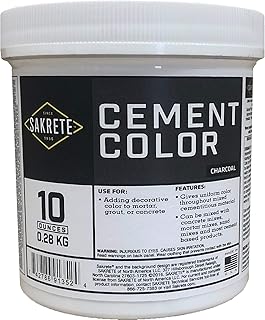
SAKRETE Cement Color Charcoal
- Synthetic mineral oxide powder; alkali and ultraviolet resistant
- 1 lb per 80 lb or 60 lb bag of SAKRETE Concrete, Sand, or Mortar Mix
- Up to 7 lb per 94 lb bag of Portland cement for custom field mixes
- Colors: Charcoal, Brown, Buff, Red, Terra Cotta; 1 lb and 5 lb packs
SAKRETE Cement Color in Charcoal deepens a gray that reads too light. The maker lists 1 lb per 80 lb or 60 lb bag of mix, and notes that the same pound gives a darker color in a 60 lb bag than in an 80 lb bag, so the bag size belongs on the dose card. The powder is a synthetic mineral oxide, and the maker lists it as durable and resistant to alkali and ultraviolet light, which matters on a sun-struck garden wall. Blend the powder with the dry mix before water is added, and keep the load low: a little charcoal goes a long way in gray.
Pros: Deepens gray cleanly; durable mineral oxide; cheap per batch.
Cons: Easy to overshoot; needs blending into dry powder.
SAKRETE Stucco Finish Coat
- 80 lb bag; about 2 gal water per bag
- Coverage about 70 sq ft at 1/8 in by trowel, about 60 sq ft by spray
- Compressive strength 875 psi at 14 days, 1100 psi at 28 days
- Gray or white base; conforms to ASTM C926; apply at 40 to 90 F
SAKRETE Stucco Finish Coat is the finish coat that carries the color in a gray repair. The maker lists coverage of about 70 sq ft at 1/8 in by trowel per 80 lb bag and compressive strength of 875 psi at 14 days and 1100 psi at 28 days, which lets the amount of mortar be worked out from the repair area before mixing. The coat comes in a gray or a white base, and the base color shifts the final tone, so the sample panel must use the same base as the repair. Apply it at the same thickness as the surrounding finish.
Pros: Standard finish coat; published coverage and strength; gray or white base.
Cons: Base color shifts the final tone; needs the same base on panel and wall.
Marshalltown PermaShape PB7GSD
- 12 x 5 in golden stainless steel blade with a broken-in shape
- DuraSoft handle; Xtralite aluminum mounting; weight 0.9 lb
The Marshalltown PermaShape PB7GSD is the trowel for laying the colored finish coat flat and true. The blade carries a broken-in shape that spreads mortar evenly without digging lines into the fresh coat, and the golden stainless steel will not rust or stain the mortar, which matters when the color is a pale gray and a rust mark would show. The DuraSoft handle gives a comfortable grip for the long, even strokes that blend a patch edge. Use the same trowel and the same pressure on the sample panel and on the wall, because the trowel finish changes how the color reads.
Pros: Broken-in shape lays a flat coat; stainless blade will not stain.
Cons: Premium trowel costs more than a plain steel blade.
Refina Medium Sponge Float
- 11 x 5.5 in head, 20 mm natural rubber sponge, medium grain
- ABS plastic easy-grip handle; opens the surface and removes trowel marks
- Dampen before use; rinse often to avoid dragging grit
The Refina Medium Sponge Float is the tool that decides how the color reads on the finished surface. A damp medium sponge evens the sand across the face of the mortar and removes trowel marks, which keeps the tone uniform instead of patchy. The same float, the same dampness, and the same pressure must be used on the sample panel and on the wall, because a harder pass burnishes the surface and darkens it. Rinse the sponge often; a gritty sponge scores the surface and leaves light streaks that no amount of color can hide.
Pros: Evens tone and texture; medium grain suits a sand finish.
Cons: Worn sponge leaves streaks; too much water lightens the surface.
Common mistakes
Changing the water amount between batches
Extra water lightens gray more than any other tone and weakens the mortar at the same time. Measure the water for every batch and keep it fixed. If the mix feels stiff, the answer is longer mixing or a wetter substrate, not more water in the batch.
Estimating the pigment dose by eye
A small change in pigment weight changes gray enough to see on a garden wall. Weigh the pigment and the cement, write the numbers down, and use the same numbers for the repair batch. Guessed doses cannot be repeated, so a second batch will never match the first.
Judging color while the mortar is wet
Wet mortar always looks darker than the same mortar after drying, and gray shifts more than most tones as it dries. A patch judged wet will be mixed too light, and the error only shows up the next day. Mix a sample panel, let it dry for a full day, and compare it dry.
Mixing the color pack into a different base
The same color pack reads differently in a gray base than in a white base, and differently again in a different brand of finish coat. Use the same finish coat for the sample panel and the repair, and record the base on the dose card.
Floating the patch harder than the sample panel
The float changes the apparent color. A hard pass burnishes the surface and darkens it; a soft pass leaves it lighter. Use the same float, the same dampness, and the same pressure on the panel and on the wall, and blend the edge with light strokes.
FAQ
How much colorant does a gray repair need?
A light dose is usually right. For a color pack, one 14 oz pack of SAKRETE Stucco Color goes into one 80 lb bag of finish coat. For dry pigment, the Davis Colors range is 0.5 to 7 lb per 94 lb sack of cement, and gray sits near the low end. For charcoal oxide, 1 lb of SAKRETE Cement Color goes into one 80 lb bag. Weigh the dose and confirm it on a dried sample panel.
Why does the patch look darker than the wall when it is wet?
Wet cement is darker than dry cement because water fills the pores and changes how light scatters from the surface. As the water leaves, the surface lightens, and gray shifts more than a warm tone. Judge the match only after the sample panel has dried for at least 24 hours.
Can a gray patch be matched without a sample panel?
No. Gray has the narrowest tolerance of any stucco tone, and the base color of the cement, the sand, the water, and the finish all shift the result. A sample panel mixed at the recorded dose and dried fully is the only honest way to judge the match before the repair batch is mixed.
Will the gray tone fade in the sun?
Mineral oxide pigments are alkali resistant and hold their tone in sun. The maker lists SAKRETE Cement Color as ultraviolet resistant and Davis Colors as lightfast and weather resistant. Organic dyes, by contrast, fade fast and should not be used in exterior mortar.
How long should the sample panel dry before comparison?
At least 24 hours in normal conditions, and longer in cool or damp weather. The panel should feel dry to the touch and show no damp patches. Compare it in daylight, held flat against the wall, from several paces away.
Conclusion
Matching a gray masonry garden wall comes down to fixed numbers, a weighed dose, and a dried sample panel. A color pack suits a single repair, a dry integral pigment suits a larger job that needs repeatability, and a little charcoal oxide deepens a gray that reads too light. Read the wall in daylight, pick the route that fits the size of the repair, weigh the pigment, and keep the water fixed from batch to batch. Use the same finish coat base on the panel and the wall, float the patch with the same pressure as the panel, and let the patch dry slowly. A repair mixed this way fades into the wall instead of announcing itself, and the method works again on the next patch because the numbers are written down.
Related guides
More from Amazon
Programs that pair well with the guide above. Offers and eligibility are set by Amazon and may change.
Free shipping on eligible items, Prime Video and more. Eligible new members can start with a free trial.
Start a Prime free trialAudiobooks and podcasts to listen to on the go. Eligible new members can start with a free trial.
Try Audible freeAd-free music streaming. Eligible new subscribers can start with a free trial.
Try Music Unlimited freeA free business account with business pricing and bulk-buying tools for work, shop or home office.
Create a business accountAs an Amazon Associate we earn from qualifying purchases.
More ways to save on your next finish
Programs that pair well with the guide above. Offers and eligibility are set by Amazon and may change.
A free business account with business pricing and bulk-buying tools for work, shop or home office.
Create a business accountFast, free shipping on eligible items, plus Prime Video and more. Eligible new members can start with a free trial.
Start a Prime free trialRead from a huge library of eBooks, including how-to guides and cookbooks. Eligible new members can start with a free trial.
Try Kindle UnlimitedAudiobooks and podcasts for the commute, the garage or the kitchen. Eligible new members can start with a free trial.
Try Audible freeAs an Amazon Associate we earn from qualifying purchases. Using these links costs you nothing extra.










Write Your Review
No reviews yet. Be the first to share your experience!