
Key takeaways
- Rain streaks leave blotchy stucco color where water runs down the wall. This guide covers sealing the streak path, fog coating, and keeping water off repairs.
As an Amazon Associate I earn from qualifying purchases. This post may contain affiliate links at no extra cost to you.
A rain streak leaves a signature on a stucco wall: a pale vertical band where water has run down the face again and again, with darker blotches on either side where the finish stayed dry. The streak itself is not dirt. It is the finish coat losing pigment and binder to running water, year after year, while the wall beside it keeps its original color. How to fix blotchy exterior stucco color near an exterior rain streak starts with the water, not with the color, because any new color coat will streak the same way if the water keeps running down the same path.
Running water does two kinds of damage. It washes fine pigment out of the surface, which lightens the streak, and it keeps the wall damp longer than the dry areas, which darkens the edges of the streak while the wall is wet and leaves salt marks when it dries. The result is a blotch that looks worse after rain and never quite evens out in dry weather. The repair has to break that cycle: stop the water from running down the same line, seal the surface so it sheds water, and then even out the color with a fog coat and a breathable sealer.
This guide covers the full sequence: finding where the water comes from, cleaning the streak, sealing the surface, fog coating the blotch, and finishing with a water repellent that keeps the next rainstorm from undoing the work. Each step names the material, the timing, and the check that shows the step worked.
Quick answer
Find the source of the water first, then clean the streak and let the wall dry fully. Seal the streak path with a silane water repellent, fog coat the blotchy area in two light coats, and finish with a breathable sealer over the whole section. The color evens out only when the water stops running down the same line, so the drainage fix and the sealer matter as much as the fog coat.
| Item | What it does | When to use it |
|---|---|---|
| KEIM Silan-100 | Silane water repellent that lines the pores and sheds rain | Sealing the streak path before any color work |
| SikaWall Fog Coat | Cement-based color equalizer that evens out tone | First color step over the cleaned streak area |
| LaHabra Perma-Elastic Elastomeric Finish | Flexible acrylic finish that bridges hairline cracks | Recoating a streaked area that also has fine cracks |
| Marshalltown Molded Rubber Float MRF94 | Rubber float that brings sand to the surface and blends texture | Floating the finish coat over the streaked area |
| Romabio Mineral Shield | Invisible breathable sealer for masonry and stucco | Final protection over the repaired color |
| SAKRETE Stucco Finish Coat | Cement finish coat for a fresh color layer | Replacing a finish coat that has lost too much pigment |
Step by step
Step 1: Find where the water comes from
A rain streak always has a source, and the source is usually above the blotch. Look at the roof edge, the gutter, the drip edge, and any trim or sill above the streak. A clogged gutter, a missing drip edge, or a window sill that slopes back toward the wall will send water down the same line in every storm. Check the gutter for leaves and debris, and look for a gap where the gutter meets the fascia. Look at the wall in rain if possible, and watch where the water starts its run. Fix the drainage first: clear the gutter, reseat a loose downspout, and add or repair a drip edge so water falls clear of the wall. A fog coat over a streak with a live water source is wasted work, because the next storm streaks it again.
Step 2: Clean the streak
Brush the streak area with a stiff dry brush, working from the top down, to remove loose dirt, chalk, and salt. Wash the wall with clean water at low pressure, and let the water run down the same path the rain takes, so the cleaning follows the streak. Do not use a high-pressure washer on the streaked finish; the jet can cut the surface and open a bigger repair. White salt marks that stay after washing are efflorescence, and they should be brushed off dry and washed again. Let the wall dry for a full day in dry weather, and look at the streak again. A streak that fades a lot after cleaning was mostly surface dirt, and the color work will be light. A streak that stays pale after cleaning has lost pigment, and it needs a fog coat and a fresh finish layer.
Step 3: Let the wall dry to an even tone
A wall that is damp in places and dry in others reads blotchy even when the color is fine, so the wall must dry fully before the color is judged. Wait for two or three dry days, and look at the wall in the morning and in the afternoon. The streak area should reach the same tone as the wall beside it when both are dry, or stay only slightly paler. If the streak area stays dark after days of dry weather, the wall may be holding water behind the finish, and the cause is usually a failed seal or a crack that lets water in. Fix that first, and give the wall more drying time. Starting color work on a damp wall traps moisture under the fog coat, and the blotch comes back as the moisture works its way out.
Step 4: Seal the streak path with silane
A silane water repellent lines the pores of the stucco without sealing the surface shut, so rain beads and runs off while vapor still escapes from inside the wall. Apply KEIM Silan-100 over the streak path and a wide margin around it, using a brush or a low-pressure sprayer. The maker lists consumption of 0.17 to 0.2 liters per square meter for one coat, and about 0.3 liters per square meter for two coats, with a penetration class of at least 10 millimeters. Work from the top down, and keep the surface wet with the repellent for a few minutes so it soaks in rather than running off. The overcoat window runs from 4 hours to 1 day, so the fog coat can follow the next day. Do not apply the repellent in rain or when rain is expected within a day, and do not apply it to a wall that is still wet from cleaning.
Step 5: Mix and spray the first fog coat
Mix SikaWall Fog Coat at one 25 lb bag in 5 gallons of water, stirring with a paddle until the liquid is smooth and lump-free. Dampen the streak area lightly with the pump sprayer, then spray the first fog coat in slow, overlapping passes, holding the wand about 14 to 18 inches from the wall. Cover the streak and extend the spray well past its edges, feathering into the surrounding wall so no hard line shows. The first coat should look like a light haze. Let it dry for about an hour. The fog coat evens out the tone difference between the washed-out streak and the wall beside it, and the first coat also shows whether the streak needs a second pass or a full finish coat.
Step 6: Spray the second fog coat and mist cure
Mist the wall lightly, then spray the second fog coat the same way as the first. Two light coats dry evenly and even out color better than one heavy coat. After the second coat, mist the surface lightly about three times a day for the first 48 hours, keeping the wall above 40 degrees Fahrenheit. The misting slows the drying so the cement color sets evenly. Look at the wall in flat light and in raking light after the second coat has dried. Most streak blotches are gone at this point. If the streak still shows as a pale band, the finish coat has lost too much pigment, and the next step is a thin finish coat rather than a third fog coat.
Step 7: Apply a thin finish coat where the pigment is gone
When the streak stays pale after two fog coats, the original finish coat is worn out, and a thin new finish coat is the right repair. Mix SAKRETE Stucco Finish Coat at about 2 gallons of water per 80 lb bag, and apply it at about 1/8 inch thick with the molded rubber float, working the streak area first and feathering the edge into the old wall. The maker lists coverage of about 70 sq ft at 1/8 inch per bag, so a single bag covers a generous streak repair. Keep the coat thin and even; a thick coat dries unevenly and brings the blotch back. Let the finish coat dry slowly, misting lightly on a hot or windy day, and protect it from rain for 12 hours and from freezing for 48 hours.
Step 8: Finish with a breathable sealer over the whole section
Once the color is even and the finish coat has cured, protect the whole section with Romabio Mineral Shield. The maker lists 1 gallon covering 200 to 300 sq ft, with a dry time of 4 to 8 hours and 1 to 2 coats, applied by brush or garden pump sprayer with no dilution. The sealer is invisible and breathable, so it sheds rain without trapping vapor inside the wall. Apply it over the repaired area and the wall around it, so the whole section sheds water at the same rate. A sealed section dries evenly after rain, and the streak has no wet path to follow. Check the drainage above the wall one more time, and clear the gutter before the next storm season.
Tools and materials
KEIM Silan-100
- Solvent-free silane water repellent
- Consumption 0.17 to 0.2 liters per square meter, about 0.3 for two coats
- Water uptake value W24 of 0.06 kg per square meter per square root hour
- Penetration class II, at least 10 mm
- Overcoat window 4 hours to 1 day
- Density 0.9 to 1.0 g per cubic centimeter
KEIM Silan-100 is the sealer for the streak path. The maker lists it as a solvent-free silane that lines the pores of masonry and stucco, so rain beads on the surface while vapor still passes out of the wall. The consumption of 0.17 to 0.2 liters per square meter for one coat, and about 0.3 for two coats, makes it easy to dose a streak repair without waste. The penetration class of at least 10 millimeters means the repellent reaches deep enough to protect the finish coat, not just the surface skin. The overcoat window of 4 hours to 1 day gives a clear schedule for the fog coat that follows. Because the treatment is invisible, it does not change the color or the texture of the wall, which matters on a repair that is already fighting a color problem.
Pros: Deep penetration with an invisible finish; wall keeps breathing; clear dosing and overcoat window.
Cons: Needs a dry wall and dry weather; no effect on color by itself, so it must pair with a fog coat.
SikaWall Fog Coat
- 25 lb bag
- Mix 25 lb in 5 gal of water
- Coverage 800 to 1000 sq ft in two coats
- Cement-based color equalizer for existing stucco
- Two light coats recommended
SikaWall Fog Coat is the color step in this repair. The maker lists it as a cement-based coating that corrects color variation on stucco finishes while letting the texture show through. One 25 lb bag mixes in 5 gallons of water and covers 800 to 1000 sq ft in two coats, so a single bag is more than enough for a streak repair, with material left for a second pass. The fog coat bonds like cement rather than sitting on the surface like paint, so it will not peel, and it evens out the tone difference between the washed-out streak and the wall beside it. Two light coats, with misting between them, give the even drying that a single heavy coat cannot.
Pros: Evens out color without hiding texture; bonds like cement; one bag covers a large area.
Cons: Needs two light coats and mist curing; the streak must be sealed first or the blotch returns.
LaHabra Perma-Elastic Elastomeric Finish
- 100 percent acrylic elastomeric textured finish
- Bridges pre-existing hairline cracks
- Fine aggregate 1.0 mm, coverage 150 to 165 sq ft per pail
- Coarse aggregate 1.5 mm, coverage 120 to 135 sq ft per pail
- Apply at 40 degrees Fahrenheit or above
LaHabra Perma-Elastic Elastomeric Finish is the finish coat for a streaked area that also carries fine hairline cracks. The maker lists it as a 100 percent acrylic elastomeric finish that bridges pre-existing hairline cracks, which matters near a rain streak, because the same water that streaks the color often opens fine cracks along the wet path. The fine aggregate at 1.0 mm covers 150 to 165 sq ft per pail, and the coarse aggregate at 1.5 mm covers 120 to 135 sq ft per pail, so the coverage is easy to plan for a streak repair. The finish goes on at 40 degrees Fahrenheit or above, and the acrylic film flexes with the wall instead of cracking again. Use the fine aggregate on a smooth wall and the coarse aggregate where the old texture is heavier.
Pros: Bridges hairline cracks; flexible acrylic film; two aggregate grades for different textures.
Cons: Needs a sound, clean base; a thick coat can hide the old texture.
Marshalltown Molded Rubber Float MRF94
- 9 x 4 in face
- 5/8 in thick molded black rubber pad
- Aluminum backing plate
- Plastic handle
- Brings sand to the surface on concrete, stucco, and drywall
The Marshalltown Molded Rubber Float MRF94 is the floating tool for the finish coat in this repair. The 5/8-inch molded black rubber pad, bonded to an aluminum backing plate, is dense enough to push the finish coat into the surface and bring the sand forward, which restores the texture that a streak has worn smooth. The 9 x 4 inch face fits into the narrow band of a streak repair without covering too much good wall, and the plastic handle stays comfortable through a long floating session. On a thin finish coat, the rubber float blends the edge of the new coat into the old wall with short, firm strokes, and the pad rinses clean in a bucket of water.
Pros: Brings sand forward and restores texture; compact face suits narrow repairs; durable bonded pad.
Cons: Too much pressure can drag the finish coat thin; the rubber pad needs cleaning before it dries hard.
Romabio Mineral Shield
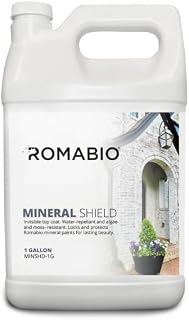
- 1 gal covers 200 to 300 sq ft
- Dry time 4 to 8 hours
- 1 to 2 coats
- Ready to use with no dilution
- Brush or garden pump sprayer application
- Invisible and breathable; algae and moss resistant
Romabio Mineral Shield is the final protection over the repaired color. The maker lists 1 gallon covering 200 to 300 sq ft, with a dry time of 4 to 8 hours and 1 to 2 coats, applied by brush or garden pump sprayer with no dilution. The sealer is invisible and breathable, so it sheds rain without trapping vapor, and the algae and moss resistance keeps the streak area from greening in damp weather. Because it goes on over the whole section rather than just the streak, the entire wall dries at the same rate after rain, which is what keeps a new streak from forming beside the old one. The ready-to-use formula needs no mixing, and the coverage makes it easy to plan a single gallon for a typical repair.
Pros: Invisible breathable protection; simple coverage and timing; keeps the whole section drying evenly.
Cons: Needs a dry, cured surface underneath; a second coat doubles the drying time.
SAKRETE Stucco Finish Coat
- 80 lb bag
- About 2 gal of water per bag
- Coverage about 70 sq ft at 1/8 in trowel, about 60 sq ft sprayed
- Compressive strength 875 psi at 14 days, 1100 psi at 28 days
- Apply at 40 to 90 degrees Fahrenheit
- Protect from rain 12 hours and from freezing 48 hours
SAKRETE Stucco Finish Coat is the replacement finish coat for a streak that has lost too much pigment for a fog coat to fix. The 80 lb bag mixes with about 2 gallons of water and covers about 70 sq ft at 1/8 inch by trowel, so a single bag handles a long streak repair. The maker lists compressive strength of 875 psi at 14 days and 1100 psi at 28 days, which gives a hard, durable surface that stands up to weather. The coat goes on at 40 to 90 degrees Fahrenheit, and it needs protection from rain for 12 hours and from freezing for 48 hours, which sets the weather window for the job. The finish comes in gray or white, and it takes liquid color in the mixing water when the old wall needs a matched tone.
Pros: Hard, durable finish with known strength; good coverage per bag; takes liquid color for matching.
Cons: Needs a dry weather window; a thick coat dries unevenly and must stay thin.
Common mistakes
Coating the streak before fixing the water source
A fog coat over a live rain streak is wasted work. The next storm runs water down the same line, washes the new color, and the blotch comes back. Clear the gutter, fix the drip edge, and watch the wall in rain before any color work starts.
Washing with a high-pressure jet
A high-pressure washer cuts into a stucco finish and opens a bigger repair than the streak. It also drives water into the wall, which lengthens the drying time before coating. Use a stiff brush and low-pressure water, and let the wall dry fully.
Spraying the fog coat on a wet wall
A wall that is still wet from washing or from rain holds the fog coat unevenly, and the color sets patchy. Wait for two or three dry days, and judge the tone only when the wall is dry in the morning and in the afternoon.
Using one heavy fog coat
One heavy coat dries at different rates across the wall and leaves its own blotch. Two light coats, with misting between them, dry evenly and even out the color. A heavy coat also runs and leaves drips down the streak.
Sealing only the streak
Sealing just the streak leaves the wall beside it absorbing water at a different rate, and the next rain draws a new line at the edge of the sealed area. Seal the whole section, and fog coat past the edges of the blotch, so the wall dries evenly.
FAQ
How do you find the source of a rain streak?
Look above the blotch at the roof edge, gutter, drip edge, and window sills. A clogged gutter, a missing drip edge, or a sill that slopes back toward the wall sends water down the same line. Watch the wall in rain and note where the water starts its run.
How long should the wall dry before fog coating a streak?
Wait for two or three dry days after cleaning, and check the tone in the morning and the afternoon. The streak area should reach nearly the same tone as the wall beside it when both are dry. If the streak stays dark, the wall may be holding water behind the finish.
Can a silane sealer change the color of the wall?
A silane water repellent is invisible and does not change the color or the texture. It lines the pores so rain beads and runs off, while vapor still escapes. The color work comes from the fog coat, not from the sealer.
Why does the streak look worse after rain?
Running water washes pigment out of the finish and keeps the wall damp longer, so the streak reads pale when dry and dark when wet, with salt marks left behind as it dries. The cycle repeats every storm until the water path is fixed and the surface is sealed.
How many fog coats does a rain streak need?
Two light coats handle most streaks. Spray the first coat as a light haze, let it dry for about an hour, mist the wall, and spray the second coat the same way. If the streak stays pale after two coats, the finish coat has lost too much pigment and needs a thin new finish coat.
Conclusion
A rain streak is a water problem wearing a color problem's clothes. The water runs down the same line, washes pigment out of the finish, and leaves a pale band with dark edges that never quite evens out. The repair works in the right order: fix the drainage above the wall, clean the streak, let the wall dry fully, seal the streak path with a silane repellent, and then even out the color with two light fog coats. A thin finish coat is there for the streaks that have lost too much pigment, and a breathable sealer over the whole section keeps the next storm from drawing a new line. With the water path fixed and the color evened out, the wall dries at one rate after rain, and the streak stays gone.
Related guides
More from Amazon
Programs that pair well with the guide above. Offers and eligibility are set by Amazon and may change.
Free shipping on eligible items, Prime Video and more. Eligible new members can start with a free trial.
Start a Prime free trialAudiobooks and podcasts to listen to on the go. Eligible new members can start with a free trial.
Try Audible freeAd-free music streaming. Eligible new subscribers can start with a free trial.
Try Music Unlimited freeA free business account with business pricing and bulk-buying tools for work, shop or home office.
Create a business accountAs an Amazon Associate we earn from qualifying purchases.
More ways to save on your next finish
Programs that pair well with the guide above. Offers and eligibility are set by Amazon and may change.
A free business account with business pricing and bulk-buying tools for work, shop or home office.
Create a business accountFast, free shipping on eligible items, plus Prime Video and more. Eligible new members can start with a free trial.
Start a Prime free trialRead from a huge library of eBooks, including how-to guides and cookbooks. Eligible new members can start with a free trial.
Try Kindle UnlimitedAudiobooks and podcasts for the commute, the garage or the kitchen. Eligible new members can start with a free trial.
Try Audible freeAs an Amazon Associate we earn from qualifying purchases. Using these links costs you nothing extra.










Write Your Review
No reviews yet. Be the first to share your experience!