
Key takeaways
- Seven sample board tool kits with panel holders, small trowels and sponge floats for learning marmorino texture combinations on small practice boards at home.
As an Amazon Associate I earn from qualifying purchases. This post may contain affiliate links at no extra cost to you.
Our top picks at a glance
4 products from this guide, in the order reviewed below.


As an Amazon Associate we earn from qualifying purchases. Prices and availability can change.
A sample board is where a marmorino finish is learned before it ever reaches a wall. The board is small, flat and forgiving: a coat that goes wrong can be sanded back or covered, a trowel angle that leaves a mark can be corrected on the next pass, and a texture combination that looks muddy can be reworked without touching a room. That freedom is the whole point of practising on boards, and it only works when the tools fit the scale of the board. A full-size finishing trowel is too long for a board the size of a sheet of paper, a heavy hawk tires the hand before the second coat, and a sponge float built for a render wall will flood a small panel with water. Choosing among the best plaster sample board tool kits with sample panel holders for learning marmorino texture combinations comes down to whether the kit gives a learner the right combination of a small trowel, a holder that keeps the panel steady and the material close, and a sponge or spatula for refining texture.
Marmorino is a lime and marble plaster that rewards thin coats and patient layering. The classic texture combinations come from the way successive coats are laid: a first coat pressed flat for body, a second coat skipped across the surface for movement, and a final pass with a clean trowel edge to compress and polish. Each of those steps asks for a different tool, and a learner who practises with only one trowel will never feel the difference between them. A kit that includes two or three blade sizes lets the learner compare a small trapezoid blade against a wider one on the same board, and a kit that includes a sponge float lets the learner open the surface before the final trowel pass. The holder matters just as much. A mortar board or hawk carries the mixed plaster within reach of the board, and a board with a rotating handle lets the learner turn the material toward the working hand instead of reaching across a wet panel.
This guide compares seven tool kits that fit learning marmorino texture combinations on sample boards. Each entry lists the specifications the maker or retailer actually publishes, notes where a figure is not listed, and explains which part of the learning process it serves. Nothing here is priced, and no claim is made about a kit the maker does not list for it. The kits were picked because their components match the work: small trowels for small panels, holders that keep plaster and panel within easy reach, sponge floats for texture, and a spatula set for broad, even finishing passes.
Quick verdict
For most learners, the Lasnten Drywall Finishing Tools Kit is the natural lead pick: its 13 inch aluminium mortar board acts as the panel holder, its rotating handle keeps the material close to the working hand, and its 11 inch stainless trowel is a sensible size for a practice board. If the work calls for a hand-held holder instead, the Rhibak Drywall Hand Tools Kit pairs a 13 by 13 inch aluminium hawk with a mud pan, a flat finishing trowel and a painter scraper, and the Konvixon 2PCS Drywall Hawk and Trowel Set offers a similar pairing with a 12 inch hawk. The Goldblatt 3-Piece Venetian Plaster Trowel Set and the LECEHIVO 6-Pc Venetian Plaster Trowel Set PMS574 supply the small polished blades that marmorino burnishing needs, the REFINA Premium Soft Grip Fine Rubber Sponge Float 228724 adds a fine sponge for smoothing the surface before the final pass, and the Bellota 5906SET Smoothing Spatula Set brings four wide flexible blades with a telescopic handle and a carrying case for keeping the whole kit together.
At a glance
| Product | Key spec | Best for |
|---|---|---|
| Lasnten Drywall Finishing Tools Kit | 11 in stainless trowel, 13 in aluminium mortar board, rotating handle | Lead pick for board practice |
| Rhibak Drywall Hand Tools Kit | 13 x 13 in aluminium hawk, mud pan, flat trowel | Hand-held holder and knife work |
| Konvixon 2PCS Drywall Hawk and Trowel Set | 12 in aluminium hawk, 12 x 4.7 in stainless trowel | Hawk and trowel pairing |
| Goldblatt 3-Piece Venetian Plaster Trowel Set | 3 polished stainless trowels, 0.7 mm blades | Small polished blades for burnishing |
| LECEHIVO 6-Pc Venetian Plaster Trowel Set PMS574 | 6 pieces, 200 x 80 to 240 x 100 mm, 0.7 mm blades | Six blade sizes for comparison |
| REFINA Premium Soft Grip Fine Rubber Sponge Float 228724 | 280 x 140 mm, 20 mm fine orange sponge | Fine sponge smoothing on boards |
| Bellota 5906SET Smoothing Spatula Set | 4 blades 200 to 800 mm, 0.3 mm, telescopic handle, case | Wide flexible finishing passes |
How we chose
The kits in this guide were picked against four questions that follow directly from the keyword. First, does the kit include a holder for the panel or the material, so the learner is not juggling a board, a bucket and a trowel at once. A mortar board, a hawk or a carrying case all count here, because each one keeps something steady while the other hand works. Second, does the kit include small finishing trowels, because marmorino on a sample board is laid with blades in the 200 to 240 millimetre range rather than with wall-size tools. Third, does the kit add a texture tool, a sponge float or a flexible spatula, because marmorino texture combinations are built by alternating trowel passes with sponge or spatula work. Fourth, are the specifications published by the maker or retailer, so the reader can check blade thickness, size and material instead of taking a description on trust.
Kits that only contained large wall tools were left out, and so were single trowels sold on their own, because the keyword asks for a kit rather than one blade. Every product below is a real kit with a published parts list. Where a retailer lists a figure the maker does not, the retailer figure is given and the source is noted in the sources file for this lot. Where a figure is not listed anywhere, the entry says so rather than filling the gap with a guess. The seven kits overlap in purpose but differ in emphasis: three lead with a holder, two lead with small trowels, one leads with sponge floats and one leads with wide spatulas, so a learner can pick the emphasis that matches the texture combination being practised.
Lasnten Drywall Finishing Tools Kit
- 11 inch stainless steel flat finishing trowel
- 13 inch aluminium mortar board with rotating handle
- Ergonomic grips on the trowel and the board handle
- Listed for drywall finishing and plaster work
The Lasnten kit leads this guide because it answers the holder question most directly. The 13 inch aluminium mortar board is the panel holder in this kit: it carries a working amount of mixed marmorino within reach of the sample board, and its rotating handle lets the learner turn the board toward the working hand instead of reaching across a wet panel. That matters more on a sample board than on a wall, because the panel is small and every reach across it risks a drip or a sleeve mark on a fresh coat. The 11 inch stainless trowel is a sensible middle size for board work, long enough to lay a smooth coat across a panel in a few passes and short enough to stay inside the panel edges. Aluminium keeps the mortar board light, which matters when the board is held in one hand through several coats.
For learning marmorino texture combinations, the pairing of board and trowel covers the first two coats well. The learner can load the trowel from the board, lay a thin base coat, and return to the board for the skip-trowel texture coat without setting anything down. The rotating handle is the detail that makes this work on a bench: a fixed handle forces the wrist into one angle, while a rotating handle lets the board sit flat and turn. The kit does not include a sponge float or a small polishing trowel, so a learner who wants the full texture range will need to add one of the kits below, but as a holder-first starting point it is the most complete single purchase in this guide.
Pros: Mortar board holder keeps material close to the panel; rotating handle reduces awkward reaches; 11 inch trowel suits board-scale coats; light aluminium board.
Cons: No sponge float included; no small polishing trowel for final burnishing; single trowel size limits blade comparison.
Rhibak Drywall Hand Tools Kit
- Putty knives and taping knives
- 13 x 13 inch aluminium hawk with soft foam grip
- Mud pan included
- Flat finishing trowel
- Painter scraper
The Rhibak kit takes a different approach to the holder: instead of a mortar board on a bench, it gives the learner a hawk held in the non-working hand, plus the knives and pan that go with it. A 13 by 13 inch aluminium hawk is a generous size for sample board work, and the soft foam grip on its handle keeps the hand comfortable through several coats. The mud pan carries a working amount of mixed marmorino within reach of the board, so the learner can load the trowel without reaching for a bucket, and the flat finishing trowel lays the coats while the putty and taping knives handle edges and small corrections. The painter scraper rounds out the kit for cleaning the board edges and the bench between coats.
For a learner, the hawk teaches a different habit from the mortar board. Holding the material in one hand and the blade in the other builds the rhythm that wall work needs, and the hawk is the tool that carries that rhythm from the practice board to the real wall. The kit is a general drywall hand tool set rather than a dedicated Venetian plaster kit, so its flat trowel is not ground for burnishing in the way a polished trapezoid blade is, and its knives are made for joint work rather than for polishing a lime coat. Even so, the combination of a large light hawk, a mud pan and a flat trowel covers the loading and laying stages of marmorino practice, and the soft foam grip makes it the most comfortable holder in this guide to carry through a long session.
Pros: Large light hawk with soft foam grip; mud pan keeps material close; flat trowel and knives cover laying and edges; painter scraper for cleaning up.
Cons: Flat trowel is not a dedicated burnishing blade; knives are made for joint work; no sponge float included.
Konvixon 2PCS Drywall Hawk and Trowel Set
- 12 inch aluminium drywall hawk
- 12 x 4.7 inch stainless steel flat trowel
- Listed for drywall, plaster and concrete
- Two-piece set with no extra parts to lose
The Konvixon set is the simplest holder pairing in this guide: one hawk, one trowel, and nothing else. The 12 inch aluminium hawk sits between the Goldblatt hawk and the Lasnten mortar board in size, and its flat face carries enough mixed marmorino for several board coats without reloading. The 12 by 4.7 inch stainless flat trowel is a full-size finishing blade, longer than the small trowels in the Goldblatt and LECEHIVO sets, which makes it better suited to larger sample panels and to learners who want to practise the long, even strokes that a wall will demand. The maker lists the set for drywall, plaster and concrete, so the blade is a general finishing tool rather than a specialist Venetian blade.
That generality is both the strength and the limit of this set. A learner who is still deciding whether marmorino suits them gets a holder and a blade that will also serve for skim coats and render work, and the two-piece format means there is nothing to assemble and nothing to lose. A learner who is ready to polish a board to a high shine will find the flat trowel less suited to burnishing than a trapezoid blade with rounded corners, and the set has no sponge or small blade for detail work. As a second kit alongside one of the small trowel sets below, it is a practical holder pairing; on its own it covers loading, laying and levelling, and leaves the texture and polishing stages to be added later.
Pros: Simple two-piece format with nothing to lose; 12 inch hawk carries several coats; long flat trowel suits larger panels; useful beyond marmorino practice.
Cons: Flat trowel is not shaped for burnishing; no small blade for detail work; no sponge float for texture.
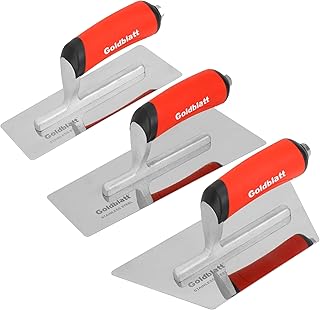
Goldblatt 3-Piece Venetian Plaster Trowel Set
- 3 polished stainless steel trowels
- Beveled trapezoid blades with rounded corners
- Blade thickness 0.7 mm
- Sizes 2-3/4 x 3-5/32 in, 3-5/32 x 3-15/16 in, 4-59/64 x 5-5/16 in
- Soft-grip ergonomic handles with aluminium shank
The Goldblatt 3-piece set is the small-trowel core of this guide, and it is the kit a learner reaches for once the holder question is settled. Three trapezoid blades in graduated sizes let the learner feel how blade size changes a marmorino coat: the smallest blade works tight corners and edges of a panel, the middle blade lays the texture coat, and the largest blade flattens and compresses the final pass. The blades are polished stainless steel at 0.7 millimetres thick, with beveled edges and rounded corners, which is the combination that lets a trowel compress a lime coat without leaving dark edge marks. The soft-grip handles and aluminium shank keep the weight down, so the hand stays relaxed through the repeated light passes that burnishing needs.
For learning texture combinations, the value of three blades is comparison. A learner can lay the same two coats on two boards and finish one with the small blade and one with the large blade, and the difference in the surface will show which blade suits which stage. The set is listed for Venetian plaster, marmorino, microcement and stucco, so the blades are made for this material rather than adapted from drywall work. The set has no holder and no sponge, so it pairs naturally with the Lasnten or Goldblatt holder kits above. A learner who buys this set first will still need a board or hawk to carry the plaster, but will have the blades that do the actual finishing.
Pros: Three graduated sizes for direct comparison; polished 0.7 mm blades with rounded corners; listed for marmorino; light soft-grip handles.
Cons: No holder included; no sponge float; smallest blade may feel short on larger panels.
LECEHIVO 6-Pc Venetian Plaster Trowel Set PMS574
- 6 pieces in three sizes
- Sizes 200 x 80 mm, 240 x 100 mm and 234 x 110 mm
- Blade thickness 0.7 mm, stainless steel
- Wooden handles
- Polished beveled edges and rounded corners
- Item weight 3.64 pounds
The LECEHIVO set is the broadest blade collection in this guide, with six pieces across three sizes, and it suits a learner who wants to compare more than one blade at each stage. The 200 by 80 millimetre blades are the panel-scale tools, small enough to work inside the edges of a sample board without overrunning them. The 240 by 100 millimetre blades are the standard finishing size, and the 234 by 110 millimetre blades add a wider option for flattening a coat in fewer passes. All six blades are 0.7 millimetre stainless steel with polished beveled edges and rounded corners, the same specification as the Goldblatt set, so the comparison between the two sets is about size range and handle feel rather than blade quality. The wooden handles give a warm, firm grip that some learners prefer over soft rubber, and the 3.64 pound total weight reflects six solid blades rather than a single light tool.
Six blades invite a systematic approach to learning texture combinations. A learner can dedicate one blade to the base coat, one to the texture coat and one to the final compression pass, and keep the second set of three clean for a different colour or a different panel, so a board in progress is never interrupted by washing a blade mid-coat. The part number PMS574 identifies the set, which helps when ordering a replacement or a second set for a workshop. The set has no holder and no sponge, so it needs a hawk or mortar board alongside it, and six blades are more than a first-time learner may need on day one. For a learner who plans to practise several texture combinations in a single session, though, the range is the point.
Pros: Six blades across three sizes for systematic comparison; 0.7 mm polished blades with rounded corners; wooden handles; part number listed for reordering.
Cons: No holder or sponge included; six blades may be more than a beginner needs; total weight is higher than a three-piece set.
REFINA Premium Soft Grip Fine Rubber Sponge Float 228724
- 280 x 140 mm float size
- 20 mm fine orange rubber sponge
- Premium soft-grip oval handle
- Fine sponge grain for a smooth, polished look
The REFINA 228724 is the texture tool in this guide, and it covers the stage that trowels alone cannot. A sponge float opens the surface of a fresh marmorino coat, brings a little moisture to the surface, and softens trowel marks before the final pass. The 20 millimetre fine orange rubber sponge is the grade the maker describes as delivering a smooth, polished look, which is exactly what a sample board needs before the final trowel pass: the sponge closes the surface, evens the moisture, and leaves the coat ready for compression. The 280 by 140 millimetre float is a full hand size, and the premium soft-grip oval handle supports a relaxed grip through the light circular passes that sponge work needs.
For a learner, a single fine sponge turns the smoothing stage into a controlled step. The board is floated after the coat has started to firm, in light circular passes with a damp rather than wet sponge, and the difference between a board floated with the sponge and a board left to the trowel alone will show in the finished surface: the floated board will be flatter, with fewer trowel lines and a more even sheen. The maker describes the fine grain as suited to a smooth finish, and the soft-grip handle as the premium option in the range, which makes this float the one to reach for when the board is nearly finished. The float has no trowel and no holder, so it is a companion to the trowel and holder kits above rather than a stand-alone starting point. A learner who already owns blades will get the most from it, because the sponge work only makes sense once the coats are laid.
Pros: Fine sponge grade for a smooth finish before polishing; soft-grip oval handle; 280 x 140 mm hand-size float; orange rubber sponge suits gypsum and finish plasters.
Cons: No trowel or holder included; single grade, no coarse or medium sponge; float is large for very small panels; sponge wears and needs replacing.
Bellota 5906SET Smoothing Spatula Set
- 4 stainless steel smoothing spatulas, 0.3 mm flexible blades
- Blade widths 200, 400, 600 and 800 mm
- Aluminium handle with adapter
- 0.73 to 1.20 m telescopic handle
- Carrying case included
- Set weight 4.5 kg
The Bellota 5906SET is the wide-blade kit in this guide, and it brings a different scale of tool to sample board practice. Four flexible stainless blades at 0.3 millimetres thick, in widths from 200 to 800 millimetres, let the learner flatten a coat across a whole panel in a single pass, which is the skill that separates a flat marmorino surface from a wavy one. The 200 millimetre blade is the panel-scale tool, while the wider blades suit larger boards and the transition from board practice to wall work. The aluminium handle is ergonomic and light, the adapter connects the handle to any of the four blades, and the telescopic handle extends from 0.73 to 1.20 metres, so the same set can finish a panel on a bench and a wall from the floor. The carrying case is the organiser in this kit: four blades, a handle, an adapter and a telescopic pole all pack into one case.
For learning texture combinations, the flexible 0.3 millimetre blade is the key detail. A stiff blade bridges high spots and leaves low spots untouched, while a flexible blade follows the surface and presses the coat evenly, which is what a marmorino finish needs for its smooth, stone-like face. The maker lists the set for finishing, plastering and rendering when installing plasterboard, and the ground, aligned and polished blades are made to glide rather than drag. The set is the heaviest in this guide at 4.5 kilograms, and the wide blades are more than a small panel needs, so a learner who only ever works on small boards may use just the 200 millimetre blade. For a learner who wants one kit that covers the panel and the wall beyond it, the range of widths and the case make it a practical choice.
Pros: Four flexible 0.3 mm blades for even flattening; telescopic handle extends reach; carrying case keeps the kit together; 200 mm blade suits panels.
Cons: Heaviest kit in this guide at 4.5 kg; wide blades exceed small panel needs; no sponge float included.
Buying guide
Start with the holder, because it decides how the practice session feels. A mortar board on a bench, like the one in the Lasnten kit, keeps the plaster still while both hands are free to work the panel, which suits a learner who practises at a table. A hawk, like the ones in the Rhibak and Konvixon kits, keeps the plaster in the non-working hand, which suits a learner who wants to build the rhythm of wall work from the start. Either holder works; the choice is about where the learner practises and whether the panel stays on a bench or moves around the room. A holder that is too small will need constant reloading, and a holder that is too heavy will tire the arm before the second coat, so the 12 to 13 inch sizes in this guide are a sensible middle ground for board work.
Next, match the blade size to the panel size. Sample boards are usually small, and a blade much longer than the panel will overrun the edges and round them over. The 200 by 80 millimetre blades in the LECEHIVO set and the smallest Goldblatt blade are the right scale for a board the size of a sheet of paper, while the 240 by 100 millimetre blades suit larger panels and the transition to wall work. Blade thickness matters too: the 0.7 millimetre blades in the Goldblatt and LECEHIVO sets are firm enough to lay a coat and flexible enough to compress it, while the 0.3 millimetre Bellota blades are made to flex and follow the surface. A learner who is still learning pressure control will find the 0.7 millimetre blade more forgiving, because it does not bend away from the surface when the hand presses too hard.
Sponge work deserves its own decision. A sponge float is not a substitute for a trowel; it is the tool that prepares the surface between trowel passes. The fine sponge in the REFINA 228724 suits the final smoothing before the polish: it brings a little moisture to the surface and softens trowel marks without removing material. A learner who skips the sponge stage will find trowel marks harder to remove, and a learner who sponges too late, after the coat has firmed, will pull at the surface instead of smoothing it. Keep the sponge damp rather than wet, rinse it often, and work in light circular passes so the moisture spreads evenly.
Storage and care close the loop. Stainless blades should be washed and dried after each session, because dried lime on a blade will scratch the next board. A carrying case, like the one in the Bellota set, keeps blades from knocking against each other, and a hawk with a soft foam grip, like the Rhibak kit, stays comfortable to hold through several coats. Wooden handles, like those on the LECEHIVO set, should be kept dry and oiled occasionally so they do not crack. A learner who looks after the kit will find the blades stay polished and the sponges stay even, which is what keeps each practice board comparable to the last.
Finally, practise in a sequence that isolates one variable at a time. Lay the same two coats on two boards and change only the blade, or only the sponge grade, or only the number of trowel passes, and label each board with what changed. That habit turns a pile of practice boards into a reference set that shows which combination produces which texture, and it is the fastest way to move from copying a finish to understanding it.
FAQ
What size sample board suits marmorino practice?
A board around the size of a sheet of paper suits most learners, because it takes two or three trowel passes per coat and shows the full texture without using much material. Larger boards suit the wider blades in the Bellota set, while smaller boards suit the 200 by 80 millimetre blades. The panel should be rigid, flat and sealed on the edges so it does not warp when the plaster dries.
Does a sample board need a holder?
A holder is not required, but it makes practice easier and cleaner. A mortar board or hawk keeps the mixed plaster within reach and off the bench, so the learner is not reaching for a bucket mid-coat. A panel holder also keeps the board itself steady, which matters when the final pass needs a light, even pressure. The Lasnten, Rhibak and Konvixon kits in this guide all include a holder of one kind.
How many coats does a marmorino sample board need?
Most marmorino texture combinations use two or three thin coats: a base coat for body, a texture coat for movement, and an optional final pass for compression and polish. The exact number depends on the material and the effect, and the maker guidance for the plaster being used should be followed. Thin coats dry faster and show the trowel work more clearly than thick ones.
Which sponge grade should a beginner start with?
The fine grade is the usual starting point for the final smoothing stage, because it brings moisture to the surface without removing material. A learner who also wants coarse and medium grades for opening a fresh coat can add a multi-grade sponge kit alongside the single fine float.
Can the same trowels be used on a wall after practising on boards?
Yes, and that is one of the reasons to practise with real tools rather than improvised ones. The blades in the Goldblatt, LECEHIVO and Bellota sets are full finishing tools, and the habits learned on a board, thin coats, light pressure, clean blades, transfer directly to wall work. The wider Bellota blades are the natural step from board to wall.
How should sample boards be stored after finishing?
Finished boards should be stored flat, face up, in a dry place out of direct sunlight, with a sheet of paper or cloth between boards if they are stacked. Lime plaster continues to cure after it feels dry, so a board should be left for several days before it is judged. Labelling each board with the material, the coats and the tools used turns the stored boards into a useful reference set.
Conclusion
Learning marmorino texture combinations on sample boards is a matter of having the right kit and using it in a steady sequence. The Lasnten Drywall Finishing Tools Kit leads this guide because its mortar board holder and 11 inch trowel cover the loading and laying stages in one purchase, and the Rhibak and Konvixon kits offer hawk-based alternatives for learners who prefer to hold the material. The Goldblatt 3-Piece and LECEHIVO 6-Pc trowel sets supply the small polished blades that do the actual finishing, the REFINA 228724 fine sponge float adds the smoothing stage between coats, and the Bellota 5906SET brings wide flexible blades and a carrying case for the step from board to wall. A learner who picks the holder first, matches the blade to the panel, and practises one variable at a time will build a set of reference boards that shows exactly which combination produces which finish, and that reference set is the real product of the practice.
Related guides
More from Amazon
Programs that pair well with the guide above. Offers and eligibility are set by Amazon and may change.
Free shipping on eligible items, Prime Video and more. Eligible new members can start with a free trial.
Start a Prime free trialAudiobooks and podcasts to listen to on the go. Eligible new members can start with a free trial.
Try Audible freeAd-free music streaming. Eligible new subscribers can start with a free trial.
Try Music Unlimited freeA free business account with business pricing and bulk-buying tools for work, shop or home office.
Create a business accountAs an Amazon Associate we earn from qualifying purchases.
More ways to save on your next finish
Programs that pair well with the guide above. Offers and eligibility are set by Amazon and may change.
A free business account with business pricing and bulk-buying tools for work, shop or home office.
Create a business accountFast, free shipping on eligible items, plus Prime Video and more. Eligible new members can start with a free trial.
Start a Prime free trialRead from a huge library of eBooks, including how-to guides and cookbooks. Eligible new members can start with a free trial.
Try Kindle UnlimitedAudiobooks and podcasts for the commute, the garage or the kitchen. Eligible new members can start with a free trial.
Try Audible freeAs an Amazon Associate we earn from qualifying purchases. Using these links costs you nothing extra.










Write Your Review
No reviews yet. Be the first to share your experience!