
Key takeaways
- Compare plaster sample board tool kits for marmorino texture combinations: varied blade shapes and trowels that help you practise smooth and veined finishes.
What's inside
As an Amazon Associate I earn from qualifying purchases. This post may contain affiliate links at no extra cost to you.
Marmorino is a plaster of combinations. A single wall can carry a glass-smooth burnished field, a softly veined passage, and a patch of combed texture, and the skill lies in moving between those characters without the joins showing. The sample board is where that skill is learned, one panel at a time, and the tools on the board decide how fast the learning goes. The best plaster sample board tool kits for learning marmorino texture combinations are the sets that give a beginner several blade shapes to work with: a trapezoid for the smooth field, a rhombus for edges and transitions, a pointed blade for veining, and a wide blade for the broad passages that tie the board together.
Learning texture combinations is a different job from copying a single finish. It asks you to compare tools side by side on the same board, to feel how a flexible 0.3 mm blade drags a vein through a wet coat while a stiff 0.7 mm blade holds the field flat, and to learn which handle lets you keep pressure steady through a long burnishing pass. A kit with several shapes and sizes turns one board into a small school: the same marmorino, the same board, and a different result from every blade. That comparison is the fastest way to build judgement, and it is why a varied kit beats a single trowel for anyone learning the craft.
The seven kits in this guide were chosen for that learning job. Each one brings a different balance of blade shapes, thicknesses, and sizes, and each section notes what it teaches best: the Konvixon pair for controlled burnishing, the rubber-handled set for long practice sessions, the Fumusae set for durable daily use, and the wide-blade sets for the broad fields that anchor a texture board. The buying guide at the end covers how to set up a practice board, how to work through texture combinations in a sensible order, and how to keep notes so each board teaches something the next one can use.
Quick verdict
If you are learning marmorino texture combinations, start with the Konvixon 2PCS Venetian Plaster Trowels. Two mirror-polished trapezoid blades in different sizes give you precise control over the smooth field and the burnish, and the ergonomic rubber handles keep your hand steady through the long passes that set a sheen. The Venetian Plaster Finishing Trowel Set 3 Pieces with Rubber Handles adds a rhombus shape for edges and transitions, while the Fumusae 3PCS Plaster Finishing Trowel Set brings a red soft-grip option with a welded aluminum shank for daily practice. The Venetian Plaster Finishing Trowel Set 3 Pcs Kit in Red covers similar ground with a different balance of sizes, and the Venetian Plaster Trowel Set 2 Pieces keeps things simple with two straightforward sizes for beginners.
For the broad passages that anchor a texture board, the Lasnten Drywall Finishing Tools Kit pairs an 11-inch trowel with a 13-inch aluminum mortar board, keeping mixed marmorino close to the panel. The Goldblatt 3 Pieces Drywall Trowel Set with Wood Handles adds carbon steel blades in 14, 12 and 8 inches for wide, flat fields. Together, these seven kits give a learner every blade character marmorino asks for, from the finest vein to the broadest field.
| Product | Key spec | Best for |
|---|---|---|
| Konvixon 2PCS Venetian Plaster Trowels | Mirror-polished stainless steel, 9.3 x 5.3 and 10 x 3.3 in | Controlled burnishing practice |
| Venetian Plaster Finishing Trowel Set 3 Pieces with Rubber Handles | 0.7 mm stainless steel, rubber handles | Long comfortable practice sessions |
| Fumusae 3PCS Plaster Finishing Trowel Set | 0.03 in high-strength stainless steel, soft-grip | Durable daily texture practice |
| Venetian Plaster Finishing Trowel Set 3 Pcs Kit in Red | 0.7 mm stainless steel, aluminum and rubber | Versatile all-round texture work |
| Venetian Plaster Trowel Set 2 Pieces | 0.7 mm stainless steel, 8 x 3 in and 10 x 4 in | Simple two-size learning |
| Lasnten Drywall Finishing Tools Kit | 11 in stainless trowel, 13 in aluminum mortar board | Keeping mixed marmorino at hand |
| Goldblatt 3 Pieces Drywall Trowel Set with Wood Handles | Carbon steel blades, 14, 12 and 8 in | Broad flat texture fields |
How we chose
The kits in this guide were chosen for learning, which sets different priorities from professional production work. Blade shape variety came first: a learner needs trapezoid, rhombus, round, and pointed blades on the bench, because each shape teaches a different stroke and a different texture. Blade thickness came next, since the contrast between a flexible 0.3 mm blade and a stiff 0.7 mm blade is itself a lesson in how marmorino behaves under the tool. Sets that offer more than one thickness, or that pair well with a set that does, earned a place.
Handle comfort mattered because practice sessions run long and a tired hand learns bad habits. Rubber, soft-grip, and shaped wood handles all suit different hands, and the guide includes each so a learner can find what fits. Size range was weighed as well: a practice board needs small blades for detail and veining, and wide blades for the broad fields that give texture its context. Finally, every kit here is a real, currently listed product with specifications published by the maker or the retailer, so the details in this guide come from product pages rather than from guesswork.
Konvixon 2PCS Venetian Plaster Trowels
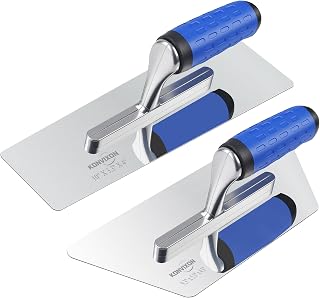
- Blade material: mirror-polished stainless steel
- Blade shape: trapezoid
- Handles: ergonomic non-slip rubber on aluminum
- Sizes: 9.3 x 5.3 x 4.3 in and 10 x 3.3 x 4 in
- Weight: 1.59 lb
- Pieces: 2
The Konvixon pair leads this guide because burnishing is the skill every marmorino learner has to master first, and these two blades teach it cleanly. Mirror-polished stainless steel glides over a fresh coat without dragging, and the trapezoid shape covers a broad field in steady passes while the narrower blade works the edges and the transitions where a burnished area meets a textured one. The one-piece aluminum construction keeps the blade and handle rigidly connected, so the pressure you apply at the handle reaches the blade without flex or wobble, and that direct connection helps a learner feel exactly how much pressure produces a sheen and how much produces a mark. Ergonomic non-slip rubber handles stay secure when hands are damp, and at 1.59 lb for the pair the tools feel planted without tiring the wrist. Two sizes are enough to learn the core lesson, that a broad blade sets the field and a narrower blade refines it, and the pair keeps the choice simple while the hand learns. For the first weeks of marmorino practice, this is the set to reach for.
Pros: Mirror-polished blades glide cleanly for burnishing practice; two sizes teach field work and edge refinement; rigid aluminum construction gives direct pressure feedback.
Cons: Only two blades, so veining and fine detail need another set; aimed at confident users rather than complete beginners.
Venetian Plaster Finishing Trowel Set 3 Pieces with Rubber Handles
- Blade thickness: 0.7 mm stainless steel
- Shapes: trapezoid and rhombus
- Handles: rubber
- Weight: 2.05 lb
- Pieces: 3
Once the smooth field is under control, the next lesson is the transition, and this rubber-handled set is built for it. The trapezoid blades lay and burnish the field, while the rhombus blade, with its angled corners, works the edges where the field meets a textured passage, softening the join so the board reads as one composition rather than two stuck together. The 0.7 mm polished stainless steel blades hold a firm edge under steady pressure, and the beveled edges with rounded corners keep the surface free of score lines. Rubber handles are the quiet advantage here: they stay comfortable and secure through the long, repetitive sessions that texture learning demands, when the same board may be coated, textured, and re-coated several times in a day. At 2.05 lb the set has enough weight to feel steady without tiring the hand. For a learner working through the combinations of smooth and textured marmorino, this set is the comfortable, forgiving partner.
Pros: Rhombus blade handles transitions between smooth and textured areas; rubber handles stay comfortable through long practice; polished blades reduce scoring.
Cons: No storage case is listed with the set; the stiff blades can feel firm for very light veining work.
Fumusae 3PCS Plaster Finishing Trowel Set
- Blade thickness: 0.03 in high-strength stainless steel
- Handles: red soft-grip ergonomic
- Shank: aluminum welded to blade
- Sizes: 2-3/4 x 3-5/32 x 7-7/8 in, 3-5/32 x 3-15/16 x 9-29/64 in, 4-59/64 x 5-5/16 x 9-1/4 in
- Pieces: 3
Practice is hard on tools, and the Fumusae set is built to take it. High-strength stainless steel blades resist rust and corrosion through daily sessions, and the aluminum shank welded to each blade holds firm under the repeated pressure of burnishing and texturing. Red soft-grip handles are comfortable through long days and easy to find on a crowded practice bench. Three graduated sizes cover the learning curve: the smallest blade for veining and detail, the middle blade for the main field, and the largest for broad passes that tie a board together. The maker lists the set for drywall, concrete, and stucco as well as plaster, which suits a learner who wants to try marmorino textures on different surfaces and compare how the same stroke behaves on each. For a student who practises every day and needs tools that survive the learning process, this set is a durable, practical choice.
Pros: High-strength blades and welded shanks stand up to daily practice; three graduated sizes cover detail and broad work; soft-grip handles stay comfortable.
Cons: No carrying case is listed with the set; blades need cleaning after use to keep the polish bright.
Venetian Plaster Finishing Trowel Set 3 Pcs Kit in Red
- Blade thickness: 0.7 mm stainless steel
- Materials: aluminum, rubber and stainless steel
- Colour: red
- Weight: 1.83 lb
- Dimensions: 9.5 x 4.3 x 3.5 in
- Pieces: 3
This red three-piece kit is the versatile all-rounder of the learning bench, and its value for a student is that it does a little of everything without demanding a specialist's touch. Three stainless steel blades at 0.7 mm give the stiffness needed for even coats and controlled burnishing, while the aluminum and rubber build keeps the tools light and the grip secure. The red finish makes the set easy to spot and easy to keep together as a kit, which matters when a practice bench accumulates tools from several sets. At 1.83 lb the tools feel planted without tiring the wrist, and the maker lists the set for plaster, drywall, and decorative surfaces, matching the mixed practice of a learner who tries marmorino on boards, offcuts, and small wall sections. Multiple sizes handle large areas, detailed corners, and curved passages, so one kit can carry a student through the whole range of texture combinations. For a learner who wants one dependable set to practise with every day, this kit is a strong, straightforward choice.
Pros: Versatile sizes cover fields, corners and curves; light build reduces fatigue; red finish keeps the set together on a busy bench.
Cons: No storage case is listed with the set; the size range may be more than a first practice board needs.
Venetian Plaster Trowel Set 2 Pieces
- Blade thickness: 0.7 mm stainless steel
- Handles: plastic and rubber
- Sizes: 8 x 3 in and 10 x 4 in
- Edges: 90-degree polished edges with round corners
- Pieces: 2
Every learner needs a simple set for the first boards, and this two-piece set is the clearest starting point in the guide. The smaller 8 x 3-inch blade handles narrow practice strips and small detail areas, while the 10 x 4-inch blade covers a standard sample board in fewer passes. Both blades are 0.7 mm stainless steel with polished edges and rounded corners, so they spread marmorino cleanly without the scoring that can confuse a beginner about whether a mark came from the tool or the technique. Plastic and rubber handles give a secure grip even when hands are damp from plaster work, and the two-size format keeps decisions simple: small board, small blade; larger board, larger blade. There is no rhombus or pointed blade for advanced veining, which is a limit, but it is also a kindness to a beginner, since the first lessons in marmorino are about pressure, angle, and timing, and those are best learned with the fewest variables. This set is light, easy to clean, and easy to carry to a class or a workshop, and it earns its place as the first kit a student buys.
Pros: Simple two-size format suits first practice boards; polished edges with round corners reduce scoring; light and easy to carry to classes.
Cons: Only two shapes, so veining and texture transitions need another set; no case is listed with the set.
Lasnten Drywall Finishing Tools Kit

- Trowel: 11 in stainless steel, impact-resistant
- Mortar board: 13 in aluminum with rotating handle
- Handles: ergonomic grips on trowel and board
- Pieces: 2
Texture practice uses more material than smooth work, because every combination needs a fresh batch, and the Lasnten kit keeps that material where the learner needs it. The 13-inch aluminum mortar board holds the working amount of marmorino beside the panel, and its rotating handle lets you adjust your grip as you load the trowel, while the 11-inch stainless steel trowel spreads the material across the board. That pairing cuts down on trips to the bucket and keeps the practice bench tidy, which matters when several boards are in progress and a drip can ruin a finished texture. The stainless trowel is impact-resistant and glides smoothly, and the aluminum board wipes clean after use. Ergonomic grips on both pieces reduce hand strain during the repeated loading and spreading cycle of a long practice session. This kit will not replace a multi-shape trowel set for detail work, but as a companion to one, it keeps the workflow smooth, and for a learner working through many texture combinations in a day, that smooth workflow is worth as much as any blade.
Pros: Mortar board keeps mixed marmorino close to the panel; rotating handle adjusts the grip while loading; stainless trowel and aluminum board clean up easily.
Cons: Only one trowel size, so detail and veining need a second set; the aluminum board can dent if dropped.
Goldblatt 3 Pieces Drywall Trowel Set with Wood Handles
- Blade material: carbon steel, sandblasted anti-rust finish
- Sizes: 14, 12 and 8 in
- Handles: camel-back wooden handles on aluminum mounts
- Blade edges: flat with beveled edges
- Pieces: 3
Broad fields are the canvas that texture combinations sit on, and this Goldblatt set provides them. Three carbon steel blades in 14, 12 and 8 inches lay wide, flat areas of marmorino in a few steady passes, and the flat beveled edges spread the material evenly without leaving a ridge where one pass meets the next. The sandblasted anti-rust finish helps the blades stand up to damp practice work, though the maker guidance is clear that the blades should be dried after use, and that habit is worth building early in a plastering education. Camel-back wooden handles sit comfortably in the hand and give good leverage on a wide blade, while the aluminum mounts hold the blade firmly. For a learner, the 14-inch blade teaches the most important broad-field lesson, that a wide blade used with steady, even pressure produces a field flat enough for any texture to sit on, and the 8-inch blade steps in for smaller boards in the same practice series. This set is the workhorse of the learning bench: less delicate than the thin Venetian sets, and better suited to covering ground while the hand learns its rhythm.
Pros: Large blades lay broad flat fields in few passes; wooden handles give good leverage; sandblasted finish helps resist rust.
Cons: Carbon steel blades must be dried after use; the large blades are too big for narrow detail strips.
Buying guide
Start with the learning order, not the shopping list. The sensible path through marmorino texture combinations runs from simple to complex: first a smooth burnished field, then a field with a soft vein, then a board that combines a smooth area with a textured passage. Each stage needs different blades, so buy for the stage you are on and the stage after it, not for every texture you might one day try. A two-piece set covers the first stage, a three-piece set with a rhombus blade covers the second, and a wide-blade set covers the broad fields that give the later combinations their context.
Blade shape is the first specification to study. Trapezoid blades lay the field and burnish it. Rhombus blades work edges and transitions. Round and pointed blades draw veins and reach into narrow passages. A kit that offers two or three of these shapes teaches more than a kit with three blades of one shape, because the comparison between shapes is itself the lesson. Read the shape description on the product page before buying, and be wary of sets that list several sizes but only one shape.
Blade thickness is the second specification, and it teaches a different lesson. A 0.7 mm blade is stiff, holds a straight edge, and suits the firm pressure of burnishing and broad fields. A 0.3 mm blade flexes, follows the board, and suits delicate veining and thin coats. A learner benefits from owning both, because the contrast between them shows how the same marmorino behaves under different tools. If you can only buy one thickness first, choose 0.7 mm for control, and add a thin-blade set when veining becomes the focus.
Handles deserve attention because practice sessions are long and repetitive. Rubber and soft-grip handles suit damp hands and long days, shaped wood suits slow deliberate strokes, and a mix across your kits lets you choose by the task. Weight counts too: a set around two pounds feels planted without tiring the wrist, while a very light set can feel skittish on a broad pass. Hold the style you plan to buy if you can, or at least read the handle description with care.
Set contents beyond the blades add value on a practice bench. A carrying case protects polished edges, and a damaged edge is the fastest way to ruin a board. A mortar board keeps mixed marmorino at hand and cuts down on trips to the bucket. Count the pieces, but count what they do more: three blades in three shapes teach more than six blades in one shape.
Finally, practise with a system. Use the same board material for every practice panel, prime them the same way, and write on the back of each board what you did: the blade, the number of coats, the pressure, and what you would change next time. Photograph the board in consistent light, and keep the boards in order so you can see the progress across a series. The kits in this guide give you the blade characters marmorino asks for; the notes and the photographs turn a pile of practice boards into a record of what you have learned.
FAQ
Which blade shape should a beginner start with?
Start with a trapezoid blade. It lays the smooth field, teaches pressure control, and burnishes well, which covers the foundation of marmorino work. Add a rhombus blade next for edges and transitions, then a round or pointed blade when veining becomes the focus.
How thick should the blade be for marmorino texture work?
A 0.7 mm blade suits most marmorino work, because it holds a firm edge for burnishing and broad fields. A 0.3 mm blade suits delicate veining and thin coats. Many learners keep both and switch by the task, using the stiff blade for the field and the flexible blade for the detail.
Can one kit cover all marmorino texture combinations?
One multi-shape kit covers a lot, but not everything. A three-piece set with trapezoid and rhombus shapes handles smooth fields, edges, and transitions. For fine veining, add a pointed-blade set, and for broad fields, add a wide-blade set. Two kits together cover the full range better than any single kit.
How many practice boards should I make per texture?
Make at least three boards per texture: one to learn the stroke, one to refine it, and one to keep as a reference. The first board is rarely the best, and the reference board lets you compare later work against a known result.
How do I keep notes on practice boards?
Write on the back of each board while the work is fresh: the blade used, the number of coats, the pressure and angle, and what you would change. Add the date, and photograph the front in consistent light. A board without notes is a souvenir; a board with notes is a lesson.
How should I clean trowels after marmorino practice?
Wipe each blade with a damp cloth as soon as you finish, then dry it before storage. Dried plaster on a blade can flake into the next coat and mark the board, and carbon steel blades in particular should be dried after every session to keep rust away.
Conclusion
Learning marmorino texture combinations is a matter of comparison: one board, several blades, and an honest record of what each blade did. The Konvixon 2PCS Venetian Plaster Trowels lead this guide because their mirror-polished blades teach burnishing with direct, readable feedback, while the rubber-handled set adds the rhombus shape that handles transitions between smooth and textured areas. The Fumusae set brings durable daily strength, the red kit adds versatile all-round value, and the simple two-piece set gives beginners a clear starting point. The Lasnten kit and the Goldblatt carbon steel set cover the practical side of the bench, from keeping mixed material at hand to laying the broad fields that give texture its context. Choose the kit that matches the stage you are on, keep your blades clean and your boards labelled, and let each panel teach the next one. The texture combinations will follow, one board at a time.
Related guides
More from Amazon
Programs that pair well with the guide above. Offers and eligibility are set by Amazon and may change.
Free shipping on eligible items, Prime Video and more. Eligible new members can start with a free trial.
Start a Prime free trialAudiobooks and podcasts to listen to on the go. Eligible new members can start with a free trial.
Try Audible freeAd-free music streaming. Eligible new subscribers can start with a free trial.
Try Music Unlimited freeA free business account with business pricing and bulk-buying tools for work, shop or home office.
Create a business accountAs an Amazon Associate we earn from qualifying purchases.
More ways to save on your next finish
Programs that pair well with the guide above. Offers and eligibility are set by Amazon and may change.
A free business account with business pricing and bulk-buying tools for work, shop or home office.
Create a business accountFast, free shipping on eligible items, plus Prime Video and more. Eligible new members can start with a free trial.
Start a Prime free trialRead from a huge library of eBooks, including how-to guides and cookbooks. Eligible new members can start with a free trial.
Try Kindle UnlimitedAudiobooks and podcasts for the commute, the garage or the kitchen. Eligible new members can start with a free trial.
Try Audible freeAs an Amazon Associate we earn from qualifying purchases. Using these links costs you nothing extra.










Write Your Review
No reviews yet. Be the first to share your experience!