
Key takeaways
- Seven flexible 10 inch stainless steel taping knives compared for feathering skim coat edges on drywall, with flex, width and handle notes for smooth edges.
What's inside
As an Amazon Associate I earn from qualifying purchases. This post may contain affiliate links at no extra cost to you.
Feathering a skim coat edge is the moment a drywall joint either disappears or announces itself for years. The skim coat goes on thin, the blade pulls it out from the joint, and the outer edge has to taper to nothing so the eye cannot find where the compound stops and the bare wall begins. A stiff blade fights that job: it holds its shape, leaves a hard line, and forces a second coat to hide the first. A flexible blade does the opposite, bending just enough to follow the wall and letting the compound thin out gradually. Choosing the best stainless steel taping knives with flexible 10 inch blades for feathering skim coat edges on drywall is therefore a search for a particular combination: ten inches of width, a flex profile that bends in the right place, and stainless steel that stays clean and rust-free through the wet work.
Ten inches is not an accident. A 6-inch knife beds tape and fills fastener holes, but it is too narrow to feather a skim edge flat, and a 12-inch blade is a better finish tool on wide walls yet unwieldy on a repair. The 10-inch blade sits between them: wide enough to span a joint and pull a full-height coat in one pass, short enough to control on a patch. The seven knives below all carry a 10-inch stainless steel blade, most with a flexible profile, from single knives to sets that include the 10-inch size. The lead pick is the Warner SSTK10, a 10-inch flexible stainless blade the maker lists for feathering out the final coat, but the LEVEL5 10-inch knife runs it close on flex control, and the sets here are worth weighing for anyone feathering more than one room.
Quick verdict
For most feathering work, buy the Warner SSTK10 first. Its 10-inch flexible stainless steel blade is built for exactly this job: a flexible blade the maker lists for feathering out the final coat, an aluminum back plate that keeps the span straight, and rust resistance that tolerates washing and damp storage between coats. The soft grip handle suits the long, even pulls that feathering demands. If flex control matters more than simplicity, the LEVEL5 10-inch knife is the better pick: its precise flex places the bend midway up the blade, and the factory-finished corners arrive ready to work without leaving track marks in wet compound.
The Hyde 06889 is the wide second-coat specialist, a 10-inch blade on a rigid aluminum backplate that keeps the span straight while the corners flex just enough to avoid gouging. For a whole room, the Goldblatt 5-piece set includes a 10-inch blade inside a full width ladder from 6 to 14 inches, so the first coat, the fill coat and the finish coat each have the right width. The Warner ProGrip 10920 adds a second ProGrip option, a 10-inch stainless blade with soft-grip ergonomic handles for applying compound to joints. The USG Sheetrock Classic and the DEWALT DXTT-2-410 are the firmer options in the list, 10-inch stainless blades that suit finishers who want more control and less bend on the feathering pass.
| Product | Key spec | Best for |
|---|---|---|
| Warner SSTK10 | 10 in flexible stainless blade, aluminum back plate | Feathering out the final coat |
| LEVEL5 10-Inch | 10 in stainless blade, precise flex, 9.17 oz | Controlled flex and clean edges |
| Hyde 06889 | 10 in stainless blade, aluminum backplate | Wide second-coat feathering |
| Goldblatt 5-Piece Set | 6, 8, 10, 12 and 14 in tempered stainless blades | A full width ladder for whole rooms |
| USG Sheetrock Classic | Stainless blades 4 to 14 in, rubberized grip | A firmer 10-inch blade for control |
| DEWALT DXTT-2-410 | 10 in all stainless joint knife, one-piece blade | Simple one-piece feathering blade |
| Warner ProGrip 10920 | 10 in stainless blade, ProGrip soft grip handles | Comfortable feathering with a secure grip |
How we chose
Every knife on this list had to clear the same three filters, because the keyword names them all. First, a 10-inch stainless steel blade had to be part of the product: a single 10-inch knife, or a set or kit that includes a 10-inch blade. Second, the blade had to flex. Flex was confirmed from published specs wherever possible: a flexible blade, a precise flex rating, a hollow-ground grind that places the flex point midway up the steel, or a tempered blade that the maker describes as flexing for feathering. Third, the blade had to be stainless steel, because a feathering knife spends its day in wet compound and needs to resist rust and wipe clean between coats.
Width alone was not enough, and neither was flex alone. A 10-inch blade that is too stiff leaves a hard edge where the skim coat stops, and a flexible blade that is too narrow cannot span the joint. The list therefore favors knives whose 10-inch blade is described as flexible in the open listing, with firmer options included deliberately for finishers who prefer control over bend. Handle design was weighed next, because feathering is a long, even pull and the hand stays on the knife for the full length of a joint. Soft-grip handles, rubber overmold and glass-reinforced nylon all appear here, and each one was weighed for how it behaves when the palm is slick with compound.
Backing plates, hammer ends and edge finish were the final filters. A rigid backing plate keeps a 10-inch blade straight across its span while the corners flex, which is the combination that feathers without gouging. A hammer end sets proud fasteners without a trip to the toolbox. Factory-finished blade corners reduce the track marks that square corners leave in wet compound. Only products with published specs from pages actually opened were considered, and any spec that could not be confirmed was left out rather than filled in from guesswork.
Warner SSTK10
- 10-inch flexible stainless steel blade
- Rust resistant blade
- Aluminum back plate
- Blade flares out at edges to reach corners
- Ergonomic soft grip handle of polypropylene and soft TPE
- Handle secured to blade with two rivets
- Listed for feathering out the final coat
The Warner SSTK10 leads this list because it is the most direct answer to the keyword: a 10-inch flexible stainless steel blade that the maker lists for feathering out the final coat of drywall compound on joints. Ten inches is the width where feathering starts. The blade spans a taped joint, bridges the slight depression left by the first coats, and pulls a full-height coat in one pass, so there is no stop halfway across a seam to leave a ridge that needs sanding later. The flexibility lets the blade follow a slightly bowed stud without chattering, and the outer edges of the coat taper to nothing when the pressure is even on both sides of the blade. The aluminum back plate keeps the span straight across ten inches while the blade flexes, which is the combination that feathers without gouging.
The blade flares out at the edges to reach into corners, so the feathering pass can run to the end of a joint without leaving a thick edge where the blade stops short. The handle is an ergonomic soft grip of polypropylene and soft TPE, which stays secure when the palm is slick with compound, and it is secured to the blade with two rivets, so the grip will not twist or loosen over time. The blade is rust resistant, which matters for a feathering knife that is washed after every coat and stored damp between sessions. A rust spot on the blade can transfer into wet compound and show through the finish, so rust resistance is a working requirement rather than a convenience. For a finisher who wants a flexible 10-inch blade built for the final coat, the SSTK10 does the job with no extras to pay for.
Pros:
- 10-inch flexible blade listed for feathering the final coat
- Aluminum back plate keeps the wide blade straight
- Flared edges reach into corners
- Rust-resistant blade tolerates washing and damp storage
Cons:
- 10 inches is too wide for tight corners and small patches
- No hammer end for setting fasteners
- Soft grip handle adds bulk beside a slim metal handle
LEVEL5 10-Inch
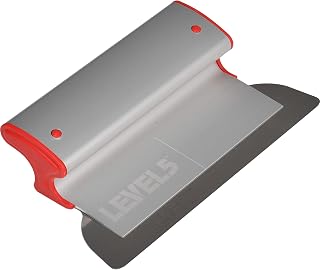
- 10-inch stainless steel blade with precise flex
- Glass-reinforced nylon soft grip handle
- Alloy hammer end
- 9.17 ounces
- Blade corners knocked off at the factory
The LEVEL5 10-inch knife is the precision instrument in this list. The maker lists a stainless steel blade with precise flex, and the review of the knife describes an even flex that follows a slightly bowed stud without chattering, with the blade tracking flat across the joint. At 10 inches the blade pulls a full-height coat in one pass, then lays down to feather the outside edges so the next coat has something to blend into. That even flex is the difference between a skim edge that tapers to nothing and one that ends in a ridge: the blade bends where it should, along the middle of the steel, instead of hinging at the handle and digging a corner into wet compound.
The handle is a glass-reinforced nylon soft grip, built for the long pulls where a wrist starts to complain, and the alloy hammer end sets proud nails without putting the knife down. At 9.17 ounces the knife is light for its size, which helps on ceiling work and on long walls where the blade stays in the hand for an hour at a time. The blade corners arrive knocked off at the factory, which matters more than it sounds: square corners leave track marks in wet compound, and a knife that arrives with the corners dressed saves the finisher from filing them before the first coat. The wide blade is clumsy in closets and around door frames, and a 10-inch blade is a poor choice for a doorknob patch, so keep a 2-inch or 4-inch knife beside it for detail work. For taping and floating whole seams, though, this is the blade that does the work with the least fighting.
Pros:
- Precise, even flex follows the wall without chattering
- Factory-finished corners avoid track marks in wet compound
- Light at 9.17 ounces for its size
- Alloy hammer end and large hang hole
Cons:
- Wide blade is clumsy in closets and around door frames
- Needs a smaller knife beside it for detail patches
- All-metal feel is absent, so the handle is the grip, not the blade
Hyde 06889
- 10-inch rust-resistant stainless steel blade
- Lightweight aluminum backplate
- Larger handle
- Flex at the blade corners
The Hyde 06889 is the wide second-coat knife in this list. Once tape is bedded and dried, the work moves to a wider blade to feather out the edges of the joint, and a 10-inch knife spans the joint, bridges the gap between drywall panels, and smooths the transition that would otherwise show as a bump under paint. The blade is rust-resistant stainless steel that holds a straight edge over time, and the lightweight aluminum backplate keeps the tool rigid across its span while the blade itself keeps just enough flex at the corners. That combination is what feathering needs: a straight spine so the coat stays flat, and corners that give a little instead of gouging into wet compound on the final sweep.
The larger handle asks for some hand strength to control over long sessions, and a 10-inch blade is not the tool for tight spaces or small patch work, where a narrower knife is required. Dropping the knife on a concrete floor can nick the blade, and a nick leaves lines in wet compound, so the edge deserves care between coats. For a DIYer who wants a durable, rust-free knife that lasts through multiple home projects without bending, the 06889 is a strong choice: the backplate, the flex at the corners and the stainless steel add up to a blade that feathers a second coat cleanly and washes up ready for the next room. It pairs well with a 6-inch knife for the first coat, and the two widths cover the tape coat and the feathering coat that decide whether a joint disappears.
Pros:
- Aluminum backplate keeps the wide blade straight
- Flex at the corners avoids gouging wet compound
- Rust-resistant stainless blade holds a straight edge
- 10-inch width spans joints for second-coat feathering
Cons:
- Larger handle needs hand strength over long sessions
- Too wide for tight spaces and small patches
- A dropped blade can nick and leave lines in compound
Goldblatt 5-Piece Set

- 6, 8, 10, 12 and 14-inch tempered stainless steel blades
- Aluminum backing
- Flex right for feathering and control
- Polypropylene soft grip handles
- Hammer ends and hang holes
- 3.2 pounds for the set
The Goldblatt 5-piece set is the width ladder in a box, and its 10-inch blade is the one this keyword cares about. Five knives cover the whole job: the 6-inch and 8-inch blades do most of the work in a normal room, the 10-inch pulls a full-height coat, and the 12-inch and 14-inch blades handle the wide, thin passes that decide how much sanding follows. The blades are tempered stainless steel with an aluminum backing, and they flex the way a finishing blade should: enough to press flat for feathering, with a stiff heel that keeps the coat under control. Working through the widths in order is the closest thing to a system in this category, because each coat goes on wider than the one before it and the joint feathers out instead of ending in a hard edge.
The 10-inch blade is the middle of that ladder, and it is the size that pulls a full-height coat on a standard wall without the unwieldiness of the 14-inch blade. Every handle is polypropylene with a soft grip and an alloy hammer end, and every blade carries a large hang hole, so the set hangs neatly between jobs. At 3.2 pounds the set is light enough to carry in one hand, and buying the widths together costs less than buying them one at a time. The trade is blade feel: the set is a step down from a premium single knife for a daily finisher, and the 14-inch blade is overkill for most rooms, while no blade under 6 inches is included for cracks and small patches. For a room of new drywall, though, the set is the practical buy, and the 10-inch blade inside it is a capable feathering tool.
Pros:
- Five widths cover taping through finish coats
- Flex is right for feathering, with a stiff heel for control
- Tempered stainless blades with aluminum backing
- Hammer end and hang hole on every knife
Cons:
- No blade under 6 inches for cracks and small patches
- Blade feel is a step down from premium singles
- 14-inch blade is overkill for most rooms
USG Sheetrock Classic
- Stainless steel blades from 4 to 14 inches
- Rubberized slip-resistant grip
- Tapered neck
- Standard hammer cap
- Traditional handle shape
The USG Sheetrock Classic is the firmer option in this list, and it earns its place by giving the feathering pass a different feel. The line offers stainless steel blades from 4 to 14 inches, so a 10-inch blade is available in the range, and the maker positions stainless steel as the stiffer, lower-maintenance option next to blue and carbon steel. That firmness suits finishers who want more control and less bend on the feathering pass: the blade still flexes, because every taping knife blade flexes under pressure, but it holds its shape more firmly than the flexible blades above, which helps when the skim coat needs to be pushed flat rather than coaxed thin. The guide that compares the USG lines recommends the Classic stainless series as the most forgiving option for new finishers, which is a fair reflection of how the knife behaves in the hand.
The handle keeps the traditional shape that finishers know, upgraded with a modern rubberized grip for comfort and control, and the tapered neck helps reduce hand fatigue while the soft grip keeps the knife from slipping. The standard hammer cap sets nails without switching tools, which is a small convenience that saves real time on a wall of joints. The stainless steel is highly rust-resistant and needs little more than a wipe after use, which suits a jobsite where cleaning is inconsistent. For a finisher who finds a very flexible blade hard to control, the Classic 10-inch is the steadier tool, and the wider sizes in the line handle the finish coat when the work moves to broad walls.
Pros:
- Traditional handle shape with a modern rubberized grip
- Tapered neck for precise control
- Standard hammer cap for setting fasteners
- Stainless blades from 4 to 14 inches cover every coat
Cons:
- Stainless steel runs firmer than the flexible blades here
- Traditional shape feels plain beside premium designs
- Standard hammer cap is smaller than an enlarged cap
DEWALT DXTT-2-410
- 10-inch all stainless steel joint knife
- One-piece premium polished metal blade
The DEWALT DXTT-2-410 is the one-piece option in this list. The maker lists a 10-inch all stainless steel joint knife with a one-piece premium polished metal blade, which means there are no seams or welds where a handle could crack or separate, and the polished surface wipes clean easily even after repeated washings. Ten inches is the width where feathering starts: the blade spans a taped joint, bridges the slight depression left by the first coats, and pulls a full-height coat in one pass, so there is no stop halfway across a seam to leave a ridge that needs sanding later. The polished stainless surface sheds compound during cleanup, and a rinse and a wipe return the blade to a clean shine.
There is less published detail on this knife than on the premium brands here, and the short spec list is a fair reflection of that: no backing plate, hammer end, handle material or weight is listed, so the knife should be judged on the two attributes the maker does publish. The one-piece build is the reason to choose it: a single piece of polished steel has no joint to work loose after a season of daily use, and the 10-inch width suits the feathering pass that decides whether a joint disappears. For a finisher who wants a simple, one-piece 10-inch blade for feathering skim coat edges without paying for extras, the DXTT-2-410 does the job, and it pairs naturally with a 6-inch knife for the first coat.
Pros:
- One-piece blade with no joint to loosen
- 10-inch width suits feathering skim coat edges
- Polished stainless surface cleans easily
- Simple spec sheet with no extras to pay for
Cons:
- No published backing plate, hammer end or handle detail
- 10 inches is too wide for tight corners and small patches
- Less published detail than premium brands
Warner ProGrip 10920
- 10-inch stainless steel blade
- ProGrip soft grip ergonomic handles
- For applying drywall compound to joints and covering screw holes
- Limited lifetime warranty
The Warner ProGrip 10920 is the second ProGrip option in this list, and it earns its place on the handle. The ProGrip line is built around a soft grip that stays secure when the palm is covered in wet compound, and the 10920 carries that grip in its ergonomic form, shaped to sit comfortably in the hand through the long, even pulls that feathering demands. The blade is a 10-inch stainless steel blade, which is the width where feathering starts: it spans a taped joint, bridges the slight depression left by the first coats, and pulls a full-height coat in one pass, so there is no stop halfway across a seam to leave a ridge that needs sanding later. The maker lists the knife for applying drywall compound to joints and covering screw holes, which is the daily work of a feathering blade, and the limited lifetime warranty from the maker backs the build.
The stainless steel blade resists rust through the washing that follows feathering work, and the soft grip handles suit finishers whose hands ache after a long session. There is less published detail on this knife than on the premium brands here, and the short spec list is a fair reflection of that: no backing plate, hammer end or weight is listed, so the knife should be judged on the four attributes the maker does publish. For a finisher who wants a comfortable 10-inch blade for feathering skim coat edges, with a grip that stays secure when wet, the ProGrip 10920 does the job, and it pairs naturally with a 6-inch knife for the first coat.
Pros:
- ProGrip soft grip handles stay secure with wet hands
- 10-inch width suits feathering skim coat edges
- Stainless steel blade resists rust and cleans easily
- Limited lifetime warranty from the maker
Cons:
- No published backing plate, hammer end or weight
- 10 inches is too wide for tight corners and small patches
- Less published detail than premium brands
Buying guide
Start with the width, because width is the mechanism that makes a skim edge disappear. A 10-inch blade is the standard feathering size for a reason: it spans a taped joint, pulls a full-height coat in one pass, and feathers the outer edges wide enough that the transition to bare wall is gradual. A 6-inch knife beds tape and fills fastener holes, but it cannot feather a skim edge flat, because the coat ends in a hard line where the blade stops. A 12-inch blade feathers wider still, and it is the better finish tool on broad walls, but on a repair it is unwieldy. The practical minimum is two knives: a 6-inch for the first coat and a 10-inch for the feathering coat, with a 12-inch added when whole walls are being skimmed.
Flex is the second decision, and the keyword names it for a reason. A flexible blade conforms to the wall and tapers the compound to nothing at the edges, which is what feathering is. Look for a hollow-ground blade, where the grind places the flex point midway up the steel, or a tempered stainless blade that the maker describes as flexing for feathering. Both give a predictable spring instead of a hinge at the handle. A blade that takes a permanent bend will never lay compound flat again, so the return to flat matters as much as the flex itself. A firmer blade has its place too: on a first coat, or where the skim coat needs to be pushed flat rather than coaxed thin, a stiffer 10-inch blade gives more control. Keep one flexible blade for feathering and one firmer blade for filling, and the two cover the job.
Handle comfort decides how the knife feels at the end of a wall. Feathering is a long, even pull, and the hand stays on the knife for the full length of a joint. Soft-grip handles and rubber overmold stay secure when the palm is covered in wet compound, while full metal handles clean beautifully but transmit cold and vibration. A hammer end is worth having on at least one knife in the set, because proud fasteners appear on every wall and setting them with the butt of the knife saves a trip to the toolbox. A backing plate matters most on a 10-inch blade, where it keeps the spine straight across the span while the corners flex; without it, a wide blade can bow under pressure and leave a crowned coat.
Cleaning decides how long the knife lasts. Rinse the blade immediately after use with warm water and wipe it dry with a cloth, and never let compound dry on the blade, because dried compound is abrasive and will pit the edge over time. Stainless steel tolerates this routine far better than carbon steel, but even stainless steel can pit if compound is left to harden on the surface. Check the edge before each coat: a nick or a burr will leave a line in wet compound, and a few strokes with a fine file along the edge will dress it out. Feather with one smooth pass per side and almost no pressure on the outer edge, and never rework a pass that has started to set, because every extra pass leaves a ridge. Thin the compound with a splash of water so it spreads like soft butter, and let each coat dry fully before the next one goes on.
FAQ
Why is 10 inches the right width for feathering skim coat edges?
A 10-inch blade spans a taped joint and pulls a full-height coat in one pass, so there is no stop halfway across a seam to leave a ridge. It is wide enough to feather the outer edges to nothing and short enough to control on a repair. A 6-inch knife is too narrow to feather flat, and a 12-inch blade is better on broad walls but unwieldy on a patch, so the 10-inch size sits in the useful middle.
How flexible should a feathering blade be?
Flexible enough to follow the wall and taper the compound to nothing at the edges, but firm enough to hold a straight line across the joint. A hollow-ground blade with a flex point midway up the steel gives the most predictable feathering, while a tempered stainless blade that returns to flat after bending avoids the permanent bend that ruins a finishing knife. A very soft blade follows every hollow and leaves a wavy coat, so the useful range is a moderate, even flex.
Stainless steel or blue steel for skim coats?
Stainless steel resists rust, cleans with a wipe, and holds a straight edge, which suits finishers who wash tools between coats and store them damp. Blue steel is more flexible and gives a softer feel for feathering, but it rusts if put away damp and needs a wipe of oil for storage. Many finishers keep both: stainless steel for bedding and first coats, blue steel for the finishing passes. For a single knife that forgives inconsistent cleaning, stainless steel is the safer choice.
How do I feather a skim coat edge so it disappears?
Thin the compound with a splash of water, lay a coat about 10 inches wide over the joint, and pull it smooth with even pressure on both edges of the blade. On the finish pass, put pressure on the outer edge of the blade and almost none on the inner edge, so the coat tapers to nothing. Make one smooth pass per side and do not rework it: every extra pass leaves a ridge. Let the coat dry fully, then sand lightly with 120-grit on a sanding sponge.
How do I clean a 10-inch taping knife without causing rust?
Rinse the blade immediately after use with warm water, wipe it dry with a cloth, and store it blade-up or hung by its hang hole. Stainless steel blades resist rust far better than blue steel, but even stainless steel can pit if compound is left to harden on the surface. Never soak a knife with a wood or plastic handle, because water can loosen the handle over time.
Should I buy a single 10-inch knife or a set?
Buy the single 10-inch knife if the work is a repair or a single room, and pair it with a 6-inch knife for the first coat. Buy a set if the work is a whole house or a full room of new drywall, because the width ladder from 6 to 14 inches covers the tape coat, the fill coat and the finish coat without improvising. A set that covers the width ladder is worth the extra cost when the work runs to more than a few joints.
Conclusion
Feathering a skim coat edge comes down to a 10-inch blade that flexes in the right place and stainless steel that stays clean through the wet work. The Warner SSTK10 leads this list because it is the most direct match: a flexible 10-inch stainless blade the maker lists for feathering out the final coat, with an aluminum back plate and a soft grip handle. Around it, the LEVEL5 10-inch knife offers the most controlled flex, the Hyde 06889 keeps a wide blade straight on a rigid backplate, the Goldblatt set puts the 10-inch blade inside a full width ladder, the Warner ProGrip 10920 adds a second ProGrip option, and the USG Classic and the DEWALT DXTT-2-410 give firmer 10-inch blades for the passes where control matters more than bend. Pick the flex profile that suits the hand, keep the blade clean between coats, and feather each edge to nothing in one smooth pass. A skim edge finished that way needs little sanding and disappears under paint, which is the whole point of the work.
Related guides
More from Amazon
Programs that pair well with the guide above. Offers and eligibility are set by Amazon and may change.
Free shipping on eligible items, Prime Video and more. Eligible new members can start with a free trial.
Start a Prime free trialAudiobooks and podcasts to listen to on the go. Eligible new members can start with a free trial.
Try Audible freeAd-free music streaming. Eligible new subscribers can start with a free trial.
Try Music Unlimited freeA free business account with business pricing and bulk-buying tools for work, shop or home office.
Create a business accountAs an Amazon Associate we earn from qualifying purchases.
More ways to save on your next finish
Programs that pair well with the guide above. Offers and eligibility are set by Amazon and may change.
A free business account with business pricing and bulk-buying tools for work, shop or home office.
Create a business accountFast, free shipping on eligible items, plus Prime Video and more. Eligible new members can start with a free trial.
Start a Prime free trialRead from a huge library of eBooks, including how-to guides and cookbooks. Eligible new members can start with a free trial.
Try Kindle UnlimitedAudiobooks and podcasts for the commute, the garage or the kitchen. Eligible new members can start with a free trial.
Try Audible freeAs an Amazon Associate we earn from qualifying purchases. Using these links costs you nothing extra.










Write Your Review
No reviews yet. Be the first to share your experience!