
Key takeaways
- Are wide plaster skimming blades worth buying on Black Friday? We compare seven blades, the walls they suit, and the cases where a narrow trowel still wins.
As an Amazon Associate I earn from qualifying purchases. This post may contain affiliate links at no extra cost to you.
Our top picks at a glance
5 products from this guide, in the order reviewed below.



As an Amazon Associate we earn from qualifying purchases. Prices and availability can change.
A wide skimming blade looks like a simple tool, and the question behind this guide is equally simple: is it worth buying one during the Black Friday shopping event, or is a standard trowel enough? The honest answer depends on the walls you skim. If you regularly smooth full walls and ceilings, a wide blade saves real time on every pass and leaves a flatter finish than a narrow trowel can. If you only patch small areas, a wide blade is a luxury you will rarely reach for. This guide asks are wide plaster skimming blades worth buying on black friday and answers it with seven real blades, the walls each one suits, and the cases where a narrower tool still wins.
A wide blade works by carrying one long, flexible edge across a surface, so a single pass flattens a strip a metre wide instead of a trowel-width at a time. The effect is most obvious on long, open walls and on ceilings, where the blade bridges small hollows and leaves fewer joins between passes. The cost is control: a long blade needs a steady stance, an even load, and room to work. Blade thickness decides how the edge behaves — a 0.3 mm stainless edge feathers a finish coat, while a 0.4 mm edge holds a firmer line for coating work. The seven blades below were all verified on pages the makers or retailers publish, and the guide ends with a direct answer to the question in the title.
Quick verdict
Yes, a wide skimming blade is worth buying on Black Friday if you skim whole walls or ceilings more than a few times a year. The Nela Edge 24-inch spatula is the best first blade for most readers: light, flexible, and easy to control. The Marshalltown ProSkim 40-inch and the LEVEL5 48-inch blades are the picks for the largest walls, the LEVEL5 24-inch aluminum and 32-inch composite blades cover the middle ground, and the Ergoplast four-piece set and the KEZERS three-blade set give a range of widths in one purchase. If you only patch small areas, save the outlay and keep your trowel.
| Product | Key spec | Best for |
|---|---|---|
| Nela Edge Finishing Spatula 24-inch | 0.30 mm golden spring steel blade, interchangeable | A light first wide blade |
| Marshalltown ProSkim 40-inch Skimming Blade SKIM100 | 0.3 mm INOX stainless blade, edge guard included | Very wide walls |
| LEVEL5 24-inch Skimming Blade, Aluminum Body | 0.3 mm European stainless blade, replaceable insert | All-round rooms and ceilings |
| LEVEL5 48-inch Skimming Blade, Aluminum Body | 0.3 mm European stainless blade, replaceable insert | The largest flat areas |
| LEVEL5 32-inch Skimming Blade, Composite Body | 0.3 mm European stainless blade, light composite body | Wide walls with less weight |
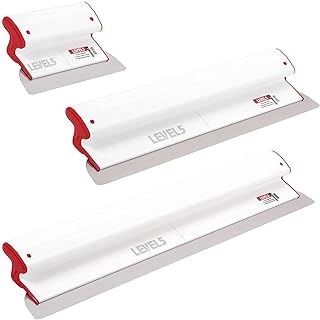
| Ergoplast 4-Piece Surface Spatula Set | 25, 40, 60 and 80 cm blades, 0.3 mm stainless | Four widths in one purchase |
| KEZERS Drywall Skimming Blade Set | 30, 55 and 80 cm blades plus 88-205 cm pole | A full width range with a pole |
How we chose
Each blade had to clear the same four checks. It had to be a real, named model currently sold, with size and blade material stated on a maker or retailer page. It had to be wide enough to work as a skimming blade: 600 mm or longer, or part of a named skimming-blade line. Its blade thickness and material had to be listed, because flex is the quality that decides how a blade handles. And it had to differ from the other picks in a real way — a different length, a different housing, a different flex or a different handle — so the list covers the range rather than repeating one tool seven times.
We weighed blade length, blade thickness, housing material, handle style, edge protection, pole compatibility and replaceable inserts. We skipped blades whose specs could not be confirmed on an open page, and we skipped tools listed as out of stock. The seven picks below give a reader a clear map of what a wide blade does well, what it does poorly, and which size fits which wall — and that map is what the final answer rests on.
Nela Edge Finishing Spatula 24-inch (610 mm)
- Blade length: 24 inches (610 mm)
- Blade material: 0.30 mm golden stainless spring steel
- Edge: rounded corners
- Blade: interchangeable
- Range: 6, 10, 16, 20, 24, 31.5, 39.5 and 47.2 inches
- Origin: made in Germany
The Nela Edge 24-inch spatula is the best first wide blade for most readers, and the reason is feel. The 0.30 mm golden stainless spring steel blade is thin and lively, with rounded corners that let the edge glide without catching, and the open spatula form keeps the tool light in the hand. Because the blade is interchangeable, the same handle can carry a shorter blade for detail work or a longer blade for full walls. The maker lists the range from 152 mm to 1200 mm, so the 610 mm size sits at the start of the wide range rather than the deep end. For a reader asking whether a wide blade is worth buying, this is the lowest-risk way to find out: it is light enough to control, flexible enough to feather, and useful on both walls and ceilings.
Pros: very light and easy to control; rounded corners and a lively spring steel edge; interchangeable blades cover many lengths on one handle.
Cons: less rigid than a housed blade across the widest spans; the thin edge needs its guard in storage.
Marshalltown ProSkim 40-inch Skimming Blade SKIM100
- Blade length: 40 inches
- Blade material: 0.3 mm INOX stainless steel
- Blade width: about 6 inches
- Handle: contoured plastic, non-slip
- Edge guard: included
- Pole compatibility: works with the ProSkim handle bracket and extension handle
- Origin: assembled in the USA with global materials
The ProSkim 40-inch blade is the pick for the largest walls in this guide. The 0.3 mm INOX stainless edge gives the flex that feathers a skim coat, and the maker lists the blade in lengths from 12 inches to 48 inches, so the 40-inch size is a known step in a full range rather than an odd size. The contoured plastic handle is light, the edge guard in the box protects the thin edge in storage, and the ProSkim handle bracket and extension handle from the same maker turn this blade into a ceiling tool. On a wide wall, a 40-inch blade covers in one pass what a 24-inch blade covers in two, and that difference is the whole case for buying wide. The trade-off is control: the long span needs a steady stance and an even load, and it is not the blade to learn on in a small room.
Pros: a 40-inch span that flattens wide walls in few passes; edge guard included; pole-ready with the maker bracket and handle.
Cons: the long span needs space and steady two-hand control; less suited to small rooms and tight corners.
LEVEL5 24-inch Skimming Blade, Aluminum Body 4-924
- Blade length: 24 inches
- Blade material: 0.3 mm high-quality European stainless steel
- Housing: extruded aircraft-grade aluminum
- Blade insert: replaceable, no tools needed
- Warranty: one-year warranty from the maker
- Pole compatibility: handle adapter fits LEVEL5 extension handles
- Line: available in 7, 10, 14, 16, 24, 32, 40 and 48 inches
The LEVEL5 24-inch aluminum-body blade is the all-round housed blade in this guide. The extruded aluminum housing holds the thin stainless insert flat across the span, so the blade does not bow in the middle of a pass, and the maker lists the insert as replaceable without tools, which extends the life of the tool. The maker recommends the 24-inch size for finishing butt joints and wider areas where a trowel would take far longer. For a reader weighing whether a wide blade is worth buying, this is the safe middle: a proven size, a rigid housing, and a replaceable edge, all in a tool that suits rooms and ceilings alike.
Pros: rigid housing keeps the blade straight; replaceable insert extends tool life; a 24-inch size that suits rooms and ceilings.
Cons: heavier than the composite-body version of the same length; the handle adapter is a separate purchase.
LEVEL5 48-inch Skimming Blade, Aluminum Body
- Blade length: 48 inches
- Blade material: 0.3 mm high-quality European stainless steel
- Housing: extruded aircraft-grade aluminum
- Blade insert: replaceable, no tools needed
- Warranty: one-year warranty from the maker
- Pole compatibility: handle adapter fits LEVEL5 extension handles
- Line: available in 7, 10, 14, 16, 24, 32, 40 and 48 inches
The LEVEL5 48-inch blade is the longest blade in this guide, and it exists for one job: the largest flat areas. The maker recommends the 40-inch and 48-inch sizes for smoothing larger areas, including walls where compound has been sprayed or rolled on and needs to be smoothed to a level finish. The extruded aluminum housing is what makes a four-foot span workable: it holds the thin stainless insert flat from end to end. The insert is replaceable without tools, which matters on a blade this long, because a nicked edge on a 48-inch tool would otherwise end the tool. This blade is worth buying only if your walls are genuinely large; on a normal room it is more tool than the job needs.
Pros: the widest working edge in the guide; rigid housing keeps a four-foot blade straight; replaceable insert.
Cons: needs large open walls and a steady stance; the longest span is the hardest to control overhead.
LEVEL5 32-inch Skimming Blade, Composite Body
- Blade length: 32 inches
- Blade material: 0.3 mm high-quality European stainless steel
- Housing: composite body
- Blade insert: replaceable, no tools needed
- Warranty: one-year warranty from the maker
- Pole compatibility: handle adapter fits LEVEL5 extension handles
- Line: composite-body blades in 10, 14, 16, 24 and 32 inches
The LEVEL5 32-inch composite-body blade is the light wide blade in this guide. It carries the same 0.3 mm European stainless blade and the same replaceable insert as the aluminum-body version, but the composite housing weighs less, which shows at the end of a long session and on ceilings. The maker lists the composite line in lengths from 10 to 32 inches, and the 32-inch size is the widest composite blade in the line. For a reader who wants a wide blade without the weight of an aluminum housing, this is the version to buy, and it answers the worth-buying question with a clear yes for anyone who skims broad walls regularly.
Pros: lighter than the aluminum-body version; same replaceable insert and 0.3 mm edge; a 32-inch span for broad walls.
Cons: the composite housing is less rigid than aluminum on the longest spans; the handle adapter is a separate purchase.
Ergoplast 4-Piece Surface Spatula Set
- Blades included: 25 cm, 40 cm, 60 cm and 80 cm
- Blade material: stainless steel, 0.3 mm
- Handle: plastic
- Weight: ultralight
- Use: smoothing plaster and surface spatulas
The Ergoplast set answers the worth-buying question with four blades instead of one: 25, 40, 60 and 80 cm surface spatulas with super flexible 0.3 mm stainless blades and plastic handles. The listing describes the set as ultralight and suited to smoothing plaster, and the four widths let a reader match the blade to the wall instead of forcing one width onto every job. The 80 cm blade is the wide skimming tool, the 60 cm blade suits rooms, and the smaller blades cover joints and patch work. For a reader who is unsure which width to buy, a set like this removes the gamble: every width is in the box, and the one that earns trust becomes the daily tool.
Pros: four widths in one purchase; ultralight plastic handles; a practical way to learn which width suits your walls.
Cons: four edges to keep clean and guarded; the smallest blades see less use once the wide blades earn trust.
KEZERS Drywall Skimming Blade Set
- Blades included: 30 cm, 55 cm and 80 cm
- Extension pole: 88-205 cm telescopic handle
- Blade material: stainless steel
- Housing: extruded aluminum
- End caps: high-impact
- Use: smoothing drywall compound and plaster
The KEZERS set puts three widths and a pole in one purchase: 30, 55 and 80 cm blades and a telescopic pole that extends from 88 to 205 cm, so the same kit covers patch work, room walls and ceilings. The blades use stainless steel in an extruded aluminum housing with high-impact end caps, a combination that keeps the working edge straight while the housing stays light. For a reader asking whether a wide blade is worth buying, this set is the strongest yes in the guide if ceilings are part of the job, because the pole turns the 80 cm blade into a ceiling tool without a second purchase. The trade-off is storage: three blades and a pole need more room than a single blade.
Pros: three widths plus a telescopic pole in one purchase; aluminum housings keep the blades light; a practical starting kit for walls and ceilings.
Cons: a set means three edges to keep clean and guarded; the pole adds storage bulk.
Buying guide
The worth-buying question has a short answer and a long answer. The short answer: yes, if you skim whole walls or ceilings more than a few times a year, and no, if you only patch small areas. The long answer is about matching the blade to the work. Measure the widest flat run you will skim: a room with short walls and many corners suits a 24-inch blade, while a long open wall suits a 32-inch or 40-inch blade. A blade that is too long for the room forces awkward angles at the edges, and a blade that is too short turns a big wall into a long afternoon.
Blade thickness is the next decision. A 0.3 mm stainless edge is the flexible standard for finish coats: it bends just enough to feather, and it forgives a slightly uneven load. A 0.4 mm edge is firmer and suits coating passes and rougher surfaces where the blade needs to hold its line. Many plasterers keep one of each, using the firmer blade early and the flexible blade for the final pass. Rounded corners matter on both: a square corner can score a line into a fresh coat, while a rounded corner lets the blade run out cleanly.
Handle and housing decide comfort. A contoured plastic or soft-grip handle stays comfortable through a long session, and an extruded aluminum housing keeps a long blade straight without adding much weight. A composite body is lighter still, and it suits readers who skim all day. Replaceable blade inserts are worth weighing: a blade that can take a fresh insert costs less over its life than a blade that must be replaced whole when the edge nicks. An edge guard is a small thing that earns its keep every time the tool goes back in storage, because a thin stainless edge bends easily in transit.
Cleaning and storage deserve a line of their own. Rinse the blade after each session, dry it before it goes away, and keep the edge guard on whenever the tool is not in the hand. A blade that is cleaned and guarded stays straight for years; a blade left dirty or unguarded picks up nicks that print lines on every wall after. If you skim whole walls regularly, the time a wide blade saves on the first job is usually enough to settle the question.
FAQ
Are wide skimming blades worth buying for a DIYer?
Yes, if the DIYer skims whole rooms rather than small patches. A 24-inch blade is the right first buy: it flattens walls faster than a trowel, it is easy to control, and it stays useful for years. For patch work only, a standard trowel is enough.
What size should I buy first?
A 24-inch blade is the safest first choice for most rooms. It is long enough to flatten a wall in a few passes, short enough to control on a ceiling, and light enough to use for a full session. Add a 32-inch or 40-inch blade later if your walls are long and open.
Is a 0.3 mm blade better than a 0.4 mm blade?
Neither is better in every case. The 0.3 mm edge flexes more, which helps feather a finish coat and forgive small hollows. The 0.4 mm edge holds a firmer line, which helps on coating passes and rougher surfaces. Many plasterers keep both and use the firmer blade early and the flexible blade last.
Can a wide blade replace my finishing trowel?
Not entirely. A wide blade excels at flattening large areas, but a finishing trowel still wins at corners, edges and detail work. The two tools complement each other: the blade does the broad work, and the trowel finishes the places the blade cannot reach.
Do I need a pole for ceiling work?
A pole helps a great deal on ceilings. Look for a handle bracket and an extension handle from the same maker, and keep the blade loaded evenly so the edge does not dig in at one end. A 24-inch blade is easier to manage overhead than a 40-inch blade.
How long does a skimming blade last?
A blade that is cleaned after each session, dried before storage, and kept guarded lasts for years. The working edge wears with use, and blades with replaceable inserts last longest, because a fresh insert restores the edge without replacing the whole tool.
Conclusion
So, are wide plaster skimming blades worth buying on Black Friday? Yes — for anyone who skims whole walls or ceilings more than a few times a year. A wide blade flattens a wall in far fewer passes than a trowel, bridges small hollows, and leaves fewer joins between passes, and the saving in time shows on the very first job. The Nela Edge 24-inch spatula is the best first blade for most readers, the LEVEL5 24-inch aluminum and 32-inch composite blades cover the middle ground, and the Marshalltown ProSkim 40-inch and LEVEL5 48-inch blades are the picks for the largest walls. The Ergoplast four-piece set and the KEZERS three-blade set give a range of widths in one purchase, with a pole included in the KEZERS kit. The only readers who should pass are those who only patch small areas: for them, a standard trowel is enough, and a wide blade would sit unused. For everyone else, the answer is yes — buy the width that matches your widest wall, and the blade will earn its keep.
Related guides
More from Amazon
Programs that pair well with the guide above. Offers and eligibility are set by Amazon and may change.
Send a Prime gift membership to someone who would use free shipping and Prime Video.
Gift Amazon PrimeGive audiobooks to someone who loves to listen. Plans and prices are set by Amazon.
Gift AudibleFree shipping on eligible items, Prime Video and more. Eligible new members can start with a free trial.
Start a Prime free trialAudiobooks and podcasts to listen to on the go. Eligible new members can start with a free trial.
Try Audible freeAs an Amazon Associate we earn from qualifying purchases.
More ways to save on your next finish
Programs that pair well with the guide above. Offers and eligibility are set by Amazon and may change.
A free business account with business pricing and bulk-buying tools for work, shop or home office.
Create a business accountFast, free shipping on eligible items, plus Prime Video and more. Eligible new members can start with a free trial.
Start a Prime free trialRead from a huge library of eBooks, including how-to guides and cookbooks. Eligible new members can start with a free trial.
Try Kindle UnlimitedAudiobooks and podcasts for the commute, the garage or the kitchen. Eligible new members can start with a free trial.
Try Audible freeAs an Amazon Associate we earn from qualifying purchases. Using these links costs you nothing extra.










Write Your Review
No reviews yet. Be the first to share your experience!