
Key takeaways
- Seven quartz grit plaster primers for Cyber Monday compared: grit size, coverage, dry times and best uses for Venetian plaster, lime finishes and stucco work.
What's inside
As an Amazon Associate I earn from qualifying purchases. This post may contain affiliate links at no extra cost to you.
A plaster finish is only as sound as the layer beneath it. Venetian plaster, lime plaster, marmorino and fine stucco all need a base that grips, and a smooth sheet of drywall or a slick painted wall gives them almost nothing to hold. That is the job of a quartz grit primer: a liquid coat loaded with fine mineral aggregate that dries to a lightly abrasive, sandpaper-like surface, so the next coat can lock on mechanically instead of sliding off. When the primer is right, trowel coats go on evenly, suction stays even across the wall, and the finish keeps its bond for years. When the primer is wrong, the plaster can blister, drag, or peel away in sheets.
Best cyber monday quartz grit plaster primers deals bring together the strongest options in this narrow but important category, from fine quartz primers made for smooth Venetian finishes to coarse silicate bonding coats that bridge old painted surfaces. The seven primers below were each checked against the maker's own data sheet or product page, and every coverage figure, drying time and grain size in this guide comes from those documents. No figure here is a guess, and no product is listed on reputation alone.
The sale weekend is a sensible moment to stock up on primer because a single project rarely needs one container. A feature wall, a bathroom in tadelakt, or a full room of lime plaster can swallow several gallons, and primer keeps well on the shelf when it is stored sealed and frost-free. Buying during the event lets a reader cover two or three rooms for the outlay of one, provided the primer chosen actually matches the plaster that will go over it. Grain size matters more than brand here: a fine quartz primer suits a polished Venetian coat, while a coarser grit suits a textured stucco or a rough render.
Quick verdict
For smooth Venetian plaster and fine lime finishes, the artSparx Fine Quartz Primer is the most direct match in this roundup: it is made for exactly that work, it dries to a fine abrasive key, and its coverage and dilution figures are clearly stated. For walls that already carry an old coating, the KEIM Contact-Plus earns the lead as a fibre-reinforced silicate bonding coat that fills hairline cracks up to half a millimetre while it primes. For render coats over concrete, brick or block, the MAPEI Eco Prim Grip is the practical pick, with silica aggregates in a ready-to-use latex and a short waiting time before the render goes on.
Readers who want one primer for a mixed job should look at the SikaWall-15 Tinted Primer, which sits under acrylic stucco finishes and can be tinted toward the finish colour, or the Larsen Weld-Crete, a long-established bonding agent for cement plaster on sound concrete. The Zinsser Bulls Eye 1-2-3 rounds out the set as a fast-drying general primer-sealer with a high alkali tolerance, useful where the wall has mixed patches of old paint and bare plaster.
| Product | Key spec | Best for |
|---|---|---|
| artSparx Fine Quartz Primer | 71 to 82 sq ft per quart; fine quartz aggregate; touch dry 30 min | Smooth Venetian plaster and fine lime finishes |
| artSparx Medium Quartz Primer | 71 to 82 sq ft per quart; medium quartz aggregate | Medium lime plaster and textured finishes |
| KEIM Contact-Plus | Max grain 0.5 mm; fibre-reinforced silicate; 0.4 to 0.5 kg per sq m | Bridging old coatings and filling hairline cracks |
| MAPEI Eco Prim Grip | Silica aggregates; 150 to 300 sq ft per gal; wait 15 to 60 min | Render coats over concrete, brick and block |
| SikaWall-15 Tinted Primer | 100 percent acrylic, tinted; 150 to 250 sq ft per gal | Under acrylic stucco finishes, colour-matched base |
| Larsen Weld-Crete | PVA bonding agent; 200 to 300 sq ft per gal; 615 psi bond | Cement plaster over sound concrete |
| Zinsser Bulls Eye 1-2-3 | Styrenated acrylic; 400 to 450 sq ft per gal; topcoat in 1 hr | Fast priming over mixed old paint and bare plaster |
How we chose
Every primer in this guide was checked against a page the maker publishes: a technical data sheet, a product page, or a retailer listing that reproduces the maker's figures. A product entered the shortlist only when its grain or aggregate content, its coverage, and its drying time could all be read from such a page. Products that merely claimed to be a plaster primer, without a published grain size or coverage figure, were left out.
The set was built to cover the real range of quartz grit work. Two primers carry fine quartz aggregate for polished finishes, one carries medium aggregate for heavier lime coats, one is a coarse silicate bonding coat for renovation, one is a silica-loaded latex for render coats, and the remaining three are acrylic or PVA primers that sit under stucco and plaster systems. Coverage figures were compared on the same basis wherever the maker states one, and drying times were noted at the maker's stated temperature and humidity, since a primer that is overcoated too early can soften under the next coat.
Fit for the plaster above the primer decided the order. A primer that is too coarse under a polished Venetian coat will show through as texture, and a primer that is too fine under a heavy render will not give enough key. The notes under each product therefore state the plaster it suits, the grain it carries, and the waiting time before the next coat.
artSparx Fine Quartz Primer
- Quartz aggregate acrylic primer for smooth lime plaster and Venetian finishes
- Spread rate 71 to 82 sq ft per quart; about 300 sq ft per gallon
- Dilution 10 to 30 percent with water per technical data
- Touch dry 30 minutes; fully dry in 24 hours at 68 F
- Shelf life 36 months unopened; quart, gallon and 4 gallon sizes
The Fine Quartz Primer is the most specialised product in this roundup, and it leads the set for that reason. The maker describes it as a granular quartz facing in an acrylic formula, made to prepare surfaces so they are absorbent, smooth and breathable before Venetian plaster, smooth lime finishes, tadelakt and marmorino. Its fine aggregate dries to a texture close to 220 grit sandpaper, which is exactly the key a polished coat needs: enough bite to hold the trowel work, not so much that it breaks the polished surface.
Application is straightforward. The primer goes on with a brush or roller, and it may be sprayed, with regular stirring so the quartz stays in suspension. The maker lists a spread rate of 71 to 82 sq ft per quart, which works out to about 300 sq ft per gallon, and a dilution range of 10 to 30 percent with water in the technical data. Touch dry time is 30 minutes, with a full dry of 24 hours at 68 F before the plaster goes on. Sizes run from a 3 lb quart through a 10 lb gallon to a 50 lb 4 gallon container, so a small feature wall and a whole room can both be covered from the same product line.
Pros: Made specifically for smooth Venetian and lime finishes; fine grit will not show through a polished coat; clear coverage and drying figures; long shelf life.
Cons: Interior decorative plaster is its home ground, so it is not the pick for heavy exterior render; the quartz settles and needs regular stirring during application.
artSparx Medium Quartz Primer
- Quartz aggregate acrylic primer for medium lime plaster finishes
- Spread rate 71 to 82 sq ft per quart; about 300 sq ft per gallon
- Medium aggregate grade for heavier plaster compounds
- Touch dry 30 minutes; fully dry in 24 hours at 68 F
- Quart, gallon and 4 gallon sizes
The Medium Quartz Primer is the same acrylic quartz formula as its fine sibling, carrying a coarser aggregate grade for plaster that needs a stronger key. Where the fine grade suits a polished Venetian coat, the medium grade suits medium lime plaster, rustic stucco and heavier decorative compounds that would otherwise slide on a slick base. The maker pairs it with its Stucco Rustico finish in its own tutorials, which is a fair guide to the weight of plaster it is meant to carry.
Coverage matches the fine grade exactly: 71 to 82 sq ft per quart and about 300 sq ft per gallon, in the same three container sizes. Drying follows the same pattern, with a 30 minute touch dry and a full dry of 24 hours at 68 F. The two grades are easy to confuse on a shelf, so the label and the intended plaster should be checked before the lid comes off: fine for smooth and polished work, medium for textured and rustic work.
Pros: Same clear figures as the fine grade; coarser key holds heavier lime and rustic coats; suits textured finishes the fine grade cannot grip.
Cons: Too coarse under a polished Venetian coat, where the grit can read through the finish; shares the need for regular stirring.
KEIM Contact-Plus
- Fibre-reinforced coarse textured silicate primer and filling coat
- Maximum grain size 0.5 mm; glass fibres and high-grade mineral fillers
- Consumption about 0.4 to 0.5 kg per sq m
- pH about 11; vapour diffusion resistance sd 0.02 m or less
- Drying at least 12 hours between coats; apply at 5 C or above
- Containers 5 kg and 25 kg; shelf life about 12 months
KEIM Contact-Plus is a different kind of primer from the quartz acrylics above, and it earns its place as the renovation specialist. It is a silicate-based priming and filling coat, fibre-reinforced, with glass fibres and mineral fillers in balanced grain sizes up to 0.5 mm. Its stated uses are filling cracks up to 0.5 mm wide, levelling differences in substrate texture, and bridging sound existing organic coatings so that a silicate finish can go over them. It is not a finish coat: the data sheet states plainly that it must be overcoated with two coats of a KEIM silicate finish.
The material figures are strong. Specific weight runs about 1.70 g per cubic centimetre, the pH sits near 11, and the vapour diffusion resistance is sd 0.02 m or less, so the coat stays highly breathable and will not peel from trapped moisture. Consumption is about 0.4 kg per sq m on a smooth non-absorbent substrate and about 0.5 kg per sq m on a smooth absorbent one. It can be tinted with up to 10 percent KEIM silicate paint, and on absorbent substrates it may be diluted with up to 10 percent KEIM Fixativ. Application is by brush in criss-cross strokes, or by airless spray with a 0.94 mm nozzle, with at least 12 hours between coats and a minimum application temperature of 5 C.
Pros: Fills hairline cracks while it primes; bridges old organic coatings for silicate finishes; non-film-forming, so it will not peel; very low vapour resistance.
Cons: Must be overcoated with a KEIM silicate finish, so it locks the reader into one system; not for horizontal or floor surfaces; heavier consumption than a thin acrylic primer.
MAPEI Eco Prim Grip

- Ready-to-use synthetic resin primer with bond-promoting silica aggregates
- Coverage 150 to 300 sq ft per gallon; 525 to 1,050 sq ft per 3.5 gallon container
- Mortar or render may go on after 15 to 60 minutes
- Apply between 50 F and 95 F; shelf life 2 years
- Low odour; no dilution required
MAPEI Eco Prim Grip is the workhorse of this set. It is a ready-to-use, low-odour synthetic resin primer with silica aggregates held in dispersion, and the maker states its purpose directly: it improves the bond of render coats over cementitious substrates and the bond of mortars to existing ceramics and other hard-to-bond surfaces. For plaster work, the render-coat use is the one that matters, and the maker lists concrete, brickwork and concrete block as suitable substrates for render coats over this primer.
The figures are practical. Coverage runs 150 to 300 sq ft per gallon, or 525 to 1,050 sq ft per 3.5 gallon container, depending on how absorbent the surface is. The primer needs no dilution and goes on with a roller or brush, and the next coat can follow after a waiting time of 15 to 60 minutes, which keeps a job moving in a single day. Application temperatures run from 50 F to 95 F, and the shelf life is 2 years in the original container, protected from freezing. The grey latex dries to a rough keyed surface that a render coat can grip, which is the same mechanical idea as a quartz grit primer, delivered in a resin base rather than an acrylic one.
Pros: Short waiting time before the render coat; ready to use with no mixing; wide substrate range for render work; generous shelf life.
Cons: Made for render and mortar bonding rather than fine decorative plaster, so it is not the pick under a polished Venetian coat; coverage varies widely with surface absorption.
SikaWall-15 Tinted Primer
- 100 percent acrylic tinted primer for stucco finishes
- Coverage 750 to 1,250 sq ft per 5 gallon pail; 150 to 250 sq ft per gallon
- Dry at least 24 hours before the finish coat
- Apply by sprayer, roller or brush; tint to match the finish colour
SikaWall-15 is the colour-matched option in this roundup. It is a 100 percent acrylic primer, tinted, made to sit under SikaWall acrylic stucco finishes. The tint is its real advantage: because the primer carries colour toward the finish, a thin spot or a small chip in the top coat is far less visible than it would be over a white primer, and the finish colour reads more evenly across the wall.
Coverage is 750 to 1,250 sq ft per 5 gallon pail, or 150 to 250 sq ft per gallon, by sprayer, roller or brush. The maker states a minimum drying time of 24 hours before the finish goes on, which is longer than the fast acrylics in this set and worth planning around. It is part of a system: the primer prepares conventional stucco, SikaWall base coats, poured concrete and unit masonry for the finish, evening out suction so the top coat dries at one rate across the wall.
Pros: Tinted base hides thin spots and evens the finish colour; solid coverage per pail; made for the full stucco system.
Cons: Needs a full day before the finish coat; tied to acrylic stucco finishes rather than lime plaster; tint choice must be settled before ordering.
Larsen Weld-Crete
- PVA homopolymer bonding agent for cement plaster and stucco
- Coverage 200 to 300 sq ft per gallon
- Tensile bond 615 psi average at 28 days per ASTM C932; shear 740 psi
- Blue film shows where it has been applied; dry about 1 hour
- Interior and exterior use; freeze-thaw stable for 5 cycles
Larsen Weld-Crete has been on the market for decades, and its figures are the most thoroughly stated of any bonding agent in this guide. It is a PVA homopolymer bonding agent that joins Portland cement plaster and stucco to sound concrete, and the maker publishes bond figures from laboratory measurement: an average tensile bond of 615 psi at 28 days under ASTM C932, flexural strength of 603 psi, and shear of 740 psi. Coverage runs 200 to 300 sq ft per gallon, and the blue film it leaves makes it easy to see which areas have been coated and which have been missed.
The product is a bonding agent rather than a grit primer in the strict sense: it carries no quartz aggregate, and its bond is chemical and adhesive rather than mechanical. It belongs in this roundup because the job it does is the same job a quartz grit primer does on concrete: it makes plaster stick to a surface that would otherwise reject it. It dries in about an hour, it can be used inside and outside, and it stays stable through 5 freeze-thaw cycles. The maker lists packaging from quarts through 55 gallon drums, so it scales from a patch repair to a commercial job.
Pros: Published bond figures from standard measurement; visible blue film shows missed spots; fast drying; interior and exterior use.
Cons: No aggregate, so it gives no mechanical key on very smooth surfaces; must go onto sound concrete, not over loose or powdery material.
Zinsser Bulls Eye 1-2-3
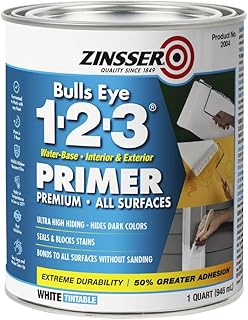
- Water-based styrenated acrylic primer-sealer
- Coverage 400 to 450 sq ft per gallon; about 350 sq ft per gallon on porous surfaces
- Touch dry 30 to 35 minutes; topcoat in 1 hour; full hardness 7 days
- Alkali resistant to pH 12.5; apply between 35 F and 90 F
- Sizes 1 quart, 1 gallon and 5 gallon
Zinsser Bulls Eye 1-2-3 is the fast generalist of the set. It is a water-based styrenated acrylic primer-sealer that bonds to glossy surfaces without scuff sanding, and its alkali tolerance to pH 12.5 makes it suitable over fresh masonry and plaster that would lift an ordinary primer. Coverage is 400 to 450 sq ft per gallon on smooth surfaces and about 350 sq ft per gallon on porous ones, which is the widest coverage in this roundup.
Speed is its main selling point. Touch dry time is 30 to 35 minutes, the next coat can go on after 1 hour, and full hardness arrives in 7 days. Application temperatures run from 35 F to 90 F, with relative humidity under 85 percent. For a plaster job, its role is the preparatory coat over a mixed wall: patches of old paint beside bare plaster, or a wall that has been repaired in several places and needs one even base before the primer that carries the grit goes on. It is not a grit primer itself, and it should not be mistaken for one, but as the first coat in a two-coat preparation it earns its place.
Pros: Fastest recoat time in this guide; bonds glossy surfaces without sanding; high alkali tolerance for fresh masonry; widest coverage per gallon.
Cons: Carries no aggregate, so it gives no mechanical key on its own; needs a grit primer over it where the plaster needs a toothed surface.
Buying guide
Start with the plaster, not the primer. A polished Venetian coat needs a fine quartz primer, because a coarse grit will print through the polished surface and spoil the finish. A medium lime plaster or a rustic stucco needs a medium grit, because a fine primer will not give a heavy coat enough to hold. A render coat over concrete needs a bonding primer with silica aggregate or a PVA bonding agent, because the render is thick and heavy and the wall beneath it is dense. Match the grain to the coat above it first, and the rest of the choice follows.
Check the substrate next. Bare drywall, fresh plaster, old paint and bare concrete each ask for a different primer. A silicate bonding coat such as KEIM Contact-Plus is the answer where an old organic coating cannot be stripped and a mineral finish must go over it. A PVA bonding agent such as Weld-Crete is the answer where sound concrete must carry cement plaster. A tinted acrylic primer is the answer where an acrylic stucco finish must read evenly. Where the wall is a mix of old paint and bare patches, a fast primer-sealer first, then the grit primer, is the sound sequence.
Read the drying time before planning the day. The fast acrylics in this guide allow a topcoat in 1 hour, while the silicate and tinted primers ask for 12 to 24 hours. A primer that is overcoated too early can soften, and a primer that is left too long can collect dust that breaks the bond. The maker's stated temperature range matters too: most of these primers need the air and the wall above 40 F or 5 C, and several should not be applied in direct sun or onto a sun-heated wall.
Work out how much primer the job needs before ordering. Measure the wall area, then divide by the coverage the maker states for the surface in question, remembering that a porous or rough surface takes far more primer than a smooth one. The Loxon figure in the wider primer family shows the spread: 200 to 320 sq ft per gallon on ordinary surfaces, but only about 80 sq ft per gallon on porous rough stucco. Order a little more than the arithmetic suggests, since running out halfway across a wall leaves a visible line where the fresh primer meets the dry edge.
Stir a quartz primer often. The aggregate is heavier than the liquid, and it settles to the bottom of the container while the work goes on. A primer applied from the top of an unstirred container can go on almost grit-free, which defeats its purpose, while the last of the container can go on far too thick. Stir at regular intervals, keep a wet edge, and do not stretch the primer further than the maker states in an effort to cover more wall.
Storage is simple but not optional. Keep containers sealed, cool and frost-free. Most of the primers here carry a shelf life of 12 to 36 months unopened, and an opened container should be closed at once and used within a few weeks. A primer that has frozen, skinned over, or developed a sour smell should not be used, however much is left in the container.
FAQ
What does a quartz grit primer actually do?
It lays a thin coat of fine mineral aggregate on a smooth or slick surface, so the plaster above it has something to grip. The aggregate dries to a lightly abrasive texture, similar to fine sandpaper, and the plaster locks onto that texture mechanically. It also evens out suction, so the plaster dries at one rate across the wall instead of drying fast over thirsty patches and slow over sealed ones.
Can a quartz grit primer go over old paint?
It depends on the primer and the paint. A silicate bonding coat such as KEIM Contact-Plus is made to bridge sound existing organic coatings, and a fast acrylic primer-sealer can prepare a mixed wall first. A plain quartz acrylic primer should go onto a clean, sound surface, and any loose, flaking or powdery paint should be removed before priming. When in doubt, a small sample panel on an inconspicuous area shows whether the bond holds.
How long must a quartz grit primer dry before plastering?
It varies by product. The acrylic quartz primers in this guide are touch dry in 30 minutes and fully dry in 24 hours at 68 F. The KEIM silicate bonding coat needs at least 12 hours between coats, and the SikaWall tinted primer needs at least 24 hours before the finish. The maker's data sheet states the figure for its own product, and that figure is the one to follow.
Is a fine or a medium quartz primer better for Venetian plaster?
Fine, for a polished Venetian coat. The fine aggregate gives a key that will not show through the polished surface. A medium aggregate is the better choice for medium lime plaster, rustic stucco and heavier decorative coats, where a fine key would not hold the weight. Using the medium grade under a polished coat risks a visible texture in the finish.
Do quartz grit primers work outside?
Some do and some do not. The Baumit UniPrimer and the KEIM silicate products are made for exterior render systems, and the SikaWall primers sit under exterior stucco. The artSparx quartz primers are aimed at interior decorative plaster. The maker's stated field of application is the guide: if the data sheet lists exterior use, the primer is made for it, and if it does not, it should stay inside.
Conclusion
A quartz grit primer is a small purchase that decides whether a plaster finish lasts. The fine artSparx primer is the right choice for smooth Venetian and fine lime work, the medium grade covers heavier lime and rustic coats, and the KEIM Contact-Plus handles the hard renovation case of an old coating that cannot be stripped. For render coats over masonry, the MAPEI Eco Prim Grip gives a fast, ready-to-use bond, while the SikaWall-15 adds a tinted base under acrylic stucco and the Larsen Weld-Crete brings published bond figures to cement plaster on concrete. The Zinsser Bulls Eye 1-2-3 completes the set as the fast first coat over a mixed wall.
During the sale weekend, the sensible move is to match the primer to the plaster first, work out the wall area against the maker's coverage figure, and order enough to finish the job without a mid-wall stop. A primer chosen this way does its work invisibly, and the plaster above it is the part that gets noticed.
Related guides
More from Amazon
Programs that pair well with the guide above. Offers and eligibility are set by Amazon and may change.
Send a Prime gift membership to someone who would use free shipping and Prime Video.
Gift Amazon PrimeGive audiobooks to someone who loves to listen. Plans and prices are set by Amazon.
Gift AudibleFree shipping on eligible items, Prime Video and more. Eligible new members can start with a free trial.
Start a Prime free trialAudiobooks and podcasts to listen to on the go. Eligible new members can start with a free trial.
Try Audible freeAs an Amazon Associate we earn from qualifying purchases.










Write Your Review
No reviews yet. Be the first to share your experience!