
Key takeaways
- Compare interior limewash paints colored with mineral pigments for mineral based kitchen walls, with coverage, coats, primers and palette notes for each one.
What's inside
As an Amazon Associate I earn from qualifying purchases. This post may contain affiliate links at no extra cost to you.
A kitchen wall has a harder job than a bedroom wall: it faces steam, cooking splashes, bright task lighting and long hours of use, and it still has to look calm. best interior limewash paints with mineral pigment colors for painting mineral based kitchen walls is a search for interior limewash paints whose color comes from mineral pigments, not synthetic dyes, for walls that are themselves mineral based, such as lime plaster, masonry, brick or stone. Mineral pigments matter here for two reasons. First, they are lightfast, so a shade keeps its character in a bright kitchen instead of fading unevenly. Second, they sit inside a lime binder that breathes, so moisture vapor can pass through the coating instead of being trapped behind it. This guide compares seven interior limewash paints with mineral pigment colors, from makers who publish their pigment story, their palette, their coverage and their primer guidance. Every product below is a real mineral limewash or lime paint, and every specification comes from the maker own published information. The goal is a kitchen wall with a soft, matte mineral color that stays true in strong light and that suits the mineral wall underneath it.
Quick verdict
If you want the widest mineral-pigment palette, start with Bauwerk Limewash Paint: 400 colors, all colored with natural pigments, in a purely mineral paint. If you want a mid-size mineral-pigment range with a clear coverage figure, look at JH Lime Wall Paint: 91 shades colored with natural earth mineral pigments, with a gallon covering about 350 square feet per coat over primed drywall. If you want a natural mineral paint with a large palette, Vasari Lime Paint lists 180 colors made from crushed limestone and powdered marble. If you want the clearest coverage numbers, Color Atelier Lime Paint lists about 350 to 400 square feet per gallon, and Meoded Lime Wash lists a quart at 50 to 75 square feet for two coats. For a mineral-based kitchen wall, prime painted drywall first and paint bare mineral surfaces directly once they are clean and sound, following the maker guidance for each product. Order a sample pot or a quart first, brush it on the kitchen wall, and check the color under the task lighting you actually cook by.
| Product | Key spec | Best for |
|---|---|---|
| Bauwerk Limewash Paint | Pure mineral; 400 natural-pigment colors; no VOC | Widest mineral-pigment palette |
| Color Atelier Lime Paint | 31 pre-mixed colors; zero VOC; 350-400 sq ft per gallon | Clear coverage and three color strengths |
| KEIM Limewash | Pit lime aged 3 years; lightfast mineral pigments; pH 11 | Historic mineral walls and breathability |
| Meoded Lime Wash | 88 colors; zero VOC; quart 50-75 sq ft for two coats | Quart size for a kitchen sample wall |
| Kalklitir Kalkpaint | Powdered 100 percent natural minerals; 20 colors | Powdered mineral paint with a sample chip set |
| JH Lime Wall Paint | Pit lime aged 36 months; 91 mineral-pigment shades; zero VOC | Mineral-pigment range with clear coverage |
| Vasari Lime Paint | Crushed limestone and marble; 180 colors; low VOC | Natural mineral paint with a large palette |
How we chose
The keyword sets three tests, and a product had to pass all three. First, it must be a genuine interior limewash or lime paint with a lime binder, not a latex paint with a mineral look. Second, its color must come from mineral pigments: natural earth pigments, lightfast inorganic pigments, or a palette the maker describes as mineral based. Products whose color story is vague did not qualify. Third, it must suit a mineral-based kitchen wall, which means the maker lists plaster, masonry, brick, stone or other porous mineral surfaces among the suitable substrates, and gives clear guidance on priming painted drywall. We also weighed palette size, because a kitchen needs shades that hold up under bright light, coverage per gallon, because kitchens are often painted in sections, and washability, because a kitchen wall will be wiped more than a bedroom wall. Products that need a sealer for a wipeable surface are still included where the maker says so plainly.
Bauwerk Limewash Paint
- Pure mineral paint made from calcium carbonate with natural pigments
- Palette of 400 colors
- No solvents and no VOC; fireproof with an A1 building class listing
- Sizes in one, five, ten and twenty litre
- Sample pots recommended by the maker for final color selection
- Usable inside and outside, including high-humidity rooms
Bauwerk Limewash Paint is made only from minerals and natural pigments. The maker explains that the paint is manufactured from calcium carbonate, the same material sea shells are made from, and that the only chemical reaction as it sets is the absorption of atmospheric carbon dioxide as the lime paint returns to limestone. That mineral character is why the finish lets walls breathe instead of sealing them under a plastic film, and why the maker lists it for rooms with high humidity as well as for ordinary living spaces.
The color range runs to 400 shades, all colored with natural pigments, so light on the wall reads differently from the same shade in a synthetic paint. The maker is open about the fact that colors can look cooler or greyer on the wall than on the color card, which is exactly why sample pots matter: a small pot brushed on the real wall, in the real light, tells you more than any screen image. For a bedroom, the soft neutrals and muted blues in the range are the natural starting point, and the maker suggests ordering the sample first and living with it for a few days.
Pros: a purely mineral formula, a very wide natural-pigment palette, and sample pots
Cons: colors can shift cooler on the wall, so a sample is close to required
Color Atelier Lime Paint
- Ready-mixed, pre-tinted authentic lime wash paint
- Curated palette of 31 pre-mixed colors
- Zero VOC and virtually odorless
- Coverage about 350 to 400 square feet per gallon
- Two coats with a lime paint brush in X-strokes; at least six hours between coats
- Sizes in quart, one gallon and five gallon; color strengths of 50, 100 and 150 percent
Color Atelier Lime Paint is an authentic lime wash paint that gives the soft patina of a traditional Mediterranean lime paint, ready-mixed and pre-tinted so it can be brushed straight from the can. The maker lists it as a brush-applied, all-natural coating that dries to a matte, velvet-like finish with mottling, and as a breathable, durable finish that is mold and mildew resistant. It is made in small batches in California from lime, clay, marble powder, sand and mineral pigments, and the maker lists it as zero VOC and virtually odorless.
The palette is a curated 31 pre-mixed colors, plus an untinted natural version that can be custom tinted, and each color is offered in three strengths so the same shade can be ordered lighter or darker without changing hue. That strength choice matters in a kitchen, where a pale mineral shade can wash out under bright task lighting and a deeper strength holds its color. Two coats are applied with a lime paint brush in X-strokes or a random, multi-directional pattern, with at least six hours of dry time between coats, and the maker lists coverage of about 350 to 400 square feet per gallon depending on porosity.
Pros: pre-mixed mineral colors in three strengths, and a generous coverage rate
Cons: a smaller curated palette than some rivals, and sealer needed for wipeable areas
KEIM Limewash
- Pit lime matured at least three years with natural mineral pigments
- pH 11 and specific weight of 1.44 grams per cubic centimetre
- Two-coat system with no primer on bare masonry
- Reversible for up to one week, which suits preservation work
- Water vapor permeability of 75 to 85 perms
- For porous mineral surfaces, interior and exterior
KEIM Limewash is a classic lime paint made with pit lime that has matured for at least three years, using only fine, natural mineral pigments, and the maker describes it as a concentrated lime paint that should be thinned before use. It is expressly formulated for porous mineral surfaces, interior and exterior, where a breathable, authentic lime finish is wanted, and the maker lists brick, stucco, historic masonry, porous stone, lime plasters, mortars and renders among the ideal surfaces. New drywall must be primed with a mineral-based paint first, since the limewash has to penetrate the surface to bond properly.
The mineral pigments are lightfast, and the finish forms with less surface tension than ordinary paints, which the maker notes is important for delicate masonry surfaces. It is non-film-forming, so it penetrates and forms chemical bonds with the masonry instead of sitting on top, and it will not peel or lose adhesion in the way a film-forming paint can. For a kitchen with mineral-based walls, that breathability is the point: moisture vapor can pass through the coating instead of being trapped behind it. The finish is reversible for up to one week, which gives a short window to correct a mistake on a historic wall.
Pros: mature pit lime, lightfast mineral pigments, and a very breathable finish
Cons: needs a mineral primer on new drywall and thinning before use
Meoded Lime Wash

- Slaked limestone mineral paint in 88 colors
- Zero VOC and solvent-free
- Sizes in quart, gallon and four gallon
- Coverage of a quart about 50 to 75 square feet and a gallon about 200 to 300 square feet for two coats
- Two-coat cross-hatch brush application
- Lime Wash Base Coat for drywall and previously painted surfaces
Meoded Lime Wash is a slaked limestone mineral paint that creates a weathered, plaster-like finish on almost any interior or exterior surface, and the maker lists it as a matte, mottled finish with a soft touch achieved with a two-coat brush application. It comes in 88 colors, with custom color matching available, and the maker lists it as completely solvent-free and zero VOC, with no harmful fumes, which suits a kitchen where the family spends a lot of time. The finish grows richer and more nuanced as it weathers and matures, according to the maker, and the color is applied in two coats using a cross-hatch technique.
For mineral-based kitchen walls, the preparation step is the decision that matters most. Unsealed brick, natural stone, plaster and other porous mineral surfaces can take the paint directly once properly prepared, while painted drywall needs Meoded Lime Wash Base Coat first to prepare the surface for adhesion and absorption. The maker lists a quart at about 50 to 75 square feet for two coats and a gallon at about 200 to 300, and advises against application below 55 degrees Fahrenheit or in excessive heat over 85 degrees. A quart is also the natural sample size for a kitchen: it covers enough wall to show the real mottling without committing to gallons.
Pros: a wide color range, a clear two-coat method, and a quart size that works as a sample
Cons: needs its own base coat on painted drywall
Kalklitir Kalkpaint
- Powdered lime paint from 100 percent natural minerals
- Mixed with water at one part paint to 1.7 parts water
- A 500 gram pack covers about 12 square metres in two coats
- 20 colors; two coats with a natural-bristle brush
- Sample chip set available before ordering
- For interior walls including bedroom, kitchen and bathroom
Kalkpaint is a powdered lime paint made by Kalklitir in Belgium from 100 percent natural minerals, mixed with water and brushed on so that minerals rise along each brushstroke and leave a soft, refined pattern. The maker lists it as a lime-based mineral paint with a matte finish, visible brush texture and tonal depth, and as breathable and moisture-regulating. It is sold in 500 gram and one kilogram packs, with a 500 gram pack covering about 12 square metres in two coats, and results can vary by about 20 percent depending on conditions and technique.
The mineral pigment story is simple here: the paint is powdered lime plus earth minerals, and the colors run from pale creams such as Crema and Calce through warm beiges such as Elle to a deep navy such as Mare. The maker lists the paint for interior walls in living rooms, bedrooms, kitchens and bathrooms, as well as for exterior walls, and offers a sample chip set so colors can be checked before ordering. Because it is a powder, it ships light and keeps without preservatives, but it has to be mixed for about ten minutes until smooth, at one part paint to 1.7 parts water, before brushing.
Pros: a true powdered mineral paint with a sample chip set and a clear mix ratio
Cons: powder mixing adds time, and coverage varies with technique
JH Lime Wall Paint
- Pit lime aged a minimum of 36 months with natural earth mineral pigments and titanium dioxide
- 91 shades; zero VOC; GREENGUARD Gold Certified
- Sizes in quart, one gallon and 3.5 gallon
- Coverage of one gallon about 350 square feet per coat over primed drywall and about 175 over porous surfaces
- Two coats minimum; dry to touch in two to four hours, recoat in six to eight hours, full cure in seven to ten days
- Sample brush-outs and 8 by 10 inch sample boards available
JH Lime Wall Paint is a lime wall paint built on pit lime aged a minimum of 36 months, colored with natural earth mineral pigments and titanium dioxide, and the maker lists it as zero VOC with a GREENGUARD Gold Certified listing. The palette runs to 91 shades, which gives a kitchen plenty of mineral-pigment choice without the overwhelm of a 400-color range, and the maker offers sample brush-outs and 8 by 10 inch sample boards so a shade can be checked on the real wall before a full order.
For a mineral-based kitchen wall, the coverage figures are the practical guide. A gallon covers about 350 square feet per coat over primed drywall and about 175 square feet per coat over porous surfaces, so a bare lime plaster wall will take noticeably more paint than a primed one, and two coats are the minimum. The paint dries to touch in two to four hours, recoats in six to eight hours, and reaches full cure in seven to ten days, which suits a kitchen painted in sections around cooking.
Pros: natural earth mineral pigments in 91 shades, and clear coverage figures for primed and porous walls
Cons: coverage drops sharply on porous mineral surfaces, so measure carefully
Vasari Lime Paint
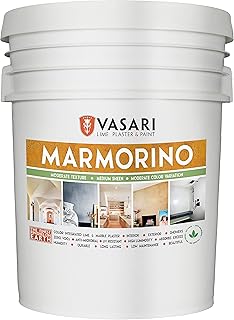
- Natural mineral paint from crushed limestone and powdered marble
- Palette of 180 colors; low VOC
- Coverage about 200 square feet per gallon per coat; minimum two coats
- Sample boards and swatch cards available
- Mineral Primer for preparation; dilutes with water to a lime wash effect
- Burnishable to a soft sheen
Vasari Lime Paint is a natural mineral paint made from crushed limestone and powdered marble, and the maker lists it in 180 colors with low VOC. The paint dilutes with water to a lime wash effect, and it can be burnished to a soft sheen, which gives a kitchen wall a little more light play than a flat matte finish without leaving the mineral family. The maker offers sample boards and swatch cards so a shade can be checked before ordering, and lists a Mineral Primer for surface preparation.
For a mineral-based kitchen wall, the coverage figure sets the order size: about 200 square feet per gallon per coat, with a minimum of two coats, so a bare porous wall will need more paint than the headline figure suggests. The 180-color palette sits between the very large ranges and the small curated ones, which helps when the wall color has to sit beside a fixed stone worktop or a tiled splashback. Two coats are the minimum, and the maker lists the paint for interior and exterior mineral surfaces.
Pros: a natural mineral formula in 180 colors, with sample boards and a burnishable finish
Cons: a smaller palette than the widest ranges, and primer preparation to plan for
Buying guide
Why mineral pigments suit a kitchen
Mineral pigments are the oldest coloring materials in paint, and they behave differently from synthetic dyes. They are lightfast, which means a shade resists fading in a bright kitchen, and they sit inside a lime binder that sets by absorbing carbon dioxide and returning to limestone. Bauwerk explains that its colors come only from natural pigments, KEIM lists only lightfast inorganic mineral pigments, and JH lists natural earth mineral pigments with titanium dioxide for opacity. That mineral character is also why the finish looks different from a synthetic paint: light hits the wall and scatters through the pigment and the lime, giving a soft, matte surface with gentle variation instead of a flat, even coat.
Read the palette before you read the price
Palette size is a practical guide, not a boast. Bauwerk lists 400 colors, Vasari lists 180, JH lists 91 shades, Meoded lists 88, Color Atelier lists 31 pre-mixed colors with three strengths each, and Kalkpaint lists 20. A large palette helps when the kitchen has a fixed element, such as a stone worktop or a tiled splashback, that the wall color has to sit beside. A small curated palette helps when you want a quick decision among shades that already work together. Color Atelier strength system is worth noting: the same shade in 50, 100 or 150 percent strength lets you keep the hue and change the depth, which is useful when a pale mineral shade washes out under bright kitchen lighting. JH lists 91 shades colored with natural earth mineral pigments, which sits between the very large ranges and the small curated palettes, and Vasari lists 180 colors from crushed limestone and powdered marble.
Prepare the mineral wall properly
A mineral-based kitchen wall is usually lime plaster, masonry, brick or stone, and most of the paints in this guide go directly onto a clean, sound, absorbent mineral surface. KEIM lists no primer on bare masonry, Color Atelier lists priming with Matte Primer as needed, and Meoded lists direct application on unsealed brick, stone and plaster. Painted drywall is a different case: Meoded needs Lime Wash Base Coat, Color Atelier needs Matte Primer, and Kalkpaint needs the wall clean and dust-free before mixing and brushing. Check the wall for loose material, grease and old flaking paint first, and repair cracks with a compatible filler before you start. A limewash will not hide a bad surface; it follows the character of the substrate beneath it, as JH puts it.
Plan for steam, splashes and wiping
A kitchen wall will be wiped, and most traditional limewash finishes are not wipeable. Portola is open about this for its limewash, and Color Atelier recommends its sealer for high-traffic or high-moisture areas. None of the seven paints in this guide lists a washability class, so for the wall behind a worktop or beside a cooker, plan on the sealer the maker recommends rather than on the paint alone. Tintural is also open that its natural paints are not suitable for interior wet areas and are best for low-traffic rooms, which is a useful warning for any limewash in a kitchen. Keep limewash away from direct water contact, such as a splashback or a shower wall, and use a sealer where the maker recommends one. For the rest of the kitchen, a matte mineral finish with a little variation will hide small marks far better than a flat synthetic paint.
Measure, mix and order in one batch
Coverage varies widely across this set, so use the maker figure for the product you choose. Color Atelier lists about 350 to 400 square feet per gallon, JH lists about 350 square feet per gallon per coat over primed drywall and about 175 over porous surfaces, Vasari lists about 200 square feet per gallon per coat, KEIM and Meoded give their own figures, and Kalkpaint lists a 500 gram pack at about 12 square metres in two coats. Measure the kitchen walls, subtract cupboards, windows and the splashback, and add 15 to 20 percent extra, since coverage depends on the porosity of the surface. Order the full project quantity at once, because mineral pigments can vary slightly between batches, and a second order may not match the first. For powdered paints such as Kalkpaint, mix at the maker ratio, one part paint to 1.7 parts water, and mix for about ten minutes until smooth.
Check the color under kitchen light
Kitchen lighting is the hardest light in the house for a wall color: bright task lights over worktops, warm pendant lights over a table, and daylight through a window, all in the same room. A mineral pigment color can look very different under each one, so brush a sample on the kitchen wall and check it while you cook, not just while you stand back and admire it. JH offers sample brush-outs and 8 by 10 inch sample boards for exactly this reason, and Vasari offers sample boards and swatch cards. If the shade holds its character under the worktop light and beside the splashback, it will hold up everywhere else in the room.
FAQ
What makes a pigment a mineral pigment?
A mineral pigment comes from earth and stone rather than from synthetic chemistry. The makers in this guide list natural earth pigments, lightfast inorganic mineral pigments, or natural pigments in a lime binder. They are valued for lightfastness and for the soft, matte color they give inside a mineral paint.
Can limewash go on a kitchen wall at all?
Yes, on the right wall and with the right expectations. Makers list mineral-based kitchen walls among the suitable surfaces, but most traditional limewash finishes are not wipeable, and several makers warn against direct water contact. Use a sealer where the maker recommends one, and keep limewash off splashbacks and shower walls.
Do I need a primer on a mineral-based kitchen wall?
On a bare, absorbent mineral wall, several makers list no primer: KEIM lists a two-coat system with no primer on bare masonry, and Meoded lists direct application on unsealed brick, stone and plaster. On painted drywall, a primer or base coat is usually required, such as Meoded Lime Wash Base Coat or Color Atelier Matte Primer.
How do I choose between 400 colors and 20 colors?
A large palette helps when the wall color must sit beside a fixed stone worktop or tiled splashback, since you can search for an exact match. A small curated palette helps when you want a quick decision among shades that already work together. In both cases, order a sample and check it under the kitchen task lighting.
Will a mineral pigment color fade in a sunny kitchen?
Mineral pigments are lightfast, and KEIM lists only lightfast inorganic mineral pigments in its limewash. That does not mean the finish never changes: limewash weathers and develops a patina over time, and the maker notes that the lime binder keeps interacting with the environment as it sets. A sample left in the sunniest part of the kitchen will show how the shade settles.
Conclusion
Mineral pigment colors suit a mineral-based kitchen wall because the pigment and the wall are made of the same kind of material: earth, stone and lime. Bauwerk Limewash Paint offers the widest natural-pigment palette, with 400 colors. JH Lime Wall Paint offers 91 shades colored with natural earth mineral pigments, and Vasari Lime Paint offers 180 colors from crushed limestone and powdered marble. Color Atelier Lime Paint and Meoded Lime Wash give clear coverage figures and a straightforward two-coat method, while KEIM Limewash and Kalkpaint bring mature pit lime and powdered minerals to the same wall. Prepare the mineral surface properly, prime painted drywall, order a sample first, and check the color under the light you cook by. The wall will keep its mineral character for years.
Related guides
More from Amazon
Programs that pair well with the guide above. Offers and eligibility are set by Amazon and may change.
Free shipping on eligible items, Prime Video and more. Eligible new members can start with a free trial.
Start a Prime free trialAudiobooks and podcasts to listen to on the go. Eligible new members can start with a free trial.
Try Audible freeAd-free music streaming. Eligible new subscribers can start with a free trial.
Try Music Unlimited freeA free business account with business pricing and bulk-buying tools for work, shop or home office.
Create a business accountAs an Amazon Associate we earn from qualifying purchases.
More ways to save on your next finish
Programs that pair well with the guide above. Offers and eligibility are set by Amazon and may change.
A free business account with business pricing and bulk-buying tools for work, shop or home office.
Create a business accountFast, free shipping on eligible items, plus Prime Video and more. Eligible new members can start with a free trial.
Start a Prime free trialRead from a huge library of eBooks, including how-to guides and cookbooks. Eligible new members can start with a free trial.
Try Kindle UnlimitedAudiobooks and podcasts for the commute, the garage or the kitchen. Eligible new members can start with a free trial.
Try Audible freeAs an Amazon Associate we earn from qualifying purchases. Using these links costs you nothing extra.










Write Your Review
No reviews yet. Be the first to share your experience!