
Key takeaways
- Clay plaster fails without the right bonding primer. Compare seven verified primers, from Claytec grain primers to mineral options, before the sale ends today.
What's inside
As an Amazon Associate I earn from qualifying purchases. This post may contain affiliate links at no extra cost to you.
Clay plaster is a forgiving finish once it is on the wall, and a demanding one before it gets there. The plaster itself carries no glue that grabs a smooth surface, so the layer underneath decides whether the finish stays put for decades or starts to shell off in sheets after the first dry season. That is why the question are clay plaster binding primers worth buying on black friday deserves a straight answer rather than a shrug. A bonding primer is the thin, gritty coat that gives clay something to hold, evens out how thirsty the wall is, and keeps the board behind the plaster from soaking up the mixing water before the clay can set.
The short version is that a primer is one of the few plaster supplies where buying ahead genuinely pays off. Primers keep for a year or more in a sealed container, they are used on nearly every clay plaster job, and the difference between the right primer and a skipped step shows up as cracked corners and hollow-sounding patches. The rest of this guide compares seven primers that have been checked against maker data sheets, so you can match the primer to your wall instead of guessing in the aisle.
Quick verdict
If your wall is smooth plasterboard, painted drywall, or a slick old plaster, a grain primer is not optional. Claytec Primer YELLOW is the most direct pick for fine clay topcoats, because its fine grain suits thin finishes and it protects boards from the moisture in the wet plaster. For coarse clay base coats, Claytec Primer RED is the matching partner, with a coarser grain and a stated limit of ten millimetres of plaster over it. Walls that sand and shed need the Claytec Deep Penetrating Primer and Stabiliser first, since grain primers add grip but do not glue loose grains together.
American Clay Sanded Primer is the system pick for anyone already working with American Clay plasters, and Zinsser Bulls Eye 1-2-3 is the practical bridge when the wall is painted or glossy and you need a primer that sticks to almost anything before the sand coat goes on. ROMABIO MicroGrip Primer is the mineral option for lime and mineral finishes, with a fine mica grain and a long dry time that suits patient schedules. Buying any of these during a sale makes sense when you have a project dated within the next year, because an unopened primer stores well and the cost of a failed bond is a whole wall of plaster.
| Product | Key spec | Best for |
|---|---|---|
| Claytec Primer YELLOW | Grain 0-1 mm; 10 L covers about 50 sq m | Fine clay topcoats on smooth boards |
| Claytec Primer RED | Grain 0-1.8 mm; plaster up to 10 mm over it | Coarse clay base coats |
| Claytec Primer WHITE | No grain; 10 L covers about 100 sq m | Clay colour coats and design plaster |
| Claytec Deep Penetrating Primer | 10 L covers about 50 sq m; up to 25 percent water | Sandy, shedding lime or cement plaster |
| American Clay Sanded Primer | Primer Sand mixed 1 lb per gallon of primer | American Clay plaster systems |
| Zinsser Bulls Eye 1-2-3 | Topcoat in 1 hour; about 400-450 sq ft per gallon | Painted or glossy walls under clay |
| ROMABIO MicroGrip Primer | Mica grain 0.125 mm; dry time 8-12 hours | Mineral and lime finishes |
How we chose
Every primer here appears on a maker data sheet or an application guide that names it for use under clay plaster or a compatible mineral finish. Grain size, coverage, dry time, and substrate limits come from those documents, not from memory. Products that only claim to work under clay without a written maker statement were left out. The list covers the three jobs a bonding primer has to do: give grip on smooth walls, even out absorption on mixed walls, and stabilise walls that shed grains. One entry, the deep penetrating primer, does the third job only, and the guide says so plainly.
Claytec Primer YELLOW
- Grain size 0 to 1 mm, fine-grained grip for thin finishes
- Item 13.425 is a 10 litre bucket covering about 50 square metres; item 13.420 is a 5 litre bucket covering about 25 square metres
- For use under fine clay topcoat plaster and YOSIMA clay design plaster
- Substrate temperature 5 to 25 degrees Celsius; allow at least 48 hours to dry
- Up to 5 percent water may be added
Claytec Primer YELLOW, sold as DIE GELBE, is the primer the maker pairs with fine clay plasters, and that pairing is the reason it leads this list. The fine grain gives a thin finish something to key into without showing through, and the coat evens out absorbency so a thin layer dries at one speed across the wall. The data sheet also notes that it protects plasterboard and other panelling against moisture from the clay plaster application, which matters because a board that swells at the joints will telegraph every seam through a two-millimetre finish. Stir it thoroughly, roll or brush it over the full surface, and wait the full two days before plastering. The ten-litre bucket covers a generous area, so a single room rarely needs more than one, and the five-litre size suits a single wall or a repair. Stir the primer again during the work so the grain stays evenly spread, and roll it on in one direction to keep the coat even.
Pros: Fine grain suits thin finishes; wide coverage per bucket; protects boards from plaster moisture.
Cons: Not the pick for coarse base coats; needs a full 48 hours of drying before plastering.
Claytec Primer RED
- Grain size 0 to 1.8 mm, coarse grain for thick clay mortars
- Item 13.435 is a 10 litre bucket covering about 30 square metres
- For use before coarse clay plaster mortars
- Total plaster thickness over primer RED is at most 10 mm
- Substrate temperature 5 to 25 degrees Celsius; allow at least 48 hours to dry
Claytec Primer RED, sold as DIE ROTE, is the coarse partner to the yellow primer, and the two should not be swapped. The larger grain holds a heavier coat, and the maker caps the plaster over it at ten millimetres, which is a limit worth respecting rather than learning the hard way. On concrete, a coarse clay plaster over this primer is the standard build-up, and the data sheet pairs it with base plasters that carry straw or a heavier aggregate. Coverage is lower than the yellow primer because the grain is coarser and the coat goes on thicker, so order by the square metres on the sheet rather than by habit.
Pros: Holds coarse and heavy clay coats; clear thickness limit from the maker; proven on concrete and firm old plaster.
Cons: Lower coverage per bucket; wrong choice under a fine finish coat.
Claytec Primer WHITE
- No granulation; smooth liquid primer for colour coats
- Item 13.415 is a 10 litre bucket covering about 100 square metres; item 13.412 is a 1 litre bucket covering about 12 square metres
- For use before CLAYFIX clay colour and YOSIMA clay surfacer
- Substrate temperature 5 to 25 degrees Celsius; allow at least 48 hours to dry
- Up to 5 percent water may be added
Claytec Primer WHITE is the quiet member of the range, and it earns its place because colour coats and thin design plasters do not want grain showing through. With no granulation at all, it prepares a surface for a clay colour or a surfacer without adding texture of its own, and its coverage is the widest of the four Claytec primers at about a hundred square metres per ten-litre bucket. That makes it the economical choice when the job is a colour wash over a sound wall rather than a full plaster build-up. It does not add grip for a thick coat, so use it where the maker places it, under thin colour and surfacer layers.
Pros: Widest coverage in the range; no grain to show through thin colour coats; small 1 litre size for touch-up work.
Cons: Adds no mechanical grip for thick plaster; limited to colour and surfacer work.
Claytec Deep Penetrating Primer and Stabiliser
- Colourless liquid for sandy lime and cement plaster substrates
- Item 13.405 is a 10 litre can covering about 50 square metres; item 13.400 is a 1 litre bottle covering about 5 square metres
- Water, potassium water glass, dispersion and additives under 1 percent
- Up to 25 percent water may be added when strengthening clay plaster surfaces
- Substrate temperature 5 to 25 degrees Celsius
This is the primer to reach for before any grain primer when the wall itself is the problem. Old lime and cement plasters that shed sand when brushed, and clay surfaces that dust under a hand, need their loose grains bound before a grip coat can do its job. The data sheet describes it as a deep penetrating primer and stabiliser for strengthening sandy substrates and for bonding dry plaster boards and interior insulation boards, and it can be applied several times wet in wet where the surface is very sandy. It does not consolidate and seal in the way a paint sealer does; it binds loose grains so the grain primer that follows has something solid to sit on.
Pros: Binds shedding and sandy surfaces; useful on old lime and cement plaster; small bottle size for small repairs.
Cons: Adds no grain or grip on its own; needs a grain primer on top for clay plaster.
American Clay Sanded Primer
- Primer Sand additive mixed into an approved paint primer
- Mixing rate of 1 lb of Primer Sand per gallon of primer
- Leaves a sandpaper-rough surface for a mechanical bond
- For painted or sealed surfaces, slick surfaces, new drywall, and gypsum plasters
- Room temperature 45 to 90 degrees Fahrenheit during application and for three days before and after
American Clay Sanded Primer is a system rather than a single tub, and that is exactly how the maker presents it. The Primer Sand additive is stirred into a primer from the maker's approved list, and the sand in the mix leaves a rough, sandpaper-like surface that clay plaster can grip mechanically. The application guide sorts walls into categories, and painted or sealed surfaces, slick troweled plasters, new drywall, and gypsum plasters all sit in the group that needs this undercoat. High-gloss paint should be sanded with 150-grit paper first so the primer itself has something to hold. Two coats are recommended on plastic corner beads, with a light sanding of the bead beforehand.
Pros: Documented system with an approved primer list; strong mechanical bond on painted walls; suits the most common wall types.
Cons: Requires buying the additive and a primer separately; mixing and stirring take care to keep the sand suspended.
Zinsser Bulls Eye 1-2-3 Water-Base Primer
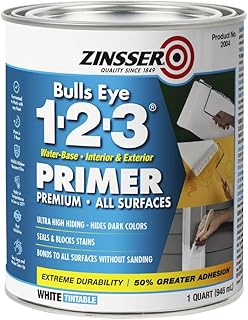
- Water-based styrenated acrylic primer-sealer and stain blocker
- Dries to the touch in about 30 minutes; topcoat in 1 hour; full adhesion in 7 days
- Coverage about 400 to 450 square feet per gallon on smooth surfaces, about 350 on porous surfaces
- Bonds to plaster, concrete, gloss enamels, glass, and tile without scuff sanding
- Apply between 35 and 90 degrees Fahrenheit; shelf life 5 years
Zinsser Bulls Eye 1-2-3 earns its place here because American Clay lists it among the primers approved for use with Primer Sand, and because it solves the one wall that defeats most primers: a glossy painted surface. The data sheet says it bonds to glossy surfaces without scuff sanding, and it blocks stains from grease, handprints, crayon, and light water marks, which matters on old walls with a history. The fast dry time is practical on a working schedule, with a topcoat possible in an hour, though full adhesion takes seven days, so the clay should not be rushed onto a freshly primed wall the same morning. Its low application temperature of 35 degrees Fahrenheit also helps in cool rooms. The primer also blocks stains from grease, handprints, crayon, and light water marks, which matters on old walls with a history. Keep the lid sealed between coats, and stir before each use so the solids stay evenly mixed.
Pros: Sticks to glossy paint without sanding; fast dry and recoat times; on the American Clay approved list; long shelf life.
Cons: Needs the Primer Sand additive to give clay a grip; full adhesion takes a week.
ROMABIO MicroGrip Primer

- Pure potassium silicate primer with fine mica granulation of 0.125 mm
- Single coat; dry time 8 to 12 hours
- Dilute 20 to 30 percent with clean water before application
- Coverage about 70 to 120 square feet per litre
- VOC content 0.3 grams per litre; pH value 11 to 11.5
ROMABIO MicroGrip Primer, listed on the American Clay approved list under its earlier name MediumGrip, is the mineral entry in this roundup. Its binder is pure potassium silicate with a fine mica grain, which gives a thin, grippy mineral coat rather than a plastic film, and that suits lime and mineral finishes that need to breathe. The data sheet calls for a single coat diluted by a fifth to nearly a third with water, applied by brush, roller, or sprayer, and it warns that the primer is not a stain blocker, so stained walls need a separate stain-blocking step first. The eight to twelve hour dry time is the longest here, which makes it a poor pick for a one-day rush and a good pick for a careful job.
Pros: Mineral binder suits lime and clay systems; fine mica grain adds grip without thickness; very low VOC content.
Cons: Long dry time; not a stain blocker; must be diluted before use.
Buying guide
Start with the wall, not the tub. Run a hand over the surface: if it feels smooth and painted, you need grain; if it sheds sand onto your palm, you need the stabiliser first; if it is bare plasterboard with taped joints, a fine grain primer is the standard route. Match the grain to the plaster that follows. Fine topcoats and design plasters take the fine grain, coarse base coats take the coarse grain, and colour coats take the primer without grain. Mixing those pairings up is the most common mistake, and it shows as a finish that looks fine on day one and loosens at the edges later.
Check the coverage figures on the data sheet before ordering, because they vary widely. The white primer covers roughly twice the area of the yellow per litre, and the red covers the least, so buying three buckets of one primer when the job needs another is an easy error. Count the wall area, subtract doors and windows, and add a margin for a second coat on thirsty spots. For the American Clay system, buy the Primer Sand additive and the approved primer together, and confirm the primer you choose is on the maker's list rather than assuming any primer will do.
Drying time is part of the purchase, not an afterthought. Claytec grain primers need at least 48 hours before plastering, the mineral primer needs eight to twelve hours, and the water-based primer reaches full adhesion in seven days. Plan the job around the slowest dry time in your build-up, and keep the room inside the stated temperature range while the primer dries. A primer that dries in a cold draught will not bond the way the data sheet promises.
Storage decides whether a sale purchase is smart. Unopened Claytec primers keep for about a year in a cool, frost-free place, and the water-based primer lists a five-year shelf life. Buy for projects dated within that window, keep the containers sealed and off the floor, and do not buy a primer for a wall you have not yet inspected. A primer bought for the wrong substrate is not a bargain at any reduction.
Ordering is the last step, and it repays a few minutes with a tape measure. Work out the wall area in square metres, subtract the doors and windows, and divide by the coverage on the data sheet for the primer you have chosen. The white primer covers roughly twice the area of the yellow per litre, and the red covers the least, so the same wall can need one bucket or three depending on the grain. Buy one extra litre for touch-ups and for the second coat on thirsty spots, and keep the receipt with the batch number in case a wall needs a matching coat later. For the American Clay system, order the Primer Sand additive and the approved primer together, and check the primer you pick is on the maker's list rather than assuming any primer will do.
FAQ
Do I need a bonding primer under every clay plaster?
No, but most walls need one. Unsealed sand-finish cement stucco, unsealed mud plaster, unsealed lime plaster, and unsealed porous stone can often take clay directly after cleaning and dusting. Painted surfaces, sealed surfaces, new drywall, slick troweled plaster, and gypsum plaster need a sanded or grain primer first, because clay has no chemical grip on a sealed face.
Can I use a grain primer on a wall that sheds sand?
Stabilise first, then prime with grain. A grain primer adds grip but does not glue loose grains together, so a sandy wall should get the deep penetrating primer first, applied wet in wet if the surface is very sandy, and only then the grain primer once the surface is firm.
How long must I wait after priming before plastering?
Claytec grain primers need at least 48 hours to dry completely. The mineral primer needs eight to twelve hours. The water-based primer can be topcoated in an hour but reaches full adhesion in seven days, so give it time before the clay goes on. Do not plaster over a primer that still feels cool or damp.
Is one coat of primer enough?
One full coat is the standard for the grain primers and the mineral primer when the surface is sound and evenly absorbent. Thirsty spots, repairs, and differences in absorbency may need a second coat, and plastic corner beads need two coats of sanded primer. A thin or patchy coat is worse than none, because the plaster will dry unevenly across it.
Can I mix Primer Sand into any primer?
No. American Clay publishes a list of approved primers for use with Primer Sand, and the list includes Zinsser Bulls Eye 1-2-3, KILZ 2 and KILZ 3, ROMABIO MediumGrip, BEHR Multi-Surface Stain-Blocking Primer, Benjamin Moore Fresh Start, and several others. Use a primer from that list, mix one pound of sand per gallon, and stir often to keep the sand suspended.
What happens if I skip the primer?
On a smooth or painted wall, clay plaster can dry, look finished, and then lose its bond in patches, often at corners and edges first. The repair means removing the loose plaster, priming properly, and redoing the coat. A primer costs far less in time and material than a second plastering of the same wall.
Conclusion
So, is a bonding primer for clay plaster worth buying during the sale? Yes, when you buy the right primer for your wall and you have a project dated within the primer's storage life. A bonding primer is not decoration; it is the layer that decides whether a clay finish stays on the wall, and the cost of skipping it is a failed coat rather than a saving. Match the grain to the plaster, stabilise a shedding wall first, respect the drying times, and order by the coverage on the data sheet. Bought that way, a primer picked up during the sale is one of the soundest purchases in a plasterer's store cupboard, and the wall you plaster next will show the difference.
Related guides
More from Amazon
Programs that pair well with the guide above. Offers and eligibility are set by Amazon and may change.
Send a Prime gift membership to someone who would use free shipping and Prime Video.
Gift Amazon PrimeGive audiobooks to someone who loves to listen. Plans and prices are set by Amazon.
Gift AudibleFree shipping on eligible items, Prime Video and more. Eligible new members can start with a free trial.
Start a Prime free trialAudiobooks and podcasts to listen to on the go. Eligible new members can start with a free trial.
Try Audible freeAs an Amazon Associate we earn from qualifying purchases.
More ways to save on your next finish
Programs that pair well with the guide above. Offers and eligibility are set by Amazon and may change.
A free business account with business pricing and bulk-buying tools for work, shop or home office.
Create a business accountFast, free shipping on eligible items, plus Prime Video and more. Eligible new members can start with a free trial.
Start a Prime free trialRead from a huge library of eBooks, including how-to guides and cookbooks. Eligible new members can start with a free trial.
Try Kindle UnlimitedAudiobooks and podcasts for the commute, the garage or the kitchen. Eligible new members can start with a free trial.
Try Audible freeAs an Amazon Associate we earn from qualifying purchases. Using these links costs you nothing extra.










Write Your Review
No reviews yet. Be the first to share your experience!