
Key takeaways
- Cyber Monday is a good time to stock bonding primers for Venetian plaster. Compare eight real primers by coverage, dry time and grip, then choose the right one.
What's inside
As an Amazon Associate I earn from qualifying purchases. This post may contain affiliate links at no extra cost to you.
Cyber Monday is the second chance of the sale weekend, and for a plasterer it is often the better one. The rush of the first day has passed, stock levels are clearer, and there is time to measure a wall and choose a primer properly instead of grabbing the first can on the shelf. The best cyber monday bonding primers for venetian plaster deals are not the cheapest cans in the store. They are the primers whose coverage, drying time and bonding strength match the wall they will go on, bought in the right quantity for a planned job.
Venetian plaster asks a lot of its primer. The finish is built in thin coats, each one polished, and every coat depends on the bond beneath it. A primer that fails to control suction will let the plaster dry too fast and crack. A primer that fails to grip will let the finish peel. A primer that cannot tolerate lime will break down under an alkaline plaster. The eight primers in this guide were chosen because each one publishes the figures that let a buyer judge those risks: coverage, drying time, bond strength or alkaline tolerance, stated by the maker.
The selection leans toward oil based and mineral primers this time, alongside two proven acrylic sealers. An oil based primer such as Zinsser Cover Stain seals chalky and stained surfaces that a water based product may not hold. A silicate primer such as KEIM Soldalit Fixativ bonds chemically with mineral surfaces. A casein primer such as Kreidezeit 145 is made for the lime and gypsum boards that Venetian plaster often covers. Different walls need different primers, and this guide covers the range.
Quick verdict
If one primer had to be picked for the widest range of Venetian plaster work, it would be the Sherwin-Williams Loxon Concrete and Masonry Primer-Sealer, which appears here alongside the Cyber Monday selection because it remains the most complete masonry primer available, with a published coverage figure for porous stucco and a pH tolerance up to 13. But the lead pick for this guide is the Zinsser Cover Stain Oil-Based Primer-Sealer, because it solves the problems a water based primer cannot: chalky masonry, stained surfaces and old paint that needs sealing before plaster goes on.
For a buyer using the sale to stock up, the practical approach is to buy for the walls you actually have. A chalky exterior render needs Cover Stain or a silicate primer. A fresh lime coat needs a casein or mineral primer. A tinted finish needs a tinted primer such as SikaWall-15, so the base colour does not show through. Buy the primer the wall needs, and the plaster will reward the care.
| Product | Key spec | Best for |
|---|---|---|
| Zinsser Cover Stain Oil-Based Primer-Sealer | About 400 sq ft per gal smooth; recoat in 2 hours | Chalky and stained masonry |
| SikaWall-15 Tinted Primer | 150 to 250 sq ft per gal; dry at least 24 hours | Tinted finishes over stucco |
| Sika Thorocoat-100 Primer | 300 to 375 sq ft per gal; recoat in 2 to 4 hours | Weak and dusty substrates |
| Parex 121 Base Coat and Adhesive | Levels and fills up to 3/8 in per pass | Parex base coats and repairs |
| KEIM Soldalit Fixativ | Primer use about 0.15 litres per sq m; pH about 11 | Silicate and mineral surfaces |
| Kreidezeit Casein Primer 145 | For gypsum, lime-gypsum and cement fibre boards | Lime plaster over boards |
| Sherwin-Williams Loxon Concrete and Masonry Primer-Sealer | 200 to 320 sq ft per gal; pH 6 to 13 | General masonry and stucco |
| Zinsser Bulls Eye 1-2-3 | 400 to 450 sq ft per gal; topcoat in 1 hour | Fast work over varied surfaces |
How we chose
Every primer in this roundup had to meet four conditions. First, it had to be a real, named product with a published role in bonding or priming masonry, plaster or stucco. Second, the maker had to publish coverage and drying figures, because those numbers decide how much to buy and how long to wait before plastering. Third, the primer had to suit at least one surface Venetian plaster is commonly applied over: cured render, plasterboard, concrete, masonry, a sound painted wall or a lime coat. Fourth, the product had to be currently sold in a pack size a plasterer can buy.
This guide gives extra weight to primers that solve a specific problem. Cover Stain earns its place by sealing chalky surfaces. Thorocoat-100 earns its place by consolidating weak, dusting substrates. Soldalit Fixativ earns its place by bonding chemically with mineral surfaces. Casein Primer 145 earns its place by preparing the boards that lime plaster is often applied over. A primer that does one difficult job well is more useful than a primer that does every easy job adequately.
Coverage and drying time were compared across the whole set, and the differences are large: from 150 square feet per gallon for a tinted stucco primer to 450 for a fast water based sealer, and from one hour to a full day of drying. Those differences decide both the quantity to buy and the schedule of the job, so they are stated for every product in this guide.
The selection was made from maker data sheets and retailer listings that publish their own specifications. No product was included on the strength of a review alone, and no specification in this guide was taken from a source that did not publish it.
Zinsser Cover Stain Oil-Based Primer-Sealer
- Type: oil based primer-sealer
- Coverage: about 400 sq ft per gallon on smooth surfaces, about 300 sq ft per gallon on rough porous surfaces
- Drying: touch dry in 30 minutes, recoat in 2 hours, fully hard in 7 days
- Application: 41 to 90F; binds chalky surfaces; for masonry including stucco, concrete block, poured concrete and brick
- Note: not for floors, decks or roofs
Cover Stain is the oil based option in this roundup, and oil brings properties a water based primer cannot match. It seals chalky masonry, locks in stains, and grips surfaces that have been painted or weathered. The maker lists it for masonry including stucco, concrete block, poured concrete and brick, which covers most of the walls a Venetian plaster will meet. On a rough porous surface the coverage drops to about 300 square feet per gallon, which is a realistic figure that helps a buyer order the right quantity.
The drying schedule is practical: touch dry in 30 minutes and ready for a recoat in 2 hours, with full hardness reached in 7 days. That means a wall primed in the morning can carry plaster the same day, while the primer continues to harden beneath the finish for a week. The trade-off for oil is odour and cleanup, which need solvents rather than water, and the application range of 41 to 90F, which rules out cold weather work. For a chalky or stained wall that a water based primer would not hold, those trade-offs are worth accepting.
Pros: Seals chalky and stained masonry that water based primers may not hold; high coverage on smooth surfaces; fast touch dry and two-hour recoat; made for stucco, block, concrete and brick.
Cons: Oil based, so cleanup needs solvents and the odour is stronger; full hardness takes 7 days; not for use below 41F; not for floors, decks or roofs.
SikaWall-15 Tinted Primer
- Type: 100 percent acrylic tinted primer
- Coverage: 750 to 1,250 sq ft per 5 gallon pail, or 150 to 250 sq ft per gallon
- Drying: dry for at least 24 hours before the finish is applied
- Purpose: tinted primer for stucco finishes, so the base colour matches the finish
SikaWall-15 is the tinted primer in this roundup, and its tint is its purpose. A Venetian plaster finish is thin, and a white primer beneath a coloured finish can show through at edges, in thin spots or where the plaster is polished hard. A tinted primer matched to the finish colour removes that risk, and it also evens out the appearance of the wall before the plaster goes on. The maker states that the primer should dry for at least 24 hours before the finish, which is the slowest drying time in this guide but a realistic one for a full acrylic coat.
The coverage of 150 to 250 square feet per gallon is modest, so a large wall needs more product than the headline figure might suggest. In return, the primer is a 100 percent acrylic product from a maker whose stucco systems are widely specified, and it is made for the same stucco bases that Venetian plaster is often applied over. For a coloured Venetian finish over a stucco base, a tinted primer is the correct preparation, and this is the product that provides it.
Pros: Tinted to match the finish, so the base colour cannot show through; 100 percent acrylic; made for stucco bases; consistent with SikaWall systems.
Cons: Slow drying, at least 24 hours before the finish; lower coverage per gallon than the fast primers; only useful where a tinted base is wanted.
Sika Thorocoat-100 Primer
- Type: clear water based modified acrylic primer
- Coverage: 300 to 375 sq ft per gallon
- Drying: recoat in 2 to 4 hours at 70F and 50 percent relative humidity
- Application: not at or below 40F; no rain within 6 hours
- Pack: 5 gallon pail; shelf life 24 months
- Purpose: consolidates weak and dusting substrates; for concrete, masonry, stucco, Portland cement plaster and previously painted surfaces; vertical and overhead use
Thorocoat-100 is the consolidating primer in this roundup, and it earns its place by doing a job the others do not state. It is made to consolidate weak and dusting substrates, which is the condition of many old renders and plasters that look sound but shed dust when touched. A primer that merely sits on a dusty surface will peel with the dust; a consolidating primer soaks in and binds the surface together, giving the plaster a solid base.
The coverage of 300 to 375 square feet per gallon is solid, and the recoat time of two to four hours fits a normal working day. The application limits are clear: not at or below 40F, and no rain within six hours, which matters for exterior work. The 24-month shelf life is generous for a water based product. For a Venetian plaster over an old, dusty or friable wall, this is the primer that prepares the surface properly instead of covering the problem.
Pros: Consolidates weak and dusting substrates rather than merely coating them; good coverage; clear application limits; 24-month shelf life; suits vertical and overhead work.
Cons: Not for use at or below 40F; needs six hours without rain; a specialist product that is more than a sound wall needs.
Parex 121 Base Coat and Adhesive
- Type: base coat and adhesive for Parex exterior insulation and finish systems
- Use: leveler and filler for masonry, concrete and stucco, up to 3/8 in per pass
- Mix: 1 to 1 with Portland cement
- Pack: 55 lb pails
Parex 121 is not a primer in the usual sense. It is a base coat and adhesive that levels and fills masonry, concrete and stucco, and it earns its place in this guide because the preparation of a wall for Venetian plaster often needs levelling before any primer goes on. A wall with hollows, rough patches or an uneven render will not take a thin Venetian finish well, and a base coat that can fill up to three-eighths of an inch in a pass is the right tool for that preparation.
The product is mixed one to one with Portland cement, and it is sold in 55-pound pails. It is the base coat in the Parex system, used with the Parex 310 primer and the 355 mesh, and it should be used as part of that system where the specification calls for it. For a Venetian plaster job where the wall needs levelling first, it is the preparation step that makes the primer and the plaster work properly.
Pros: Levels and fills up to 3/8 in per pass; made for masonry, concrete and stucco; part of a specified Parex system; clear mixing ratio with Portland cement.
Cons: A base coat, not a primer, so it does not replace the primer coat; only the right choice inside a Parex system; needs mixing with cement.
KEIM Soldalit Fixativ
- Type: sol-silicate primer and diluent, silica sol plus water glass
- Density: 1.0 to 1.1 g per cubic centimetre; pH about 11; organic content 5 percent or less
- Consumption as primer: about 0.15 litres per square metre
- Application: apply undiluted as a primer; minimum 5C
- Packs: 5 and 20 litres; shelf life about 12 months
Soldalit Fixativ is the silicate primer in this roundup, and it works in a different way from the acrylic primers. A silicate primer bonds chemically with a mineral surface, forming a bond that is part of the wall rather than a film on top of it. That makes it a strong choice for mineral renders, lime plasters and silicate finishes, where a chemical bond is more durable than a mechanical one. The pH of about 11 shows that it is made for alkaline mineral surfaces, and the organic content of 5 percent or less keeps it close to a pure mineral product.
The consumption figure of about 0.15 litres per square metre is precise, which makes it easy to work out the quantity for a wall. It is applied undiluted as a primer, at temperatures above 5C, and it comes in 5 and 20 litre packs with a shelf life of about 12 months. For a Venetian plaster over a mineral render, or for a silicate finish system, it is the primer that matches the chemistry of the wall.
Pros: Chemical silicate bond with mineral surfaces; very low organic content; precise consumption figure; alkaline pH suits lime and mineral plasters; two practical pack sizes.
Cons: Only for mineral surfaces, not for painted or glossy walls; minimum application temperature of 5C; shelf life of about 12 months is shorter than the acrylic primers.
Kreidezeit Casein Primer 145
- Type: casein primer for lime and gypsum based surfaces
- Surfaces: gypsum plasters, lime-gypsum plasters, concrete, plasterboards, gypsum fibre boards, Wedi boards and cement fibre boards
- Use: priming coat before the lime wall finish, followed by the lime wall finish coat
Casein Primer 145 is the board primer in this roundup, and it is made for the surfaces that Venetian plaster most often covers in a modern interior. Plasterboard, gypsum fibre board and cement fibre board are smooth, absorbent in patches, and often jointed, which makes them difficult to plaster without preparation. A casein primer evens out the suction across the boards and the joints, and it gives the lime finish a consistent base to grip.
The maker lists a wide range of boards and plasters, which shows that the primer is made for the job rather than adapted to it. It is followed by the lime wall finish coat, which is the intermediate layer beneath a tadelakt or Venetian finish, so the primer sits at the start of a proper lime system. For a Venetian plaster over boards in a bathroom, a kitchen or a new interior wall, it is the correct preparation, and it is the primer a lime plasterer will reach for first.
Pros: Made for plasterboard and fibre boards, the commonest interior surfaces for Venetian plaster; evens suction across boards and joints; part of a proper lime system; casein base suits lime finishes.
Cons: Only for the boards and plasters the maker lists, not for exterior masonry; no coverage figure published on the maker guide, so quantity must be worked out from the board area and the maker's data sheet.
Sherwin-Williams Loxon Concrete and Masonry Primer-Sealer
- Type: acrylic primer-sealer for concrete and masonry
- Coverage: 200 to 320 sq ft per gallon, and 80 sq ft per gallon on porous rough stucco
- Drying: touch dry in 4 hours, recoat after 24 hours at 77F and 50 percent relative humidity
- Alkalinity: tolerates pH 6 to 13
- Application: minimum 40F; topcoat within 14 days on exterior work
- Shelf life: 36 months
Loxon returns in this guide because it remains the most complete masonry primer available, and a Cyber Monday selection would be weaker without it. Its data sheet gives a separate coverage figure for porous rough stucco, which is the surface a plasterer is most likely to meet, and it states a pH range up to 13, which covers lime plaster comfortably. The recoat window of 24 hours is slower than the fast primers, but it is a realistic figure for a sealer that needs to settle into a porous surface.
For a buyer comparing the whole set, Loxon is the reference point: any primer that cannot match its coverage honesty, its pH tolerance or its shelf life should be judged against it. For a general Venetian plaster job over sound masonry or render, it is still the primer to start with, and a sale purchase of a gallon will keep for 36 months if it is not needed at once.
Pros: Published coverage for porous stucco as well as normal masonry; wide pH tolerance that suits lime plaster; long 36-month shelf life; clear recoat and topcoat windows.
Cons: Slower recoat time than fast drying rivals; coverage drops sharply on very porous surfaces, so a rough wall needs more product than the headline figure suggests.
Zinsser Bulls Eye 1-2-3
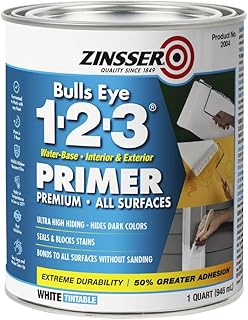
- Type: water based styrenated acrylic primer-sealer
- Coverage: 400 to 450 sq ft per gallon
- Drying: touch dry in about 30 minutes, topcoat in 1 hour, full hardness in 7 days
- Bonding: bonds glossy surfaces without scuff sanding
- Application: low application temperature of 35F
Bulls Eye 1-2-3 is the fast option in this roundup, and it earns its place by doing in an hour what the slowest primers in this guide take a day to do. A touch dry time of about 30 minutes and a topcoat time of one hour mean that a wall primed in the morning can carry plaster in the afternoon. The coverage of 400 to 450 square feet per gallon is the highest in this guide, so a single gallon covers a large area.
The maker states that the primer bonds glossy surfaces without scuff sanding, which makes it useful on a painted wall or a smooth sealed surface where a masonry sealer might struggle. It is water based, so cleanup is simple and the odour is low. For Venetian plaster over a sound but glossy surface, or for a job where the schedule is tight, it is a strong pick, and it is a sensible product to have on the shelf for the next job.
Pros: Very fast drying with a one-hour topcoat time; high coverage per gallon; bonds glossy surfaces without sanding; water based with easy cleanup.
Cons: A general purpose primer rather than a dedicated masonry sealer, so it is not the first choice for very porous render; full hardness takes 7 days, so the finish should not be stressed early.
Buying guide
Start with the wall, and be honest about its condition. A chalky wall that leaves dust on your hand needs an oil based sealer such as Cover Stain, or a consolidating primer such as Thorocoat-100. A weak, dusty render needs consolidation before anything else goes on. A sound masonry wall needs a sealer that controls suction, such as Loxon. A board wall needs a casein primer such as Kreidezeit 145. A coloured finish needs a tinted primer such as SikaWall-15. The primer follows the wall, not the other way round.
Read the coverage figure as a range, and use the lower end for a porous wall. Every maker in this guide gives a range, because a rough surface takes more primer than a smooth one. Measure the wall, divide by the lower coverage figure, and add a margin for a second coat where the maker calls for one. A tinted primer such as SikaWall-15 covers only 150 to 250 square feet per gallon, so a large wall needs several gallons, while a fast primer such as Bulls Eye 1-2-3 covers 400 to 450 and needs far less.
Check the drying time against your schedule before you buy. A primer that needs 24 hours, such as SikaWall-15, means the wall cannot be plastered the same day. A primer that is ready in one hour, such as Bulls Eye 1-2-3, allows priming and plastering in a single day. A silicate primer such as Soldalit Fixativ needs a minimum of 5C, and an oil based primer such as Cover Stain needs at least 41F. Do not buy a primer that the weather will not allow you to use.
Check alkaline tolerance wherever the maker publishes it. Venetian plaster is lime based, and a primer that cannot tolerate a high pH will break down beneath the finish. Loxon states a pH range up to 13, and Soldalit Fixativ states a pH of about 11, which are both clear, useful figures. Where a maker does not state a pH figure, prefer a mineral primer made for lime finishes, or ask the maker before buying.
Buy the system primer when the job names a system. If the specification calls for a Parex finish, use the Parex 121 base coat with the Parex 310 primer and mesh. If the job calls for a SikaWall base, use the SikaWall primer made for it. Mixing systems is a common cause of failure, and the saving from substituting a cheaper primer is small beside the cost of redoing a wall.
Finally, buy for the area, not for the shelf. Primers have shelf lives, from about 12 months for a silicate primer to 36 months for Loxon, and a can that sits unopened for two years may still be usable, but it is not a bargain if it is never opened. Measure the walls, work out the quantity from the coverage range, and buy that quantity with a small margin. A Cyber Monday purchase makes sense when it covers a planned job; it makes less sense as a stockpile.
FAQ
Do I need a bonding primer under Venetian plaster?
Yes, in almost every case. Venetian plaster is applied in thin layers, and it needs a primed surface to grip, to dry evenly and to resist the suction of the wall beneath. An unprimed porous wall will draw water out of the plaster too fast, which leads to uneven drying and cracking. An unprimed glossy wall will not grip at all. A bonding primer solves both problems, and it is a small part of the total cost of a plaster job.
Can I use an oil based primer under a lime plaster?
Yes, provided the primer is made for masonry and the plaster maker accepts it. Zinsser Cover Stain is listed for masonry including stucco, concrete block and brick, and it seals chalky surfaces that a water based primer may not hold. Allow the full recoat time the maker states, and confirm that the plaster you plan to use is compatible with an oil based base. For a lime system where the maker specifies a mineral primer, use the mineral primer instead.
How long should I wait after priming before applying Venetian plaster?
Follow the maker figure for the primer you used. Bulls Eye 1-2-3 is ready for a topcoat in one hour, Cover Stain is ready for a recoat in two hours, Thorocoat-100 needs two to four hours, and SikaWall-15 needs at least 24 hours. The wall should be dry to the touch and the primer fully set before plastering begins. Rushing this step is one of the most common causes of a failed bond.
How much primer do I need for one room?
Measure the wall area and divide by the coverage figure for your primer, using the lower end of the range for a porous wall. As a rough guide, a gallon of Bulls Eye 1-2-3 at 400 square feet per gallon covers a large room, while a gallon of SikaWall-15 at 150 square feet per gallon covers a small one. Always add a margin for a second coat where the maker calls for one, and for the extra primer a porous wall will absorb.
What is the difference between a bonding primer and a sealer?
A sealer controls suction and evens out absorption, while a bonding primer adds grip for the coat that follows. Many products in this guide do both, and the distinction is less important than the maker's stated purpose. Loxon is described as a primer-sealer, Weld-Crete as a bonding agent, and Soldalit Fixativ as a silicate primer. Read the maker's description of the job the product does, and match it to the wall.
Conclusion
The best Cyber Monday bonding primer for Venetian plaster is the one that matches the condition of your wall. For a chalky or stained surface, Zinsser Cover Stain is the lead pick, with an oil based seal that water based primers cannot match. For a weak and dusty render, Sika Thorocoat-100 consolidates the surface before the plaster goes on. For a mineral render, KEIM Soldalit Fixativ bonds chemically with the wall. For boards, Kreidezeit Casein Primer 145 prepares the surface for a lime finish. For a coloured finish, SikaWall-15 gives a tinted base. And for a general job over sound masonry, Loxon remains the reference primer, with Bulls Eye 1-2-3 as the fast alternative.
Buy the primer the wall needs, in the quantity the area needs, and allow the full drying time the maker states. A sale purchase is a sound move when it covers a planned job, and a poor move when it is a guess. With the right primer beneath it, a Venetian plaster finish will hold its shine and its bond for years, and that is the result a careful purchase is really buying.
Related guides
More from Amazon
Programs that pair well with the guide above. Offers and eligibility are set by Amazon and may change.
Send a Prime gift membership to someone who would use free shipping and Prime Video.
Gift Amazon PrimeGive audiobooks to someone who loves to listen. Plans and prices are set by Amazon.
Gift AudibleFree shipping on eligible items, Prime Video and more. Eligible new members can start with a free trial.
Start a Prime free trialAudiobooks and podcasts to listen to on the go. Eligible new members can start with a free trial.
Try Audible freeAs an Amazon Associate we earn from qualifying purchases.
More ways to save on your next finish
Programs that pair well with the guide above. Offers and eligibility are set by Amazon and may change.
A free business account with business pricing and bulk-buying tools for work, shop or home office.
Create a business accountFast, free shipping on eligible items, plus Prime Video and more. Eligible new members can start with a free trial.
Start a Prime free trialRead from a huge library of eBooks, including how-to guides and cookbooks. Eligible new members can start with a free trial.
Try Kindle UnlimitedAudiobooks and podcasts for the commute, the garage or the kitchen. Eligible new members can start with a free trial.
Try Audible freeAs an Amazon Associate we earn from qualifying purchases. Using these links costs you nothing extra.










Write Your Review
No reviews yet. Be the first to share your experience!