
Key takeaways
- Compare bonding primers for Venetian plaster on painted drywall accent walls: grip, absorption control, drying and topcoat compatibility for a lasting finish.
As an Amazon Associate I earn from qualifying purchases. This post may contain affiliate links at no extra cost to you.
A painted drywall accent wall is a common starting point for Venetian plaster, and it is also one of the trickier ones. The paint on the wall may be glossy, it may be old, and it may absorb unevenly from one area to another, which means the plaster can grip well in one place and slip in another. A bonding primer changes that by giving the plaster a uniform surface to hold onto, with enough tooth for the first coat to key into and enough sealing to even out the absorption of the paint beneath. Without it, the plaster can peel, blister or dry in patches, and the fault will show in the polished finish. The best bonding primers for Venetian plaster for preparing painted drywall accent walls are the ones that bond to a painted surface, give the plaster a mechanical key, control absorption, and dry to a base that the plaster can be worked over without lifting.
Painted drywall presents two problems at once. The first is adhesion: a glossy or hard paint film gives the plaster little to grip, so the first coat needs a primer with aggregate or a chemical bond to the paint. The second is absorption: bare drywall paper, filled joints and painted areas all absorb at different rates, so the plaster dries unevenly and the colour can vary across the wall. A good bonding primer solves both, by sealing the surface to an even absorption and by leaving a textured key that the plaster can hold.
Preparation before priming matters as much as the primer itself. The wall should be clean, sound and dry, with loose paint removed and glossy areas lightly sanded to break the sheen. Joints should be filled and flat, because Venetian plaster is thin and will show every ridge and hollow beneath it. Dust should be removed, because a dusty surface weakens the bond no matter how good the primer is. Once the wall is prepared, the primer is applied evenly, allowed to dry fully, and the plaster is started only when the primer has cured to the maker's guidance.
Drying time is a practical point that is often rushed. A primer that feels dry to the touch may still be soft underneath, and plaster laid over a soft primer can lift or slide. The drying times in this roundup range from half an hour to overnight, and the longer times belong to primers that form a chemical bond with the surface. Waiting the full time is part of the job, and it is cheaper than repairing a wall that has failed.
This roundup compares six bonding primers that suit painted drywall accent walls: a mineral primer with a chemical bond, quartz primers with a mechanical key, a lime-specific primer, a general multipurpose primer-sealer, and two decorative-system primers. Each entry gives the verified specification, the drying time and the surface it suits, so the choice can be made on the wall in front of you.
Best products
Romabio MicroGrip Primer

Romabio MicroGrip Primer is a universal mineral primer for interior and exterior use, based on pure potassium silicate with fine mica granulation of 0.125 millimetres. It is a single-coat, non-acrylic primer that creates a permanent chemical bond with mineral substrates through petrification, giving adhesion that conventional acrylic primers cannot match. It is sold in 1 litre, 2.5 litre and 15 litre buckets, with a coverage of 70 to 120 square feet per 1 litre coat, and it must be diluted with water, starting at 25 percent dilution. The ideal drying time is at least 8 to 12 hours.
- Binder: pure potassium silicate with fine mica, 0.125 millimetre granulation
- Type: universal mineral primer, non-acrylic, interior and exterior
- Pack sizes: 1 litre, 2.5 litres, 15 litres
- Coverage: 70 to 120 square feet per 1 litre, one coat
- Dilution: 20 to 30 percent with water
- Drying: 8 to 12 hours before overcoating
- Surfaces: painted drywall, painted brick, painted stone, concrete, cement board, stucco
MicroGrip leads for painted drywall accent walls because it bonds chemically to the mineral surface and bridges the gap between an acrylic paint film and a mineral plaster. Where a painted wall would reject a lime plaster, MicroGrip gives the plaster a mineral base to hold onto, and its fine mica aggregate leaves a slight texture that adds a mechanical key as well. It is the primer specified under Romabio Venetian Glaze on interior drywall, where one coat is applied, left to dry overnight and then lightly sanded to a uniform surface before the plaster goes on.
The long drying time is part of the bond. The primer should be left at least 8 to 12 hours, and on a painted wall it is worth leaving it overnight, so the silicate bond can form fully before the plaster is applied. The primer is white-based and should generally not be tinted beyond a small amount of colorant. For an accent wall that will carry a Venetian plaster, MicroGrip gives the most secure base in this roundup, and its single-coat application keeps the preparation simple.
Romabio MediumGrip Primer
Romabio MediumGrip Primer is a one-coat, non-acrylic primer paint with fine to medium aggregate, for interior and exterior surfaces. It is the coarser-aggregate companion to MicroGrip in the Romabio mineral primer range, and it is the primer required under Romabio Marmorino Satin. The product must be diluted 20 to 30 percent with water before application, and the drying time is 8 to 12 hours. Coverage is approximately 55 to 85 square feet per 1 litre, 130 to 215 square feet per 2.5 litres, and 800 to 1,300 square feet per 15 litres, for one coat diluted as directed.
- Type: one-coat, non-acrylic primer paint with fine to medium aggregate
- Use: interior and exterior, under Romabio mineral plasters including Marmorino Satin
- Pack sizes: 1 litre, 2.5 litres, 15 litres
- Coverage: 55 to 85 square feet per 1 litre, 130 to 215 per 2.5 litres, 800 to 1,300 per 15 litres
- Dilution: 20 to 30 percent with water
- Drying: 8 to 12 hours
- Application: brush, roller or spray
MediumGrip suits an accent wall where the finish will be a Romabio mineral plaster and the painted surface is sound but slick, because its medium aggregate gives the first coat a stronger mechanical key than a fine primer. The aggregate sits proud of the paint film and the plaster locks around it, which helps on a painted wall where a fine primer might not bite firmly enough. It is a single-coat primer, so the preparation stays simple, and its mineral base bridges the paint film and the lime plaster in the same way MicroGrip does.
In practice, the wall should be sanded lightly where the paint is glossy, dusted clean, and given one even coat diluted at about 25 percent, by brush or roller. The primer should be left a full 8 to 12 hours, and on a painted wall it is worth leaving it overnight, so the bond can form fully before the plaster is started. The plaster should then be applied in thin coats, so the primer is not overloaded. For a Venetian plaster accent wall built with Romabio materials, MediumGrip gives a system-matched base with a stronger key than its fine-aggregate companion.
Stucco Italiano Primer Normal
Stucco Italiano Primer Normal is a special primer for lime-based products, made from a special acrylic polymer, water and special additives. It is transparent in colour and opaque with a slightly rough appearance, and it is used as a primer for Marmorino Veneziano, lime paint and Intonachino. It is sold in 10 litre and 1 litre polyethylene containers, with a dilution of 600 to 900 percent with water, a theoretical yield of 150 to 200 grams per square metre, and a drying time of 1 hour to the touch and 18 hours below the surface.
- Composition: special acrylic polymer, water, special additives
- Colour: transparent; appearance: opaque, slightly rough
- Pack sizes: 10 litres, 1 litre
- Dilution: 600 to 900 percent with water
- Yield: 150 to 200 grams per square metre
- Drying: 1 hour to the touch, 18 hours below the surface
- Surfaces: new plaster, gypsum, plasterboard, medium density wood, old plaster, washable paint
Primer Normal suits a painted drywall accent wall where the plaster will be a Stucco Italiano lime product, because the primer is made for that system. Its slightly rough, opaque finish gives the plaster a key, and its high dilution means a small amount of product goes a long way. The primer is applied by brush or roller, and it should be used within a temperature range of 5 to 30 degrees Celsius, with relative humidity below about 85 percent.
The drying time needs care. The surface feels dry after an hour, but the primer is not dry below the surface until about 18 hours, so the plaster should not be rushed onto a freshly primed wall. For an accent wall, priming in the evening and plastering the next day fits the drying time well. The primer has a shelf life of 24 months, so a part-used container can be kept for a later wall if it is sealed and stored properly.
Zinsser Bulls Eye 1-2-3
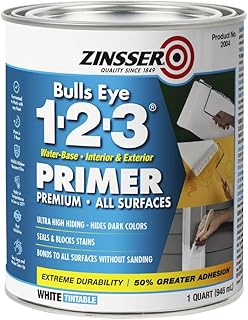
Zinsser Bulls Eye 1-2-3 is a water-based multipurpose primer-sealer suited to many properly prepared interior and exterior surfaces. It is a general primer rather than a plaster-specific one, and its value on a painted drywall accent wall is that it seals and unifies a mixed surface, blocking stains and evening out absorption so the plaster dries evenly. It is widely stocked, applies by brush, roller or spray, and dries quickly enough for a wall to be primed and plastered within a working day.
- Type: water-based multipurpose primer-sealer
- Use: interior and exterior, on properly prepared surfaces
- Function: seals, blocks stains, evens absorption
- Application: brush, roller or spray
- Base: water-based, low odour
Bulls Eye 1-2-3 suits an accent wall where the painted surface is mixed, with bare patches, filled joints and old paint side by side, because it seals the whole wall to a uniform base. It does not give the quartz key of a plaster primer, so it is best used as the first coat on a mixed wall, followed by a quartz or mineral primer that gives the plaster its grip. Used that way, it solves the absorption problem while the second primer solves the adhesion problem.
In practice, the wall should be cleaned, sanded where glossy, and given one even coat of Bulls Eye 1-2-3, left to dry fully before the plaster primer goes on. The primer-sealer is a practical choice where the wall has stains or marks that might bleed through, because its sealing action keeps them locked beneath the plaster. For a Venetian plaster accent wall, it is the general-purpose base that makes the specialist primer work better.
Loggia Primer for Venetian Plaster
Loggia Primer for Venetian Plaster is a primer made in Italy for Venetian plaster, sold in 1 kilogram packs for medium and coarse Marmorino work in the Loggia Primavolare and Primainfinito ranges. It is a dedicated plaster primer rather than a general wall primer, and its 1 kilogram pack suits a single accent wall or a sample area before a larger order is placed. The primer is listed for medium and coarse Marmorino, which is the grade range that gives a Venetian plaster its body and key.
- Brand: Loggia, made in Italy
- Pack size: 1 kilogram
- Type: primer for Venetian plaster
- Use: medium and coarse Marmorino, Primavolare and Primainfinito ranges
- Coverage and drying: see product page
- Application: brush or roller
Loggia Primer suits an accent wall where the finish will be a Loggia Venetian plaster, because the primer and the plaster are made to work together. Its medium and coarse grade gives the first coat of plaster a key that a fine primer cannot give, which helps on a painted wall where the plaster needs something firm to bite into. The small 1 kilogram pack is a practical size for an accent wall, and it lets the plasterer confirm the primer suits the wall before ordering a larger quantity for a full room.
In practice, the wall should be sanded lightly where the paint is glossy, dusted clean, and given an even coat of primer by brush or roller. The primer should be left to dry fully before the plaster is started, and the plaster should be applied in thin coats so the primer is not overloaded. For a Venetian plaster accent wall built with Loggia materials, this primer gives a system-matched base in a pack size that fits the job.
Valpaint Primer 1200
Valpaint Primer 1200 is a white water-based acryl-siloxane primer for interior and exterior use, made with special resins and fillers that let the wall breathe. It gives good covering, resistance and washability, and it is the primer Valpaint specifies beneath its decorative finishes, including Rococo Stucco Veneziano, which is a Venetian plaster. It is sold in 1 litre, 2.5 litre, 5 litre and 12 litre tins, with a coverage of 8 to 10 square metres per litre as a covering coat, a surface drying time of 2 hours and a readiness for overpainting after 4 to 6 hours at 20 degrees Celsius.
- Type: white water-based acryl-siloxane primer, interior and exterior
- Pack sizes: 1 litre, 2.5 litres, 5 litres, 12 litres
- Coverage: 8 to 10 square metres per litre, covering coat
- Dilution: 15 to 20 percent with water for a covering coat, 50 percent as a fixative on old walls
- Drying: 2 hours to the touch, overpaint after 4 to 6 hours, dry in depth after 24 hours
- Surfaces: cement, plaster, plaster of Paris, plasterboard, wood, iron, previously painted surfaces
- Application: brush, roller or spray, between 10 and 30 degrees Celsius
Primer 1200 suits a painted drywall accent wall where the finish will be a Valpaint Venetian plaster, because the primer is specified beneath Rococo Stucco Veneziano. Its breathable acryl-siloxane base lets the wall manage moisture, and its white covering coat gives an even base for the plaster. On old walls, a coat diluted 50 percent with water acts as a fixative, followed after about 4 hours by a covering coat diluted 15 to 20 percent, which gives a sound base even where the old paint is chalky.
In practice, the primer should be applied in criss cross strokes for even coverage, and the plaster should not be started until the primer has had its 4 to 6 hours. The primer works on plasterboard and on previously painted surfaces, provided the existing coat is not peeling, so a sound painted drywall wall is a suitable base. For a Venetian plaster accent wall, Primer 1200 gives a breathable, system-matched base with a clear drying schedule.
| Product | Key spec | Best for |
|---|---|---|
| Romabio MicroGrip Primer | Potassium silicate, mica 0.125 mm, dry 8 to 12 h | Painted walls needing a chemical bond |
| Romabio MediumGrip Primer | Fine/medium aggregate, dry 8 to 12 h | Romabio mineral plasters on painted walls |
| Stucco Italiano Primer Normal | Acrylic polymer, dry 1 h touch, 18 h below surface | Stucco Italiano lime plasters |
| Zinsser Bulls Eye 1-2-3 | Water-based multipurpose primer-sealer | Mixed walls needing sealing and even absorption |
| Loggia Primer for Venetian Plaster | 1 kg pack, medium/coarse Marmorino | Loggia Venetian plaster accent walls |
| Valpaint Primer 1200 | Acryl-siloxane, 8 to 10 sq m per litre | Valpaint Venetian plaster on plasterboard |
How to choose
Check the paint before choosing the primer
The condition of the paint decides the primer. A sound, flat painted wall needs only a bonding primer with a quartz or aggregate key, such as MediumGrip or a quartz primer. A glossy wall needs sanding first, and a primer that bonds chemically, such as MicroGrip, gives extra security. A mixed wall with bare patches and old paint needs a sealing primer first, such as Bulls Eye 1-2-3, followed by a bonding primer. Look at the wall, note the paint condition, and choose the primer that answers the problem the wall actually has.
Match the primer to the plaster system
A primer and a plaster made by the same maker are specified together, and that pairing is worth keeping. MicroGrip goes under Romabio mineral finishes, MediumGrip goes under Romabio Marmorino Satin, Primer Normal goes under Stucco Italiano lime products, Loggia Primer goes under Loggia Venetian plaster, and Primer 1200 goes under Valpaint Rococo Stucco Veneziano. Mixing systems can work, but a matched pair removes one variable from a job where the finish is thin and faults show easily.
Respect the drying time
A primer that feels dry to the touch may still be soft underneath, and plaster laid over a soft primer can lift or slide. MicroGrip needs 8 to 12 hours, Primer Normal needs 18 hours below the surface, and Primer 1200 needs 4 to 6 hours before overpainting. Plan the work so the primer is applied in the evening and the plaster is started the next day, or allow the full drying time within the working day. Rushing this step is the most common cause of a failed accent wall.
Apply the primer evenly and check the key
The primer should be applied in even strokes with no misses and no heavy runs, because a missed area will not bond and a run will show through the thin plaster. Once dry, run a hand over the wall: it should feel slightly rough where a quartz primer has been used, and uniformly sealed where a mineral primer has been used. Any smooth or glossy patch should be sanded lightly and reprimed before the plaster is started.
Common mistakes
A common mistake is plastering over a glossy painted wall without sanding or priming. A glossy paint film gives the plaster nothing to grip, and the first coat can peel away from the wall in sheets. Break the sheen by sanding, remove the dust, and apply a bonding primer with a quartz key or a chemical bond before any plaster goes on.
Another mistake is starting the plaster before the primer has dried fully. A primer that is dry to the touch but soft underneath will lift when the trowel passes over it, and the plaster will slide rather than key. Wait the full drying time given by the maker, and on a painted wall it is worth waiting overnight where the primer allows it.
A third mistake is using a standard latex primer under a lime plaster. A latex primer seals the wall but gives the plaster no key and no mineral base to bond to, so the plaster can sit on the surface without a real bond. Use a primer made for mineral plasters, with quartz aggregate or a silicate bond, and keep the latex primer for paint work.
A fourth mistake is leaving joints and hollows unfilled before priming. Venetian plaster is thin, and every ridge and hollow in the drywall will show through the finish. Fill and sand the joints flat, check the wall with a raking light, and prime only when the surface is truly flat. The primer cannot hide a poor substrate.
FAQ
Do I need a primer on painted drywall before Venetian plaster?
Yes, a painted drywall wall needs a bonding primer before Venetian plaster. The paint film gives the plaster little to grip, and the primer gives it a uniform key and evens out absorption so the plaster dries evenly. Without a primer, the plaster can peel, blister or dry in patches.
Which primer is best for a glossy painted wall?
A glossy painted wall should be sanded lightly to break the sheen, dusted clean, and primed with a bonding primer. Romabio MicroGrip Primer gives a chemical bond through petrification and suits a glossy wall well, while a medium aggregate primer such as Romabio MediumGrip or Loggia Primer gives a mechanical key. Either approach needs the sanding step first.
How long should primer dry before Venetian plaster?
Drying times vary by product. MicroGrip needs 8 to 12 hours, Primer Normal needs 18 hours below the surface, and Valpaint Primer 1200 is ready for overpainting after 4 to 6 hours. A primer that feels dry to the touch may still be soft underneath, so the full time given by the maker should be allowed before plastering starts.
Can I use a general primer-sealer under Venetian plaster?
A general primer-sealer such as Zinsser Bulls Eye 1-2-3 can seal a mixed wall and even out absorption, but it does not give the plaster a quartz key. It works best as a first coat on a mixed surface, followed by a bonding primer made for mineral plasters. Used alone, it may leave the plaster without enough grip.
Should the primer match the plaster brand?
Matching the primer to the plaster brand is the safest approach, because the two are specified together. MicroGrip goes under Romabio finishes, MediumGrip under Romabio Marmorino Satin, Primer Normal under Stucco Italiano lime products, Loggia Primer under Loggia Venetian plaster, and Primer 1200 under Valpaint Venetian plaster. A matched pair removes one variable from the job.
Conclusion
A painted drywall accent wall needs a bonding primer that grips the paint, evens out absorption and gives the Venetian plaster a surface it can hold. Romabio MicroGrip Primer leads where a chemical bond is needed, Romabio MediumGrip Primer leads for Romabio Marmorino Satin, and Stucco Italiano Primer Normal leads for Stucco Italiano lime work. Zinsser Bulls Eye 1-2-3 seals a mixed wall so a bonding primer can work better, Loggia Primer leads for Loggia Venetian plaster, and Valpaint Primer 1200 leads under Valpaint Venetian plaster. Prepare the wall by cleaning, sanding glossy paint and filling joints flat, apply the primer evenly, and wait the full drying time before the plaster is started. Done that way, the accent wall will hold its plaster, dry evenly, and give the polished finish the sound base it needs.
Related guides
More from Amazon
Programs that pair well with the guide above. Offers and eligibility are set by Amazon and may change.
Free shipping on eligible items, Prime Video and more. Eligible new members can start with a free trial.
Start a Prime free trialAudiobooks and podcasts to listen to on the go. Eligible new members can start with a free trial.
Try Audible freeAd-free music streaming. Eligible new subscribers can start with a free trial.
Try Music Unlimited freeA free business account with business pricing and bulk-buying tools for work, shop or home office.
Create a business accountAs an Amazon Associate we earn from qualifying purchases.



Write Your Review
No reviews yet. Be the first to share your experience!