
Key takeaways
- Compare the bonding primers for Venetian plaster on smooth plasterboard before marmorino, with system compatibility, quartz texture and full drying guidance.
As an Amazon Associate I earn from qualifying purchases. This post may contain affiliate links at no extra cost to you.
Smooth plasterboard is a good base for marmorino, but only when the primer and the plaster belong to the same working system. Plasterboard is flat, sealed and absorbent in different places at once: the paper face drinks water, the joint compound drinks more, and a painted area drinks nothing at all. Marmorino is a lime plaster that needs to bond with the wall as it sets, and a primer that does not belong to the plaster system can leave the finish sitting on top of the wall instead of joined to it. That is why choosing the best bonding primers for Venetian plaster with plaster system compatibility for coating smooth plasterboard before marmorino is a question of matching, not just of grip. The primer has to be one the plaster maker accepts, and the plaster has to be one the primer maker lists.
The six primers below were picked for smooth plasterboard before marmorino in particular. Each one is a real product with published maker or retailer specifications, and each one sits inside a known plaster system. Three are San Marco fixatives that the maker pairs with its own lime finishes. One is a Novacolor fixative from the same group, made for gypsum plaster and plasterboard. One is a general bond coat that grips glossy surfaces, and one is a clear binding primer for drywall and plaster. The differences between them are practical: which system they belong to, how they grip, how they dry and which surfaces each maker lists. Read the entries with your own wall in mind, and use the comparison table after the product entries to put the key numbers side by side.
System compatibility is worth a plain explanation. A plaster system is a set of products made to work together: a fixative, a primer, a base coat and a finish, each one formulated so the next layer bonds to it. When the primer and the finish come from the same system, the bond between them has been checked by the maker. When they come from different makers, the bond is unproven until someone checks it. On a smooth plasterboard wall that will carry marmorino, the safest route is to keep the primer inside the system the marmorino belongs to, or to use a primer the marmorino maker lists as compatible.
Best products
Novacolor Decofix
- Micronized water-based fixative for interiors and exteriors
- High penetration formula that consolidates chalky walls and old paint
- Use on gypsum plaster and plasterboard surfaces
- Touch dry in 30 to 40 minutes at 25 degrees Celsius and 65 percent relative humidity
- Apply one layer diluted with a roller or brush, then wait at least 2 hours before the finish
- Yield of 8 to 18 square meters per liter per coat
Novacolor Decofix leads this set because it is made for the exact surface in the keyword: gypsum plaster and plasterboard. The technical data sheet describes Decofix as a water-based solvent-free insulating product with high penetration performance, made for the impregnation and consolidation of interior and exterior surfaces. It consolidates chalky walls and surfaces covered with several layers of old paint, and it isolates the surface so the finish has a uniform absorption level and a perfect anchor. The uses list names gypsum plaster and plasterboard surfaces directly, along with new and pre-existing plasters, concrete and old paints. The application guidance is clear: apply one layer diluted with a roller or brush, and after at least 2 hours proceed with the finishing product. The dilution figures are generous on gypsum and plasterboard, at 50 to 100 percent, which lets the fixative soak into a thirsty board. The yield of 8 to 18 square meters per liter per coat makes planning simple. Novacolor is a brand of San Marco Group, which puts Decofix inside the same family as the San Marco lime finishes, and that family link is what makes it the lead choice for plasterboard before marmorino.
San Marco IDROFIS
- Acrylic water-based wall fixative
- Use on standard plaster, gypsum and gypsumboard surfaces
- See product page for coverage and drying figures
San Marco IDROFIS is an acrylic water-based wall fixative, and it is the standard fixative in the San Marco system for plasterboard. The San Marco guidance for Stucco Veneziano lists IDROFIS as the fixative for standard plaster, gypsum and gypsumboard surfaces, which is exactly the wall in this article. A fixative in this system is the first coat that bonds the surface and evens out absorption before the plaster goes on. IDROFIS is water based, which suits an interior plasterboard wall, and it sits inside the same system as Marmorino Classico and the other San Marco lime finishes. Published specification detail for IDROFIS is limited in the sources available, so coverage and drying figures should be taken from the product page before ordering. For a smooth plasterboard wall that will carry a San Marco marmorino, IDROFIS is the fixative the system itself calls for.
San Marco ISOMARC
- Solvent-based fixative for chalking surfaces
- Use on highly chalking surfaces, thin old tempera and deteriorated paint
- See product page for coverage and drying figures
San Marco ISOMARC is a solvent-based fixative, and it earns its place here as the fixative for a plasterboard wall with problem areas. The San Marco guidance lists ISOMARC for highly chalking surfaces, thin layers of old tempera and deteriorated paints, which are the conditions where a water-based fixative may not be enough. On a smooth plasterboard wall, ISOMARC is the primer to use where the old paint is powdery or where the board has been damaged and needs a stronger consolidating coat before the main primer. Its solvent base gives it a different grip from the water-based fixatives, and the maker pairs it with the same lime finishes. Published specification detail for ISOMARC is limited in the sources available, so coverage and drying figures should be taken from the product page before ordering. For a plasterboard wall with chalky or deteriorated areas, ISOMARC is the right first step before the bonding coat.
San Marco ATOMO
- Micronized solvent-free fixative for interior and exterior use
- High penetration formula for consolidating surfaces
- Use on highly chalking surfaces, thin old tempera and deteriorated paint
- See product page for coverage and drying figures
San Marco ATOMO is a micronized solvent-free fixative, and it closes the San Marco trio in this set as the low emission option for problem areas. The San Marco guidance lists ATOMO alongside ISOMARC for highly chalking surfaces, thin layers of old tempera and deteriorated paints, and for bonding a coat of fixative before the plaster goes on. ATOMO is micronized, which means its fine particles penetrate the surface and consolidate it, and it is solvent free, which suits an interior room where a solvent smell is unwanted. On a smooth plasterboard wall, ATOMO is the fixative to use where the old paint is powdery or where the board needs firming before the bonding primer. Published specification detail for ATOMO is limited in the sources available, so coverage and drying figures should be taken from the product page before ordering. For a plasterboard wall that needs consolidation without a solvent base, ATOMO is the right choice.
Zinsser Bulls Eye 1-2-3
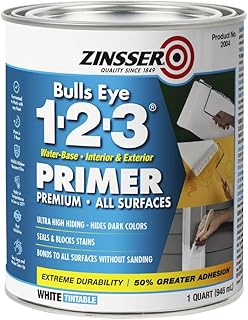
- Water-based styrenated acrylic primer, sealer and stain blocker
- Bonds to wood, plaster, concrete, gloss enamels, hardboard, glass and tile
- Touch dry in about 30 minutes, topcoat in 1 hour
- Coverage of approximately 400 to 450 square feet per gallon
- Apply between 35 and 90 degrees Fahrenheit
- Volatile organic compounds under 100 grams per liter
Zinsser Bulls Eye 1-2-3 is a water-based styrenated acrylic primer, sealer and bond coat made for priming all surfaces, and it is the general purpose adhesion primer in this set. The maker states that it bonds to wood, plaster, concrete, gloss enamels, hardboard, glass and tile, and that it is designed for interior and exterior surfaces. The performance figures are strong: it sticks to glossy surfaces without scuff sanding, it dries to the touch in about 30 minutes, it can be topcoated in 1 hour, and full adhesion and hardness develop in 7 days. Coverage is approximately 400 to 450 square feet per gallon, and it can be applied between 35 and 90 degrees Fahrenheit with relative humidity under 85 percent. On a smooth plasterboard wall, Bulls Eye 1-2-3 is the primer to use when the board carries glossy paint or stains that need sealing before the system primer goes on. It leaves no texture of its own, so it is best used as a first bond coat under a quartz or mineral primer when the marmorino needs a textured key.
Polar Clear Binding Primer

- High-adhesion primer for drywall, plaster, cement, stucco and wood
- Clear base coat for interior and exterior use
- Sold in a 33 fluid ounce size
- See product page for coverage and drying figures
Polar Clear Binding Primer is a high-adhesion primer made for drywall, plaster, cement, stucco and wood, and it earns its place here because plasterboard is drywall by another name. The primer is described as a high-adhesion primer for drywall, plaster, cement, stucco and wood, for interior and exterior use, and it comes in a 33 fluid ounce size that suits a single wall. Its clear base means it does not change the color of the wall underneath, which helps when the marmorino coat is a light color and the base needs to stay neutral. Published specification detail is limited, so coverage and drying figures should be taken from the product page before ordering. For a smooth plasterboard wall where the primer has to grip the board and stay invisible, Polar Clear is a sound choice.
| Primer | System and base | Dry time | Coverage | Best for |
|---|---|---|---|---|
| Novacolor Decofix | San Marco Group, micronized water-based fixative | Touch dry 30 to 40 minutes, finish after 2 hours | 8 to 18 sqm per liter | Gypsum plaster and plasterboard |
| San Marco IDROFIS | San Marco system, acrylic water-based fixative | See product page | See product page | Standard plaster, gypsum and gypsumboard |
| San Marco ISOMARC | San Marco system, solvent-based fixative | See product page | See product page | Chalking surfaces and deteriorated paint |
| San Marco ATOMO | San Marco system, micronized solvent-free fixative | See product page | See product page | Problem areas without a solvent base |
| Zinsser Bulls Eye 1-2-3 | General, water-based styrenated acrylic bond coat | Touch dry 30 minutes, topcoat 1 hour | 400 to 450 sq ft per gallon | Glossy paint and stained plasterboard |
| Polar Clear Binding Primer | General, high-adhesion clear base coat | See product page | 33 fluid ounce size | Invisible grip on plasterboard |
How to choose
Keep the primer inside the plaster system
The safest route on a plasterboard wall before marmorino is to use the primer the marmorino maker lists. Decofix, IDROFIS, ISOMARC and ATOMO all sit inside the San Marco family, and Marmorino Classico is a San Marco lime plaster. When the primer and the finish come from the same family, the bond between them has been checked by the maker. When they come from different makers, the bond is unproven until someone checks it. Read the product page for the marmorino you have chosen and use the primer it lists.
Match the fixative to the wall condition
A sound plasterboard wall needs a standard fixative such as IDROFIS or Decofix. A chalky or powdery wall needs a consolidating fixative such as ATOMO or ISOMARC. A glossy painted wall needs a bond coat such as Bulls Eye 1-2-3 that grips a slick face. The wall condition decides the fixative, not the other way around. Walk the wall, press on the paint film, and check for powdery areas before choosing.
Mind the texture the marmorino needs
Marmorino is a lime plaster that needs a key to hold its first coat, and a fixative alone leaves no texture. On a smooth plasterboard wall, the fixative should be followed by a quartz or mineral primer that leaves the grain the plaster needs, unless the marmorino maker states that its fixative is enough on its own. A smooth wall with no texture under a heavy lime coat is a wall that can release the finish. Plan the primer coat and the texture coat as two steps, not one.
Plan the drying time
Fixatives dry at different rates, and the finish should only go on when the primer is fully dry. Decofix lists a 30 to 40 minute touch dry and a wait of at least 2 hours before the finishing product. Bulls Eye 1-2-3 lists a 30 minute touch dry and a 1 hour topcoat time, with full adhesion developing in 7 days. In a cool or damp room, allow extra time. The primer should be fully dry, not just dry to the touch, before the first marmorino coat goes on.
Common mistakes
The most common mistake on smooth plasterboard is to mix primer and plaster from different systems without checking. A primer from one maker and a marmorino from another can work, but the combination should be one both makers accept. When the two product pages do not list each other, the bond between them is unproven, and a failure may only show up weeks after the work is done, when the plaster starts to sound hollow or lift at an edge. The safe route is to keep the primer inside the system the marmorino belongs to, and to check both product pages before buying when mixing brands.
A second mistake is to skip the fixative and trust the plaster to bond to bare board. Plasterboard paper drinks water fast, and a lime coat applied to an unprimed board can set too quickly and bond poorly. A fixative evens out the absorption and gives the plaster a sound base. The fixative coat costs little compared with a second round of plaster, and it is the step that makes the finish last.
A third mistake is to plaster before the primer is fully dry. A primer that feels dry to the touch can still be soft underneath, and a trowel will drag it and mix it into the plaster. Decofix lists a wait of at least 2 hours before the finishing product, and that wait should be respected. In a cool room, allow more time. Patience at this step is what keeps the first plaster coat clean.
A fourth mistake is to use a standard paint primer where a system fixative is needed. A general primer evens out a painted wall for another coat of paint, but it does not give a heavy lime coat the bond it needs on plasterboard. A fixative from the plaster system, or a bonding primer made for plaster work, is the right layer. The difference shows up only when the plaster goes on, which is too late to fix cheaply.
A fifth mistake is to apply the primer too thin. A thin, starved coat leaves bare board showing through, and the plaster will bond to board in those spots instead of to primer. Roll the primer on at full strength, keep a wet edge, and check the wall in raking light after the coat dries. Any thin or missed area should get a second pass before the plaster goes on.
A sixth mistake is to prime in the wrong conditions. A cold room slows drying and can leave the primer soft under the plaster, while a hot room or a wall in direct sun can dry the primer too fast and leave lap marks where one rolled section meets the next. Check the temperature and the humidity before starting, keep the room steady while the primer dries, and avoid priming an exterior wall when rain is expected within a day. A primer that dries at a steady pace gives the plaster a uniform base, and that uniform base is what the finished wall shows.
A seventh mistake is to forget that plasterboard joints need extra care. The joints are filled with compound that absorbs differently from the board face, and a single primer coat can leave them showing through the finish as pale lines. Check the joints in raking light after the primer dries, and give them a second pass if they still look different from the board. The extra pass takes minutes and keeps the joints from showing through the marmorino.
FAQ
Do I need a system primer on smooth plasterboard before marmorino?
Yes. Plasterboard is a mix of paper face and joint compound, and those materials absorb water at different rates. A system primer or fixative evens out that absorption and gives the marmorino a sound base to bond to. Without it, the plaster can set unevenly and the joints can show through the finished wall.
Can I use a general primer instead of the primer from the marmorino system?
A general primer can be a first step, especially on glossy paint or stained areas, and Bulls Eye 1-2-3 is a strong bond coat for that job. On its own, though, a general primer does not replace the fixative the plaster system calls for. Use the general primer first if the wall needs it, then follow with the system fixative or bonding primer that is made for the marmorino.
How long should I wait after priming plasterboard before applying marmorino?
Follow the drying time on the product page. Decofix lists a 30 to 40 minute touch dry and a wait of at least 2 hours before the finishing product. Bulls Eye 1-2-3 lists a 30 minute touch dry and a 1 hour topcoat time. In a cool or damp room, allow extra time. The primer should be fully dry, not just dry to the touch, before the first marmorino coat goes on.
Is Decofix compatible with San Marco marmorino?
Decofix is a Novacolor product, and Novacolor is a brand of San Marco Group, the same group behind San Marco. The data sheet lists gypsum plaster and plasterboard among its uses, and it is made to prepare surfaces for the finishing product that follows. Check the product page for the marmorino you have chosen to confirm the primer it lists, and use the primer from the same family when the maker gives that guidance.
Can I roll the primer on plasterboard or do I need a brush?
Most primers in this guide can be brushed, rolled or sprayed. Decofix is applied with a roller or brush, and Bulls Eye 1-2-3 can be applied with a brush, roller or sprayer. A roller covers a large plasterboard wall quickly and leaves an even film, which is what the wall needs. Use a brush at edges and corners, keep a wet edge while rolling, and check the dried coat in raking light for thin spots before the plaster goes on.
Conclusion
Smooth plasterboard can carry a marmorino finish that looks as if the wall was made for it, but only when the primer belongs to the plaster system. Novacolor Decofix leads this set as the fixative made for gypsum plaster and plasterboard, San Marco IDROFIS is the standard fixative for the system, ISOMARC and ATOMO handle the chalky and damaged areas, Zinsser Bulls Eye 1-2-3 grips glossy paint and seals stains, and Polar Clear Binding Primer holds the board without changing its color. Keep the primer inside the system, follow the drying time on the product page, and let the primer dry fully before the first marmorino coat. Check the primer color too when the marmorino is a light shade, since a white drying primer can show through a thin coat while a clear primer stays neutral. The wall will repay that care with a finish that stays bonded and even for years.
Related guides
More from Amazon
Programs that pair well with the guide above. Offers and eligibility are set by Amazon and may change.
Free shipping on eligible items, Prime Video and more. Eligible new members can start with a free trial.
Start a Prime free trialAudiobooks and podcasts to listen to on the go. Eligible new members can start with a free trial.
Try Audible freeAd-free music streaming. Eligible new subscribers can start with a free trial.
Try Music Unlimited freeA free business account with business pricing and bulk-buying tools for work, shop or home office.
Create a business accountAs an Amazon Associate we earn from qualifying purchases.



Write Your Review
No reviews yet. Be the first to share your experience!