
Key takeaways
- Seven wet dry vacuums for plaster job sites compared on tank size, hose reach, filter care and footprint, all in the lower price band for compact workshops.
As an Amazon Associate I earn from qualifying purchases. This post may contain affiliate links at no extra cost to you.
Our top picks at a glance
3 products from this guide, in the order reviewed below.


As an Amazon Associate we earn from qualifying purchases. Prices and availability can change.
A plaster workshop is a small room with a big mess. Lime dust settles on every shelf, a knocked-over bucket leaves a white puddle across the floor, and a mixing station throws damp splashes onto the walls before the first coat is even on. A broom moves the dry dust around and a mop spreads the wet plaster thinner, so a wet dry vacuum earns its place in the room by doing both jobs with one machine. The best wet dry vacuums for plaster job sites under three hundred fifty dollars for maintaining compact workshop spaces are the ones that fit in a tight corner, pick up dry lime dust without choking, swallow a spill of wet plaster without a filter change, and roll out of the way when the mixing table needs the floor.
Size matters more than raw power in a compact workshop. A sixteen-gallon drum holds a lot, but it also takes up the floor space of a mixing table and needs two hands to drag when it is half full of water. A six-gallon or nine-gallon machine tucks under a bench, rolls between the mixing area and the door, and empties in one lift into a bucket. The seven vacuums below were chosen for that balance: enough tank to finish a cleanup without stopping every few minutes, a hose long enough to reach across a small room from one outlet, and a filter setup that handles fine plaster dust and wet spills without constant attention.
Best products
DeWalt DXV06P 6 Gallon 4 Peak HP Wet Dry Vacuum
- Type: corded wet dry vacuum, portable
- Tank: 6 gallons
- Motor: 4 peak HP
- Hose: see product page
- Cord: see product page
- Filter: cartridge
The DeWalt DXV06P leads this roundup because it is the smallest machine here that still behaves like a proper workshop vacuum. Six gallons is enough for a day of plaster dust and a knocked-over mixing bucket, and the compact body fits under a workbench or in the corner beside the mixing table. The four peak horsepower motor gives it enough pull to lift fine lime dust out of a floor crack and to draw water out of a damp patch of plaster without leaving a grey film behind. Portability is the point: the machine carries by its handle, rolls on its casters, and parks in a space no wider than a bucket. For a one-person plaster workshop where the vacuum shares the room with a mixing table, a trowel rack and a stack of sample boards, the DXV06P takes up the least floor and still clears the mess at the end of the day. It suits a plasterer who works alone, mixes in small batches, and wants a vacuum that is always within reach rather than one that needs to be fetched from another room.
RIDGID HD1200 12 Gallon 5.0 Peak HP NXT Wet Dry Vacuum
- Type: corded wet dry vacuum
- Tank: 12 gallons
- Motor: 5.0 peak HP
- Airflow: 144 CFM
- Water lift: 55 inches
- Hose: 2-1/2 in x 7 ft Tug-A-Long locking hose
- Cord: 15 ft
- Drain: yes
- Blower port: yes
The RIDGID HD1200 is the mid-size workhorse of this group, and it earns its place by pairing a twelve-gallon drum with a locking hose that will not pull loose mid-pass. The 144 CFM airflow and 55 inches of water lift give it the pull to move damp plaster and heavy lime dust in one pass, and the 2-1/2 inch hose resists clogs when a chunk of dried plaster or a lump of wet mix goes up the tube. The Tug-A-Long hose locks at both ends, so the operator can drag the machine across the room by the hose without the connection coming apart, which matters when the vacuum is parked in a corner and the spill is at the far end of the bench. A built-in drain lets the operator empty a full tank of plaster water without lifting the drum, and the blower port turns the machine into a blower for clearing dust off a bench or out of a doorway. For a compact workshop that still mixes full batches, the HD1200 holds enough to finish the job and still fits against the wall.
Shop-Vac 12 Gallon 6.0 Peak HP Stainless Steel Wet Dry Vacuum
- Type: corded wet dry vacuum
- Tank: 12 gallons, stainless steel
- Motor: 6.0 peak HP
- Airflow: 100 CFM
- Hose: 7 ft
- Filter: cartridge
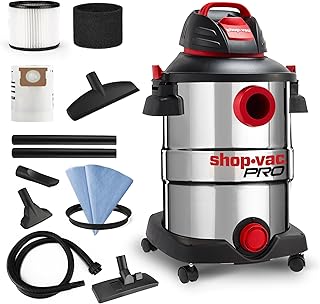
The Shop-Vac 12 Gallon Stainless Steel model brings a steel drum to a plaster workshop, and the steel matters because plaster dust is abrasive and wet plaster is corrosive to a plastic tank over time. The stainless drum resists dents from a dropped trowel and wipes clean after a wet pickup, so the machine does not carry a grey stain from one job to the next. The 6.0 peak horsepower motor and 100 CFM airflow give it enough pull for dry dust and for water, and the seven-foot hose reaches from a corner position to the mixing table without moving the machine. The cartridge filter handles dry plaster dust, and the machine switches to wet pickup by removing the dry filter and fitting the foam sleeve, which is the standard routine for a wet dry vacuum. For a workshop where the vacuum lives beside the mixing area and gets knocked around, the steel tank is the feature that keeps it working year after year.
Stanley SL18115P 5 Gallon 4 Peak HP Wet Dry Vacuum
- Type: corded wet dry vacuum
- Tank: 5 gallons
- Motor: 4 peak HP
- Blower: 3-in-1 blower function
- Hose: see product page
- Cord: see product page
The Stanley SL18115P is the smallest machine in this roundup after the Armor All, and it suits a plaster workshop that is really a corner of a garage or a spare room. Five gallons is enough for the dust from a day of sanding and the water from a single spill, and the compact body stores on a shelf or under a bench when the room is needed for something else. The four peak horsepower motor handles dry lime dust and wet plaster alike, and the three-in-one blower function lets the operator blow dust out of a doorway or off a bench before vacuuming it up. The machine is light enough to carry up a step or out to a van, which matters when the workshop is not a permanent room but a space that changes with the job. For a plasterer who works in a small rented space and needs a vacuum that can be packed away, the SL18115P is the easiest machine here to live with.
Armor All AA255 2.5 Gallon 2 Peak HP Wet Dry Vacuum
- Type: corded wet dry vacuum
- Tank: 2.5 gallons
- Motor: 2 peak HP
- Cord: 10 ft
- Weight: 7 lb
- Blower: yes
The Armor All AA255 is the lightest machine in this roundup at seven pounds, and it earns its place as the quick-cleanup tool for a compact workshop. A two-and-a-half-gallon tank will not hold a full mixing bucket, but it will hold the dust from a sanding session and the water from a small spill, and it empties in seconds into a sink or a bucket. The two peak horsepower motor is modest, but it is enough for fine dust on a hard floor and for water on a sealed surface, and the ten-foot cord reaches across a small room from a single outlet. The blower function clears dust from a bench or a windowsill before the vacuum picks it up. For a plasterer who needs a vacuum for the daily tidy-up rather than the weekly deep clean, the AA255 is the machine that gets used every day because it is always at hand and never in the way.
DeWalt DXV09P 9 Gallon 5 Peak HP Wet Dry Vacuum
- Type: corded wet dry vacuum
- Tank: 9 gallons
- Motor: 5 peak HP
- Hose: 1-7/8 in x 7 ft
- Cord: 10 ft
- Drain: yes
- Blower: yes
- Storage: accessory bag
The DeWalt DXV09P sits in the middle of this group at nine gallons, and it is the machine for a workshop that needs more capacity than a portable unit but less bulk than a twelve-gallon drum. The five peak horsepower motor gives it strong suction for dry dust and for water, and the nine-gallon tank holds a full cleanup without an emptying stop. The 1-7/8 inch hose is narrower than the 2-1/2 inch hoses on the larger machines, which makes it easier to handle in a tight room and less likely to knock over a bucket or a sample board. A built-in drain empties the tank without lifting, and the blower function clears dust from corners and benches. The accessory bag keeps the nozzles and wands together, so the machine is ready to work without a hunt through a cupboard. For a compact workshop that mixes plaster most days, the DXV09P is the balanced choice between size and capacity.
Craftsman CMXEVBE17594 12 Gallon 6.0 Peak HP Wet Dry Vacuum
- Type: corded wet dry vacuum
- Tank: 12 gallons
- Motor: 6.0 peak HP
- Airflow: 155 CFM
- Water lift: 39 inches
- Air watts: 216
- Hose: 2-1/2 in x 7 ft
- Cord: 20 ft
- Noise: 75 dB
- Warranty: 3-year limited
The Craftsman CMXEVBE17594 closes this roundup with the longest cord here at twenty feet, and that cord is the feature that matters most in a compact workshop with one outlet. The operator can park the machine in its corner and still reach the far wall, the door, and the mixing table without an extension lead. The twelve-gallon tank and 155 CFM airflow handle a full day of plaster dust and a large spill, and the 2-1/2 inch hose moves chunks of dried plaster without clogging. The three-year limited warranty is the longest cover in this group, which matters for a machine that will be used every day in a dusty room. For a workshop where the outlet is in the wrong place and the vacuum has to reach everywhere from one spot, the CMXEVBE17594 is the machine that covers the whole room.
| Product | Tank | Motor | Hose and cord | Best for |
|---|---|---|---|---|
| DeWalt DXV06P | 6 gal | 4 peak HP | See product page | Smallest portable, under bench |
| RIDGID HD1200 | 12 gal | 5.0 peak HP | 2-1/2 in x 7 ft, 15 ft cord | Locking hose, mid-size work |
| Shop-Vac 12 Gallon Stainless | 12 gal | 6.0 peak HP | 7 ft hose | Steel drum, hard use |
| Stanley SL18115P | 5 gal | 4 peak HP | See product page | Smallest room, packs away |
| Armor All AA255 | 2.5 gal | 2 peak HP | 10 ft cord | Daily tidy, lightest |
| DeWalt DXV09P | 9 gal | 5 peak HP | 1-7/8 in x 7 ft, 10 ft cord | Balanced size and capacity |
| Craftsman CMXEVBE17594 | 12 gal | 6.0 peak HP | 2-1/2 in x 7 ft, 20 ft cord | Longest cord, one outlet |
How to choose
Match the tank to the size of the room
A compact workshop does not need the biggest drum. A twelve-gallon tank holds a lot, but it also needs floor space and weighs a lot when it is full of water, and a full tank of plaster water is heavy enough to need two hands and a drain. A six-gallon or nine-gallon tank empties in one lift and stores under a bench, which is worth more in a small room than the extra capacity of a big drum. Count how much dust and water a normal day produces: a day of mixing and sanding in a small room rarely fills more than nine gallons, and a machine that empties easily will be emptied, while a machine that is hard to empty will be left full. Choose the smallest tank that still finishes a normal day without an emptying stop.
Check the hose before the motor
The hose decides whether the vacuum is easy to use in a tight room. A 2-1/2 inch hose moves large debris and resists clogs, but it is stiff and can knock over a bucket in a narrow space. A 1-7/8 inch hose is lighter and easier to steer around a mixing table, but it clogs faster on chunks of dried plaster. A locking hose that clicks into the machine and the wand will not pull loose when the operator drags the vacuum across the room, which is the most common annoyance in a small workshop. Measure the distance from the vacuum's parking spot to the farthest corner and make sure the hose and cord together cover it, because a vacuum that cannot reach the spill is no use at all.
Plan the filter routine for dust and water
A wet dry vacuum needs a different filter for dry dust and for water, and the change between them is the routine that decides whether the machine works well. A cartridge filter handles dry lime dust, and a foam sleeve handles water; running a dry cartridge into a puddle ruins the filter and chokes the motor. A washable cartridge filter saves money over a year of daily use, because a plaster workshop clogs filters faster than a normal garage. Check how the filter comes off: a Qwik Lock or twist-off filter changes in seconds, while a filter held by a nut needs a tool and a dry hand. Keep a spare dry filter and a foam sleeve beside the machine so the change takes a minute, not a trip to the shop.
Think about emptying before buying
A vacuum that is hard to empty will be left full, and a full vacuum loses suction and starts to smell. A built-in drain lets the operator empty a tank of plaster water into a bucket or a floor drain without lifting the drum, which matters when the tank holds twelve gallons of water. A machine with a detachable drum lifts off its base and carries to a sink, which suits a small workshop with a utility sink nearby. A machine with a top handle and a light body carries out to a van or a skip. Walk through the emptying routine in the shop before buying: lift the drum, open the drain, carry the water, and put the machine back. If any step is awkward in the room, choose a different machine.
Buy for the price band, not the brand
A compact workshop vacuum under three hundred fifty dollars does not need a famous badge to do the job. What matters is the tank size, the hose diameter, and the drain, because those three features decide whether the machine clears a spill in one pass or needs two. Compare the machines in this roundup on those three numbers before looking at the brand, and buy the one that fits the corner and holds a full cleanup.
Common mistakes
The most common mistake in a plaster workshop is vacuuming wet plaster with a dry filter fitted. The filter clogs in seconds, the motor strains, and the vacuum loses suction for the rest of the day. Fit the foam sleeve before any wet pickup, and fit the dry cartridge only when the floor is dry. A second mistake is leaving plaster dust in the tank overnight. Lime dust absorbs moisture from the air, sets hard in the drum, and coats the filter with a crust that will not wash off. Empty the tank at the end of every day, rinse it, and leave the lid off so it dries. A third mistake is buying the biggest vacuum for the smallest room. A sixteen-gallon drum in a compact workshop takes the floor space of a mixing table, and the operator ends up moving the vacuum to reach the work instead of moving the work to the vacuum. A fourth mistake is ignoring the hose diameter. A narrow hose clogs on dried plaster, and a wide hose knocks over buckets in a tight room, so match the hose to the room and the debris. A fifth mistake is running the vacuum with a torn filter. A torn cartridge lets fine lime dust through to the motor, and the motor wears out long before its time. Check the filter every week, hold it up to the light, and replace it when the pleats are torn or clogged past cleaning.
FAQ
Can a wet dry vacuum pick up wet plaster without damage?
Yes, if the dry filter is removed and the foam sleeve is fitted first. A wet dry vacuum is built for water, but the dry cartridge filter is not: water turns the dust in the cartridge into a paste that blocks airflow and strains the motor. Fit the foam sleeve, pick up the spill, then empty the tank and rinse the drum before the plaster sets. Never run the machine with a wet cartridge filter, and never leave wet plaster in the tank overnight.
How often should the filter be cleaned in a plaster workshop?
A plaster workshop clogs filters faster than a normal garage because lime dust is fine and sticks to the pleats. Tap the cartridge clean after every dusty session, wash a washable cartridge at the end of the week, and keep a spare dry filter so the machine is never out of action while one dries. Replace a cartridge when tapping and washing no longer restore airflow, which in daily plaster use can be every few months.
What tank size suits a compact workshop?
Six to twelve gallons covers most compact plaster workshops. A six-gallon machine stores under a bench and empties in one lift, which suits a one-person room. A nine-gallon machine finishes a full day without an emptying stop. A twelve-gallon machine suits a room where two people mix and sand, but it needs floor space and a drain for emptying. Measure the floor space first, then choose the largest tank that still leaves room to work.
Does a longer cord matter in a small room?
Yes, because a compact workshop often has one outlet in the wrong place. A twenty-foot cord lets the vacuum park in its corner and still reach the door, the mixing table and the far wall. A ten-foot cord needs an extension lead or a mid-room move, which is awkward when the floor is covered in dust. Count the outlets before buying, and choose the cord that reaches the whole room from the vacuum's parking spot.
Can the vacuum also blow dust out of the workshop?
Most wet dry vacuums in this roundup have a blower port, and the blower is useful for clearing dust off a bench, out of a doorway, or off a sample board before vacuuming. Fit the hose to the blower port, point it away from the work, and wear a dust mask, because blowing lifts fine dust into the air. Blow the dust toward the door or into a pile, then vacuum the pile, and always blow before the final vacuum pass, never after.
Conclusion
A compact plaster workshop needs a vacuum that fits the room, handles both dry dust and wet spills, and empties without a struggle. The DeWalt DXV06P leads this roundup for the smallest rooms, the RIDGID HD1200 and the Craftsman CMXEVBE17594 cover the mid-size rooms with locking hoses and long cords, the Shop-Vac stainless model takes the hard knocks, the Stanley SL18115P and the Armor All AA255 handle the daily tidy, and the DeWalt DXV09P balances size and capacity. Measure the room, match the tank to a normal day, check the hose and the filter routine, and empty the tank every evening. Done that way, the vacuum stays out of the way, the floor stays clear, and the workshop is ready for the next batch.
Related guides
More from Amazon
Programs that pair well with the guide above. Offers and eligibility are set by Amazon and may change.
Free shipping on eligible items, Prime Video and more. Eligible new members can start with a free trial.
Start a Prime free trialAudiobooks and podcasts to listen to on the go. Eligible new members can start with a free trial.
Try Audible freeAd-free music streaming. Eligible new subscribers can start with a free trial.
Try Music Unlimited freeA free business account with business pricing and bulk-buying tools for work, shop or home office.
Create a business accountAs an Amazon Associate we earn from qualifying purchases.
More ways to save on your next finish
Programs that pair well with the guide above. Offers and eligibility are set by Amazon and may change.
A free business account with business pricing and bulk-buying tools for work, shop or home office.
Create a business accountFast, free shipping on eligible items, plus Prime Video and more. Eligible new members can start with a free trial.
Start a Prime free trialRead from a huge library of eBooks, including how-to guides and cookbooks. Eligible new members can start with a free trial.
Try Kindle UnlimitedAudiobooks and podcasts for the commute, the garage or the kitchen. Eligible new members can start with a free trial.
Try Audible freeAs an Amazon Associate we earn from qualifying purchases. Using these links costs you nothing extra.



Write Your Review
No reviews yet. Be the first to share your experience!