
Key takeaways
- Six bonding primers for Venetian plaster on painted drywall accent walls, all in the lower price band, compared on grip, dry time, coverage, and pack size.
As an Amazon Associate I earn from qualifying purchases. This post may contain affiliate links at no extra cost to you.
Our top picks at a glance
3 products from this guide, in the order reviewed below.

As an Amazon Associate we earn from qualifying purchases. Prices and availability can change.
An accent wall is the smallest room in the house to plaster and the easiest one to get wrong. It is one wall, often the first wall a visitor sees, and a Venetian finish on it has nowhere to hide a weak bond or a patchy base. The wall underneath is usually painted drywall, which sounds simple until the applicator remembers that paint is a sealed film, drywall paper is soft, and a heavy plaster coat needs a base that grips both. The best bonding primers for Venetian plaster under seventy-five dollars for preparing painted drywall accent walls solve that problem inside the lower price band, giving a single accent wall a firm, even base without asking the budget to stretch across a whole house.
Price matters here in a practical way. An accent wall is a small job, and a primer that only comes in a large container can cost more than the plaster itself. The primers in this roundup all sit in the lower price band, and most come in quart and gallon sizes, so the applicator buys the amount the wall needs and nothing more. A quart covers a small accent wall with material to spare, and a gallon covers a large one with enough left over for a second wall or a repair. The comparison below weighs grip and drying time first, because a cheap primer that fails is the most expensive primer of all, and then weighs coverage and pack size, because those decide what the wall actually costs to prepare.
Every primer below is a real product with published data. Each one bonds to painted drywall, each one states a drying time, and each one is judged on the same points: what it is made of, how it grips a sealed paint film, how fast it dries, how much wall one container covers, and how it behaves under a Venetian plaster coat. The lead product is the one that does the most for the least fuss on a painted drywall accent wall, and the rest of the list covers the cases where a different strength matters more.
Best products
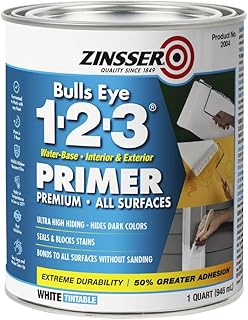
Zinsser Bulls Eye 1-2-3
- Water-based styrenated acrylic primer, sealer, and stain blocker
- Bonds to glossy surfaces without scuff sanding in most cases
- Dry to the touch in about 30 minutes; topcoat in one hour
- Available in quart, gallon, and five gallon sizes
- Sticks to wood, plaster, concrete, gloss enamels, hardboard, glass, and tile
Zinsser Bulls Eye 1-2-3 leads this roundup because it does the two things a painted drywall accent wall needs most: it grips a glossy paint film without a full sanding pass, and it dries fast enough to keep a one-day job on schedule. The primer is a water-based styrenated acrylic, and the maker states that it bonds to glossy surfaces without scuff sanding, which matters on an accent wall where the old paint is often a semi-gloss or satin finish chosen for a living room or bedroom. A light scuff still helps, and a careful applicator will do one, but the primer does not depend on it the way a plain drywall primer would.
Speed is the second reason for the lead. The film dries to the touch in about 30 minutes and accepts a topcoat in one hour, so priming in the morning and plastering in the afternoon is a realistic plan for a single wall. Coverage runs about 400 square feet per gallon on smooth surfaces, which means a quart covers a typical accent wall with room to spare, and a gallon covers a very large wall or two medium ones. The primer also blocks stains, so old marks, water rings, and tannin that sit under the old paint stay locked in the primer film instead of showing through the plaster. It goes on by brush, roller, or sprayer, cleans up with soap and water, and can be tinted toward the topcoat color with a small amount of universal colorant. For a Venetian finish, the white base keeps the plaster color true, and the one-hour topcoat window keeps the working day short.
KILZ Adhesion Primer
- Water-base modified acrylic bonding primer made for hard-to-paint surfaces
- Dry to the touch in 30 minutes; ready to recoat in one hour
- Coverage of 300 to 400 square feet per gallon, depending on surface texture and porosity
- VOC content under 100 grams per litre
- Bonds to Kynar, PVC, vinyl, Formica, glass, tile, glazed brick, chalky paint, glossy finishes, fiberglass, and metals
KILZ Adhesion Primer is the specialist in this list, built for surfaces that ordinary primers cannot hold. The resin is a modified acrylic, and the maker formulates it to bond to dense, glossy surfaces while reducing or removing the need for sanding. The data sheet lists the surfaces it handles: Kynar, PVC, vinyl, Formica, glass, tile, glazed brick, chalky paint, glossy finishes, fiberglass, and metals. A painted drywall accent wall sits comfortably inside that range, and the primer gives Venetian plaster a base that holds even where the old paint is slick or the drywall paper underneath is soft.
The drying numbers match the lead product. The film dries to the touch in 30 minutes and is ready to recoat in one hour, so a morning prime and an afternoon plaster is realistic. Coverage runs 300 to 400 square feet per gallon, and the maker notes that the exact figure depends on surface texture, porosity, and application method. On a sealed accent wall, the high end of the range is the realistic figure, because the primer sits on the surface instead of soaking in. The product goes on by brush, roller, or sprayer, and it cleans up with soap and water. One piece of guidance from the data sheet is worth following: while the primer is made to bond without sanding, the maker still recommends a small adhesion check on an inconspicuous area before the full coat goes on. That check costs a few minutes and settles the one question that matters on a painted wall, which is whether this particular old paint film will hold.
Sherwin-Williams Extreme Bond Primer
- Waterborne urethane modified acrylic primer for interior and exterior use
- Coverage of 450 to 500 square feet per gallon
- Dry to the touch in 30 minutes; recoat as a primer in one hour
- VOC content under 50 grams per litre; volume solids of 32 percent
- One coat application; bonds to PVC, plastics, glass, wall laminate, glossy surfaces, aluminum, and fiberglass
Sherwin-Williams Extreme Bond Primer brings the highest coverage in this roundup, and coverage is money on a small job. At 450 to 500 square feet per gallon, a single gallon covers a large accent wall and still leaves material for a second coat or a second wall, which is useful when the wall has patches of different sheen that drink primer unevenly. The resin is a urethane modified acrylic, and the maker describes it as a high quality waterborne primer designed for hard, slick, glossy surfaces with minimal surface preparation. That description fits a painted drywall accent wall well, because the wall is usually in good condition and the problem is grip, not repair.
The drying schedule is fast. The film dries to the touch in 30 minutes and recoats as a primer in one hour, so the working day stays short. The product is a one-coat primer in most cases, which saves a second pass across the wall, and it can be tinted with no more than two ounces of colorant per gallon. The maker notes that the primer must be topcoated within fourteen days, which is no constraint at all on a plaster job that starts the same day. One caution from the data sheet is worth noting: when priming larger exterior pre-finished metal surfaces, the maker points to a different product, but that guidance has no bearing on an interior drywall accent wall. For the wall in this keyword, Extreme Bond Primer offers the best coverage per container in the lower price band.
PPG Seal Grip 17-921
- Acrylic latex universal primer and sealer for interior and exterior use
- Meets MPI category 17 for bonding primers, water based
- Coverage of about 400 square feet per gallon on nonporous surfaces
- Dry to the touch in 30 minutes; topcoat in one hour
- Volume solids of 39 percent; VOC content of 84 grams per litre
PPG Seal Grip 17-921 is the universal primer in this list, and its strength is breadth. The data sheet lists it as a whole-house primer for properly prepared interior and exterior wood, masonry, plaster, wallboard, cement, brick, stucco, cement composition board, and wall coverings. That breadth matters on an accent wall, because a painted drywall wall often meets other materials at its edges: a plaster return, a masonry chimney breast, a wood trim, or a patched corner. A primer that bonds to all of them means one product for the whole wall instead of a different primer for each patch.
The product meets MPI category 17, which is the Master Painters Institute category for bonding primers, water based, and that listing is a useful check for anyone comparing primers on paper. Coverage runs about 400 square feet per gallon on nonporous surfaces, and the film dries to the touch in 30 minutes with a one-hour topcoat window. Volume solids run 39 percent, which is a solid figure for a universal primer, and the product goes on by brush, roller, paint pad, or spray equipment. For maximum stain-blocking performance the maker says not to thin the product, and that guidance is worth following on an accent wall where old marks sit under the paint. Seal Grip is a steady, well-documented choice for a wall that needs one primer to do the whole job.
BEHR Premium Plus Interior All-In-One Primer & Sealer No. 75
- Styrene acrylic latex primer and sealer for interior use
- Coverage of 250 to 400 square feet per gallon, depending on application
- Dry to the touch in 30 minutes to one hour; recoat in one hour
- VOC content under 5 grams per litre
- Adheres to glossy surfaces and locks in stains
BEHR Premium Plus Interior All-In-One Primer and Sealer No. 75 is the interior specialist in this roundup, and its low VOC figure is the headline. At under 5 grams per litre, it is one of the lowest-emission primers a homeowner can buy, which matters on an interior accent wall in a lived-in room, especially where windows stay shut or the room is a bedroom. The resin is a styrene acrylic latex, and the maker describes it as a multi-purpose stain-blocking formula that adheres to glossy surfaces and creates a uniform surface for improved hiding, adhesion, and flow of topcoats.
The drying numbers are straightforward. The film dries to the touch in 30 minutes to one hour and recoats in one hour, so a morning prime and an afternoon plaster is realistic. Coverage runs 250 to 400 square feet per gallon, and the lower end of that range applies to rough or porous surfaces, while a sealed accent wall should land near the high end. The product is made for interior use on drywall, galvanized metal, vinyl, aluminum, wood, concrete, and glossy surfaces, and it works under all sheens. It is tintable, which helps when the plaster color is dark and the white primer would otherwise show through a thin first coat. The full cure runs two weeks, but that figure matters for washing the wall, not for plastering over it, since the recoat window of one hour is the number that governs the plaster schedule.
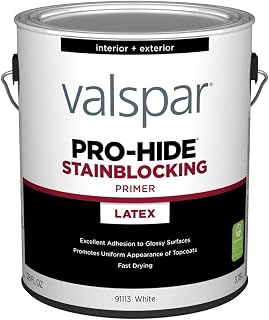
Valspar Stainblocking Bonding Primer
- Styrene acrylic copolymer primer and sealer for interior and exterior use
- Coverage of up to 400 square feet per gallon, depending on surface porosity
- Dry to the touch in 30 minutes; recoat in two hours with latex
- VOC content under 50 grams per litre; volume solids of 43 percent
- Available in quart and gallon sizes
Valspar Stainblocking Bonding Primer closes this list with a balance of adhesion and stain blocking. The resin is a styrene acrylic copolymer, and the maker describes it as a high quality latex primer providing extreme adhesion over glossy surfaces. It is made for cabinets, tile, trim, doors, glass, metal, drywall, wood, masonry, and paneling, which covers every surface an accent wall is likely to meet. The stain-blocking side matters too, because an accent wall often carries the history of the room: smoke, water marks, pencil, and old repairs that sit under the paint and wait for a chance to show through a light plaster.
The drying schedule runs a little slower than the fastest primers here. The film dries to the touch in 30 minutes, recoats in two hours with latex, and in four hours with oil, so the plaster schedule should allow the full two hours before the first trowel goes on. Coverage runs up to 400 square feet per gallon, and volume solids run 43 percent, which is a strong figure for a latex bonding primer. The product goes on by roller, brush, or airless sprayer, and it can be tinted with up to two fluid ounces of colorant per gallon. For an accent wall where the old paint hides stains as well as gloss, Valspar offers the two protections in one can.
| Primer | Binder type | Dry to topcoat | Coverage per gallon | Pack sizes |
|---|---|---|---|---|
| Zinsser Bulls Eye 1-2-3 | Styrenated acrylic | One hour | About 400 square feet | Quart, gallon, five gallon |
| KILZ Adhesion Primer | Modified acrylic | One hour | 300 to 400 square feet | Quart, gallon |
| Sherwin-Williams Extreme Bond Primer | Urethane modified acrylic | One hour | 450 to 500 square feet | Quart, gallon, five gallon |
| PPG Seal Grip 17-921 | Acrylic latex | One hour | About 400 square feet | Gallon, five gallon |
| BEHR Premium Plus No. 75 | Styrene acrylic latex | One hour | 250 to 400 square feet | Quart, gallon, five gallon |
| Valspar Stainblocking Bonding Primer | Styrene acrylic copolymer | Two hours with latex | Up to 400 square feet | Quart, gallon |
How to choose
Start with the paint film, not the primer
The old paint on the accent wall decides the primer, not the other way around. A flat, sound paint film needs only a basic bonding coat, while a glossy or satin film needs a primer that states it bonds to glossy surfaces without heavy sanding. A chalky film needs a consolidating product first, because no bonding primer can hold loose chalk. A stained film needs a primer with stain-blocking resin, or the stains will travel through the plaster. Check the film with a tape pull in several places, look for peeling edges around outlets and corners, and rub a damp cloth over the surface to find chalk. The primer that matches what the check finds is the right one, even if it is not the primer that leads this roundup.
Let the wall size set the pack size
An accent wall is a small job, and pack size decides what the job costs more than the per-gallon figure does. A quart covers a typical accent wall of about one hundred square feet with material to spare, and it is the right buy for a single wall. A gallon suits a large wall, a wall with patches that drink primer, or two walls primed in one session. A five gallon container only makes sense for a whole floor or a professional who will use the rest within weeks, because an opened primer can skin over in the can and a half-used five gallon container is money sitting on a shelf. Measure the wall, divide by the coverage figure for the chosen primer, and buy the smallest container that covers the calculation with a little extra.
Compare drying times against the working day
Every primer in this list except Valspar states a one-hour topcoat window, and Valspar states two hours with latex. That similarity makes the choice simpler: the drying time rarely decides between these six, and the decision turns on grip, coverage, and pack size instead. The one case where drying time matters is a cold or damp room, where every stated time stretches. A room below 50 degrees Fahrenheit needs longer waits across the board, and a room with poor ventilation needs longer still. Plan the priming for the morning and the plastering for the afternoon, leave the full stated window plus a margin, and do not let the schedule compress the wait.
Read the VOC figure for a lived-in room
An accent wall usually sits in a room people live in, and the VOC figure decides how the room smells and how soon it can be used again. BEHR No. 75 leads this list at under 5 grams per litre, and Sherwin-Williams Extreme Bond Primer and Valspar sit under 50 grams per litre. KILZ Adhesion Primer sits under 100 grams per litre. All of these are low figures by the standards of a generation ago, and any of them is workable in a ventilated room, but the lowest figure is worth choosing when the room is a bedroom, a nursery, or a space with poor airflow. Ventilate the room during priming and plastering regardless of the figure on the can.
Common mistakes
The most common mistake on a painted drywall accent wall is skipping the adhesion check. The wall looks sound, the paint looks even, and the primer goes on without a test. Days later, a patch of plaster peels away with the old paint still stuck to its back, and the failure is not in the primer but in the bond between the old paint and the drywall paper beneath it. A tape pull in several places takes five minutes and finds the weak spots before they become a failure. Any area that fails the tape check gets scraped, patched, and primed again.
The second mistake is buying the wrong pack size. A five gallon container looks like good value per gallon, but an accent wall needs a quart or a gallon, and the rest of the container sits open, skins over, and goes to waste. Buy the smallest container that covers the wall with a little extra, and keep the receipt in case a second container is needed for a second coat.
The third mistake is plastering before the primer has dried. The film feels dry after 30 minutes, the schedule is tight, and the trowel is ready, so the first coat goes on half an hour early. On a sealed paint film, the primer is still soft at the bond line, and the plaster drags it, leaves trowel lines, or peels in patches. Wait the full stated window, and add time when the room is cool or damp.
The fourth mistake is applying the primer too thick. A bonding primer works as a thin, even film, and a thick coat can skin over while staying soft underneath. One even coat at the maker's stated coverage does the job. A second coat belongs only where the first coat shows thin spots after drying, or where the data sheet calls for it.
The fifth mistake is ignoring the edges of the wall. An accent wall meets the ceiling, the floor, and the adjoining walls, and those edges are where plaster fails first. Prime right up to the edges, keep the film even at the corners, and do not leave a bare strip where the roller could not reach. A missed edge shows as a line of weak plaster that peels when the room is next painted.
FAQ
How much primer do I need for one accent wall?
Measure the wall by multiplying its length by its height, then subtract large openings like doors and windows. Divide the result by the coverage figure for the chosen primer. A typical accent wall of about one hundred square feet needs about a quart of most primers in this list, since coverage runs 250 to 500 square feet per gallon. Buy a little extra for patches and thin spots, and keep the receipt in case a second container is needed.
Do I need to sand painted drywall before priming for Venetian plaster?
A light sanding helps in almost every case, even under primers that claim to bond without it. Sanding dulls the gloss, gives the primer a slight texture to grip, and reveals weak paint that would otherwise fail under plaster. Use fine sandpaper, sand lightly and evenly, then dust the wall thoroughly before priming. Loose or peeling paint must be scraped off and the area patched first, since sanding will not save a failing film.
Can I use a drywall primer instead of a bonding primer on painted drywall?
A drywall primer is the wrong product for painted drywall. Drywall primers are made to seal porous paper and joint compound, and they have little grip on a closed paint film. A bonding primer is made for the opposite problem: gripping a slick, sealed surface so a heavy plaster can hold. Use a bonding primer from this roundup, and keep drywall primer for new, unpainted drywall.
How long after priming can I apply Venetian plaster?
Wait the full stated topcoat or recoat time on the primer data sheet. Most primers in this list state one hour, and Valspar states two hours with latex. Add time when the room is cool or damp, because drying times on data sheets assume moderate temperature and humidity. A film that feels dry on the surface can still be soft at the bond line on a sealed substrate, so the clock on the data sheet matters more than the feel of the surface.
Which primer in this list is best for a glossy painted accent wall?
Zinsser Bulls Eye 1-2-3 and KILZ Adhesion Primer are the strongest choices for a glossy wall, because both state that they bond to glossy surfaces without heavy sanding. Sherwin-Williams Extreme Bond Primer also targets hard, slick, glossy surfaces with minimal preparation. Whichever one is chosen, a light scuff sanding and a tape adhesion check are still worth doing before the primer goes on.
Is one coat of bonding primer enough for an accent wall?
One even coat is enough in most cases, provided the old paint is sound, clean, and dull after preparation. A second coat helps where the first coat shows thin spots, where the old paint has patches of different sheen, or where the primer maker calls for two coats on glossy surfaces. Let the first coat dry fully before judging whether a second is needed, and do not apply a second coat to fix a first coat that was applied too thick.
Conclusion
A painted drywall accent wall is a small job with a high profile, and the primer is what decides whether the Venetian finish on it lasts or peels. The six primers in this roundup all sit in the lower price band, and all of them bond to painted drywall, but they lead in different ways. Zinsser Bulls Eye 1-2-3 leads on grip and speed, with a one-hour topcoat window and a stated bond to glossy surfaces. KILZ Adhesion Primer leads on difficult surfaces, with a resin made for the slickest films. Sherwin-Williams Extreme Bond Primer leads on coverage, at 450 to 500 square feet per gallon. PPG Seal Grip 17-921 leads on breadth, covering every material the wall is likely to meet. BEHR Premium Plus No. 75 leads on low emissions for a lived-in room. Valspar Stainblocking Bonding Primer leads where the old paint hides stains as well as gloss.
Whatever primer is chosen, the working rules stay the same. Check the old paint with tape, sand the gloss lightly, clean the wall, buy the right pack size, apply one even coat, and wait the full stated drying time before the first trowel of plaster goes on. A bonding primer is a small part of the cost of an accent wall and a large part of its success, because every coat above it depends on the bond it makes. Choose by the data sheet, honor the drying window, and the finish will have the base it needs to last.
Related guides
More from Amazon
Programs that pair well with the guide above. Offers and eligibility are set by Amazon and may change.
Free shipping on eligible items, Prime Video and more. Eligible new members can start with a free trial.
Start a Prime free trialAudiobooks and podcasts to listen to on the go. Eligible new members can start with a free trial.
Try Audible freeAd-free music streaming. Eligible new subscribers can start with a free trial.
Try Music Unlimited freeA free business account with business pricing and bulk-buying tools for work, shop or home office.
Create a business accountAs an Amazon Associate we earn from qualifying purchases.
More ways to save on your next finish
Programs that pair well with the guide above. Offers and eligibility are set by Amazon and may change.
A free business account with business pricing and bulk-buying tools for work, shop or home office.
Create a business accountFast, free shipping on eligible items, plus Prime Video and more. Eligible new members can start with a free trial.
Start a Prime free trialRead from a huge library of eBooks, including how-to guides and cookbooks. Eligible new members can start with a free trial.
Try Kindle UnlimitedAudiobooks and podcasts for the commute, the garage or the kitchen. Eligible new members can start with a free trial.
Try Audible freeAs an Amazon Associate we earn from qualifying purchases. Using these links costs you nothing extra.



Write Your Review
No reviews yet. Be the first to share your experience!