
Key takeaways
- Compare the best vapor permeable plaster sealers for lime plaster in dry living areas, with mineral compatible finishes that let walls breathe and stay dry.
As an Amazon Associate I earn from qualifying purchases. This post may contain affiliate links at no extra cost to you.
Lime plaster in a dry living room asks for a different kind of protection than a facade that faces driving rain. The wall is not wet, the air inside is mild, and the plaster itself is sound, so the sealer does not need to fight weather. It needs to hold the surface together, keep dust down, and leave the wall able to breathe. best vapor permeable plaster sealers for protecting lime plaster in dry living areas with mineral surface compatibility are the products that do that job without building a plastic film over a mineral wall, and the seven below were chosen because each one states its chemistry, its vapor behavior, and its limits in plain terms.
A mineral surface and a mineral sealer share the same chemistry, and that match is what keeps the protection honest. Potassium silicate fixatives bond with the silica in the plaster, silane and siloxane impregnations line the pores without closing them, and silicic acid ester consolidants turn into silica gel inside the wall. None of these products paints over the plaster. Each one works inside the surface or as a thin mineral film, so the wall keeps moving moisture in and out the way lime plaster was made to do. The products below cover that range: fixatives for dusting surfaces, consolidants for soft old plaster, and invisible topcoats for finished limework that needs a little extra defense against marks and damp air.
The choice comes down to what the wall needs most. A dusty surface needs a fixative. A soft, crumbling surface needs a consolidant. A finished lime wall that gets touched, leaned on, or splashed needs an invisible topcoat. Every product in this roundup is a real product with published data, and each entry below gives the figures the maker states, with a dash where the maker does not state a figure, so the comparison rests on published facts rather than on sales language.
Best products
KEIM Fixative
- Clear binder, thinner and consolidant made from pure liquid potassium silicate
- Vapor permeability of 93 perms or more by ASTM E 96
- Specific weight about 1.17 grams per cubic centimetre
- pH value 11.3, VOC content under 1 gram per litre
- Penetration depth class II, 10 millimetres, active content 100 percent
KEIM Fixative earns the lead spot in this roundup because it is the most direct answer to the question the keyword asks. It is a clear liquid potassium silicate that soaks into mineral surfaces and bonds with them, and the maker states a vapor permeability of 93 perms or more, which is a high figure for a product that also holds a surface together. On a lime plaster wall in a dry living area, that combination matters: the plaster gets a firm, dust-free face, and the wall keeps breathing at nearly the rate of untreated plaster. The product is fully miscible in water, dries clear with a natural mineral matte finish, and does not alter existing colors, so a lime wall keeps its own tone after treatment.
The maker lists the product as an anti-dusting finish for interior or exterior brick, stone, stucco, concrete, and any masonry surface, and describes how it ties down loose dust and consolidates the surface. As a mild consolidant it also suits friable and damaged masonry, where the penetrating action strengthens weakened material by rebonding its structure at a fine scale and filling small voids. One point to respect is that the maker is clear about what the product is not: it is not a sealer in the film sense, because the stone stays breathable, though it does slow the rate at which ambient moisture is absorbed. For a dry living room, that is exactly the right trade, since the wall is not facing rain and the goal is a stable, breathable surface rather than a waterproof skin.
BEECK Fixative
- Primer and consolidator made from pure mineral potassium waterglass
- Colourless and transparent, for interior and exterior mineral surfaces
- Available in 1 kilogram and 5 kilogram packs
- About 0.04 kilograms per square metre on a smooth substrate for priming, when thinned with 2 parts water
- Dilute 1 part fixative with 2 parts clean potable water before application
BEECK Fixative is the second fixative in this roundup, and it earns its place through simplicity and a stated use on lime plaster. The maker describes it as a multi-purpose primer and consolidator for mineral surfaces, and as a thinner for Beeck mineral paints, which means it belongs to a full mineral system rather than standing alone as a generic coating. On a lime plaster wall that dusts under the hand, a coat of this fixative binds the available silica in the substrate and helps hold the surface together, which is the same job the keyword describes, carried out with a single mineral binder and no synthetic resin.
Application is straightforward and the maker gives a clear dilution: 1 part fixative to 2 parts clean potable water for priming and consolidating, with the exact dilution and background preparation varying by substrate. Coverage runs about 0.04 kilograms per square metre on a smooth substrate for priming at that dilution, so a small room needs only a small quantity. The product suits fresh lime render or plaster, cement render or plaster, and limewashed surfaces, and it is colourless and transparent, so the lime wall keeps its color and texture. For a dry living area where the plaster is sound but powdery, this is a light, honest treatment that adds grip and stability without changing the look of the wall.
BEECK SOL-Fixative
- Silica-sol potassium silicate fixative, ready to use, without organic fractions
- Sd value for water vapor diffusion 0.01 metres
- Density 1.09 kilograms per litre, pH value 11
- VOC content 0 grams per litre, non-flammable
- For lime and cement plaster, concrete, natural stone, and external thermal insulation composite systems
BEECK SOL-Fixative is the third fixative in this list, and it brings the lowest stated vapor diffusion resistance of the three. An Sd value of 0.01 metres means the dried treatment adds almost no resistance to water vapor passing through the wall, which is the strongest form of the breathability the keyword asks for. The product is a ready-to-use silica-sol potassium silicate mixture, free of synthetic resins and free of solvents, biocides, and preservatives, and it works by silicification, the chemical reaction between substrate, silica-sol, and potassium silicate that bonds the treatment inseparably to the mineral surface.
The maker lists the product for priming and finishing porous mineral building material on interiors and facades, including lime and cement plaster, concrete, natural stone, and external thermal insulation composite systems, as well as weathered matte dispersion coatings. It also serves as a ready-to-use thinner for single-component Beeck sol and silicate systems. Because it is thinned and ready to use, there is no mixing step to get wrong, and the treatment solidifies the surface without forming a film or stopping up the pores. For a lime plaster wall in a dry living area, that means a firm surface, a clear finish, and vapor movement that stays close to the untreated wall.
KEIM Silex-OH
- Colourless silicate-based consolidant based on silicic acid ester, without a water-repellent component
- Density 0.94 grams per cubic centimetre, active component content 75 percent by weight
- Gel deposition 33 percent by weight
- Consumption 0.5 to 5 litres per square metre, depending on pore volume and depth of the unsound zone
- Available in 5 litre and 25 litre containers, shelf life 12 months under cool, frost-free conditions
KEIM Silex-OH is the consolidant in this roundup, and it belongs here because some old lime plaster is not merely dusty but soft and crumbly, and a fixative alone is not enough for that wall. The product is a colourless silicate-based consolidant based on silicic acid ester, and the OH in the name means it carries no water-repellent component, so it consolidates without adding hydrophobicity. Its fluidity lets it penetrate deep into the pores of the building material, and once the small solvent content has evaporated, the silicate reacts with moisture in the material and in the air to form silica gel and alcohol. The reaction generally takes about 3 weeks, after which only the silica gel remains, and that mineral gel consolidates the crumbly material without impairing water vapor permeability.
Consumption is the number to plan around, because it ranges from 0.5 to 5 litres per square metre or more in extreme cases, depending on pore volume and the depth of the unsound zone. The maker advises a test treatment on a representative sample area to fix the quantity for the wall in hand, and application by brush or by flooding, repeated at intervals of about 10 minutes until the surface is visibly saturated, without spraying. A minimum waiting time of 10 days applies before water-repellent treatment with KEIM Lotexan, and 3 weeks before opaque finishes or mineral renders. For a dry living area with old lime plaster that has gone soft, this is the deep treatment that restores cohesion from inside the wall rather than covering the problem.
Romabio Mineral Shield
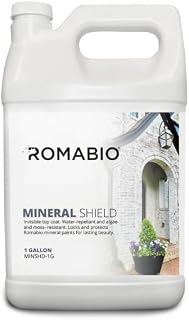
- Invisible, breathable protective topcoat for exterior limewash and masonry finishes
- Coverage about 200 to 300 square feet per gallon at average absorption
- Ready to use, do not dilute with water
- Apply in temperatures above 10 degrees Celsius and below 35 degrees Celsius
- Apply with a pump sprayer or brush, biodegradable and completely water-soluble
Romabio Mineral Shield is the invisible topcoat in this roundup, and it earns its place because it protects a finished lime surface without changing how it looks. The maker describes it as an invisible coating that locks and protects mineral paint finishes from natural patina and weathering created by water, while the breathable coating repels water droplets yet still allows water vapor to pass through. It does not change the sheen of the finish or the texture of the surface, and it protects lime-based coatings such as Romabio Classico Limewash from the temporary discoloration that appears when the surface is wet from rain and water absorption. It also protects uncoated porous brick, stone, stucco, concrete, and other masonry.
Coverage runs about 200 to 300 square feet per gallon at average absorption, and the maker advises a check on the actual surface to fix the exact consumption, since texture and absorption vary. The product is ready to use and must not be diluted with water, and a second coat, where wanted, goes on wet on wet within five minutes. Application temperature sits above 10 degrees Celsius and below 35 degrees Celsius, and the product is described as eco friendly, safe for children, pets, and gardens, and biodegradable and completely water-soluble. It also helps hold back algae, moss, and mold, and it reduces staining from clay, dirt, and grass. For a dry living area, the interior use the maker lists includes fireplaces painted with Romabio, where the topcoat helps hold back chalking. On a finished lime wall that needs protection without a visible layer, this is the lightest touch in the list.
Meoded Stain Shield
- Natural-look sealer for Venetian plaster and decorative finishes
- Repels oil and water while preserving the true appearance of the finish
- Forms an invisible protective barrier that resists moisture, stains, and oil
- No change to color, texture, or existing sheen
- Apply after the plaster has dried for at least 24 to 48 hours
Meoded Stain Shield is the natural-look sealer in this roundup, and it earns its place because many lime plaster walls in living areas are touched, leaned on, and splashed, and they need protection that does not add gloss. The maker describes it as a premium natural-look sealer that repels oil and water while preserving the true appearance of the finish, forming an invisible protective barrier that resists moisture, stains, and oil without changing color, texture, or adding sheen. That description fits the keyword closely: a sealer for a lime plaster wall that keeps the wall looking exactly as it did before treatment.
The maker recommends a sealed sample before applying the topcoat to the whole wall, which is sound practice for any invisible product, since the only way to confirm invisibility is to see it on the actual plaster. Application follows the plaster maker's drying rule, with lime-based Venetian plaster left to dry for at least 48 hours before wax or sealer goes on, and the sealer is the right choice where protection is wanted without added sheen, while the maker's HydroWax is the choice where a soft luster is wanted instead. For a dry living area with a matte lime finish that must stay matte, Stain Shield is the sealer that protects without advertising itself.
PROSOCO Siloxane PD
- Ready-to-use, water-based silane and siloxane water repellent
- Active content 7 percent, total solids 4 percent by ASTM D 5095
- VOC content under 30 grams per litre, specific gravity 0.996, pH 4 to 5
- Water vapor transmission 1.22 grains per hour per square foot, permeance 2.99
- Service life estimated at more than 10 years, alkaline stable
PROSOCO Siloxane PD closes this roundup as the ready-to-use water-based repellent, and it earns its place through its stated vapor figures. The maker gives a water vapor transmission value of 1.22 grains per hour per square foot and a permeance of 2.99, which are the kind of numbers that let a reader check breathability rather than take it on trust. The product is a prediluted silane and siloxane water repellent for concrete and most masonry and stucco surfaces, and the maker states plainly that it will not impair the natural breathing characteristics of treated surfaces. It penetrates deeply, works on vertical or horizontal surfaces, and has an estimated service life of more than 10 years.
The product is alkaline stable, so it suits new green concrete 14 to 28 days old, and it is ready to use with no on-site dilution, which removes a common source of error. It is a cloudy white liquid with no odor, a flash point above 212 degrees Fahrenheit, and a freeze point of 32 degrees Fahrenheit, with a shelf life of 1 year in a tightly sealed, unopened container. Water absorption reduction figures are given as 85.61 percent for concrete, 91.80 percent for brick, and 92.22 percent for CMU, which shows how strongly the treatment cuts liquid water uptake while the vapor figures show the wall still breathes. For a dry living area, the water-based formula also keeps fumes and fire risk low compared with solvent-based repellents, which matters in an occupied room.
| Product | Main specification | Best suited for | Coverage |
|---|---|---|---|
| KEIM Fixative | Clear potassium silicate, 93 perms or more | Dusty lime plaster that needs consolidating | See product page |
| BEECK Fixative | Potassium waterglass, dilute 1 part to 2 parts water | Sound but powdery lime plaster | About 0.04 kg per square metre |
| BEECK SOL-Fixative | Silica-sol potassium silicate, Sd 0.01 m | Walls where vapor resistance must stay near zero | See product page |
| KEIM Silex-OH | Silicic acid ester, 75 percent active | Soft, crumbly old lime plaster | 0.5 to 5 litres per square metre |
| Romabio Mineral Shield | Invisible breathable topcoat | Finished limewash that must keep its look | 200 to 300 square feet per gallon |
| Meoded Stain Shield | Natural-look sealer, oil and water repellent | Matte lime finishes that must stay matte | See product page |
| PROSOCO Siloxane PD | Water-based silane and siloxane, 7 percent active | Masonry and stucco that need a ready-to-use repellent | See product page |
How to choose
Match the chemistry to the plaster
Mineral plaster and mineral sealer belong together, because the bond is chemical rather than mechanical. A potassium silicate fixative reacts with silica in the plaster, a silicic acid ester turns into silica gel inside the pores, and a silane or siloxane lines the pore walls without closing them. An acrylic film, by contrast, sits on top of the wall and can trap moisture behind it, which is the failure the keyword is written to avoid. Check the composition line on the data sheet first: potassium silicate, silica-sol, silicic acid ester, silane, and siloxane are the chemistries that belong on lime plaster, and a product that does not state its binder should be set aside until the maker answers.
Read the vapor figure before the marketing words
Every sealer in this roundup claims breathability, but only some of them publish a number for it. An Sd value in metres, a perm rating, or a water vapor transmission figure lets the reader compare products on the same scale, while a product with no figure asks for trust. For a dry living area, a low Sd value or a high perm rating is the sign that the wall will keep drying out through the finish, and a product that states its figure is a safer choice than one that only uses the word breathable. Where the maker gives no vapor figure, ask for it, or choose a product that does.
Decide what the wall needs most
A dusty surface, a soft surface, and a finished surface need different products, and buying the wrong one wastes money and time. If the plaster powders under the hand, a fixative is the answer. If the plaster is soft and crumbly below the surface, a consolidant is the answer, and it needs weeks to finish its reaction before any finish goes over it. If the plaster is sound and finished, and the need is protection against marks and damp air, an invisible topcoat is the answer. Walk the wall, press it, brush it, and note where it powders and where it holds, then match the product to the worst defect rather than to the best-looking label.
Check the substrate limits on the data sheet
Every maker in this roundup states limits, and those limits are part of the product, not fine print to skip. Some products are for facades only, some are not for use against rising damp, some need the substrate dry and dust-free, and some need a waiting period after the plaster or after a previous treatment. A silane primer, for example, is not a cure for rising damp where no damp proof course exists, and a consolidant needs weeks before a water-repellent treatment goes over it. Read the substrate section, check the wall against it, and do not use a product outside its stated limits, since a sealer applied to the wrong substrate can fail in ways that are hard to undo.
Common mistakes
The most common mistake on lime plaster is choosing a film-forming sealer because it looks protective in the can. A glossy film may look like armor, but on a mineral wall it traps moisture, and trapped moisture is what causes plaster to blister, salts to crystallize behind the surface, and paint to peel in sheets. The fix is to choose by chemistry and by vapor figure, not by shine, and to confirm that the dried treatment leaves the wall able to pass vapor. A simple check is to read the Sd value or perm rating on the data sheet, and to walk away from any product that will not state one.
The second mistake is applying a sealer to a dirty or damp wall. Dust, grease, and loose material sit between the treatment and the plaster, so the sealer bonds to the dirt instead of the wall, and the protection fails in patches. The fix is to clean the wall, remove loose material, and let it dry fully before the first coat goes on, since nearly every data sheet in this roundup lists a clean, dry, sound substrate as a requirement. A wall that is still damp from washing or from a leak needs time, not a sealer.
The third mistake is skipping the sample area. Invisible products are the hardest to judge, because the only way to know whether a treatment changes the color or sheen is to see it on the actual plaster. The fix is to treat a small, hidden area first, let it dry fully, and look at it in daylight and in lamplight before treating the whole wall. That sample also fixes the consumption figure for the wall in hand, which matters for consolidants whose use can range from half a litre to five litres per square metre.
The fourth mistake is rushing the waiting time. Consolidants need weeks to finish reacting, fixatives need the plaster to be dry before application, and topcoats need the plaster to be fully dry before they go on. A second coat applied too soon, or a finish applied over a treatment that has not finished reacting, can leave a hazy film or a weak bond. The fix is to read the waiting times on the data sheet and to plan the job around them, even when the room is needed back quickly.
The fifth mistake is over-applying the product. A sealer that is meant to soak in should be applied until the surface is saturated and no more, with excess removed, because pooled material dries as a skin on the surface and that skin is exactly the film the job was meant to avoid. The fix is to apply in thin passes, to watch how fast the wall drinks the product, and to stop when the surface stays wet without absorbing more.
FAQ
Will a vapor permeable sealer change the color of lime plaster?
A clear mineral fixative or a colourless impregnation should not change the color, and the makers in this roundup state that their products dry clear or transparent. A wax topcoat can deepen the color and add sheen, which is a different effect and should be chosen only where that change is wanted. The safe step is a sample area on the actual wall, checked after full drying in daylight.
Can a sealer be used on old lime plaster that is already painted?
It depends on the paint. A mineral paint or limewash that is sound and porous can usually take a mineral fixative, while an acrylic paint forms a closed film that a penetrating sealer cannot pass. Check the substrate section of the data sheet, and where the old paint is acrylic or unknown, a sample area will show whether the treatment soaks in or sits on the surface.
How long should lime plaster dry before sealing?
Fresh lime plaster needs to carbonate and dry before any sealer goes on, and the waiting time depends on thickness, temperature, and humidity. For a topcoat over Venetian plaster, the maker guidance in this roundup is at least 24 to 48 hours, and for lime-based plaster the guidance is at least 48 hours. Older plaster that is already dry can be treated once it is clean and sound.
Does a breathable sealer stop rising damp?
No. A penetrating water repellent reduces rain absorption and slows capillary uptake from the surface, but it does not stop water rising from the ground. Rising damp needs the source dealt with at the base of the wall, and several makers in this roundup state plainly that their products are not to be used against rising damp where no horizontal barrier exists.
How often does a vapor permeable sealer need reapplying?
It depends on the product and the exposure. A mineral fixative that bonds chemically with the plaster can last for years indoors, while a water-repellent impregnation on a facade weathers and needs renewal after several years. In a dry living area the exposure is mild, so the interval is long, and the sign that renewal is due is a return of dusting or a change in how the wall takes water.
Conclusion
Lime plaster in a dry living area does not need a heavy shield. It needs a treatment that matches its chemistry, holds its surface together, and leaves its vapor path open, and the seven products in this roundup cover that need from three directions. KEIM Fixative leads for a dusty wall that needs a clear mineral bond with a stated vapor figure. BEECK Fixative and BEECK SOL-Fixative lead where a simple waterglass primer or the lowest vapor resistance is wanted. KEIM Silex-OH leads where old plaster has gone soft and needs consolidation from inside. Romabio Mineral Shield and Meoded Stain Shield lead where a finished wall needs invisible protection, and PROSOCO Siloxane PD leads where a ready-to-use water-based repellent with stated vapor figures is wanted.
Whatever product is chosen, the working rules stay the same. Read the data sheet, match the chemistry to the plaster, check the vapor figure, treat a sample area first, and honor the waiting times. A sealer is a small part of the cost of a lime plaster wall and a large part of its working life, because every coat above it depends on the bond it makes. Choose by the published figures, and the wall will stay dry, firm, and able to breathe.
Related guides
More from Amazon
Programs that pair well with the guide above. Offers and eligibility are set by Amazon and may change.
Free shipping on eligible items, Prime Video and more. Eligible new members can start with a free trial.
Start a Prime free trialAudiobooks and podcasts to listen to on the go. Eligible new members can start with a free trial.
Try Audible freeAd-free music streaming. Eligible new subscribers can start with a free trial.
Try Music Unlimited freeA free business account with business pricing and bulk-buying tools for work, shop or home office.
Create a business accountAs an Amazon Associate we earn from qualifying purchases.
More ways to save on your next finish
Programs that pair well with the guide above. Offers and eligibility are set by Amazon and may change.
A free business account with business pricing and bulk-buying tools for work, shop or home office.
Create a business accountFast, free shipping on eligible items, plus Prime Video and more. Eligible new members can start with a free trial.
Start a Prime free trialRead from a huge library of eBooks, including how-to guides and cookbooks. Eligible new members can start with a free trial.
Try Kindle UnlimitedAudiobooks and podcasts for the commute, the garage or the kitchen. Eligible new members can start with a free trial.
Try Audible freeAs an Amazon Associate we earn from qualifying purchases. Using these links costs you nothing extra.



Write Your Review
No reviews yet. Be the first to share your experience!