
Key takeaways
- Compare vapor permeable plaster sealers for breathable masonry: silicate fixatives, silane impregnators and mineral topcoats, with substrate limits, coverage.
As an Amazon Associate I earn from qualifying purchases. This post may contain affiliate links at no extra cost to you.
A masonry wall that can breathe stays drier, keeps its finish longer and shows fewer stains than a wall sealed behind a film. Lime plaster, mineral render, brick and stone all move moisture in and out through their pores, and a sealer that blocks that movement traps water behind the surface, where it lifts paint, loosens plaster and feeds salt damage. The best vapor permeable plaster sealers with manufacturer's substrate limitations for maintaining breathable masonry finishes are the ones whose makers state plainly which substrates they suit, which they do not suit, and how much vapor still passes after treatment, so the choice rests on documented limits rather than on a label claim.
Substrate limits matter because no single sealer suits every mineral surface. A potassium silicate fixative that bonds well to lime plaster may fail on a dense, non-absorbent render. A silane impregnator that sinks deep into porous brick may sit on the surface of a smooth cement render and leave a patchy sheen. A water-based siliconate that works on absorbent stucco may be wrong for a horizontal surface that holds standing water. Reading the maker's stated limits before buying saves the cost of a failed coat and the work of removing it, and it is the fastest way to narrow a long list of sealers down to the few that fit a particular wall.
This roundup compares seven sealers with documented vapor permeability and stated substrate limits, drawn from technical data sheets and maker guidance. Each entry gives the chemistry, the vapor behavior, the substrates the maker lists as suitable, the substrates the maker rules out, and the coverage and drying figures from the data sheet. The comparison table at the end of the product section puts the key figures side by side, so a reader can match a wall type to a sealer in one glance.
Best products
KEIM Fixativ
KEIM Fixativ is a pure liquid potassium silicate binder, fixative and consolidant, and it leads this roundup because its data sheet states both its vapor performance and its substrate limits in plain numbers. The maker lists it as highly water vapor permeable, with a value above ninety-three perms under the ASTM E96 method, which means water vapor passes through a treated surface almost as freely as through an untreated one. It is a non-film-forming liquid, so it does not leave a skin on the surface, and it consolidates friable masonry by binding loose grains together rather than coating them.
- Chemistry: pure liquid potassium silicate, non-film-forming
- Vapor permeability: above ninety-three perms (ASTM E96)
- Use: anti-dusting finish and consolidant for interior and exterior brick, stone, stucco and concrete
- Dilution: one part Fixativ to one or two parts water, as a primer or diluent
- Drying: at least twelve hours between coats
- Consumption: around zero point one litres per square metre
- Density: around one point one seven grams per cubic centimetre; pH around eleven point three
- VOC: under one gram per litre; packs of four litres and twenty-four litres
- Application temperature: above plus five degrees Celsius
The substrate limits are part of the product's value. Fixativ is made for absorbent mineral surfaces, and the data sheet directs it at brick, stone, stucco and concrete, including friable and dusty faces that need consolidation before a finish coat. It is not a finish paint on its own and it is not a filler for cracks or a repair for loose render that has lost its bond to the wall. On a dusty lime plaster it works as a consolidant that firms the surface without changing its look, and on a sound mineral render it works as a diluent and primer for silicate paints. A wall that is wet, salt-laden or coated with an old acrylic paint needs cleaning and, where needed, removal of the old coating first, because Fixativ needs an absorbent mineral face to react with.
KEIM Silan-100
KEIM Silan-100 is a clear, one hundred percent active silane water repellent, and it earns its place here because the maker describes it as completely vapor permeable, with the pores of the treated substrate lined rather than filled. The silane molecules are small enough to sink deep into the capillaries of masonry and concrete, where they react and form a water-repellent zone, while the open pore structure that carries vapor stays open. The result is a surface that sheds liquid water and beading rain yet still lets moisture vapor escape.
- Chemistry: solvent-free alkylalkoxysilane, one hundred percent active content
- Vapor behavior: completely vapor permeable; water vapor diffusion not impeded
- Penetration depth: class two, at least ten millimetres
- Density: around zero point nine grams per cubic centimetre
- Flash point: above forty degrees Celsius; VOC under ten grams per litre
- Consumption: around zero point one seven to zero point two litres per square metre for two coats
- Drying: touch dry in two to four hours above fifty degrees Fahrenheit; reapply after ten to twenty-four hours
- Application: ready to use, applied to saturation by low-pressure spray, brush or roller
- Application temperature: from plus five degrees Celsius to a substrate temperature of twenty-five degrees Celsius
The maker's field of application is concrete, natural stone, stucco, concrete block, brick and all absorbent masonry where added protection from surface water is wanted, and the data sheet also lists it as a primer before KEIM Concretal paints. The limits are clear too: the substrate must be clean, dry and absorbent, and non-wettable surfaces and surfaces with salt efflorescence are listed as not suitable. Water contact must be avoided before application, and the surface may need cleaning first. For an old lime plaster that is sound and absorbent, Silan-100 gives strong water repellency without closing the pores; for a plaster that is already sealed with a non-mineral coating, it has nothing to bond to and should not be used.
Romabio Mineral Shield
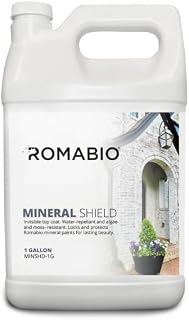
Romabio Mineral Shield is an invisible, breathable topcoat made to protect limewash, marmorino, brick, stone, stucco and concrete while letting vapor pass, and it suits this roundup because its maker states both the surfaces it protects and the surfaces it must not touch. It repels water droplets on the surface yet allows vapor to move through the wall, so a lime plaster finish keeps its breathability after treatment. The product is ready to use and must not be diluted, which removes one common source of error on site.
- Form: invisible breathable topcoat, ready to use, do not dilute
- Vapor behavior: repels water droplets while allowing vapor to pass through
- Surfaces: limewash, marmorino, brick, stone, stucco, concrete
- Coverage: around two hundred to three hundred square feet per gallon
- Application temperature: above ten degrees Celsius (fifty degrees Fahrenheit) and below thirty-five degrees Celsius (ninety-five degrees Fahrenheit)
- Timing: apply five to ten days after painting
- Limit: not for non-porous acrylic coatings
The limit on non-porous acrylic coatings is the detail that decides many jobs. Mineral Shield is made for mineral finishes that absorb, and an acrylic coating that does not absorb gives the product no pore structure to work with, so adhesion and performance fall away. On a fresh limewash or marmorino that has had five to ten days to set, it adds water repellency without changing the look of the finish, and on exterior brick and stone it gives a clear shield that does not alter color. Interior use is equally straightforward where the wall is a mineral finish, but a wall painted with a standard acrylic emulsion should be left alone or stripped back to a mineral surface first.
Mapei Antipluviol S
Mapei Antipluviol S is a solvent-based silane and siloxane impregnator, and it belongs here because its data sheet gives a measured vapor diffusion value and a clear list of surfaces it does not suit. The product does not form a skin on the surface and does not substantially change the vapor permeability of the treated material, with a diffusion-equivalent air layer thickness under zero point one four metres, which places it in class one for highly transpirant products under EN ISO 7783-2. It penetrates the pores and lines them, so rain is held back while vapor continues to move.
- Chemistry: silane and siloxane impregnator, solvent-based
- Vapor behavior: sD under zero point one four metres, class one highly transpirant (EN ISO 7783-2)
- Form: no skin formed; vapor permeability not substantially changed
- Consumption: zero point three to two kilograms per square metre (render zero point three to one point zero litres per square metre)
- Surfaces: render, plaster, brick, stone and concrete
- Limits: not for horizontal surfaces; not for non-absorbent substrates
The two limits in the data sheet do real work on a job. A horizontal surface such as a sill or a flat coping holds standing water, and an impregnator made for vertical faces cannot be relied on there, so the maker rules those surfaces out. A non-absorbent substrate gives the silane and siloxane nothing to penetrate, so the product stays on the surface and wastes material. On a vertical mineral render that absorbs, Antipluviol S gives strong water repellency with a measured vapor figure to back it, and the consumption range in the data sheet lets a buyer estimate how much a wall will need based on how thirsty the render is.
Remmers Funcosil SNL
Remmers Funcosil SNL is a clear, solvent-based silane and siloxane impregnation, and it fits this roundup because its data sheet states that it enables vapor diffusion while listing the materials it must not be used on. The product is applied by flooding the surface so the liquid soaks into the pores, where it forms a water-repellent zone without closing the pore network. The maker lists it for mineral building materials outdoors, including render, brick and natural stone, and gives a minimum consumption figure for render so coverage can be planned.
- Chemistry: silane and siloxane impregnation, solvent-based
- Active ingredient: around seven percent
- Density: around zero point seven eight grams per cubic centimetre
- Flash point: above thirty degrees Celsius
- Vapor behavior: enables water vapor diffusion
- Consumption: minimum zero point five litres per square metre on render
- Application temperature: from plus ten to plus twenty-five degrees Celsius
- Limits: not for solvent-sensitive materials such as polystyrene and bitumen
The limit on solvent-sensitive materials is the one to check before opening the can. Polystyrene insulation boards and bitumen coatings can be damaged by the solvent carrier, so a wall with those materials exposed needs a water-based alternative instead. On a plain mineral render, brick or stone face, Funcosil SNL is a straightforward choice, and the minimum consumption figure for render gives a firm basis for ordering. The product needs a clean, dry and absorbent face, and the wall should be protected from rain until the treatment has taken hold.
Beeckosil Fine
Beeckosil Fine is a pure mineral potassium water glass silicate paint, and it earns its place because it is a finish in its own right that remains extremely vapor permeable, with a fine grain that suits smooth mineral surfaces. Unlike an impregnator that disappears into the pores, Beeckosil Fine leaves a thin mineral coat that bonds with the substrate through a silicification reaction, so the paint becomes part of the surface rather than a film sitting on it. The fine grade gives an even, smooth finish on lime and cement stucco, brick and stone.
- Chemistry: pure mineral potassium water glass silicate paint
- Vapor behavior: extremely vapor permeable
- Grain: fine, for smooth mineral surfaces
- Surfaces: lime and cement stucco, brick, stone
- Application: brush, roller or spray; ready to use
- Consumption: around zero point one two five to zero point one nine litres per square metre per coat
The substrate limits follow from the chemistry. Beeckosil Fine needs a mineral, absorbent surface to bond with, so lime plaster, cement render, brick and stone are the right faces, while a wall coated with a synthetic resin paint or an old oil paint will not give the silicate anything to react with. A sound lime plaster that has been cleaned and, where dusty, consolidated first takes the paint well, and the fine grain keeps the finish smooth enough for interior feature walls as well as exterior facades. Two coats at the stated consumption give a durable mineral finish that keeps the wall breathing.
Sika Sikagard-700 S
Sika Sikagard-700 S is a one-part siloxane-based water repellent impregnation, and it closes this roundup because its data sheet states plainly that it does not act as a vapor barrier while listing the uses it is not intended for. The product penetrates well into the open pores of absorbent cementitious substrates, giving durable water repellency while still allowing water vapor diffusion in both directions. It complies with EN 1504-2 for hydrophobic impregnation, penetration depth class one.
- Chemistry: silanes and siloxanes blend in organic solvent
- Vapor behavior: allows water vapor diffusion in both directions; does not act as a vapor barrier
- Density: around zero point eight kilograms per litre (at plus twenty degrees Celsius)
- Flash point: around thirty-six to forty degrees Celsius
- Consumption: around zero point three to zero point five kilograms per square metre per coat for a normally absorbent substrate
- Packs: five and twenty-five litre pails
- Application: low-pressure spray, brush or roller, working from bottom up
- Curing: protect from rain for at least three hours at plus twenty degrees Celsius
- Limits: not for waterproofing under hydrostatic pressure, in permanent contact with water, or for below-grade waterproofing; not for sealing visible cracks
The limits are the reason this product fits a breathable masonry brief rather than a waterproofing brief. A wall below ground, a surface under constant water pressure, or a crack wider than a hairline needs a different system, and the data sheet says so directly. For an exposed absorbent render, concrete tile, fibre cement, brickwork or natural stone above ground, Sikagard-700 S gives a colorless treatment that usually does not change the look of the substrate, reduces chloride ingress and efflorescence, and keeps vapor moving both ways.
| Product | Key spec | Suited to |
|---|---|---|
| KEIM Fixativ | Potassium silicate fixative; above 93 perms; 0.1 l per sq m | Dusty lime plaster, brick, stone, stucco, concrete |
| KEIM Silan-100 | 100 percent silane; penetration at least 10 mm; VOC under 10 g per l | Absorbent concrete, stone, stucco, brick |
| Romabio Mineral Shield | Invisible breathable topcoat; 200 to 300 sq ft per gal; ready to use | Limewash, marmorino, brick, stone, stucco, concrete |
| Mapei Antipluviol S | Silane and siloxane; sD under 0.14 m, class 1; render 0.3 to 1.0 l per sq m | Vertical mineral render, plaster, brick, stone |
| Remmers Funcosil SNL | Silane and siloxane; 7 percent active; render min 0.5 l per sq m | Mineral render, brick, natural stone outdoors |
| Beeckosil Fine | Potassium water glass silicate paint; extremely vapor permeable; fine grain | Smooth lime and cement stucco, brick, stone |
| Sika Sikagard-700 S | Silanes and siloxanes; EN 1504-2 class 1; 0.3 to 0.5 kg per sq m per coat | Absorbent render, concrete, brickwork, natural stone |
How to choose
Match the chemistry to the wall
The first choice is between a silicate fixative, a silane or siloxane impregnator, and a mineral paint, and the wall decides. A dusty or friable lime plaster needs a consolidant first, and KEIM Fixativ is the product in this roundup made for that job, because it binds loose grains and leaves the surface firm without a film. A sound wall that needs water repellency but no consolidation suits an impregnator such as Silan-100, Antipluviol S, Funcosil SNL or Sikagard-700 S, which sink into the pores and leave no visible coat. A wall that needs both color and protection suits a mineral paint such as Beeckosil Fine, which bonds with the substrate and keeps vapor moving. Choosing the wrong chemistry wastes the coat: an impregnator on a dusty wall has nothing firm to grip, and a paint on a wall that only needed repellency adds a coat the wall did not ask for.
Read the stated substrate limits first
Every product in this roundup carries limits from its maker, and those limits are the quickest filter. Check whether the wall is absorbent, because every impregnator here needs an absorbent face, and a wall sealed with an acrylic coating rules out Mineral Shield, Silan-100 and the silane family until the old coating is removed. Check whether the surface is horizontal, because Antipluviol S rules out horizontal faces. Check for solvent-sensitive materials nearby, because Funcosil SNL rules out polystyrene and bitumen. Check whether the wall is below ground or under water pressure, because Sikagard-700 S rules out those uses. A product whose limits match the wall is a safe buy; a product whose limits clash with the wall is a failed coat waiting to happen.
Use the vapor figure, not the label
Labels that say breathable vary widely in what they mean, so the measured figure is the better guide. Fixativ gives a value above ninety-three perms under ASTM E96. Antipluviol S gives an sD under zero point one four metres, class one under EN ISO 7783-2. Silan-100 and Sikagard-700 S are described by their makers as completely vapor permeable and as not acting as a vapor barrier. Where a maker gives a number, compare numbers; where a maker gives only a description, treat the description as a claim to weigh against the chemistry. A non-film-forming silicate or a silane that lines pores without filling them has a sound reason to stay permeable, while a product that forms a thick film needs a measured figure before it can be trusted on a lime wall.
Plan coverage from the data sheet
Coverage figures differ by product and by how thirsty the wall is, so ordering should start from the maker's range rather than from a guess. Fixativ runs around zero point one litres per square metre, Silan-100 around zero point one seven to zero point two litres per square metre for two coats, Antipluviol S from zero point three to one point zero litres per square metre on render, Funcosil SNL at a minimum of zero point five litres per square metre on render, and Sikagard-700 S at zero point three to zero point five kilograms per square metre per coat. A porous old lime plaster will take the top of the range, while a dense cement render will take the bottom. Buying to the top of the range for a thirsty wall avoids running short halfway across a facade, and a sample area of one or two square metres settles the real consumption before the full order is placed.
Common mistakes
The most common mistake is sealing a wall that is not ready. A lime plaster that is still damp, a render with salt efflorescence on its face, or a wall coated with an old acrylic paint will not take an impregnator or a silicate fixative properly, because the product needs a clean, dry and absorbent mineral face. The fix is to clean the wall, brush off salts, let the surface dry, and strip any non-mineral coating before starting. A day spent on preparation saves a coat that would otherwise peel or sit patchy on the surface.
A second mistake is treating a horizontal surface with a product made for vertical faces. Sills, copings and flat ledges hold standing water, and an impregnator rated for vertical render cannot be relied on there. The fix is to use a product or a detail made for horizontal exposure, or to accept that the horizontal surface needs a different approach, such as a cover or a drip detail, rather than a coat of sealer.
A third mistake is diluting a product that must be used as supplied. Mineral Shield states plainly that it must not be diluted, and Silan-100 is supplied ready to use. Adding water to a ready-to-use product weakens the active content and leaves the wall under-protected, while the saving in material is small. The fix is to follow the dilution line on the data sheet exactly: dilute only where the maker gives a ratio, as with Fixativ at one part to one or two parts water, and use everything else as it comes from the can.
A fourth mistake is applying a solvent-based impregnator near materials the solvent can damage. Funcosil SNL rules out polystyrene and bitumen, and the same care applies to any solvent carrier near plastic trims, sealants or bitumen flashings. The fix is to mask or protect those materials before spraying, or to choose a water-based product for a wall where solvent-sensitive materials are exposed.
A fifth mistake is judging the job too soon. A silicate fixative needs at least twelve hours between coats, a silane needs ten to twenty-four hours before a second coat, and a topcoat such as Mineral Shield should go on five to ten days after painting. Rushing the next step traps moisture, clouds the finish or lifts the coat. The fix is to plan the schedule around the drying figures on the data sheet and to keep the wall dry and sheltered while each coat sets.
FAQ
Can a vapor permeable sealer be used on old lime plaster?
Yes, where the plaster is sound, clean and absorbent. A silicate fixative such as KEIM Fixativ consolidates a dusty face, a silane such as Silan-100 adds water repellency without closing pores, and a mineral paint such as Beeckosil Fine gives a breathable finish. The plaster must be dry and free of loose material and salt crusts first, and any old non-mineral coating should be removed so the sealer can reach the mineral surface.
What does the maker's substrate limit tell me?
It tells you where the product has been shown to work and where it has not. A limit such as not for horizontal surfaces, not for non-absorbent substrates, or not for solvent-sensitive materials is a boundary drawn from the product's chemistry and from field experience. Staying inside the stated limits is the simplest way to avoid a failed coat, and a wall that falls outside a product's limits needs a different product rather than a hope that the limit does not matter.
How do I know if a sealer will keep a wall breathing?
Look for a measured vapor figure or a clear statement of behavior. Fixativ gives above ninety-three perms under ASTM E96, Antipluviol S gives an sD under zero point one four metres in class one, and Silan-100 and Sikagard-700 S are described by their makers as completely vapor permeable and as not acting as a vapor barrier. A product that forms no film and lines pores rather than filling them has a sound basis for staying permeable.
Should I dilute a silicate fixative before use?
Only where the maker gives a ratio. KEIM Fixativ is diluted one part to one or two parts water when used as a primer or diluent, and the data sheet gives that ratio plainly. Romabio Mineral Shield must not be diluted, and KEIM Silan-100 is supplied ready to use. Diluting a ready-to-use product weakens it, so the rule is simple: follow the data sheet, and if no ratio is given, use the product as supplied.
How much sealer will a wall need?
It depends on the product and on how absorbent the wall is. Fixativ runs around zero point one litres per square metre, Silan-100 around zero point one seven to zero point two litres per square metre for two coats, Antipluviol S from zero point three to one point zero litres per square metre on render, and Sikagard-700 S at zero point three to zero point five kilograms per square metre per coat. A sample area of one or two square metres on the real wall settles the figure before the full order is placed, and a porous old plaster will take the top of the range.
Conclusion
A breathable masonry finish survives because the wall can dry, and the sealer that protects it must leave that drying path open. The seven products in this roundup all carry documented vapor behavior and stated substrate limits, from the consolidating power of KEIM Fixativ on dusty lime plaster to the measured vapor figure of Mapei Antipluviol S on vertical render. The right choice starts with the wall: its material, its absorbency, its exposure and the limits its maker states. Match the chemistry to the wall, respect the limits, plan coverage from the data sheet, and the finish will keep its breathability for years.
Related guides
More from Amazon
Programs that pair well with the guide above. Offers and eligibility are set by Amazon and may change.
Free shipping on eligible items, Prime Video and more. Eligible new members can start with a free trial.
Start a Prime free trialAudiobooks and podcasts to listen to on the go. Eligible new members can start with a free trial.
Try Audible freeAd-free music streaming. Eligible new subscribers can start with a free trial.
Try Music Unlimited freeA free business account with business pricing and bulk-buying tools for work, shop or home office.
Create a business accountAs an Amazon Associate we earn from qualifying purchases.
More ways to save on your next finish
Programs that pair well with the guide above. Offers and eligibility are set by Amazon and may change.
A free business account with business pricing and bulk-buying tools for work, shop or home office.
Create a business accountFast, free shipping on eligible items, plus Prime Video and more. Eligible new members can start with a free trial.
Start a Prime free trialRead from a huge library of eBooks, including how-to guides and cookbooks. Eligible new members can start with a free trial.
Try Kindle UnlimitedAudiobooks and podcasts for the commute, the garage or the kitchen. Eligible new members can start with a free trial.
Try Audible freeAs an Amazon Associate we earn from qualifying purchases. Using these links costs you nothing extra.



Write Your Review
No reviews yet. Be the first to share your experience!