
Key takeaways
- Compare the best vapor permeable plaster sealers for breathable masonry finishes, with transparent treatments that protect without changing the look at all.
As an Amazon Associate I earn from qualifying purchases. This post may contain affiliate links at no extra cost to you.
A masonry finish that breathes is a working system, not a decoration. Air and vapor move through the brick, the mortar, and the plaster, and that movement keeps the wall dry from the inside out. A sealer that blocks that movement may look protective on the day it goes on, but it traps moisture behind the surface, and trapped moisture is what causes spalling, salt damage, and peeling finishes. best vapor permeable plaster sealers for maintaining breathable masonry finishes with transparent finish are the products that protect the surface while leaving the vapor path open, and the seven below were chosen because each one is transparent or clear, each one states its vapor behavior, and each one suits a masonry finish that must keep breathing.
Transparency matters as much as breathability here. A masonry finish has a color, a texture, and a matte surface that the owner chose, and a sealer that darkens, glosses, or yellows the wall changes the finish it was meant to protect. The products in this roundup dry clear or invisible, and the makers state that plainly: no sheen change, no color change, no visible film. That is the standard a transparent finish must meet, and any product that cannot meet it does not belong on a finished masonry wall, however strong its water repellency may be.
The seven products cover the main ways to keep a masonry finish breathing. Siloxane impregnations line the pores and shed liquid water. Potassium silicate fixatives bond with the mineral surface and hold dust down. An invisible topcoat shields a finished limewash from rain and staining. Each entry below gives the figures the maker states, with a dash where the maker does not state a figure, so the comparison rests on published facts rather than on sales language.
Best products
Romabio Mineral Shield
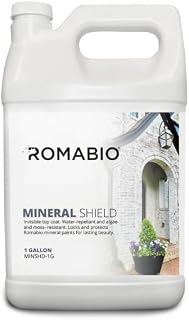
- Invisible, breathable protective topcoat for exterior limewash and masonry finishes
- Coverage about 200 to 300 square feet per gallon at average absorption
- Ready to use, do not dilute with water
- Apply in temperatures above 10 degrees Celsius and below 35 degrees Celsius
- Apply with a pump sprayer or brush, biodegradable and completely water-soluble
Romabio Mineral Shield leads this roundup because it is the clearest example of the transparent finish the keyword asks for. The maker describes it as an invisible coating that locks and protects mineral paint finishes from natural patina and weathering created by water, while the breathable coating repels water droplets yet still allows water vapor to pass through. It does not change the sheen of the finish or the texture of the surface, and it protects lime-based coatings such as Romabio Classico Limewash from the temporary discoloration that appears when the surface is wet from rain and water absorption. It also protects uncoated porous brick, stone, stucco, concrete, and other masonry.
Coverage runs about 200 to 300 square feet per gallon at average absorption, and the maker advises a check on the actual surface to fix the exact consumption, since texture and absorption vary. The product is ready to use and must not be diluted with water, and a second coat, where wanted, goes on wet on wet within five minutes. Application temperature sits above 10 degrees Celsius and below 35 degrees Celsius. The product is described as eco friendly, safe for children, pets, and gardens, and biodegradable and completely water-soluble, and it helps hold back algae, moss, and mold while reducing staining from clay, dirt, and grass. For a breathable masonry finish that must look exactly as it did before treatment, this is the product that sets the standard for invisibility.
KEIM Lotexan
- Colourless siloxane-based water-repellent protective treatment
- Sd value for water vapor diffusion 0.05 metres
- Water absorption coefficient under 0.1 kilograms per square metre root hour
- Consumption about 0.4 litres per square metre for two coats, ranging from 0.2 to 0.8
- Available in 5 litre and 25 litre containers, shelf life 12 months
KEIM Lotexan is the siloxane impregnation in this roundup, and it earns its place through a stated vapor figure and a long record on mineral renders. The maker describes it as a colourless, siloxane-based water-repellent final treatment for mineral renders and coatings, fair-faced concrete, prefabricated concrete elements, exposed aggregate concrete, calcareous sandstone, and fibre-cement boards, and states that it protects from water, acid rain, and atmospheric pollution. The active ingredient is very small in particle size, so it penetrates deep into the pores, and once the solvent has evaporated it is deposited on the pore walls, where it develops its water repellency by reacting with moisture in the material and in the air.
The vapor figure is the point that matters for this keyword. The maker states an Sd value of 0.05 metres, and describes the treatment as non-film-forming, highly water vapor permeable, and complete in its water vapor permeability, which means the pores are not sealed and vapor keeps moving through the wall. Application is by brush or by flooding, twice wet on wet with an interval of about 10 minutes, and the maker warns not to spray. A minimum depth of penetration of 2 millimetres is normally necessary for effective water repellency, and at least 8 days must pass after the final coat of KEIM Purkristalat coatings before treatment. For a breathable masonry finish that faces rain, Lotexan is the treatment that sheds liquid water while leaving the vapor path open.
BEECK SP Plus
- Colourless, solvent-borne hydrophobic impregnation based on silane and siloxane technology
- Sd value about 0.03 metres, very low added resistance to water vapor diffusion
- For porous mineral exterior facades including lime render and mineral render
- Penetrates into the porous mineral surface rather than creating a surface film
- Substrate must be sound, dry, clean, and free from significant defects before treatment
BEECK SP Plus is the hydrophobic impregnation in this roundup, and it earns its place because it was made for the exact problem the keyword describes: a sound lime-rendered facade that absorbs too much wind-driven rain. The maker describes it as a colourless, solvent-borne hydrophobic impregnation based on silane and siloxane organosilicon technology, designed for porous mineral exterior facades including lime render, mineral render, natural stone, brick, calcium silicate masonry, concrete, and compatible Beeck active silicate coatings. It reduces liquid water absorption through capillary action while retaining very low resistance to water vapor diffusion, with a stated Sd value of about 0.03 metres.
The point of the product is not to seal the wall but to reduce the amount of driving rain absorbed through the outer surface while retaining drying potential. The treatment penetrates into the porous mineral surface rather than creating a conventional surface film, and the render should be stable, sufficiently dry, and free from significant defects before treatment. It should not be used to make up for cracked, detached, or otherwise failing render, since no impregnation can fix a broken substrate. For a breathable masonry finish on an exposed facade, SP Plus is the treatment that cuts rain uptake while keeping the wall able to dry out.
Remmers Funcosil WS
- Hydrophobising impregnation on a silane and siloxane base in aqueous emulsion form
- Active ingredient content about 10 percent by mass, density about 1.0 grams per cubic centimetre
- pH value about 7.0, neutral, milky liquid appearance
- Available in 5 litre and 30 litre plastic canisters
- Solvent-free, PFAS-free formulation, enables water vapor diffusion
Remmers Funcosil WS is the water-based impregnation in this roundup, and it earns its place because it brings silane and siloxane protection without solvents. The maker describes it as a hydrophobising impregnation on a silane and siloxane base in aqueous emulsion form, for porous mineral building materials such as brick masonry, sandstone and sand-lime brick, mineral renders, and aerated concrete, as well as mineral topcoats in thermal insulation systems. It repels water, enables water vapor diffusion, is UV-resistant and alkali-resistant, and carries a PFAS-free formulation, which matters where the treatment is used near soil and planting.
Application rates are stated per substrate, with render needing at least 0.5 litres per square metre, and the maker advises a sample area of 1 to 2 square metres to fix the exact quantity for the wall in hand. The product is applied by flow coating without pressure, in a liquid film 30 to 50 centimetres long flowing down the surface, repeated at least twice wet on damp until no further material is absorbed. Temperature of material, air, and substrate must sit from 10 degrees Celsius to 25 degrees Celsius during application. For a breathable masonry finish where solvents are not wanted, whether because the work is indoors or near planting, Funcosil WS is the water-based choice that keeps the vapor path open.
PROSOCO Siloxane WB Concentrate
- Solvent-free blend of silanes and oligomeric alkoxysiloxanes, concentrated
- Dilute with up to 19 parts fresh water, one gallon of concentrate covers up to 4,000 square feet
- Specific gravity 0.96, total solids 48 percent by ASTM D 5095
- VOC content 16 to 41 grams per litre as diluted
- Water vapor transmission 1.21 grains per hour per square foot
PROSOCO Siloxane WB Concentrate is the concentrate in this roundup, and it earns its place through economy and a stated vapor figure. The maker describes it as a solvent-free blend of silanes and oligomeric alkoxysiloxanes that mixes easily with fresh water on the job site to produce a penetrating water repellent for dense or porous masonry surfaces. It penetrates and chemically bonds deep within the masonry substrate to give long-lasting protection against water-related staining and deterioration, and it will not darken the surface, produce a surface film, or impair the natural breathing characteristics of treated surfaces. Treated surfaces breathe and do not trap moisture.
The dilution is the figure to note: mix with up to 19 parts fresh water, and one gallon of concentrate covers up to 4,000 square feet, which makes the product economical for large walls. The diluted mix must be applied within 24 hours of dilution for maximum effectiveness, and the product is alkaline stable, so it suits new concrete. Water absorption reduction figures are given as 94.52 percent for concrete, 99.23 percent for brick, and 82.03 percent for CMU, while water vapor transmission is stated as 1.21 grains per hour per square foot. One limit to respect is that the product is not appropriate for use on limestone, marble, travertine, or other calcareous stones, so it does not suit every masonry finish. For a large breathable masonry wall where cost per square metre matters, this concentrate is the economical choice with published vapor figures.
Meoded Stain Shield
- Natural-look sealer for Venetian plaster and decorative finishes
- Repels oil and water while preserving the true appearance of the finish
- Forms an invisible protective barrier that resists moisture, stains, and oil
- No change to color, texture, or existing sheen
- Apply after the plaster has dried for at least 24 to 48 hours
Meoded Stain Shield is the natural-look sealer in this roundup, and it earns its place because a finished masonry wall in a living space is touched, leaned on, and splashed, and it needs protection that does not add gloss. The maker describes it as a premium natural-look sealer that repels oil and water while preserving the true appearance of the finish, forming an invisible protective barrier that resists moisture, stains, and oil without changing color, texture, or adding sheen. That description fits the transparent finish the keyword asks for, since the wall keeps the exact look it had before treatment.
The maker recommends a sealed sample before applying the topcoat to the whole wall, which is sound practice for any invisible product, since the only way to confirm invisibility is to see it on the actual plaster. Application follows the plaster maker's drying rule, with lime-based Venetian plaster left to dry for at least 48 hours before wax or sealer goes on, and the sealer is the right choice where protection is wanted without added sheen, while the maker's HydroWax is the choice where a soft luster is wanted instead. For a breathable masonry finish that must stay matte and invisible, Stain Shield is the sealer that protects without advertising itself.
KEIM Fixative
- Clear binder, thinner and consolidant made from pure liquid potassium silicate
- Vapor permeability of 93 perms or more by ASTM E 96
- Specific weight about 1.17 grams per cubic centimetre
- pH value 11.3, VOC content under 1 gram per litre
- Penetration depth class II, 10 millimetres, active content 100 percent
KEIM Fixative closes this roundup as the mineral fixative, and it earns its place because it holds a dusty masonry finish together while keeping vapor movement high. It is a clear liquid potassium silicate that soaks into mineral surfaces and bonds with them, and the maker states a vapor permeability of 93 perms or more, which is a high figure for a product that also consolidates the surface. The product is fully miscible in water, dries clear with a natural mineral matte finish, and does not alter existing colors, so a masonry finish keeps its own tone after treatment.
The maker lists the product as an anti-dusting finish for interior or exterior brick, stone, stucco, concrete, and any masonry surface, and describes how it ties down loose dust and consolidates the surface. As a mild consolidant it also suits friable and damaged masonry, where the penetrating action strengthens weakened material by rebonding its structure at a fine scale and filling small voids. The maker is clear about what the product is not: it is not a sealer in the film sense, because the stone stays breathable, though it does slow the rate at which ambient moisture is absorbed. For a breathable masonry finish that is sound but powdery, that is exactly the right trade, since the goal is a stable, breathable surface rather than a waterproof skin.
| Product | Main specification | Best suited for | Coverage |
|---|---|---|---|
| Romabio Mineral Shield | Invisible breathable topcoat | Finished limewash that must keep its look | 200 to 300 square feet per gallon |
| KEIM Lotexan | Siloxane water repellent, Sd 0.05 m | Mineral renders facing rain | About 0.4 litres per square metre |
| BEECK SP Plus | Silane and siloxane impregnation, Sd 0.03 m | Lime render on exposed facades | See product page |
| Remmers Funcosil WS | Aqueous silane and siloxane emulsion, 10 percent active | Masonry where solvents are not wanted | Render at least 0.5 litres per square metre |
| PROSOCO Siloxane WB Concentrate | Solvent-free concentrate, dilute up to 1 part to 19 parts water | Large masonry walls, economical coverage | 1 gallon covers up to 4,000 square feet |
| Meoded Stain Shield | Natural-look sealer, oil and water repellent | Matte finishes that must stay matte | See product page |
| KEIM Fixative | Clear potassium silicate, 93 perms or more | Dusty masonry finishes | See product page |
How to choose
Insist on a transparent result
A transparent finish is a result to check, not a word to trust. The maker should state that the product dries clear, invisible, or without sheen change, and the reader should confirm it with a sample area on the actual wall, checked after full drying in daylight and in lamplight. A product that darkens the wall when wet and stays dark when dry has failed the transparency test, even if its water repellency is strong. Where the finish is a limewash or a mineral paint with a delicate tone, that sample area is the most important step in the whole job.
Read the vapor figure, not the adjective
Every sealer in this roundup claims breathability, but only some of them publish a number for it. An Sd value in metres, a perm rating, or a water vapor transmission figure lets the reader compare products on the same scale, while a product with no figure asks for trust. For a masonry finish that must keep breathing, a low Sd value or a high perm rating is the sign that the wall will keep drying out through the finish, and a product that states its figure is a safer choice than one that only uses the word breathable. Where the maker gives no vapor figure, ask for it, or choose a product that does.
Match the treatment to the exposure
A dry interior wall, a sheltered garden wall, and an exposed facade face different amounts of water, and they need different treatments. A fixative or an invisible topcoat is enough for a dry interior, where the need is dust control and light protection. A siloxane impregnation is the right choice for a facade that faces driving rain, where liquid water uptake must fall sharply while vapor keeps moving. Buying a heavy exterior impregnation for a dry interior wall wastes money, and buying a light interior topcoat for an exposed facade leaves the wall under-protected. Judge the exposure first, then choose the product.
Check compatibility with the finish below
A sealer must suit the finish it goes over, and the maker should state which finishes it suits. Some products in this roundup are made for mineral renders and mineral paints, some are made for limewash and lime slurry, and some are made for uncoated porous masonry. A product made for mineral surfaces may not suit an acrylic paint, and a product made for dense concrete may not suit a soft lime render. Read the field of application on the data sheet, check it against the finish on the wall, and do not use a product outside its stated field, since a sealer applied to the wrong finish can fail in ways that are hard to undo.
Common mistakes
The most common mistake on a breathable masonry finish is choosing a film-forming sealer because it looks protective in the can. A glossy film may look like armor, but on a mineral wall it traps moisture, and trapped moisture is what causes plaster to blister, salts to crystallize behind the surface, and paint to peel in sheets. The fix is to choose by chemistry and by vapor figure, not by shine, and to confirm that the dried treatment leaves the wall able to pass vapor. A simple check is to read the Sd value or perm rating on the data sheet, and to walk away from any product that will not state one.
The second mistake is applying a sealer to a dirty or damp wall. Dust, grease, and loose material sit between the treatment and the masonry, so the sealer bonds to the dirt instead of the wall, and the protection fails in patches. The fix is to clean the wall, remove loose material, and let it dry fully before the first coat goes on, since nearly every data sheet in this roundup lists a clean, dry, sound substrate as a requirement. A wall that is still damp from washing or from a leak needs time, not a sealer.
The third mistake is skipping the sample area. Transparent products are the hardest to judge, because the only way to know whether a treatment changes the color or sheen is to see it on the actual finish. The fix is to treat a small, hidden area first, let it dry fully, and look at it in daylight and in lamplight before treating the whole wall. That sample also fixes the consumption figure for the wall in hand, which matters for impregnations whose use can range widely with pore volume.
The fourth mistake is applying the product too thinly or too thickly. An impregnation needs to saturate the surface to reach its stated penetration depth, and a thin mist that only wets the face will not give the stated protection. A topcoat that is pooled on the surface dries as a skin, and that skin is exactly the film the job was meant to avoid. The fix is to follow the application rate on the data sheet, to apply in the stated number of passes, and to remove excess material where the maker asks for it.
The fifth mistake is ignoring the waiting times between treatments. A consolidant needs weeks to finish reacting, a water-repellent treatment needs days after a fresh mineral coating, and a topcoat needs the plaster to be fully dry before it goes on. A second treatment applied too soon can leave a hazy film or a weak bond. The fix is to read the waiting times on the data sheet and to plan the job around them, even when the room is needed back quickly.
FAQ
Will a vapor permeable sealer change the color of a masonry finish?
A clear mineral fixative or a colourless impregnation should not change the color, and the makers in this roundup state that their products dry clear or transparent. A wax topcoat can deepen the color and add sheen, which is a different effect and should be chosen only where that change is wanted. The safe step is a sample area on the actual wall, checked after full drying in daylight.
Can a sealer be used over limewash?
Yes, where the maker states it. Several products in this roundup are made for limewash and lime slurry, and an invisible topcoat can protect a limewash finish from rain staining without changing its look. The limewash must be fully dry and sound first, and a sample area will show whether the treatment soaks in evenly or marks the surface.
How long should a masonry finish dry before sealing?
Fresh mineral renders and limewash need to cure and dry before any sealer goes on, and the waiting time depends on thickness, temperature, and humidity. For a topcoat over Venetian plaster, the maker guidance in this roundup is at least 24 to 48 hours, and for lime-based plaster the guidance is at least 48 hours. A water-repellent treatment over a fresh mineral coating can need 8 days or more, so the data sheet should be checked for the exact figure.
Does a breathable sealer stop rising damp?
No. A penetrating water repellent reduces rain absorption and slows capillary uptake from the surface, but it does not stop water rising from the ground. Rising damp needs the source dealt with at the base of the wall, and several makers in this roundup state plainly that their products are not to be used against rising damp where no horizontal barrier exists.
How often does a vapor permeable sealer need reapplying?
It depends on the product and the exposure. A mineral fixative that bonds chemically with the plaster can last for years indoors, while a water-repellent impregnation on a facade weathers and needs renewal after several years. In a dry interior the exposure is mild, so the interval is long, and the sign that renewal is due is a return of dusting or a change in how the wall takes water.
Conclusion
A breathable masonry finish stays healthy only while vapor keeps moving through it, and a sealer that blocks that movement does more harm than good. The seven products in this roundup protect the surface while leaving the vapor path open, and they do it in different ways. Romabio Mineral Shield leads where the finish must look exactly as it did before treatment. KEIM Lotexan and BEECK SP Plus lead where rain uptake must fall sharply on a mineral render. Remmers Funcosil WS leads where solvents are not wanted. PROSOCO Siloxane WB Concentrate leads where a large wall needs economical coverage with stated vapor figures. Meoded Stain Shield leads where a matte finish needs invisible protection, and KEIM Fixative leads where a dusty surface needs a mineral bond with a stated vapor figure.
Whatever product is chosen, the working rules stay the same. Read the data sheet, match the chemistry to the finish, check the vapor figure, treat a sample area first, and honor the waiting times. A sealer is a small part of the cost of a masonry wall and a large part of its working life, because every coat above it depends on the bond it makes. Choose by the published figures, and the finish will stay dry, firm, and able to breathe.
Related guides
More from Amazon
Programs that pair well with the guide above. Offers and eligibility are set by Amazon and may change.
Free shipping on eligible items, Prime Video and more. Eligible new members can start with a free trial.
Start a Prime free trialAudiobooks and podcasts to listen to on the go. Eligible new members can start with a free trial.
Try Audible freeAd-free music streaming. Eligible new subscribers can start with a free trial.
Try Music Unlimited freeA free business account with business pricing and bulk-buying tools for work, shop or home office.
Create a business accountAs an Amazon Associate we earn from qualifying purchases.
More ways to save on your next finish
Programs that pair well with the guide above. Offers and eligibility are set by Amazon and may change.
A free business account with business pricing and bulk-buying tools for work, shop or home office.
Create a business accountFast, free shipping on eligible items, plus Prime Video and more. Eligible new members can start with a free trial.
Start a Prime free trialRead from a huge library of eBooks, including how-to guides and cookbooks. Eligible new members can start with a free trial.
Try Kindle UnlimitedAudiobooks and podcasts for the commute, the garage or the kitchen. Eligible new members can start with a free trial.
Try Audible freeAs an Amazon Associate we earn from qualifying purchases. Using these links costs you nothing extra.



Write Your Review
No reviews yet. Be the first to share your experience!