
Key takeaways
- Compare the best vapor permeable plaster sealers with a transparent finish for mineral render interiors, with coverage, drying times and protection compared.
As an Amazon Associate I earn from qualifying purchases. This post may contain affiliate links at no extra cost to you.
A transparent sealer is judged by what it does not do. It does not change the colour of the plaster, it does not add a sheen, it does not fill the texture, and it does not leave a visible edge where the treated area ends and the untreated area begins. On a mineral render interior that invisibility is the whole point, because the finish is the decoration: the soft matt face of a lime plaster, the clouded tones of a Marmorino panel, the pale wash of a limewash wall. A sealer that alters any of that has failed, however well it protects. Choosing the best vapor permeable plaster sealers with transparent finish for finishing compatible mineral render interiors means finding products that protect the surface from water and dust while leaving it looking exactly as it did before treatment, and that keep the wall open to vapor at the same time.
Transparency is not the same as clarity in the can. Several products in this guide are milky white liquids that dry clear, and several are clear liquids that can still leave a faint sheen if they are over applied. The honest check is a sample patch on a hidden area, left for a few days and then looked at in raking light, which is light that falls across the wall at a shallow angle and shows every change in surface and sheen. A product that passes that check is transparent in the sense that matters: invisible on the wall, not just clear in the tin. Every product below is clear, colourless or invisible once dry according to its maker, and each one is listed with the finish its maker actually states.
A mineral render interior also needs a sealer that works with the surface rather than against it. Some products in this guide are silicate fixatives that bond chemically with the render and dry clear. Others are silane and siloxane impregnations that soak into the pores without forming a film. A few are consolidants that strengthen a soft surface before it takes a finish. The right choice depends on whether the render is new or old, sound or dusty, and on whether you need a primer under a silicate paint, an invisible topcoat over a finished wall, or a clear consolidant that simply steadies the surface. The guide below covers all of those jobs, with a lead pick for each one.
Best products
Romabio Mineral Shield
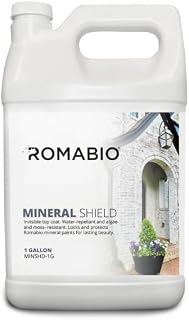
Romabio Mineral Shield is the strongest pick for a transparent finish, because it is an invisible breathable topcoat made for exactly this job. It repels water droplets while allowing vapor to pass through, so rain splash, condensation and everyday marks stay on the surface instead of soaking in, while the wall keeps breathing underneath. The maker states that it protects Classico Limewash, Lime Slurry, masonry paints and Marmorino plasters, as well as uncoated porous brick, stone, stucco and concrete, which covers most mineral render interiors, and the finish is invisible, so a decorative lime or Marmorino surface keeps its colour, its clouding and its matt look.
- Base: invisible breathable topcoat
- Coverage: about 200 to 300 square feet per gallon
- Application: pump sprayer or brush, do not dilute
- Application temperature: 10 to 35 degrees Celsius
- Finish: invisible, does not change the look of the surface
Mineral Shield is applied after the finish has cured, and it needs no dilution, which makes the application straightforward: spray or brush it on evenly and let it dry. The coverage range is wide because absorbent surfaces take more product than dense ones, so a small sample patch on an inconspicuous area is the sensible way to judge how much a particular render will take, and to confirm that the finish stays invisible in raking light. Because it adds no colour and no sheen, it is the natural choice for a feature wall, a pigmented lime finish, or any render interior where the look of the plaster is the reason the wall exists.
KEIM Lotexan
KEIM Lotexan is a clear silane and siloxane hydrophobic finishing treatment, and it is the pick for a transparent finish that also needs water repellency. The maker states an Sd value of 0.05 metres and describes the treatment as non film forming, with the pores remaining open and water vapor diffusion maintained, which is a clear, published statement rather than a vague claim. Because it is a clear liquid that leaves no film, it adds no colour and no sheen, and the render keeps its matt, mineral look while gaining water repellency.
- Base: clear silane and siloxane hydrophobic finishing treatment
- Sd value: 0.05 metres
- Vapor behaviour: non film forming, pores remain open, water vapor diffusion maintained
- Density: about 0.8 to 0.9 grams per cubic centimetre
- Consumption: about 0.4 to 0.8 litres per square metre for two coats
- Pack sizes: 5 litres and 25 litres
- Application temperature: at least 5 degrees Celsius
- Surfaces: mineral plasters and paints, concrete, sand lime brick and natural stone
The Sd value of 0.05 metres is low enough that the treated wall dries almost as freely as bare plaster, and the consumption figure of 0.4 to 0.8 litres per square metre for two coats is the realistic planning number for a render interior. The maker also lists dust suppression among its uses, so it suits a wall that sheds a little dust and sees the occasional mark. Lotexan is a finishing treatment, so it goes on after the surface has been consolidated if the face is dusty, because it lines the pores and keeps water out rather than adding the solid binder a powdery surface needs.
Limeworks Ecologic Waterglass Primer and Consolidant
Limeworks Ecologic Waterglass Primer and Consolidant is a clear primer, conditioner and thinner for silicate paints, and it is the pick for a transparent finish on an older lime render that needs steadying first. It is vapor permeable, and it stabilizes old lime and cement plaster by binding loose surface material back into the wall, which gives a dusty face a firm base for paint or limewash. The liquid is milky white in the can and dries clear, so it does not tint the render or show through a pale finish, and the transparency holds even on a white or pale lime wall.
- Base: clear waterglass primer, conditioner and thinner for silicate paints
- Vapor behaviour: vapor permeable
- Coverage: about 240 square feet per gallon
- Touch dry: about one hour
- Time between coats: six to eight hours
- Application temperature: 41 to 113 degrees Fahrenheit, equal to 5 to 45 degrees Celsius
- Finish: milky white liquid that dries clear
The one hour touch dry time and the six to eight hour recoat window make it easy to work with on a render interior, because priming often needs two passes and a product that dries fast lets the next pass go on the same day. On a historic lime plaster the gentle chemistry matters as much as the transparency: a waterglass primer works with the lime rather than against it, and it does not introduce resins or solvents that could trap moisture or change the character of the old work. Dilution follows the maker directions for the job at hand, whether that is priming, conditioning or thinning paint.
PROSOCO Conservare H100
PROSOCO Conservare H100 is an ethyl silicate and silane consolidation and water repellent treatment, and it is the pick for a transparent finish on a render that is soft as well as dusty. Ethyl silicate soaks deep into the pores and deposits silica there, which binds the loose particles together and restores strength to the surface, while the silane adds water repellency. The maker states that the treatment is vapor permeable and that treated surfaces breathe, and because the treatment works inside the pores rather than coating the surface, it adds no visible layer, so the render keeps its colour and texture.
- Base: ethyl silicate and silane consolidation and water repellent treatment
- Vapor behaviour: vapor permeable, treated surfaces breathe
- Total solids: 47 percent
- Specific gravity: 0.936
- Flash point: 110 degrees Fahrenheit, equal to 43 degrees Celsius
- Shelf life: one year
- Surfaces: sandstone, limestone, cast stone, stucco, brick and terra cotta
The total solids figure of 47 percent is the useful comparison number: it is the share of the liquid that stays behind in the plaster as solid binder after the carrier has gone, and a higher solids figure means more binder per litre. H100 is applied by flooding the surface until it stops absorbing, usually in repeated passes while the previous pass is still damp, and the one year shelf life matters because an opened can that has sat in a damp shed may already have started reacting. Buy fresh, use it within the year, and keep the room ventilated while the solvent carrier dries off.
Remmers Funcosil WS
Remmers Funcosil WS is a hydrophobising impregnation on a silane and siloxane base in an aqueous emulsion, and it is the pick for a transparent finish that also needs water repellency with no solvent smell. It is solvent free, it allows water vapor diffusion, and its pH is about 7.0, which is neutral, so it is gentle on lime render and comfortable to apply indoors. The milky liquid soaks into the pores and lines them with a water repellent layer, rather than coating the surface, so it adds no sheen and the render keeps its matt, mineral look.
- Base: silane and siloxane hydrophobising impregnation in aqueous emulsion
- Vapor behaviour: allows water vapor diffusion
- Density: about 1.0 grams per cubic centimetre
- Active ingredient: about ten percent by mass
- pH: about 7.0, neutral
- Solvent: solvent free
- Pack sizes: 5 litres and 30 litres
- Application temperature: plus 10 to plus 25 degrees Celsius
The neutral pH and the water based carrier make Funcosil WS one of the easiest products in this guide to live with during application, and the 5 litre pack suits a single room while the 30 litre pack covers a whole house. Application temperature matters: below 10 degrees Celsius the product will not penetrate properly, and above 25 degrees it can dry too fast on the surface, so a mild day and a cool wall are the right conditions. Two coats are often needed on a thirsty lime render, with the second coat going on while the first is still damp, following the maker directions for the substrate. Over application is the enemy of transparency here: a coat left pooling on the surface dries into a visible skin, so any excess should be brushed out before it dries.
PROSOCO Conservare OH100
PROSOCO Conservare OH100 is a ready to use ethyl silicate consolidation treatment, and it is the pick for a transparent finish on a dusty lime render that needs strengthening before it is sealed. Ethyl silicate soaks deep into the pores of the plaster and deposits silica there as it reacts with moisture, which binds the loose particles together from the inside and restores strength to a soft, powdery face. The maker states that the treatment retains the substrate natural vapor permeability, so the consolidated wall keeps breathing, and the treatment is invisible once cured, so the render keeps its colour and texture.
- Base: ready to use ethyl silicate consolidation treatment
- Vapor behaviour: retains the substrate natural vapor permeability
- Specific gravity: 0.997
- Total solids: 43 percent
- Flash point: 104 degrees Fahrenheit, equal to 40 degrees Celsius
- Shelf life: one year
- Surfaces: natural stone, concrete, stucco, brick and terra cotta
OH100 is ready to use, which removes the guesswork of dilution, and it is applied by flooding the surface until it stops absorbing, usually in repeated passes while the previous pass is still damp. The 43 percent solids figure is the useful comparison number: it is the share of the liquid that stays behind in the plaster as solid binder after the carrier has gone, and a higher solids figure means more binder per litre. Because the treatment works inside the pores rather than on the surface, it adds no visible layer at all, which makes it the right first step on a decorative render that must stay exactly as it looks.
Remmers Funcosil FC Ultra
Remmers Funcosil FC Ultra is a cream hydrophobising impregnation on a silane and siloxane base, and it is the pick for a transparent finish where a single coat and a tidy application matter. The cream form is applied in one pass and stays where it is put, which suits a wall that cannot take a flood coat without runs, and the active ingredient figure of about 40 percent by mass is the highest in this guide. The surface is rain proof in about 60 minutes, and the treatment leaves no visible change on the render, so a decorative lime finish keeps its look.
- Base: cream silane and siloxane hydrophobising impregnation
- Active ingredient: about 40 percent by mass
- Application rate: about 0.15 to 0.20 litres per square metre
- Rain proof: about 60 minutes after application
- Carrier: water based, solvent free
- Vapor behaviour: see product page
The low application rate of 0.15 to 0.20 litres per square metre reflects the cream form, which carries a high share of active ingredient in a small volume and does not run off the wall. That makes it economical in use and tidy to apply, with no drips on the floor or skirting, and no glossy runs on the render. Because it is water based and solvent free, it has little odour and suits interior work, though gloves are still sensible during application. A sample patch is worth doing first, because a cream product behaves differently from a liquid one on a very absorbent lime face, and the patch shows how far a single coat will go and whether the finish stays invisible.
| Product | Base type | Finish once dry | Vapor behaviour | Coverage or consumption |
|---|---|---|---|---|
| Romabio Mineral Shield | Invisible breathable topcoat | Invisible | Lets vapor pass, repels droplets | 200 to 300 square feet per gallon |
| KEIM Lotexan | Silane and siloxane | Clear, no film | Sd 0.05 metres, pores stay open | 0.4 to 0.8 litres per square metre, two coats |
| Limeworks Ecologic Waterglass | Waterglass primer and consolidant | Dries clear | Vapor permeable | About 240 square feet per gallon |
| PROSOCO Conservare H100 | Ethyl silicate and silane | No visible layer, works inside pores | Vapor permeable, surfaces breathe | See product page |
| Remmers Funcosil WS | Silane and siloxane emulsion | Milky liquid, soaks into pores | Allows water vapor diffusion | See product page |
| PROSOCO Conservare OH100 | Ethyl silicate consolidant | Invisible once cured | Retains natural vapor permeability | See product page |
| Remmers Funcosil FC Ultra | Cream silane and siloxane | No visible change | See product page | 0.15 to 0.20 litres per square metre |
How to choose
Judge transparency in raking light
The first check is not the label but the wall itself, looked at in raking light. Raking light falls across the wall at a shallow angle and shows every change in surface, sheen and texture, including changes that are invisible in flat, frontal light. Apply a sample patch the size of a hand on a hidden area, leave it for a few days until it has cured fully, and then look at it from the side in daylight. A product that is truly transparent will be impossible to find. A product that leaves a sheen, a darkening or a hard edge will show up at once, and that is the time to find out, not after the whole room has been treated.
Match the product to the job
The second decision is what the sealer has to do. A new lime render that will take a silicate paint needs a primer, and the right primer is a silicate primer made for mineral surfaces, such as Limeworks Ecologic Waterglass Primer and Consolidant, which is made as a primer, conditioner and thinner for silicate paints. A finished decorative surface that only needs protection wants an invisible topcoat such as Romabio Mineral Shield. An old render that is dusty or soft needs a consolidant first, such as PROSOCO Conservare OH100 or Limeworks Ecologic Waterglass, before any paint or topcoat goes on. A render that faces splash or condensation wants a water repellent impregnation such as Remmers Funcosil WS or Funcosil FC Ultra. Buying the product that matches the job is worth more than buying the product with the longest list of features.
Check the vapor figure before the label
The word breathable appears on many labels, and it means little on its own. The figure that matters is the Sd value, measured in metres, and lower is better: an Sd under 0.01 metres means the coating offers almost no resistance to vapor, while an Sd of 0.5 metres or more means the wall will dry far more slowly. Where no Sd value is published, look for a plain statement in the data sheet that the product does not form a film and that water vapor diffusion is maintained. If neither a figure nor a statement exists, treat the product as unproven for a mineral render interior and pick one that publishes its data. The products in this guide all pass one of those two checks.
Plan coverage, temperature and drying time
Coverage figures in this guide are planning numbers, not promises, because a porous lime render can take twice as much product as a dense cement render. Buy ten percent more than the calculation suggests, and keep the receipt for an unopened pack. Temperature matters just as much: most products in this guide need the wall and the air above 10 degrees Celsius, and several stop working properly above 25 or 30 degrees. Drying times vary from about one hour to 12 hours between coats, so read the data sheet before starting and plan the day around the slowest step, not the fastest. A primer that needs 12 hours before recoating cannot be rushed with a heater, because forced drying can trap moisture in the render.
Common mistakes
The most common mistake with a transparent sealer is judging it in the can instead of on the wall. A milky white liquid can dry perfectly clear, and a clear liquid can still leave a sheen if it is over applied, so the colour in the tin says nothing about the result. The only honest check is a sample patch, left to cure fully and then looked at in raking light. Skipping that patch and treating the whole room is how a decorative lime finish ends up with a glossy band across the middle of the wall.
A second mistake is over applying. A sealer that is meant to soak in cannot do its job if it is left pooling on the surface, and puddles and runs dry into a glossy skin that blocks vapor and shows up as a shine exactly where the product was supposed to stay invisible. The right technique is a thin, even coat, worked in with a brush or roller, with any excess brushed out before it dries. A second coat, if the maker calls for one, goes on while the first is still damp, not after it has dried hard.
A third mistake is sealing a mineral render with a product that forms a film. Acrylic sealers, varnishes and ordinary emulsion paints look fine on the day and then fail over the following months, as trapped moisture pushes the coating off the render in blisters and flakes. The damage is worst in rooms with high humidity, such as kitchens and bathrooms, and on external walls that face driving rain. The fix is to strip the film back and start again with a vapor permeable product, which costs far more than choosing the right sealer the first time.
A fourth mistake is applying a sealer to a damp render. Silane and siloxane impregnations need dry pores to soak into, and a waterglass primer needs a surface that is not already saturated. A render that looks dry on the face can still hold moisture deeper in, especially after a wet winter or a leak. Let the wall dry for several days, check it with the back of the hand, and if in doubt wait another day. Applying too soon wastes product and leaves the treatment sitting on the surface instead of inside the pores where it belongs.
A fifth mistake is mixing systems without checking. A silicate primer under an acrylic paint, a quartz primer under a limewash, or a water repellent topcoat over a fresh silicate paint can all react badly, because the chemistry of one layer fights the chemistry of the next. Keep the primer, the paint and the topcoat inside one system where the maker offers one, and where that is not possible, check the data sheets of both products for a compatibility statement before starting.
FAQ
How do I check if a sealer is really transparent?
Apply a sample patch the size of a hand on a hidden area, leave it for a few days until it has cured fully, and then look at it in raking light, which is light that falls across the wall at a shallow angle. Raking light shows every change in sheen, darkening and texture, including changes that are invisible in flat, frontal light. A product that is truly transparent will be impossible to find. A product that leaves a sheen or a hard edge will show up at once, and that is the time to find out.
Will a transparent sealer change the colour of a pigmented lime finish?
A good one will not. Clear primers and waterglass fixatives dry clear, silane impregnations do not form a film, and invisible topcoats are designed to leave no visible change. The surface may look slightly darker while wet, and that darkening fades as the product dries. Pigmented finishes deserve extra care, because any darkening or sheen shows up more clearly on a coloured surface, so the sample patch matters even more there than on a white wall.
Can I use a transparent sealer over Marmorino?
Yes, provided the product is vapor permeable and invisible once dry. Romabio Mineral Shield is made for Marmorino plasters among other finishes, and it is the natural choice where an invisible topcoat is wanted. A silicate primer or a silane impregnation can also suit a Marmorino surface, but a sample patch is essential, because Marmorino is a polished, decorative finish and any change in sheen would spoil the effect. Let the Marmorino cure fully before sealing it.
How long does a transparent sealer stay invisible?
A good treatment stays invisible for years, because it works inside the pores rather than on the surface, and there is no film to yellow, peel or wear. Silicate fixatives bond with the mineral surface itself and do not wear off in the way a surface coating does. Silane and siloxane impregnations sit inside the pores and are protected by the render around them, so they degrade slowly. The practical check is to watch for water starting to soak in again, and to look at the wall in raking light once a year, and to reapply when the protection fades.
Is a transparent sealer safe to apply in a lived in house?
Most products in this guide are low odour and water based, and several state VOC figures at or near zero, which makes them suitable for interior use. Solvent based products such as some silane impregnations have a stronger smell and need the room ventilated during application, with windows open and the door to the rest of the house closed. Gloves and eye protection are sensible for all of them, and waterglass products with a pH around 11 need care because they are alkaline. Keep children and pets out of the room until the product has dried.
Conclusion
A mineral render interior stays beautiful when its sealer protects the surface without changing how it looks, and the seven products in this guide all do that job with published data to back the claim. Romabio Mineral Shield leads for its invisible finish and its stated protection of limewash, Marmorino and masonry paints, KEIM Lotexan leads where a published Sd value and water repellency are wanted together, and PROSOCO Conservare OH100 leads where a dusty render needs consolidating invisibly first. The rest of the list covers the other jobs a render interior can ask for: priming under a silicate paint, adding water repellency without any sheen, and a single coat cream treatment for a wall that cannot take a flood coat.
The practical steps are simple. Run a sample patch on a hidden area and judge it in raking light after it has cured fully. Identify whether the wall needs a primer, a consolidant or a topcoat. Check the Sd value or the film forming statement in the data sheet. Apply on a dry wall, in the temperature range the maker states, in thin even coats, brushing out any excess before it dries. Done in that order, a transparent vapor permeable sealer will protect a mineral render interior for years while the wall keeps looking exactly as it was built to look.
Related guides
More from Amazon
Programs that pair well with the guide above. Offers and eligibility are set by Amazon and may change.
Free shipping on eligible items, Prime Video and more. Eligible new members can start with a free trial.
Start a Prime free trialAudiobooks and podcasts to listen to on the go. Eligible new members can start with a free trial.
Try Audible freeAd-free music streaming. Eligible new subscribers can start with a free trial.
Try Music Unlimited freeA free business account with business pricing and bulk-buying tools for work, shop or home office.
Create a business accountAs an Amazon Associate we earn from qualifying purchases.
More ways to save on your next finish
Programs that pair well with the guide above. Offers and eligibility are set by Amazon and may change.
A free business account with business pricing and bulk-buying tools for work, shop or home office.
Create a business accountFast, free shipping on eligible items, plus Prime Video and more. Eligible new members can start with a free trial.
Start a Prime free trialRead from a huge library of eBooks, including how-to guides and cookbooks. Eligible new members can start with a free trial.
Try Kindle UnlimitedAudiobooks and podcasts for the commute, the garage or the kitchen. Eligible new members can start with a free trial.
Try Audible freeAs an Amazon Associate we earn from qualifying purchases. Using these links costs you nothing extra.



Write Your Review
No reviews yet. Be the first to share your experience!