
Key takeaways
- Compare air compressors for texture hopper guns on repeated wall patch jobs, with CFM ratings, tank sizes and duty cycle matched to the gun and quiet operation.
As an Amazon Associate I earn from qualifying purchases. This post may contain affiliate links at no extra cost to you.
Our top picks at a glance
4 products from this guide, in the order reviewed below.
As an Amazon Associate we earn from qualifying purchases. Prices and availability can change.
A wall patch job asks an air compressor to do the same thing many times in a row: fill the hopper, pull the trigger, lay down a patch of texture, stop, move to the next patch, and start again. The compressor that suits that rhythm is not the one with the biggest number on the box. It is the one that keeps enough air in the tank between patches, refills fast while the plasterer scrapes and reloads, and holds a steady working pressure at the gun from the first patch of the morning to the last one of the afternoon. The best air compressors for texture hopper guns for working on repeated wall patch jobs with compatible CFM rating are the ones that match air delivery to the gun, store enough air to cover a patch without the pump running constantly, and recover quickly in the pauses between patches.
A texture hopper gun is an air-hungry tool. It blows a heavy plaster or stucco mix out of a hopper with a stream of compressed air, and the amount of air it uses is set by the nozzle size and the working pressure the gun needs. That is why the figure that matters most for this job is the compressor's air delivery at 40 PSI, not the headline figure at 90 PSI. A hopper gun works at a lower pressure than a nail gun, so the CFM at 40 PSI tells the plasterer how much air the pump can actually feed the gun while it sprays. A compressor that delivers only 3 CFM at 40 PSI will run a hopper gun in short bursts and then need a pause while the tank refills. A compressor that delivers 6 CFM or more at 40 PSI will keep the gun spraying through a whole patch and recover in the time it takes to reload the hopper.
Repeated patch work also punishes a compressor in a way that a single long spray run does not. Every start of the pump is a load on the motor, and every patch is a small drain on the tank. A machine with a small tank and a slow pump will cycle on and off all day, running hot and wearing out faster. A machine with a large tank, a pump that delivers air faster than the gun uses it, and a duty cycle that allows long running periods will settle into a calm rhythm: spray, pause, refill, spray again. The seven compressors below were chosen for that rhythm. Each one has a verified CFM figure at 40 PSI or at 90 PSI from the maker or the manual, a tank big enough to cover a patch, and a recovery time that fits the pace of patch work.
Best products
California Air Tools 10020C
- Motor: 2.0 HP
- Tank: 10 gal steel tank
- Air delivery: 6.4 CFM at 40 PSI, 5.3 CFM at 90 PSI
- Maximum pressure: 125 PSI
- Sound level: 70 dB
- Weight: 82.5 lbs
- Pump: oil-free dual-piston pump, 1680 RPM
- Power: 110V, 14 A
- Fill time: 120 seconds from empty
- Recovery time: 25 seconds from 95 to 125 PSI
- Duty cycle: 70/30
The California Air Tools 10020C leads this group because it is the only machine here that pairs a 10-gallon tank with more than 6 CFM at 40 PSI and a recovery time of 25 seconds. On repeated patch jobs that combination means the gun rarely starves for air. The pump delivers 6.4 CFM at 40 PSI, which is more than most hopper guns draw at working pressure, so the tank stays topped up while the gun sprays and refills in the short pause while the plasterer moves to the next patch. The 10-gallon steel tank stores enough air to cover a full patch even when the pump is still catching up, and the 25-second recovery from 95 to 125 PSI is the fastest in this group.
At 70 dB the 10020C is also one of the quieter machines in this set, which matters when patch work runs inside an occupied house or a flat where the pump will cycle all day. The oil-free dual-piston pump needs no oil checks and no oil changes, and the 1680 RPM running speed is low enough to keep the pump cool during long running periods. The trade-off is weight: at 82.5 lbs this is a machine that rolls on its wheel kit rather than one that gets carried up a flight of stairs. For patch work that stays on one floor, or moves room to room on flat ground, the weight is a fair price for the air delivery. It draws 14 amps, so it needs a sound household circuit and a short, heavy extension lead if one is used at all.
Makita MAC2400
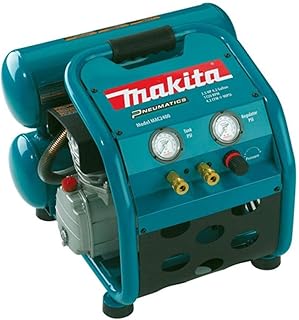
- Motor: 2.5 HP
- Tank: 4.2 gal twin-stack tank
- Air delivery: 4.8 CFM at 40 PSI, 4.2 CFM at 90 PSI
- Maximum pressure: 130 PSI
- Weight: 77 lbs
- Pump: oil-lubricated cast-iron Big Bore pump, 1730 RPM
- Power: 12.3 A
- Frame: roll cage
The Makita MAC2400 is the classic twin-stack compressor, and it earns its place in this group on build quality and on the strength of its cast-iron pump. It delivers 4.8 CFM at 40 PSI, which is enough air to run a hopper gun through a patch of ordinary size, and 4.2 CFM at 90 PSI. The 4.2-gallon twin-stack tank is smaller than the 10020C, so the pump works harder between patches, but the oil-lubricated Big Bore pump is built for exactly that kind of steady running. Makita lists the pump at 1730 RPM, a low speed that keeps heat down and stretches the life of the pump when the machine cycles all day.
The roll cage is a real advantage on patch work. The compressor gets dragged across floors, bumped against door frames, and set down on rough ground, and the cage takes the knocks that would dent a bare tank or crack a fitting on a lighter machine. At 77 lbs it is heavy, and the twin-stack shape is awkward to carry, so it is best treated as a roll-and-place machine rather than a carry machine. The oil-lubricated pump needs its oil level checked and topped up, which is a small job that has to be done before the first patch of the day. In return the MAC2400 gives a steady, predictable air supply and a long working life, and its 130 PSI maximum leaves plenty of headroom above the pressure a hopper gun needs.
Makita MAC5200
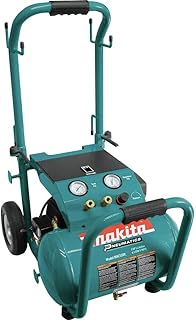
- Motor: 3.0 HP
- Tank: 5.2 gal tank
- Air delivery: 6.9 CFM at 40 PSI, 6.5 CFM at 90 PSI
- Maximum pressure: 140 PSI
- Weight: 88 lbs
- Pump: oil-lubricated Big Bore pump, 3420 RPM
- Power: 13.8 A
The Makita MAC5200 delivers the most air in this group: 6.9 CFM at 40 PSI and 6.5 CFM at 90 PSI. For repeated patch jobs that figure is the whole point. A hopper gun drawing air at a rate below the pump's delivery never empties the tank, so the plasterer can move from patch to patch without waiting for the compressor to catch up. The 5.2-gallon tank is large enough to cover a patch on its own, and the pump refills it fast enough that the next patch is ready when the hopper is. On a day with twenty or thirty patches, that difference adds up to real time saved and a texture pattern that stays even from the first patch to the last.
The cost of that air delivery is weight and speed. At 88 lbs the MAC5200 is the heaviest machine in this group, and its pump runs at 3420 RPM, which is twice the speed of the MAC2400. A faster pump makes more noise and more heat, and it needs its oil level watched. It also draws 13.8 amps, so it belongs on a sound circuit with no other heavy load on the same line. For a plasterer who works mostly in one place, with the compressor parked in a hallway or a garage and a long hose running to the gun, the MAC5200 is the strongest choice here. It is not the machine to carry up two flights of stairs, but for ground-floor patch work it keeps the gun fed all day.
DeWalt D55146

- Motor: 1.6 HP continuous
- Tank: 4.5 gal tank
- Air delivery: 5.2 SCFM at 90 PSI
- Maximum pressure: 200 PSI cut-out, 160 PSI cut-in
- Tank storage pressure: 225 PSI
- Sound level: 78 dBA
- Weight: 83 lbs
- Pump: oil-free
- Power: 120V, 15 A
- Frame: wheels
The DeWalt D55146 takes a different approach to the same problem. Instead of a very large tank, it stores air at a much higher pressure: the tank holds air at 225 PSI and the pump cuts out at 200 PSI, with a cut-in at 160 PSI. That stored pressure is a reserve the gun can draw on. When the trigger is pulled, the regulator drops the pressure down to working level, and the high tank pressure means the tank holds more usable air than its 4.5-gallon size suggests. The manual lists 5.2 SCFM at 90 PSI, which is a strong delivery figure for a machine of this size, and the oil-free pump needs no oil care at all.
At 78 dBA the D55146 is noisier than the quiet California Air Tools machines, and at 83 lbs it is heavy, though the wheel kit makes it easy to roll across a floor. It draws 15 amps, which is the full load of a standard household circuit, so it should run on its own circuit and with no extension lead if that can be avoided. For repeated patch jobs the high-pressure storage is a genuine advantage: the gun sees a steady regulated pressure while the tank drains from 200 down toward 160 PSI, and the pump only needs to run when the tank falls to the cut-in point. That long, calm cycle suits patch work, where the gun is used in bursts with pauses in between.
Metabo HPT EC914S THE TANK

- Motor: 1.3 running HP
- Tank: 6 gal pancake tank
- Air delivery: 5.1 CFM at 40 PSI, 4.0 CFM at 90 PSI
- Maximum pressure: 200 PSI
- Weight: 41 to 42 lbs
- Pump: oil-free
- Power: 13.5 A
- Duty cycle: S3, 5 minutes on and 5 minutes off
- Pressure switch: cut-in 170 PSI, cut-out 200 PSI
- Sound level: 76 dB
- Couplers: 2
The Metabo HPT EC914S, known as THE TANK, is the lightest high-delivery compressor in this group. At 41 to 42 lbs it weighs roughly half as much as the machines above it, yet it delivers 5.1 CFM at 40 PSI and 4.0 CFM at 90 PSI, with a 200 PSI maximum. The trick is the same as the DeWalt: the 6-gallon pancake tank stores air at up to 200 PSI, and the regulator drops it to the pressure the gun needs. That gives the gun a strong, steady supply through a patch, and the pump refills the tank while the plasterer reloads the hopper. Two couplers let two tools stay connected, which is handy when a patch job also needs a blow gun to clear dust from the wall before the texture goes on.
The duty cycle needs attention. Metabo HPT rates the EC914S at S3, which means 5 minutes on and 5 minutes off, and that rhythm actually fits patch work well: the gun sprays for a minute or two, then stops while the plasterer moves and reloads, and the pump rests during that pause. A plasterer who tries to spray without a break will hit the limit, so the machine suits patch work rather than long continuous spraying. At 76 dB it is louder than the quiet machines, and it draws 13.5 amps. For a plasterer who carries the compressor from room to room and wants strong air delivery in a light package, the EC914S is the best balance of weight and performance in this group.
Ridgid OF60150HA
- Motor: 1.5 HP
- Tank: 6 gal pancake tank
- Air delivery: 3.5 SCFM at 40 PSI, 2.6 SCFM at 90 PSI
- Maximum pressure: 150 PSI
- Weight: 34 to 35 lbs
- Pump: oil-free
- Power: 120V, 12.5 A
- Sound level: 80 dBA
- Regulator: locking regulator
- Couplers: 2 universal push-to-connect couplers
The Ridgid OF60150HA is the budget-friendly workhorse of this group, and it earns its place with a locking regulator and two push-to-connect couplers. The locking regulator is a small feature that matters on patch work: once the working pressure is set, the knob locks so it cannot be knocked out of place when the compressor is dragged across a floor or bumped against a door frame. A regulator that drifts changes the texture pattern from patch to patch, so a lock keeps the finish even. The two push-to-connect couplers let the gun hose snap in and out with one hand, which saves time when the compressor moves between rooms.
Air delivery is modest: 3.5 SCFM at 40 PSI and 2.6 SCFM at 90 PSI. That is enough for small patches and for a gun with a small nozzle, but the pump will run often and the plasterer will need to pause between patches while the 6-gallon tank refills. At 34 to 35 lbs it is light enough to carry with one hand, and at 80 dBA it is one of the louder machines here. The OF60150HA suits a plasterer who patches a few walls at a time and values a light machine, a locking regulator, and quick hose changes over raw air delivery. For a full day of back-to-back patches, one of the higher-CFM machines above it will keep a steadier pace.
California Air Tools 8010
- Motor: 1.0 HP
- Tank: 8 gal steel tank
- Air delivery: 3.10 CFM at 40 PSI, 2.20 CFM at 90 PSI
- Maximum pressure: 120 PSI
- Sound level: 60 dB
- Weight: 48 lbs
- Pump: oil-free dual-piston pump
- Power: 110V, 8.5 A
- Fill time: 165 seconds from empty
- Recovery time: 60 seconds from 90 to 120 PSI
- Frame: wheel kit
The California Air Tools 8010 is the quietest machine in this group at 60 dB, and that is its main claim on a patch job inside an occupied home. A compressor that runs at the sound level of a normal conversation can cycle all day without wearing out the patience of the people living in the house. The 8-gallon steel tank is generous for a 1.0 HP machine, and it stores enough air to cover a patch while the pump catches up. The oil-free dual-piston pump needs no oil care, and the wheel kit makes the 48 lbs easy to roll from room to room.
Air delivery is the limit: 3.10 CFM at 40 PSI and 2.20 CFM at 90 PSI, with a 60-second recovery from 90 to 120 PSI. The 8010 suits small patches and a gun with a small nozzle, worked at a relaxed pace with pauses between patches. A plasterer who rushes from patch to patch will outrun the pump and end up waiting for the tank to refill. Used at the pace the machine sets, with the hopper reloaded during each recovery, the 8010 does steady, quiet work all day and draws only 8.5 amps, so it runs happily on a shared household circuit. It is the right choice when the job is indoors, the patches are small, and quiet running matters more than speed.
| Product | Tank | CFM at 40 PSI | CFM at 90 PSI | Max pressure | Weight |
|---|---|---|---|---|---|
| California Air Tools 10020C | 10 gal | 6.4 | 5.3 | 125 PSI | 82.5 lbs |
| Makita MAC2400 | 4.2 gal | 4.8 | 4.2 | 130 PSI | 77 lbs |
| Makita MAC5200 | 5.2 gal | 6.9 | 6.5 | 140 PSI | 88 lbs |
| DeWalt D55146 | 4.5 gal | – | 5.2 | 200 PSI | 83 lbs |
| Metabo HPT EC914S THE TANK | 6 gal | 5.1 | 4.0 | 200 PSI | 41-42 lbs |
| Ridgid OF60150HA | 6 gal | 3.5 | 2.6 | 150 PSI | 34-35 lbs |
| California Air Tools 8010 | 8 gal | 3.10 | 2.20 | 120 PSI | 48 lbs |
How to choose
Match the CFM at 40 PSI to the gun
The first number to check is the compressor's air delivery at 40 PSI, because that is close to the pressure a hopper gun works at. A gun with a large nozzle draws more air than a gun with a small nozzle, so the compressor has to deliver at least as much air as the gun uses, or the tank will drain during a patch and the spray pattern will weaken. As a rule, a compressor that delivers 5 CFM or more at 40 PSI will keep most hopper guns spraying without a pause. A compressor that delivers 3 to 4 CFM at 40 PSI will run the gun in bursts, with a short wait between patches while the tank refills. The gun's own manual usually states the air it needs, and that figure should be compared with the compressor's 40 PSI delivery, not the 90 PSI figure. A machine that looks strong at 90 PSI can be weak at 40 PSI, and the 40 PSI figure is the one that decides how the gun behaves on the wall.
Size the tank for the patch
The tank is a store of air, and its size decides how long the gun can spray before the pump has to catch up. A patch on a small wall needs only a short spray, so a 4-gallon tank is enough. A patch that covers a whole ceiling or a long run of wall needs a longer spray, and a 6-gallon or 10-gallon tank gives the gun more time before the pressure starts to fall. A larger tank also smooths out the pump's work: the pump runs in longer, calmer cycles instead of switching on and off every minute. The cost of a large tank is weight, so the choice is a balance between how far the compressor has to be carried and how long each patch takes to spray. For work that stays on one floor, a large tank is worth its weight. For work that moves up stairs, a smaller tank with a stronger pump is the better trade.
Read the duty cycle and the recovery time
A compressor that runs without a break will overheat, so every maker states how long the pump can run before it needs a rest. That duty cycle matters on repeated patch work because the pump is used in bursts all day. A machine rated for long running periods, such as the 10020C with its 70/30 duty cycle, will keep up with a full day of patches. A machine rated for short bursts, such as the EC914S with its 5 minutes on and 5 minutes off, needs the plasterer to work at its pace and take the pauses the machine needs. The recovery time is the other half of the same question: it tells how long the tank takes to refill after a patch. A recovery of 25 seconds means the next patch can start almost at once. A recovery of 60 seconds means the plasterer reloads the hopper and scrapes the wall while the pump catches up. Both are fine, as long as the pace of the work matches the pace of the machine.
Check the noise level and the power draw
Patch work usually happens inside an occupied home, so the sound level of the compressor matters as much as its air delivery. A machine rated at 60 dB can run in a hallway without disturbing the household. A machine rated at 80 dBA will be heard through the whole house, and it may need to be parked outside with a long hose. The power draw matters too: a compressor that draws 14 or 15 amps needs a sound circuit on its own, while a machine that draws 8.5 amps can share a circuit with other tools. Before buying, check the circuit the compressor will run on and the length of hose that will be needed, because a long hose drops the pressure at the gun and a weak circuit will trip the breaker in the middle of a patch.
Common mistakes
The most common mistake on repeated patch work is buying on horsepower alone. Horsepower tells how strong the motor is, not how much air the pump delivers, and two machines with the same horsepower can have very different CFM figures. A 2.0 HP machine with a small pump can deliver less air than a 1.0 HP machine with a large pump. The CFM at 40 PSI is the figure that decides whether the gun keeps spraying, so it should be checked first and horsepower should be treated as a secondary figure.
Another mistake is setting the regulator too high. A hopper gun needs only a modest working pressure, and turning the pressure up does not make the texture better. High pressure blows the mix too hard, throws material past the patch, and empties the tank fast. The regulator should be set to the lowest pressure that gives an even spray pattern, and then left alone. A locking regulator helps here, because it stops the setting from drifting when the compressor is moved.
A third mistake is using a hose that is too long or too narrow. A long hose drops the pressure between the compressor and the gun, so the gun sees less pressure than the regulator shows. A narrow hose does the same thing. The hose should be as short as the job allows and wide enough to carry the air the gun needs. A fourth mistake is ignoring the tank drain. Water collects in the tank every time the pump runs, and a tank that is never drained will rust from the inside and spit water into the air line, which spoils the texture. The drain valve should be opened at the end of each working day.
FAQ
How much CFM does a texture hopper gun need?
A hopper gun's air need depends on its nozzle size and the working pressure, and the gun's manual states the figure. Most hopper guns used for wall patches draw between 3 and 7 CFM at working pressure. A compressor that delivers 5 CFM or more at 40 PSI will run most guns without a pause. A compressor that delivers 3 CFM at 40 PSI will run a small-nozzle gun in bursts with a short wait between patches. The safest approach is to read the gun's stated air need and choose a compressor whose 40 PSI delivery meets or beats that figure, with a little headroom for the tank to stay ahead of the gun.
Is a bigger tank always better for patch jobs?
A bigger tank is usually better, but it is not always the right choice. A large tank stores more air, so the gun can spray longer before the pump has to catch up, and the pump runs in longer, calmer cycles. The cost is weight: a 10-gallon tank adds real weight to the machine, and a compressor that has to be carried up stairs every day will wear out the plasterer faster than it wears out the pump. For work on one floor, a large tank is worth it. For work that moves between floors, a smaller tank with a strong pump and a fast recovery time is the better balance.
Why does my compressor run constantly during patch work?
A compressor runs constantly when the gun uses air faster than the pump can replace it. That usually means the compressor's CFM at 40 PSI is below the gun's air need, or the regulator is set too high and the gun is drawing more air than it needs. The fix is to check the gun's stated air need against the compressor's 40 PSI delivery, lower the regulator to the lowest pressure that gives an even pattern, and check the hose for leaks. A hose with a leak at a fitting can waste enough air to keep the pump running all day.
Can I use a quiet compressor for patch work inside an occupied house?
Yes, and a quiet compressor is often the best choice for work inside an occupied home. Machines rated at 60 dB run at the sound level of a normal conversation and can cycle all day without disturbing the household. The trade-off is that quiet machines often deliver less air than louder machines of the same size, so the plasterer should check the CFM at 40 PSI and accept a slower pace between patches. For small patches and a small nozzle, a quiet machine is more than enough, and the household will be glad of the choice.
How do I keep the texture pattern even from patch to patch?
An even pattern comes from a steady working pressure and a steady mix. Set the regulator to the lowest pressure that gives an even spray, lock it if the regulator has a lock, and do not change it during the day. Keep the mix the same from batch to batch, because a thicker mix sprays differently from a thinner one. Hold the gun at the same distance from the wall for every patch, and move at the same speed. If the pattern changes during the day, the first thing to check is the pressure at the gun, because a falling tank pressure is the most common cause of a pattern that fades.
Conclusion
Repeated wall patch work rewards a compressor that delivers enough air at 40 PSI, stores enough air in the tank to cover a patch, and recovers fast enough to be ready for the next one. The California Air Tools 10020C is the strongest all-round choice in this group, with 6.4 CFM at 40 PSI, a 10-gallon tank, and a 25-second recovery, and it runs quietly enough for work inside an occupied home. The Makita MAC5200 delivers the most air of all, at 6.9 CFM at 40 PSI, and suits a plasterer who works mostly in one place and wants the gun fed without a pause. The Metabo HPT EC914S is the lightest machine here that still delivers strong air, at 5.1 CFM at 40 PSI in a 41 to 42 lb package, and it is the one to carry from room to room.
For a plasterer who patches a few walls at a time and values quiet running over speed, the California Air Tools 8010 does steady work at 60 dB with a generous 8-gallon tank. For a plasterer who wants a locking regulator and quick hose changes at a modest weight, the Ridgid OF60150HA is the practical pick. Whichever machine is chosen, the rule stays the same: match the CFM at 40 PSI to the gun, size the tank to the patch, and set the regulator once and leave it alone. A compressor chosen that way will keep the texture even from the first patch of the day to the last.
Related guides
More from Amazon
Programs that pair well with the guide above. Offers and eligibility are set by Amazon and may change.
Free shipping on eligible items, Prime Video and more. Eligible new members can start with a free trial.
Start a Prime free trialAudiobooks and podcasts to listen to on the go. Eligible new members can start with a free trial.
Try Audible freeAd-free music streaming. Eligible new subscribers can start with a free trial.
Try Music Unlimited freeA free business account with business pricing and bulk-buying tools for work, shop or home office.
Create a business accountAs an Amazon Associate we earn from qualifying purchases.
More ways to save on your next finish
Programs that pair well with the guide above. Offers and eligibility are set by Amazon and may change.
A free business account with business pricing and bulk-buying tools for work, shop or home office.
Create a business accountFast, free shipping on eligible items, plus Prime Video and more. Eligible new members can start with a free trial.
Start a Prime free trialRead from a huge library of eBooks, including how-to guides and cookbooks. Eligible new members can start with a free trial.
Try Kindle UnlimitedAudiobooks and podcasts for the commute, the garage or the kitchen. Eligible new members can start with a free trial.
Try Audible freeAs an Amazon Associate we earn from qualifying purchases. Using these links costs you nothing extra.



Write Your Review
No reviews yet. Be the first to share your experience!