
Key takeaways
- We compare the best stucco patch repair mixes with sand texture options for blending isolated stucco chips, with sand grain size, drying times and coverage.
As an Amazon Associate I earn from qualifying purchases. This post may contain affiliate links at no extra cost to you.
Our top picks at a glance
3 products from this guide, in the order reviewed below.


As an Amazon Associate we earn from qualifying purchases. Prices and availability can change.
An isolated chip in a stucco wall draws the eye out of proportion to its size, and the reason is almost always the sand. The wall around the chip may be sound, the color may still be even, and the patch may be the right shade, yet if the grain of the patch does not match the grain of the wall, the repair reads as a smooth spot on a textured surface, or a rough spot on a smooth one, every time the light changes. Sand texture is the difference between a repair that disappears and a repair that announces itself. The best stucco patch repair mixes with sand texture options for blending isolated stucco chips are the products that give the repairer a choice of grain, with a sand grade that can be matched to the wall, and this roundup compares seven of them.
Sand texture matters more than color for a chip repair, because color can be fixed with paint and texture cannot. A patch with fine sand will look smooth against a coarse wall, and a patch with coarse sand will look rough against a fine wall, and neither error can be hidden by a coat of paint. The grain of the wall can be read by running a hand over it and looking at the pattern: a fine float finish has a close, even grain, a standard sand float shows a clear sand pattern, and a coarse dash finish has a heavy, open texture. The products below are chosen because their makers state a sand grade, or carry a texture that can be worked to match the wall, with published numbers for thickness, setting time, and coverage, so the choice can be made from facts rather than from a guess.
This roundup compares seven patch mixes that suit isolated chips with a sand texture to match. Some carry a stated sand grade, such as 16 to 20 grit, which suits a standard sand float finish. Some carry a 16/20 aggregate in a color coat base, which suits a heavier texture. Some are ready-to-use tubs with a textured finish, which suit a shallow chip that needs a quick repair. Each entry below carries the same points: what it is made of, what sand grade it carries, how thick it can go in one lift, how long it takes to set, how much wall one container covers, and where it works hardest.
Best products
LaHabra Exterior Stucco Color Coat Patch
- Finish coat patch in a 9 pound box, with 20 or more colors available
- Finish coat only, with a maximum thickness of 1/8 inch
- Coverage of about 9 to 14 square feet per box
- Shelf life of 12 months in unopened containers
- Apply when air and surface temperatures sit above 40 degrees Fahrenheit
- Meets ASTM C926 for portland cement plaster
LaHabra Exterior Stucco Color Coat Patch leads this roundup because it is the product in this list that pairs a stated texture with a stated color, and both matter for a chip that has to disappear. The product is a finish coat patch in a 9 pound box, with 20 or more colors available, and it is made for the finish coat only. The stated maximum thickness is 1/8 inch, which is the lift thickness for a finish coat, and going past it invites shrinkage cracks as the patch dries. Coverage runs about 9 to 14 square feet per box, which suits a wall with several small chips.
The color range is the reason this product leads. An isolated chip is seen at close range, and a finish patch in the right color disappears into the wall without paint, while a gray patch beside a colored wall needs paint to hide it. The product meets ASTM C926, the standard specification for application of Portland cement-based plaster, and it should be applied when air and surface temperatures sit above 40 degrees Fahrenheit. Shelf life runs 12 months in unopened containers. For a chip where the base coats are sound and only the finish has broken away, this is the product that finishes the job in the right color and the right texture.
LaHabra Exterior Stucco Color Coat 16/20 Tint Base
- Color coat base in a 90 pound bag, made of Portland cement and hydrated lime
- Carries a 16/20 aggregate, which suits a heavier sand texture
- Float finish coverage of 135 to 180 square feet per bag
- Layer thickness of about 1/8 inch
- Apply when air and surface temperatures sit above 40 degrees Fahrenheit
- Shelf life of 15 months in unopened bags
LaHabra Exterior Stucco Color Coat 16/20 Tint Base is the heavy-grain option in this roundup, and it is here because some stucco walls carry a coarse texture that a fine patch cannot match. The product is a color coat base in a 90 pound bag, made of Portland cement and hydrated lime, and it carries a 16/20 aggregate. That aggregate grade is the sand texture of the product, and it suits a wall with a heavier sand float or dash finish, where a fine patch would read as a smooth spot. The layer thickness runs about 1/8 inch, which is the right depth for a finish coat, and the float finish coverage runs 135 to 180 square feet per bag.
The bag is large, so it suits a wall with many chips or a whole wall face that needs finish work, rather than a single small chip. Mixing follows the usual color coat routine: add water, mix to a uniform consistency, and apply with a trowel or float, working the surface to match the surrounding texture. The product should be applied when air and surface temperatures sit above 40 degrees Fahrenheit, and shelf life runs 15 months in unopened bags. For a coarse-textured wall where the chips need a heavy grain to disappear, this is the product that carries the right sand.
Rapid Set Stucco Patch
- Premium, fast-setting stucco repair material in 10, 25 and 50 pound sizes
- Working time of 20 minutes, with priming and painting possible after about 2 hours
- Applied in a single application from 1/8 inch to 1 inch thick
- Textured with 16 to 20 grit sand for matching a range of stucco surfaces
- Compressive strength of 2500 psi at 24 hours
- Mix 1 part clean water to 4 parts patch, or 2 quarts per 25 pound bag
Rapid Set Stucco Patch earns its place here as the product with the clearest stated sand grade in this roundup. The product is a premium, fast-setting stucco repair material, made with Rapid Set hydraulic cement, advanced polymers and high quality aggregates, and it can be applied full depth in a single application and textured to match a variety of stucco surfaces. The working time is 20 minutes, and the patch can be primed and painted after about 2 hours, which means a chip repaired in the morning can be back in normal use by the afternoon.
The sand grade is the point: the patch is textured with 16 to 20 grit sand, which suits a standard sand float finish, and the trowel can work that sand into the same pattern as the wall around the chip. The depth range is generous as well: the patch goes on in a single application from 1/8 inch to 1 inch thick, so a chip where the render has broken away down to the base coat can be filled in one lift, rather than built up in thin layers over several days. Mixing takes 1 part clean potable water to 4 parts patch, or 2 quarts per 25 pound bag, mixed by hand or with a power-driven mechanical mixer to a uniform, lump-free consistency. The material should not be retempered, and the work should be organized so that all tools are in place before mixing, because the 20 minute working time leaves no room for a search for a missing float.
Rapid Set Stucco Mix
- One-coat and three-coat base stucco in a 50 pound bag
- Working time of 45 minutes, with color ready in 1 hour after moist curing
- Mix 2.0 to 3.5 quarts of water per 50 pound bag
- Covers about 7 square feet at 3/4 inch thickness, with a yield of 0.45 cubic feet
- Meets ASTM C1328 and holds ESR-2671
- Shelf life of 12 months in unopened bags
Rapid Set Stucco Mix is the base-coat option in this roundup, and it belongs here because a chip that has gone deeper than the finish needs a proper base before any finish goes on. The product is a one-coat and three-coat base stucco in a 50 pound bag, made for scratch and brown coats or as a one-coat base, and it is the material for a chip where the damage runs past the finish coat into the coats underneath. A chip that has opened wide enough to show the base coat needs a proper base, and this mix builds that base in a single product.
The working window is generous for a fast-setting material. Working time runs 45 minutes, and the surface is ready for color in 1 hour after moist curing, which means a deep chip can be based, finished and colored in a single working session. Mixing takes 2.0 to 3.5 quarts of water per 50 pound bag, and one bag covers about 7 square feet at 3/4 inch thickness, with a yield of 0.45 cubic feet. The product meets ASTM C1328 and holds ESR-2671, an evaluation report that documents its performance for code purposes. Shelf life runs 12 months in unopened bags, so a bag bought for one chip stays usable for the next one if it is stored dry.
DAP All-Purpose Stucco Patch 10504
- Ready-to-use latex emulsion paste in a 1 quart pail
- Textured finish that blends with stucco
- Interior and exterior use, with a water resistant finish
- Minimum set time of 4 hours
- Coverage of about 18 square feet per quart
- Apply with a putty knife, broad knife, or margin trowel
DAP All-Purpose Stucco Patch 10504 is the ready-to-use option in this roundup, and it suits the shallow chip that needs a textured finish rather than a smooth fill. The product is a ready-to-use latex emulsion paste in a 1 quart pail, with a textured finish that blends with stucco, and it is made for interior and exterior use. The water resistant finish suits an exterior wall, where rain runs down the face, and the minimum set time of 4 hours gives the repairer time to work the texture properly before the material firms up.
The application is straightforward. Apply with a putty knife, broad knife, or margin trowel, then spread and texture the patch to match the surrounding stucco, with a rubber stucco float recommended for the best result. Coverage runs about 18 square feet per quart, which is generous for shallow chip repairs and leaves material for the next job. The surface must be clean, dry and free of loose material, grease and dirt, and scaling paint should be removed with a wire brush before the patch goes on. The patch should not be applied if rain is expected within 12 hours, and it should be protected from freezing. For a shallow chip on a textured wall, this is the simplest product in the list, and it takes minutes rather than hours.
DAP ElastoPatch Textured
- Flexible patching compound in a 10.1 ounce tube
- Made for recurring cracks and for flexible joints that move with the wall
- Available in smooth and textured finishes, with the textured version matching stucco
- Easy to apply from the tube, with a tool for matching the surrounding texture
- Paintable once dry, for interior and exterior use
- Suited to chips and cracks that open and close with temperature changes
DAP ElastoPatch Textured is the flexible option in this roundup, and it is here because some chips sit beside a crack that moves with the seasons, and a rigid patch in that kind of spot will crack again along the same line. The product is a flexible patching compound in a 10.1 ounce tube, made for recurring cracks and for flexible joints, and the textured version carries a finish that matches stucco rather than reading as a smooth bead of sealant. The flexible body stays in the repair as the wall moves, which is the whole point of the product: a rigid filler would fail at the first temperature swing, while a flexible one absorbs the movement and holds its seal.
The application is the simplest in this list. Clean the chip and the crack beside it, cut the tip, squeeze the compound in, and tool it to match the surrounding texture. The tube suits a small chip beside a fine crack, where a trowel-applied patch would be slow and wasteful. Paint once the compound is dry, using a paint that suits exterior stucco, and the repair disappears into the wall. For a chip that sits on a moving joint, this is the product that stays in place when a rigid patch would not.
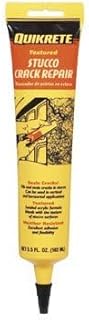
QUIKRETE Stucco Crack Repair
- Textured repair caulk in a 10 ounce tube
- Seals cracks up to 1/2 inch wide, made for cracks only
- Easy to use, with a cut tip applied at an angle
- Texture matched with a trowel, float, sponge, or similar technique
- Prepare cracks by opening them up and removing loose debris first
- Squeeze material on generously, then match the existing texture
QUIKRETE Stucco Crack Repair is the narrowest tool in this roundup, and it is here because many isolated chips sit beside a fine crack, and the crack needs closing before the chip can be patched. The product is a textured caulk that seals cracks up to 1/2 inch wide, and it is made for cracks only. It comes in a 10 ounce tube, and it is the fastest way to close a fine, straight crack that runs beside a chip, before rain gets in behind the finish coat.
The method is simple, but the preparation is not optional. Cracks should be opened up, or chased, and loose debris and particles removed before the caulk goes in. Cut the tip at an angle, squeeze the material on generously, and match the existing texture using a trowel, float, sponge, or similar technique. The caulk is textured to match the rough appearance of stucco, so it reads as part of the wall rather than as a smooth bead of sealant. It should not be used as a patch for holes or spalls, because it has no body for filling a void, and a crack filled with caulk where a patch was needed will sink and reopen. For the fine cracks beside a chip, though, it is the right product, and it takes minutes rather than hours.
| Product | Main specification | Best suited for |
|---|---|---|
| LaHabra Exterior Stucco Color Coat Patch | Finish coat, max 1/8 inch, 20 or more colors | Color-matched finish chips |
| LaHabra Exterior Stucco Color Coat 16/20 Tint Base | 16/20 aggregate, layer about 1/8 inch | Coarse-textured walls |
| Rapid Set Stucco Patch | 16 to 20 grit sand, 1 inch single lift | Standard sand float finishes |
| Rapid Set Stucco Mix | 45 minute working time, ready for color in 1 hour | Deep chips needing a base coat |
| DAP All-Purpose Stucco Patch 10504 | Ready-to-use, coverage about 18 sq ft per quart | Shallow textured chips |
| DAP ElastoPatch Textured | Flexible compound, 10.1 ounce tube | Chips beside moving cracks |
| QUIKRETE Stucco Crack Repair | Textured caulk, seals cracks up to 1/2 inch | Fine cracks beside a chip |
How to choose
Read the grain of the wall first
The grain of the wall decides the product, so it should be read before anything is bought. Run a hand over the wall around the chip and look at the pattern: a fine float finish has a close, even grain, a standard sand float shows a clear sand pattern, and a coarse dash finish has a heavy, open texture. A patch mixed with fine sand will look smooth against a coarse wall, and a coarse patch will look rough against a fine wall, and neither error can be fixed by paint. The products in this roundup state their sand grade where the maker publishes it, with the Rapid Set patch carrying a 16 to 20 grit sand and the LaHabra tint base carrying a 16/20 aggregate. Match the grain first, then worry about the size of the container.
Choose the product by depth, not by container
Chip damage varies in depth, and the depth should decide the product. A shallow chip up to 1/4 inch deep is a premixed patch job, and the ready-to-use tubs in this list cover it. A chip where the render has broken away down to the base coat is a base coat job, and the dry mixes in this list build up scratch and brown coats properly. A finish chip on a colored wall is a color coat job, and the LaHabra patch in this list finishes it in the right color. A single thick lift past the stated maximum invites shrinkage cracks, because the surface skins over while the material underneath is still soft. Build deep damage in layers, allow the stated drying time between them, and keep each lift inside the published limit.
Check the sand grade on the data sheet
Where the maker states a sand grade, use it. The Rapid Set Stucco Patch in this roundup states a 16 to 20 grit sand, which suits a standard sand float finish. The LaHabra Exterior Stucco Color Coat 16/20 Tint Base states a 16/20 aggregate, which suits a heavier texture. Where the aggregate is not stated, the only honest check is a small sample patch on a hidden part of the wall, left to dry fully before the real repair is started. A small sample settles the question before the visible repair is started, and it costs nothing but a few minutes.
Plan around the weather and the drying time
A chip repair happens on an exterior wall, so the drying time matters as much as the bond. A fast-setting mix like Rapid Set Stucco Patch can be primed and painted after about 2 hours, which means the wall can be back in normal use the same day. A slow-curing patch needs the wall left alone for longer. Check the forecast before starting: most products in this list should not be applied if rain is expected within 12 hours, and several should not be applied below 40 or 50 degrees Fahrenheit. The wall should be dry before application, and the fresh patch should be protected from freezing and from rain before full cure.
Common mistakes
The most common mistake on a chip repair is choosing the patch by container size instead of by texture. A quart tub is convenient, but if its sand is finer than the wall, the repair will read as a smooth spot on a textured surface, and paint will not hide the difference. Match the sand first, then worry about the size. A small sample patch on a hidden area, left to dry fully, settles the question before the visible repair is started.
The second mistake is using a smooth filler on a textured wall. An isolated chip is seen at close range, and a smooth patch on a sand float finish reads as a flat scar every time someone walks past the wall. Match the sand grade and the tool, and work the patch with the same kind of float the original finisher used. A rubber stucco float suits a sand float finish, a sponge suits a fine finish, and a trowel suits a smooth or skip trowel finish.
The third mistake is patching over a dirty edge. The chip collects dust, loose paint flakes, and fragments of broken stucco, and a patch laid over that debris bonds to the dirt instead of to the wall. The repair looks sound for a week, then the whole patch pops out in one piece. The fix costs nothing: brush the area clean, remove every loose fragment, and dampen the surface lightly before the patch goes on, so the dry base does not pull water out of the mix too fast.
The fourth mistake is filling a deep chip in one thick lift. Every product in this roundup states a maximum thickness per application, usually 1/4 inch for premixed patches, and going past it invites shrinkage cracks as the patch dries. The Rapid Set Stucco Patch in this list is the exception, with a stated single lift of up to 1 inch, and that range should not be assumed for other products. Build deep damage in layers, allow the stated drying time between them, and keep each lift inside the published limit.
The fifth mistake is painting too soon. A patch that looks dry on the surface can still hold moisture underneath, and paint laid over it will bubble, peel, or flash a different sheen. Wait the full stated curing time, and longer in cool or damp weather. A patch that has cured fully takes paint evenly, and the repair disappears instead of drawing the eye to a fresh rectangle of paint on the wall.
FAQ
How do I match the sand texture of a stucco wall?
Match the sand grade and the tool. A fine float finish needs a fine sand patch and a rubber float, a standard sand float needs a sanded patch worked with a float, and a coarse dash finish needs a coarse sand patch worked with a trowel. The products in this roundup state their sand grade where the maker publishes it, with the Rapid Set patch carrying a 16 to 20 grit sand and the LaHabra tint base carrying a 16/20 aggregate. Practice on a hidden area first, let the sample dry fully, and check the match from the distance the wall is normally seen from.
What sand grade suits a standard sand float finish?
A 16 to 20 grit sand suits a standard sand float finish, and the Rapid Set Stucco Patch in this roundup states exactly that grade. For a heavier texture, the LaHabra Exterior Stucco Color Coat 16/20 Tint Base carries a 16/20 aggregate. For a fine finish, a fine sand patch worked with a rubber float gives the closest match. Where the aggregate is not stated, a small sample patch on a hidden part of the wall settles the question before the visible repair is started.
Can I use a smooth filler on a textured stucco wall?
No. A smooth filler on a textured wall reads as a flat scar, and paint will not hide the difference. Use a patch with a sand texture that matches the wall, and work it with the same kind of float the original finisher used. The textured products in this roundup are made for exactly that job, with a sand grade or a textured finish that blends with the stucco around the chip.
How deep can a chip repair go in one lift?
Most premixed patches state a maximum of 1/4 inch per application. The Rapid Set Stucco Patch in this roundup states a single lift of up to 1 inch, which suits a chip where the render has broken away down to the base coat. For other products, build deep damage in layers of no more than 1/4 inch each, with the stated drying time between layers.
Should I paint over a chip repair?
Yes, once the patch has cured fully. Paint protects the patch from water and sun, and it hides the repair in the wall. Use a high-quality exterior masonry grade breathable acrylic latex paint, and wait the full stated curing time before painting. A color-matched finish patch, such as the LaHabra Color Coat Patch in this roundup, can disappear into the wall without paint, where the color matches.
Conclusion
An isolated chip in a stucco wall is a small repair with a high standard, and the standard is set by the sand. The seven mixes in this roundup cover the range of ways to meet it: color coat patches for a finish chip in the right color, heavy aggregate bases for a coarse-textured wall, stated-grit fast patches for a standard sand float finish, ready-to-use tubs for a shallow chip, and flexible compounds and textured caulk for the cracks beside the chip. LaHabra Exterior Stucco Color Coat Patch leads for a color-matched finish chip, with 20 or more colors and a stated maximum of 1/8 inch. Rapid Set Stucco Patch leads for a standard sand float finish, with a stated 16 to 20 grit sand and a single lift of up to 1 inch. LaHabra Exterior Stucco Color Coat 16/20 Tint Base leads for a coarse-textured wall, with a stated 16/20 aggregate.
Whatever mix is chosen, the working rules stay the same. Read the grain of the wall, match the sand grade, keep each lift inside the stated thickness, clean the edges, and wait the full curing time before paint. A chip repaired on those rules reads as one surface again, and it holds up to the weather that damaged it in the first place. Choose by the data sheet, honor the drying window, and the repair will last as long as the wall around it.
Related guides
More from Amazon
Programs that pair well with the guide above. Offers and eligibility are set by Amazon and may change.
Free shipping on eligible items, Prime Video and more. Eligible new members can start with a free trial.
Start a Prime free trialAudiobooks and podcasts to listen to on the go. Eligible new members can start with a free trial.
Try Audible freeAd-free music streaming. Eligible new subscribers can start with a free trial.
Try Music Unlimited freeA free business account with business pricing and bulk-buying tools for work, shop or home office.
Create a business accountAs an Amazon Associate we earn from qualifying purchases.



Write Your Review
No reviews yet. Be the first to share your experience!