
Key takeaways
- Compare air compressors for texture hopper guns that hold regulated pressure through stucco spot repairs, with regulators, tank size and CFM matched each time.
As an Amazon Associate I earn from qualifying purchases. This post may contain affiliate links at no extra cost to you.
Our top picks at a glance
4 products from this guide, in the order reviewed below.
As an Amazon Associate we earn from qualifying purchases. Prices and availability can change.
A stucco spot repair is judged by how well it disappears. The new patch has to match the old stucco around it in pattern, in depth, and in colour, and the pattern is set by the pressure at the gun. If the pressure falls halfway through a patch, the spray turns thin and the new texture sits flatter than the old. If the pressure rises, the spray turns coarse and the patch stands proud of the wall. The best air compressors for texture hopper guns for maintaining pressure during stucco spot repairs with regulated output pressure are the machines that hold a steady regulated pressure from the first second of the spray to the last, with a regulator that can be set precisely and a tank that does not sag while the gun is running.
Regulated output pressure is the key idea. A compressor tank stores air at a high pressure, often 125 PSI or 200 PSI, and the regulator drops that pressure down to the working level the gun needs. A good regulator holds that working pressure steady even as the tank pressure falls, so the gun sees the same pressure at the end of a patch as it saw at the start. A poor regulator lets the working pressure drift down with the tank, and the pattern changes while the patch is still wet. That is why this group is led by machines with strong regulators, high tank pressure, and enough stored air to finish a patch without the pump having to catch up mid-spray.
Stucco spot repairs are also short jobs. A single spot takes a minute or two of spraying, and the compressor spends most of the day waiting between spots. The seven machines below were chosen for that pace: compressors with regulators that hold their setting, tanks that store enough air to cover a spot, and air delivery that refills the tank while the plasterer prepares the next repair.
Best products
Metabo HPT EC914S THE TANK

- Motor: 1.3 running HP
- Tank: 6 gal pancake tank
- Air delivery: 5.1 CFM at 40 PSI, 4.0 CFM at 90 PSI
- Maximum pressure: 200 PSI
- Weight: 41 to 42 lbs
- Pump: oil-free
- Power: 13.5 A
- Duty cycle: S3, 5 minutes on and 5 minutes off
- Pressure switch: cut-in 170 PSI, cut-out 200 PSI
- Sound level: 76 dB
- Couplers: 2
The Metabo HPT EC914S leads this group because it stores air at 200 PSI and regulates it down to the working pressure the gun needs, and that large gap between tank pressure and working pressure is what keeps the output steady. The regulator draws from a tank that holds air at 170 to 200 PSI, so the working pressure stays flat while the tank drains, and the gun sees the same pressure at the end of a spot repair as it saw at the start. The 6-gallon pancake tank stores enough air to cover a whole spot repair without the pump starting, and the 5.1 CFM at 40 PSI refills the tank fast when the pump does run.
At 41 to 42 lbs the EC914S is light enough to carry to the wall being repaired, and two couplers let a blow gun stay connected beside the texture gun, so the spot can be blown clean and sprayed without swapping hoses. The duty cycle is rated S3, which means 5 minutes on and 5 minutes off, and that rhythm fits spot repair work well: the gun sprays for a minute or two, then stops while the next spot is prepared, and the pump rests during that pause. At 76 dB it is louder than the quiet machines, and it draws 13.5 amps. For a plasterer who needs a steady regulated pressure in a light package, the EC914S is the best balance in this group.
Ridgid OF60150HA
- Motor: 1.5 HP
- Tank: 6 gal pancake tank
- Air delivery: 3.5 SCFM at 40 PSI, 2.6 SCFM at 90 PSI
- Maximum pressure: 150 PSI
- Weight: 34 to 35 lbs
- Pump: oil-free
- Power: 120V, 12.5 A
- Sound level: 80 dBA
- Regulator: locking regulator
- Couplers: 2 universal push-to-connect couplers
The Ridgid OF60150HA earns its place with a locking regulator, and on stucco spot repairs that feature matters more than raw air delivery. A regulator that can be locked holds its setting all day, so the pressure that matched the old stucco in the morning is still the pressure that matches it in the afternoon. A regulator without a lock can be knocked out of place when the compressor is dragged across a driveway or bumped against a wall, and a small change in pressure is enough to make the new patch look different from the old stucco around it. The locking knob on the OF60150HA stops that drift, and two push-to-connect couplers let the gun hose snap on and off with one hand.
Air delivery is 3.5 SCFM at 40 PSI and 2.6 SCFM at 90 PSI, which is enough for a spot repair and a small nozzle. The 6-gallon pancake tank stores enough air to cover a spot without the pump running, and the pump refills while the next spot is prepared. At 34 to 35 lbs the OF60150HA is the lightest machine in this group, and it carries with one hand. At 80 dBA it is one of the louder machines here, so it is best parked a little further from the wall with a hose running to the gun. For a plasterer who repairs stucco spots one at a time and wants the pressure setting to stay put all day, the locking regulator is the feature that matters most.
Craftsman CMEC6150
- Motor: 0.8 HP
- Tank: 6 gal pancake tank
- Air delivery: 3.7 SCFM at 40 PSI, 2.6 SCFM at 90 PSI
- Maximum pressure: 150 PSI
- Weight: 30 lbs
- Pump: oil-free
- Power: 120V, 10 A
- Sound level: 82 dB
- Pressure switch: cut-in 120 PSI, cut-out 150 PSI
- Couplers: 2
The Craftsman CMEC6150 is a simple, light pancake compressor that holds a steady working pressure through a spot repair because its 6-gallon tank stores enough air to cover the spray without the pump starting. It delivers 3.7 SCFM at 40 PSI and 2.6 SCFM at 90 PSI, and the pressure switch cuts in at 120 PSI and out at 150 PSI, so the tank stays in a narrow band and the regulator has a steady supply to draw from. Two couplers let a blow gun stay connected beside the texture gun, which is handy on stucco work where the spot has to be blown clean of dust before the new texture goes on.
At 30 lbs the CMEC6150 is one of the lightest machines in this group, and it carries with one hand from the van to the wall. The oil-free pump needs no oil care, and the machine draws 10 amps on a standard circuit. At 82 dB it is the loudest machine here, so it belongs a little further from the work, with a hose running to the gun. The CMEC6150 suits a plasterer who repairs stucco spots outdoors or in a garage, where noise matters less, and who wants a light machine that holds its pressure through a short spray and refills while the next spot is prepared.
California Air Tools 10020C
- Motor: 2.0 HP
- Tank: 10 gal steel tank
- Air delivery: 6.4 CFM at 40 PSI, 5.3 CFM at 90 PSI
- Maximum pressure: 125 PSI
- Sound level: 70 dB
- Weight: 82.5 lbs
- Pump: oil-free dual-piston pump, 1680 RPM
- Power: 110V, 14 A
- Fill time: 120 seconds from empty
- Recovery time: 25 seconds from 95 to 125 PSI
- Duty cycle: 70/30
The California Air Tools 10020C holds pressure through a spot repair by sheer air delivery. It delivers 6.4 CFM at 40 PSI, which is more air than most hopper guns draw, so the tank stays full while the gun sprays and the regulator never has to cope with a falling tank. The 10-gallon steel tank stores enough air to cover several spot repairs before the pump needs to run, and the recovery from 95 to 125 PSI takes only 25 seconds, so the machine is ready again almost as soon as the last spot is finished. The 70/30 duty cycle allows long running periods, which suits a day with many spots in a row.
At 70 dB the 10020C is one of the quieter machines in this group, and that matters when stucco repairs run on the outside of an occupied house, where the pump will cycle all day within earshot of the rooms inside. The oil-free dual-piston pump needs no oil care, and the low running speed of 1680 RPM keeps the pump cool during long running periods. The trade-off is weight: at 82.5 lbs this is a machine that rolls on its wheel kit rather than one that gets carried. For a plasterer who works along a whole wall of stucco, moving from spot to spot on flat ground, the 10020C keeps the pressure steady from the first spot to the last.
Makita MAC700
- Motor: 2.0 HP
- Tank: 2.6 gal tank
- Air delivery: 3.8 CFM at 40 PSI, 3.3 CFM at 90 PSI
- Maximum pressure: 130 PSI
- Weight: 52 lbs
- Pump: oil-lubricated cast-iron Big Bore pump, 1730 RPM
- Power: 12.4 A
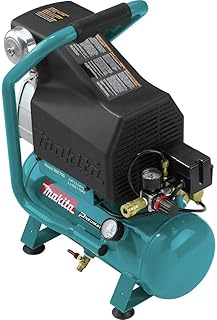
The Makita MAC700 holds pressure through a spot repair with a strong pump rather than a large tank. It delivers 3.8 CFM at 40 PSI and 3.3 CFM at 90 PSI, which is more air than any other machine here in the same size class, and the oil-lubricated cast-iron Big Bore pump keeps delivering that air steadily through a whole spray. The 2.6-gallon tank is small, so the pump runs during a longer spray, but the pump is strong enough to keep the tank pressure up while the gun is running, and the regulator sees a steady supply. The low running speed of 1730 RPM keeps the pump cool and stretches its life across many days of spot work.
At 52 lbs the MAC700 is heavier than the pancake machines, and the oil-lubricated pump needs its oil level checked before work starts. In return it gives a cast-iron pump built for long service and air delivery that suits a larger nozzle or a thicker stucco mix. The MAC700 suits a plasterer who repairs stucco spots with a gun that draws more air than the light machines can feed, and who is willing to carry a heavier machine in exchange for a pump that does not sag during a spray. It is still light enough to carry with one hand, and it fits beside the wall being repaired without taking over the workspace.
DeWalt DWFP55126

- Motor: 0.9 HP
- Tank: 6 gal pancake tank
- Air delivery: 3.7 SCFM at 40 PSI, 2.6 SCFM at 90 PSI
- Maximum pressure: 165 PSI
- Weight: 30 lbs
- Pump: oil-free dual-piston pump
- Power: 120V, 10 A
- Sound level: 75.5 dBA
The DeWalt DWFP55126 holds pressure through a spot repair with a 6-gallon tank and a 165 PSI maximum, which gives the regulator a useful reserve above the working pressure. The tank stores enough air to cover a spot without the pump starting, and the 165 PSI ceiling means the tank holds more usable air than a 150 PSI machine of the same size. Air delivery is 3.7 SCFM at 40 PSI and 2.6 SCFM at 90 PSI, which is enough for a spot repair and a small nozzle, and the oil-free dual-piston pump needs no oil care.
At 30 lbs the DWFP55126 is one of the lightest machines in this group, and the pancake tank sits flat and stable on any ground, so it will not tip over when the hose is pulled toward the wall. It draws 10 amps on a standard circuit. At 75.5 dBA it is louder than the quiet machines, so it is best parked a little further from the wall with a hose running to the gun. The DWFP55126 suits a plasterer who wants a light machine with a generous tank and a high maximum pressure, so the gun sees a steady regulated pressure through a whole spot repair and the pump refills while the next spot is prepared.
California Air Tools 2010A
- Motor: 1.0 HP
- Tank: 2 gal aluminum tank
- Air delivery: 3.10 CFM at 40 PSI, 2.20 CFM at 90 PSI
- Maximum pressure: 120 PSI
- Sound level: 60 dB
- Weight: 35 lbs
- Pump: oil-free dual-piston pump, 1680 RPM
- Power: 110V, 8.5 A
- Fill time: 50 seconds from empty
- Recovery time: 14 seconds from 90 to 120 PSI
- Duty cycle: 70/30
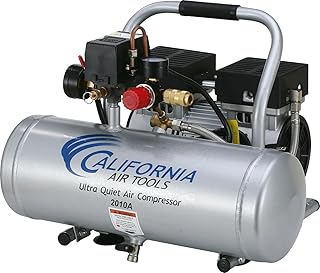
The California Air Tools 2010A closes this group as the quietest machine here, at 60 dB, and the lightest machine with an aluminum tank. It delivers 3.10 CFM at 40 PSI and 2.20 CFM at 90 PSI, which is enough for a small spot repair and a small nozzle. The 2-gallon aluminum tank is small, so the pump will run during a longer spray, but the recovery from 90 to 120 PSI takes only 14 seconds, and the 70/30 duty cycle allows long running periods. The aluminum tank is lighter than a steel tank of the same size and will not rust from the inside.
At 35 lbs the 2010A carries with one hand, and at 60 dB it runs at the sound level of a normal conversation, so it can sit beside the wall being repaired without disturbing the household. It draws only 8.5 amps, so it runs on a shared household circuit. The 2010A suits a plasterer who repairs small stucco spots indoors, where quiet running matters more than air delivery, and who works at a relaxed pace with pauses between spots while the pump refills the small tank. For a single spot at a time, it holds its pressure well enough to keep the pattern even.
| Product | Tank | CFM at 40 PSI | CFM at 90 PSI | Max pressure | Weight |
|---|---|---|---|---|---|
| Metabo HPT EC914S THE TANK | 6 gal | 5.1 | 4.0 | 200 PSI | 41-42 lbs |
| Ridgid OF60150HA | 6 gal | 3.5 | 2.6 | 150 PSI | 34-35 lbs |
| Craftsman CMEC6150 | 6 gal | 3.7 | 2.6 | 150 PSI | 30 lbs |
| California Air Tools 10020C | 10 gal | 6.4 | 5.3 | 125 PSI | 82.5 lbs |
| Makita MAC700 | 2.6 gal | 3.8 | 3.3 | 130 PSI | 52 lbs |
| DeWalt DWFP55126 | 6 gal | 3.7 | 2.6 | 165 PSI | 30 lbs |
| California Air Tools 2010A | 2 gal | 3.10 | 2.20 | 120 PSI | 35 lbs |
How to choose
Look for a regulator that holds its setting
The regulator is the part that decides whether the new patch matches the old stucco, so it deserves the most attention. A good regulator holds the working pressure steady as the tank drains, and it returns to the same setting every time it is adjusted. A locking regulator is worth seeking out, because it stops the setting from drifting when the compressor is moved or bumped. Before buying, turn the regulator knob and feel how it moves: it should turn smoothly, hold its place, and show the pressure clearly on the gauge. A regulator that creeps or sticks will change the pattern from patch to patch, and no amount of skill with the gun can make up for a pressure that will not stay put.
Keep a gap between tank pressure and working pressure
A regulator can only hold the working pressure steady while the tank pressure stays above it. If the tank pressure falls to the working pressure, the regulator has nothing left to regulate with, and the output falls with the tank. That is why a machine with a high maximum pressure, such as the EC914S at 200 PSI, holds its output so well: the working pressure of a hopper gun is far below the tank pressure, so the regulator has a large reserve to draw from. A machine with a 120 PSI maximum and a working pressure close to that ceiling has little reserve, and the output will sag sooner. When comparing machines, look at the gap between the maximum pressure and the pressure the gun needs, and choose the machine with the wider gap.
Size the tank for one spot, not for a whole wall
A stucco spot repair needs only a short spray, so the tank only has to cover one spot at a time. A 6-gallon tank stores enough air for a spot repair without the pump starting, and the pump refills while the next spot is prepared. A 2-gallon tank can cover a small spot, but the pump will run during a longer spray, so the plasterer should check the recovery time as well as the tank size. A 10-gallon tank is more than a spot repair needs, but it earns its place when the spots come one after another along a whole wall, because the pump runs in longer, calmer cycles instead of switching on and off every few minutes.
Match the air delivery to the nozzle
A spot repair is usually sprayed with a small nozzle, so it draws less air than a whole wall, but the nozzle size still decides the air delivery needed. A compressor that delivers 3.5 CFM or more at 40 PSI will run most small nozzles without a pause. A compressor that delivers less will drain its tank during a spray and leave the second half of the spot thinner than the first. The gun's manual states the air it needs, and that figure should be compared with the compressor's delivery at 40 PSI. A machine that is stronger than the nozzle needs is fine, but it costs weight and money that a spot repair does not need.
Common mistakes
The most common mistake on stucco spot repairs is changing the regulator setting between spots. A plasterer who turns the pressure up because the first spot looked thin, then turns it down because the second looked coarse, will end up with a wall of patches that all look different. The regulator should be set once, on a scrap board, to the pressure that matches the old stucco, and then left alone for the whole job. A locking regulator helps, but the discipline of leaving the setting alone matters more than the lock.
Another mistake is spraying before the old stucco is clean. Dust and loose material on the wall keep the new texture from bonding, and the patch will flake off later. The spot should be brushed and blown clean before the gun is used, and a blow gun connected to the second coupler makes that job quick. A third mistake is using a hose that is too long. A long hose drops the pressure between the compressor and the gun, so the gun sees less pressure than the regulator shows, and the pattern comes out thinner than expected. The hose should be as short as the job allows.
A fourth mistake is ignoring the tank drain. Water collects in the tank every time the pump runs, and a tank that is never drained will rust from the inside and spit water into the air line. Water in the air line leaves marks on the stucco and keeps the new texture from bonding. The drain valve should be opened at the end of each working day.
FAQ
Why does my stucco patch look different from the old stucco around it?
A patch looks different when the spray pattern does not match the old texture, and the pattern is set by the pressure at the gun, the mix, and the distance from the wall. If the pressure falls during the spray, the pattern turns thin and flat. If the pressure is too high, the pattern turns coarse and proud. Set the regulator to the pressure that matches the old stucco, lock it if the regulator has a lock, and do not change it during the job. Keep the mix the same and hold the gun at the same distance from the wall for every spot. A scrap board is the best place to check the pattern before spraying the wall.
How do I set the regulator for a stucco spot repair?
Start with the regulator low and spray a scrap board, then raise the pressure in small steps until the pattern matches the old stucco. Write down the pressure that gives the match, because it will be needed again for the next spot. Once the pressure is set, leave it alone for the whole job. A locking regulator holds the setting, but even without a lock the setting should not be touched between spots. If the pattern changes during the day, check the pressure at the gun first, because a falling tank pressure is the most common cause.
Does a bigger tank help hold pressure during a spot repair?
Yes, a bigger tank helps, because it stores more air and the pressure falls more slowly while the gun sprays. A 6-gallon tank stores enough air to cover a spot repair without the pump starting, so the regulator sees a steady supply through the whole spray. A 2-gallon tank will drain faster, and the pump will need to run during the spray to keep up. The tank size matters less than the gap between the tank pressure and the working pressure, but a larger tank is always steadier than a smaller one at the same pressure.
Can I use the same compressor for stucco spot repairs and for larger texture jobs?
Yes, if the compressor delivers enough air for the larger job. A machine that delivers 5 CFM or more at 40 PSI will run a hopper gun on a spot repair and on a larger area, because the air delivery is what limits the gun. A machine that delivers only 2.5 CFM at 90 PSI will manage a spot repair but will struggle on a whole wall, where the gun runs for longer and the tank drains faster. The regulator and the tank size matter on both jobs, but the air delivery decides how large a job the machine can take on.
How do I stop water from spoiling a stucco patch?
Water reaches the gun from the tank, where it collects every time the pump runs. The tank drain valve should be opened at the end of each working day, and the tank should be left open overnight to dry out. A water trap in the air line, fitted between the compressor and the gun, catches any water that gets past the tank drain. On a damp day, or when the compressor has been running for a long time, the trap should be checked and emptied before the next spot is sprayed.
Conclusion
A stucco spot repair disappears when the pressure at the gun stays steady from the first second of the spray to the last, and the compressors in this group were chosen for that steadiness. The Metabo HPT EC914S is the strongest choice here, with a 200 PSI tank that gives the regulator a wide reserve, 5.1 CFM at 40 PSI, and a weight of only 41 to 42 lbs. The Ridgid OF60150HA is the best choice for a plasterer who wants the pressure setting to stay put all day, with a locking regulator and two push-to-connect couplers in a 34 to 35 lb machine. The California Air Tools 10020C is the strongest machine for a whole wall of spots, with 6.4 CFM at 40 PSI, a 10-gallon tank, and a 25-second recovery.
For a plasterer who wants a light machine with a generous tank, the DeWalt DWFP55126 stores 6 gallons of air in a 30 lb package with a 165 PSI maximum. For a plasterer who repairs small spots indoors and wants quiet running, the California Air Tools 2010A runs at 60 dB with a 14-second recovery. Whichever machine is chosen, the rule stays the same: set the regulator on a scrap board, lock it if it has a lock, and leave it alone for the whole job. A compressor chosen and used that way will keep the pressure steady and the patch invisible.
Related guides
More from Amazon
Programs that pair well with the guide above. Offers and eligibility are set by Amazon and may change.
Free shipping on eligible items, Prime Video and more. Eligible new members can start with a free trial.
Start a Prime free trialAudiobooks and podcasts to listen to on the go. Eligible new members can start with a free trial.
Try Audible freeAd-free music streaming. Eligible new subscribers can start with a free trial.
Try Music Unlimited freeA free business account with business pricing and bulk-buying tools for work, shop or home office.
Create a business accountAs an Amazon Associate we earn from qualifying purchases.
More ways to save on your next finish
Programs that pair well with the guide above. Offers and eligibility are set by Amazon and may change.
A free business account with business pricing and bulk-buying tools for work, shop or home office.
Create a business accountFast, free shipping on eligible items, plus Prime Video and more. Eligible new members can start with a free trial.
Start a Prime free trialRead from a huge library of eBooks, including how-to guides and cookbooks. Eligible new members can start with a free trial.
Try Kindle UnlimitedAudiobooks and podcasts for the commute, the garage or the kitchen. Eligible new members can start with a free trial.
Try Audible freeAs an Amazon Associate we earn from qualifying purchases. Using these links costs you nothing extra.



Write Your Review
No reviews yet. Be the first to share your experience!