
Our Top Picks
As an Amazon Associate I earn from qualifying purchases. This post may contain affiliate links at no extra cost to you.
Our top picks at a glance
6 products from this guide, in the order reviewed below.
As an Amazon Associate we earn from qualifying purchases. Prices and availability can change.
Wall patch work never comes as a single job. It comes as a dozen small patches across several rooms, each one needing the same clean texture as the wall around it, and each one separated by the time it takes to prep the next area, blend the last one, and move the equipment. A compressor built for that rhythm needs to recover quickly between patches, carry easily from room to room, and hold enough air for a patch or two before the motor has to catch up. It does not need to spray a whole wall without stopping, because patch work never asks it to.
The best air compressors for texture hopper guns under five hundred dollars for working on repeated wall patch jobs are the machines that balance airflow, recovery speed, and portability inside the mid-range band. A hopper gun asks for four to ten cubic feet per minute at forty pounds per square inch while it sprays, and the machines here deliver between two and a half and just over four cubic feet per minute at the pressures that matter, so they suit short bursts on patches with pauses while the tank refills. Used that way, with the gun running in passes and the operator moving on to the next patch while the tank recovers, they keep a steady pattern across a whole day of patch work.
Best products
Makita MAC2400
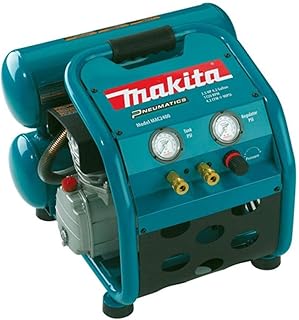
- Tank capacity: 4.2 gallons
- Air delivery: 4.2 CFM at 90 PSI
- Maximum pressure: 130 PSI
- Motor: 2.5 HP
- Noise level: 79 dB
- Weight: 81 lbs
- Pump: oil-lubricated, cast iron
- Best for: the strongest airflow in this roundup for patch after patch
The Makita MAC2400 leads this roundup because it delivers four point two cubic feet per minute at ninety pounds per square inch from a four point two gallon tank, the strongest airflow figure in this group. Its Big Bore cast iron pump moves more air per stroke than the small pancake pumps, so the tank recovers faster between patches and the gun keeps its pattern through a patch even when the mix is thick. The two point five horsepower motor and the oil-lubricated pump suit repeated use, and the roll cage frame protects the machine when it is carried through doorways and up stairs.
The four point two gallon tank is small, and the honest limit is that the motor runs often. For patch work, that rhythm fits: spray a patch, move to the next one, and let the pump refill the tank while the next area is prepped. At seventy-nine decibels the MAC2400 is louder than the quiet machines here, so hearing protection is wise for a full day of patches. For a plasterer who works through a long list of patches and wants the fastest recovery in the mid-range band, the MAC2400 is the strongest pick.
Makita MAC700
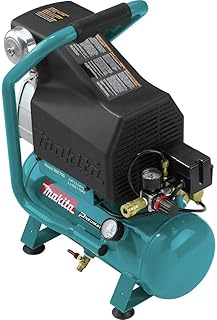
- Tank capacity: 2.6 gallons
- Air delivery: 3.3 CFM at 90 PSI
- Maximum pressure: 130 PSI
- Motor: 2.0 HP
- Noise level: 80 dB
- Weight: 52 lbs
- Pump: oil-lubricated, Big Bore cast iron
- Best for: a compact Big Bore pump for small patches
The Makita MAC700 packs a Big Bore cast iron pump into a two point six gallon machine that weighs fifty-two pounds, and it delivers three point three cubic feet per minute at ninety pounds per square inch. The oil-lubricated pump runs cooler than an oil-free pump of the same size, and the compact frame carries easily from room to room. The one hundred thirty pound per square inch maximum pressure leaves plenty of headroom above the twenty-five to fifty pound per square inch range a hopper gun uses.
The two point six gallon tank suits the smallest patches, sprayed in a few seconds with a pause while the next area is prepped. At eighty decibels it is the loudest machine in this roundup, so hearing protection matters for a day of patch work. For a plasterer who wants a compact, durable machine for small patches and who does not mind the noise, the MAC700 is a solid pick, and its cast iron pump is built for repeated use.
Metabo HPT EC914S

- Tank capacity: 6 gallons
- Air delivery: 4.0 CFM at 90 PSI
- Maximum pressure: 200 PSI
- Motor: 1.3 HP
- Pump: oil-free
- Best for: the strongest airflow at ninety PSI with the highest maximum pressure
The Metabo HPT EC914S, known as THE TANK, delivers four cubic feet per minute at ninety pounds per square inch from a six gallon tank, and it tops out at two hundred pounds per square inch, the highest maximum pressure in this roundup. The one point three horsepower motor drives a pump that recovers faster than the small pancake pumps, so the pauses between patches are shorter. The oil-free pump keeps the routine to draining the tank and cleaning the intake filter, with no oil to watch.
Four cubic feet per minute at ninety pounds per square inch translates to more air at the forty pounds per square inch a hopper gun uses, and that is what makes the EC914S the most capable machine in this roundup for patch work on a six gallon tank. It suits patches sprayed in short bursts, with the tank refilling while the next area is prepped. For a plasterer who wants strong airflow, a high maximum pressure, and a simple oil-free routine, the EC914S is the pick.
California Air Tools 8010A
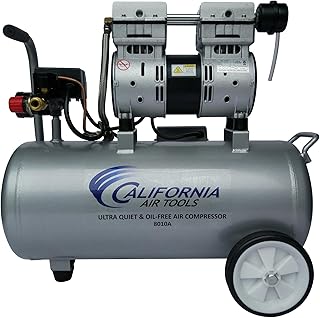
- Tank capacity: 8 gallons, aluminum
- Air delivery: 3.1 CFM at 40 PSI, 2.2 CFM at 90 PSI
- Maximum pressure: 120 PSI
- Motor: 1.0 HP
- Noise level: 60 dB
- Weight: 37.3 lbs
- Pump: oil-free
- Features: wheels
- Best for: the quietest machine here, light enough to carry anywhere
The California Air Tools 8010A is an eight gallon aluminum machine that runs at sixty decibels, the quietest figure in this roundup by a wide margin, and it weighs thirty-seven point three pounds, which makes it easy to carry from room to room. The aluminum tank will not rust the way a steel tank can, and the oil-free pump needs no oil checks. The wheels let it roll across a floor, and the three point one cubic feet per minute at forty pounds per square inch is the strongest low-pressure figure among the quiet machines here.
Three point one cubic feet per minute at forty pounds per square inch suits light orange peel and small patches, sprayed in short bursts with pauses while the tank refills. The quiet running is the real reason to pick this machine: at sixty decibels it can run in an occupied home without dominating the room, and the operator can work a full day of patches without the fatigue that a loud compressor brings. For patch work in occupied houses, the 8010A is the kindest machine in this roundup to live with.
Campbell Hausfeld DC080500

- Tank capacity: 8 gallons
- Air delivery: 3.5 CFM at 40 PSI, 2.4 CFM at 90 PSI
- Maximum pressure: 125 PSI
- Motor: 1 HP
- Noise level: 68 dBA
- Weight: 70 lbs
- Fittings: 1/4 in. IM Quick Connect tank outlet
- Pump: oil-free
- Best for: the strongest low-pressure airflow with a quick connect outlet
The Campbell Hausfeld DC080500 delivers three point five cubic feet per minute at forty pounds per square inch, the strongest low-pressure airflow in this roundup, from an eight gallon tank that holds more air than the six gallon pancake units. At sixty-eight decibels it runs quietly enough for work on an occupied home, and the quarter inch IM Quick Connect outlet lets the hose click on and off without tools as the work moves from room to room. The seventy pound weight keeps the machine steady on the floor while still being liftable into a van.
The eight gallon tank and the strong low-pressure airflow mean a patch sprays with less pressure drop than the smaller machines here, and the tank refills during the pause while the next patch is prepped. The oil-free pump needs no oil checks. For a plasterer who wants the most capable machine in the mid-range band for patch work, and who values quiet running and fast hose changes, the DC080500 is the strongest all-round pick.
Craftsman CMEC6150K
- Tank capacity: 6 gallons, pancake
- Air delivery: 2.6 CFM at 90 PSI
- Maximum pressure: 150 PSI
- Motor: 0.8 HP
- Weight: 30 lbs
- Noise level: 78.5 dBA
- Fittings: dual 1/4 in. Industrial quick connect couplers
- Pump: oil-free
- Best for: the lightest machine here, with two couplers
The Craftsman CMEC6150K weighs thirty pounds, the lightest machine in this roundup, and it carries dual quarter inch Industrial quick connect couplers on the tank, so the gun hose and a blow gun can stay connected at the same time. The pancake tank sits low and stable, the oil-free pump needs no oil, and the kit version includes a thirteen piece accessory set that covers the hose and fittings a patch job needs in one box. The blow gun on the second coupler clears dust from a patch before spraying, which saves the time of swapping hoses between patches.
Two point six cubic feet per minute at ninety pounds per square inch sets the honest limit: small patches sprayed in short bursts, with pauses while the tank refills. For a long list of small patches across several rooms, the light weight and the dual couplers earn their keep, because the machine moves with one hand and the blow gun is always ready. For larger patches or heavier patterns, a stronger machine from this roundup will serve better.
Porter-Cable C2002

- Tank capacity: 6 gallons, pancake
- Air delivery: 2.6 CFM at 90 PSI
- Maximum pressure: 150 PSI
- Motor: 0.8 HP
- Weight: 34 lbs
- Fittings: quick coupler, included in the kit
- Pump: oil-free
- Power: 120 volt
- Best for: the simplest carry-and-spray option for patch work
The Porter-Cable C2002 is a six gallon pancake compressor that weighs thirty-four pounds and carries a quick coupler in its kit, so the hose connects with a click and the machine moves to the next patch with one hand. The pancake tank sits low and stable on a floor or a scaffold board, the oil-free pump needs no oil checks, and the one hundred fifty pound per square inch maximum pressure leaves plenty of headroom above the gun working range. It is the kind of machine that lives in the back of a van and comes out for a day of patch work.
Two point six cubic feet per minute at ninety pounds per square inch is modest airflow, and the honest way to use it is in short bursts: spray a patch, pause to check the blend, let the tank refill, and move to the next patch. A wall patch needs only a few passes, and the C2002 covers them. For a plasterer who works through a list of small patches and wants the simplest machine that does the job, the C2002 is the straightforward pick.
| Compressor | CFM at 40 PSI | Best for |
|---|---|---|
| Makita MAC2400 | see product page | Strongest airflow, fastest recovery |
| Makita MAC700 | see product page | Compact Big Bore pump, small patches |
| Metabo HPT EC914S | see product page | Strongest airflow at 90 PSI |
| California Air Tools 8010A | 3.1 | Quietest, lightest carry |
| Campbell Hausfeld DC080500 | 3.5 | Strongest low-pressure airflow |
| Craftsman CMEC6150K | see product page | Lightest machine, two couplers |
| Porter-Cable C2002 | see product page | Simplest carry-and-spray option |
How to choose
Recovery speed matters more than tank size for patch work
Patch work runs in bursts, and the time between patches is when the tank refills. A pump that delivers more air per minute shortens that refill window, so the operator spends less time waiting and more time spraying. The Makita MAC2400 and the Metabo HPT EC914S lead this roundup on airflow, at four point two and four cubic feet per minute at ninety pounds per square inch, and that shows up as shorter pauses between patches. A large tank helps too, because it holds more air for the next patch, but a large tank with a weak pump still leaves the operator waiting. For repeated patches, read the airflow figure first and the tank size second.
Keep the machine close to the work
A patch job moves from room to room, and the compressor should move with it. A thirty pound pancake machine carries with one hand, while a seventy or eighty pound machine needs wheels or a second pair of hands. The machines in this roundup run from thirty to eighty-one pounds, and the right weight depends on how far the machine travels between patches. A short hose also helps: a long hose drops pressure between the compressor and the gun, and it tangles across fresh patches. Keep the compressor near the wall being patched, and keep the hose short and free of kinks.
Set the regulator for the patch pattern
A hopper gun runs between twenty-five and fifty pounds per square inch at the gun, with orange peel at the upper end and knockdown at the lower end. The compressor maximum pressure, which runs from one hundred twenty to two hundred pounds per square inch in this roundup, is not the spraying pressure, and the regulator is what bridges the two. Set the regulator to the low forties for orange peel and the high twenties to mid thirties for knockdown, then adjust in small steps while watching the pattern on a scrap piece. A patch must match the texture around it, so the regulator setting deserves a check before each patch, not just at the start of the day.
Weigh noise against a full day of patches
Noise figures in this roundup run from sixty decibels for the California Air Tools 8010A to eighty decibels for the Makita MAC700, and the gap matters over a full day of patch work. A sixty decibel machine can run in an occupied home without dominating the room, while an eighty decibel machine needs hearing protection and wears on the operator. The quiet machines here trade a little airflow for the quieter running, and for patch work in occupied houses that trade is usually worth making.
Common mistakes
The most common mistake is starting the next patch before the tank has recovered. The motor needs time to refill the tank, and starting a patch on a half-empty tank gives a weak first pass that has to be covered again. The pause to prep the next patch is also the refill window, and using it properly keeps every patch starting at full pressure.
A second mistake is running the regulator too high to compensate for weak airflow. More pressure does not replace missing air volume, and running a hopper gun at sixty or seventy pounds per square inch blows the texture thin and throws material past the patch. The working band is twenty-five to fifty pounds per square inch, and the right setting is found on a scrap piece, not by turning the regulator up.
A third mistake is skipping the water drain. Compressors condense water inside the tank, and that water travels down the hose into the gun, where it thins the mix and leaves pale spots in the texture. Draining the tank at the end of every patch day takes a minute and keeps the air dry, and it matters more on damp days when condensation builds faster.
A fourth mistake is patching without a scrap piece check. The texture on the wall around a patch was sprayed under particular settings, and matching it needs the same mix, the same nozzle, and the same pressure. A scrap piece sprayed with the same settings shows the pattern before the real patch is committed, and it takes only a minute to run.
A fifth mistake is letting the hose drag across fresh patches. A hose on the floor catches on corners and pulls across wet texture, and the damage shows as a drag mark that has to be repaired again. Keep the hose short, keep it off the fresh work, and hang it over a shoulder or a hook between patches.
FAQ
How many patches can a small compressor handle in a day?
A small compressor can handle a full day of patches, because patch work runs in bursts with pauses between them. The tank refills during each pause, while the next patch is prepped and the last one is checked. The limit is the size of each patch and the pattern: small patches and light orange peel suit the machines in this roundup, while large patches and heavy knockdown need stronger airflow and a larger tank.
What is the best tank size for repeated wall patch jobs?
A six to eight gallon tank is a good middle ground for patch work. It holds enough air for a patch or two before the motor needs to catch up, and it stays light enough to carry from room to room. A two to four gallon tank suits the smallest patches but needs longer pauses between them, while a twenty gallon tank holds more air but weighs more and moves less easily.
How long does a compressor take to recover between patches?
Recovery time depends on the pump airflow and the tank size. A strong pump on a small tank recovers in well under a minute, while a weak pump on a large tank takes several minutes. The machines in this roundup recover during the natural pause between patches, while the next area is prepped, so the operator rarely has to wait.
Should I use a blow gun between patches?
A blow gun clears dust and loose material from a patch before spraying, and it helps the new texture bond to the wall. The Craftsman CMEC6150K carries dual couplers, so a blow gun can stay connected alongside the gun hose. On the other machines here, a quick connect fitting makes it easy to swap the blow gun in for a few seconds and then swap the gun hose back.
What pressure should the regulator be set to for patch work?
Most hopper guns run between twenty-five and fifty pounds per square inch at the gun. Orange peel patterns sit at the upper end, around forty to fifty pounds per square inch, and knockdown patterns sit at the lower end, around twenty-five to thirty-five. Start in the middle of the range for the pattern, spray a scrap piece, and adjust in small steps until the texture matches the wall around the patch.
Is an oil-free pump better for patch work?
An oil-free pump removes oil changes from the routine and removes any chance of oil mist reaching the air line, which is a small but real benefit when the air carries a plaster mix onto a wall. Five of the seven machines in this roundup use oil-free pumps. The two Makita machines use oil-lubricated cast iron pumps, which run cooler and often last longer under repeated use, but they need their oil level watched. Either type works for patch work.
Conclusion
Repeated wall patch work rewards a compressor that recovers fast, carries easily, and holds its pattern from the first patch to the last. The Makita MAC2400 leads on airflow and recovery speed, the Metabo HPT EC914S pairs strong airflow with the highest maximum pressure here, and the Campbell Hausfeld DC080500 leads on low-pressure airflow at three point five cubic feet per minute at forty pounds per square inch. The California Air Tools 8010A is the quietest and lightest choice for occupied homes, while the Craftsman CMEC6150K and Porter-Cable C2002 carry the job in the simplest package. Pick the machine that matches the patch size and the working space, spray in passes, let the tank recover while the next patch is prepped, and the texture will match from the first patch of the day to the last.
Related guides
More from Amazon
Programs that pair well with the guide above. Offers and eligibility are set by Amazon and may change.
Free shipping on eligible items, Prime Video and more. Eligible new members can start with a free trial.
Start a Prime free trialAudiobooks and podcasts to listen to on the go. Eligible new members can start with a free trial.
Try Audible freeAd-free music streaming. Eligible new subscribers can start with a free trial.
Try Music Unlimited freeA free business account with business pricing and bulk-buying tools for work, shop or home office.
Create a business accountAs an Amazon Associate we earn from qualifying purchases.
More ways to save on your next finish
Programs that pair well with the guide above. Offers and eligibility are set by Amazon and may change.
A free business account with business pricing and bulk-buying tools for work, shop or home office.
Create a business accountFast, free shipping on eligible items, plus Prime Video and more. Eligible new members can start with a free trial.
Start a Prime free trialRead from a huge library of eBooks, including how-to guides and cookbooks. Eligible new members can start with a free trial.
Try Kindle UnlimitedAudiobooks and podcasts for the commute, the garage or the kitchen. Eligible new members can start with a free trial.
Try Audible freeAs an Amazon Associate we earn from qualifying purchases. Using these links costs you nothing extra.



Write Your Review
No reviews yet. Be the first to share your experience!