
Key takeaways
- Compare air compressors with quick connect air hose fittings for texture hopper guns, keeping pressure steady through stucco spot repairs on small patches.
As an Amazon Associate I earn from qualifying purchases. This post may contain affiliate links at no extra cost to you.
Our top picks at a glance
4 products from this guide, in the order reviewed below.

As an Amazon Associate we earn from qualifying purchases. Prices and availability can change.
Stucco spot repair is stop-start work. The plasterer patches one area, steps back to check the blend, moves to the next patch, and repeats the cycle across a wall. Between patches the gun sits idle, the hose gets dragged to a new position, and the compressor has a short window to rebuild pressure before the next burst. In that rhythm, the fitting where the hose meets the compressor matters more than it does on a long continuous spray, because every connection and disconnection is a chance for air to leak away, and a slow leak means the first seconds of the next patch spray weak.
The best air compressors for texture hopper guns with quick connect air hose fittings for maintaining pressure during stucco spot repairs all ship with proper quick connect couplers on the tank outlet, hold a working pressure between twenty-five and fifty pounds per square inch at the gun, and carry enough stored air to cover a patch or two before the motor needs to catch up. A quick connect fitting seals the moment it clicks home, so pressure stays in the tank between patches instead of hissing out through a loose threaded joint, and it lets the operator break the hose down in seconds when the work moves to another wall. The seven machines below all carry that kind of fitting, and each one is judged on how well it keeps pressure ready between bursts.
Best products
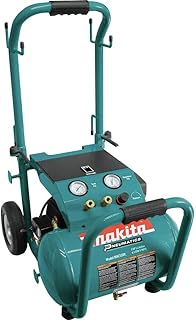
Makita MAC5200
- Tank capacity: 5.2 gallons
- Air delivery: 6.9 CFM at 40 PSI, 6.5 CFM at 90 PSI
- Maximum pressure: 140 PSI
- Motor: 3.0 HP, 2.1 HP running
- Weight: 88 lbs net
- Fittings: two 1/4 in. universal quick couplers included
- Features: wheels and folding handle
- Best for: the strongest airflow with two couplers ready to use
The Makita MAC5200 leads this roundup because it is the only machine here that ships with two universal quick couplers already fitted, one for the gun hose and one for a second tool or a spare hose. The couplers are the quarter inch universal type, so they accept the fittings found on most air hoses without an adapter, and the click-home seal holds tank pressure between patches. Six point nine cubic feet per minute at forty pounds per square inch is the strongest airflow in this group, so the gun keeps its pattern through a patch even when the mix is thick.
The five point two gallon tank suits the stop-start rhythm of spot repair, because the motor refills it during the pauses between patches while the operator checks the blend. The wheels and folding handle make it easy to roll the machine along a wall as the work moves, and the eighty-eight pound weight is manageable on flat ground. For a plasterer who repairs patches across a whole wall and wants the hose to connect in a second and stay sealed, the MAC5200 is the most complete package here.
Craftsman CMEC6150K
- Tank capacity: 6 gallons, pancake
- Air delivery: 2.6 CFM at 90 PSI
- Maximum pressure: 150 PSI
- Motor: 0.8 HP
- Weight: 30 lbs
- Noise level: 78.5 dBA
- Fittings: dual 1/4 in. Industrial quick connect couplers
- Pump: oil-free
- Best for: a light carry-around unit with two couplers
The Craftsman CMEC6150K is the lightest machine in this roundup at thirty pounds, and it carries dual quarter inch Industrial quick connect couplers on the tank, so the gun hose and a blow gun can stay connected at the same time. The pancake tank sits low and stable on a floor or a scaffold board, and the oil-free pump needs no oil checks. The kit version includes a thirteen piece accessory set, which covers the hose and fittings a repair job needs in one box.
Two point six cubic feet per minute at ninety pounds per square inch is modest airflow, and the honest limit is that this machine suits small patches and short bursts rather than large areas. A spot repair is exactly that kind of work: a burst of spray, a pause to check the blend, another burst. The tank refills during each pause, and the dual couplers mean the hose never needs to be unscrewed between patches. For small stucco patches on a house wall, the Craftsman is easy to carry, quick to connect, and strong enough for the job.
Campbell Hausfeld DC080500
- Tank capacity: 8 gallons
- Air delivery: 3.5 CFM at 40 PSI, 2.4 CFM at 90 PSI
- Maximum pressure: 125 PSI
- Motor: 1 HP
- Noise level: 68 dBA
- Weight: 70 lbs
- Fittings: 1/4 in. IM Quick Connect tank outlet
- Pump: oil-free
- Best for: quiet running with a proper quick connect outlet
The Campbell Hausfeld DC080500 carries a quarter inch IM Quick Connect outlet on the tank, a fitting type built for fast hose changes without tools, and it runs at sixty-eight decibels, which is quiet enough for work on an occupied house. Three point five cubic feet per minute at forty pounds per square inch is the strongest low-pressure airflow among the small machines in this roundup, and the eight gallon tank holds more air than the six gallon pancake units, so a patch sprays with less pressure drop. The seventy pound weight is heavy enough to stay put on a floor and light enough to lift into a van.
The oil-free pump and the simple control layout keep the routine short: connect the hose with a click, set the regulator, spray the patch, and let the motor refill the tank while the blend is checked. The DC080500 suits a plasterer who works on occupied homes and wants a quiet machine that connects fast and holds pressure between patches without fuss.
Stealth SAQ-12018
- Tank capacity: 20 gallons
- Air delivery: 6.0 CFM at 40 PSI, 5.0 CFM at 90 PSI
- Maximum pressure: 150 PSI, cut-out
- Motor: 1.8 HP
- Noise level: 68 dB
- Weight: 121 lbs
- Fittings: two quick couplers
- Features: eight inch rubber wheels
- Pump: oil-free
- Best for: a large tank that keeps pressure ready all day
The Stealth SAQ-12018 brings a twenty gallon tank and six cubic feet per minute at forty pounds per square inch to spot repair work, which means the pressure is ready for the next patch almost as soon as the operator is. The two quick couplers let the gun hose stay connected alongside a second hose, and the eight inch rubber wheels roll the one hundred twenty-one pound machine across rough ground and over thresholds without catching. At sixty-eight decibels it is the quietest large machine in this roundup, so it suits work on occupied buildings.
A twenty gallon tank is more air than a single patch needs, and that is the point: the reserve means the regulator never sees a pressure dip while the gun runs, and the motor cycles off for long stretches between patches. The oil-free pump keeps maintenance to draining the tank and cleaning the intake filter. For a plasterer who repairs patches across several rooms or a whole wall and wants the compressor to be ready whenever the gun is, the Stealth is the patient, quiet choice.
Porter-Cable C2002

- Tank capacity: 6 gallons, pancake
- Air delivery: 2.6 CFM at 90 PSI
- Maximum pressure: 150 PSI
- Motor: 0.8 HP
- Weight: 34 lbs
- Fittings: quick coupler, included in the kit
- Pump: oil-free
- Power: 120 volt
- Best for: the simplest carry-and-spray option
The Porter-Cable C2002 is a six gallon pancake compressor that weighs thirty-four pounds and carries a quick coupler in its kit, so the hose connects with a click and the machine moves to the next patch with one hand. The pancake tank sits flat and stable, the oil-free pump needs no oil, and the one hundred fifty pound per square inch maximum pressure leaves plenty of headroom above the gun working range. It is the kind of machine that lives in the back of a van and comes out for a morning of patch work.
Two point six cubic feet per minute at ninety pounds per square inch is the limit to respect. This machine suits small patches sprayed in short bursts, with pauses while the blend is checked and the tank refills. For a stucco spot repair, where each patch is a small area and the gun runs for seconds rather than minutes, the C2002 keeps up. For larger areas or continuous spraying, a machine with more airflow from this roundup will serve better.
Husky C201H
- Tank capacity: 20 gallons
- Air delivery: 5.2 SCFM at 40 PSI, 4.0 SCFM at 90 PSI
- Maximum pressure: 175 PSI
- Motor: 1.3 HP
- Weight: 73 lbs
- Fittings: quick connection, listed in the manual parts list
- Pump: oil-free
- Features: wheels, seven minute fill from empty
- Best for: a large tank on a light frame
The Husky C201H pairs a twenty gallon tank with five point two cubic feet per minute at forty pounds per square inch, and it does so at seventy-three pounds, which is light for a twenty gallon machine. The quick connection fitting on the tank outlet lets the hose click on and off without tools, and the wheels carry the weight across a workshop or a driveway. The one hundred seventy-five pound per square inch maximum pressure is the highest in this roundup, and the seven minute fill from empty means the machine is ready soon after it is switched on.
Five point two cubic feet per minute at forty pounds per square inch covers light orange peel and medium knockdown patterns, and the twenty gallon tank means the gun can run through several patches before the motor needs to work hard. The oil-free pump keeps the routine simple. For a plasterer who wants a large reserve without a heavy machine, and who moves between patches on a big wall, the C201H is the lightest way to carry twenty gallons of ready air.
California Air Tools 2010A
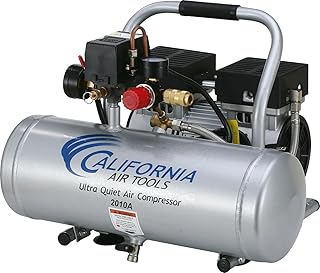
- Tank capacity: 2 gallons, aluminum
- Air delivery: 3.1 CFM at 40 PSI, 2.2 CFM at 90 PSI
- Maximum pressure: 120 PSI
- Motor: 1.0 HP running, 2.0 HP peak
- Noise level: 60 dB
- Weight: 35 lbs
- Fittings: quick connector, listed in the maker information sheet
- Pump: oil-free
- Features: fifty second fill, fourteen second recovery from ninety to one hundred twenty PSI
- Best for: the quietest machine here, for the smallest patches
The California Air Tools 2010A is a two gallon aluminum machine that runs at sixty decibels, the quietest figure in this roundup, and it carries a quick connector on the tank outlet for fast hose changes. The aluminum tank keeps the weight to thirty-five pounds, so the machine carries up a ladder or onto a scaffold with one hand, and the fifty second fill and fourteen second recovery mean the tank is ready again quickly after a burst. Three point one cubic feet per minute at forty pounds per square inch is the strongest low-pressure figure among the very small machines.
The two gallon tank is the honest limit. This machine suits the smallest patches, a burst of spray and a pause, and it is not a match for larger areas or for back-to-back patches without a break. For a single small stucco patch on an occupied home, where quiet running and easy carrying matter more than tank size, the 2010A is a practical choice, and the quick connector means the hose is on and off in seconds.
| Compressor | Fittings | Best for |
|---|---|---|
| Makita MAC5200 | Two 1/4 in. universal quick couplers | Strongest airflow, two couplers |
| Craftsman CMEC6150K | Dual 1/4 in. Industrial quick connect | Light carry-around, two couplers |
| Campbell Hausfeld DC080500 | 1/4 in. IM Quick Connect outlet | Quiet running, fast hose changes |
| Stealth SAQ-12018 | Two quick couplers | Large tank, pressure always ready |
| Porter-Cable C2002 | Quick coupler in kit | Simplest carry-and-spray option |
| Husky C201H | Quick connection | Large tank on a light frame |
| California Air Tools 2010A | Quick connector | Quietest, smallest patches |
How to choose
Check the coupler type before the hose
Quick connect couplers come in several types, and the two common ones are Industrial and universal, both in quarter inch size. The machines in this roundup carry a mix: the Makita MAC5200 ships with universal couplers, the Craftsman CMEC6150K with Industrial couplers, and the Campbell Hausfeld DC080500 with an IM Quick Connect outlet. Before buying, check which type the gun hose already carries, and match the compressor to it. An adapter solves a mismatch, but every adapter is one more joint that can leak, and a direct match keeps the air path short and tight.
Size the tank to the patch rhythm
Spot repair runs in bursts, and the tank is what carries the gun through each burst. A two to six gallon tank suits a single small patch, sprayed in a few seconds with a pause while the blend is checked. An eight to twenty gallon tank suits a run of patches across a wall, because the reserve covers several bursts before the motor has to catch up. The mistake is to pair a small tank with a weak pump and expect it to run continuously, since the pressure will sag halfway through a patch. For most stucco spot work, a six to eight gallon tank with three or more cubic feet per minute at forty pounds per square inch is a sound middle ground.
Keep the regulator in the gun working band
A hopper gun runs between twenty-five and fifty pounds per square inch at the gun, with orange peel at the upper end and knockdown at the lower end. The compressor maximum pressure, which runs from one hundred twenty to one hundred seventy-five pounds per square inch in this roundup, is not the spraying pressure. Set the regulator to the low forties for orange peel and the high twenties to mid thirties for knockdown, and adjust in small steps while watching the pattern on a scrap piece. A regulator that holds its setting between patches is worth more than a high maximum pressure figure.
Listen for leaks at every joint
A quick connect fitting only saves pressure if it seals properly. A worn coupler, a damaged O-ring, or a hose end that does not seat fully will hiss air away between patches, and the tank will be soft when the next patch starts. The check takes seconds: connect the hose, bring the tank to pressure, switch the compressor off, and listen. If the gauge falls, the leak is at a joint, and the fix is usually a new O-ring or a new coupler rather than a new compressor. Keeping a spare coupler and a few O-rings in the tool box costs little and saves a repair day.
Common mistakes
The most common mistake is leaving the hose connected to a leaking coupler and blaming the compressor for weak pressure. A slow leak drains the tank between patches, so the first seconds of the next patch spray thin and the pattern looks starved. The fix is to listen for hissing at every joint after connecting, and to replace worn couplers and O-rings before they become a problem.
A second mistake is running the gun straight from a threaded connection with tape that has worn thin. Threaded joints loosen with vibration and with repeated hose movement, and they leak more each time the hose is dragged to a new patch. Quick connect fittings exist to solve this, and the machines in this roundup all carry them, so the threaded joint should be left to the coupler and the hose should click on and off instead.
A third mistake is setting the regulator once and never checking it again. Regulators drift, especially after the machine has been moved, and a setting that was right in the morning can be wrong by the afternoon. A quick glance at the gauge before each patch, and a scrap piece spray to confirm the pattern, takes less than a minute.
A fourth mistake is spraying a patch with a tank that is still half empty from the last patch. The motor needs time to refill the tank, and starting a patch before the pressure has recovered gives a weak first pass that has to be covered again. The pause to check the blend of the previous patch is also the refill window, and using it properly keeps every patch starting at full pressure.
A fifth mistake is using a hose that is too long for the job. A long hose drops pressure between the compressor and the gun, and it tangles and drags across fresh patches. For spot repair, a short hose kept close to the work keeps the pressure up and the work area clear, and the quick connect fitting makes it easy to swap to a longer hose only when the job needs it.
FAQ
What is a quick connect air hose fitting?
A quick connect fitting is a coupler that joins an air hose to a compressor with a push and a click, sealing the joint without tools or thread tape. Pulling back the sleeve releases the hose. The machines in this roundup carry quarter inch quick connect couplers in Industrial, universal, or IM types, and the fitting type should match the hose end to avoid adapters.
Why does pressure drop between stucco patches?
Pressure drops between patches for two reasons: the tank is still refilling after the last burst, and air is leaking from a joint. A leaking coupler or a worn O-ring hisses air away while the gun sits idle, so the tank is soft when the next patch starts. The check is simple: bring the tank to pressure, switch the compressor off, and listen at each joint. A tight system holds its gauge reading.
How much air does a stucco spot repair need?
A spot repair uses short bursts, and a hopper gun draws four to ten cubic feet per minute at forty pounds per square inch while it sprays. Light orange peel needs four to six cubic feet per minute, and heavier knockdown needs six to nine. The machines in this roundup run from two point two to six point nine cubic feet per minute at the relevant pressures, and the right pick depends on the size of the patch and the pattern. Small patches suit the smaller machines, while larger patches and heavier patterns need the stronger ones.
Can one compressor run both the gun and a blow gun at once?
Yes, when the compressor carries two couplers. The Makita MAC5200, the Craftsman CMEC6150K, and the Stealth SAQ-12018 all ship with two quick couplers, so a gun hose and a blow gun hose can stay connected at the same time. The blow gun clears dust from a patch before spraying, and having it ready on the second coupler saves the time of swapping hoses between patches.
How do I keep a quick connect fitting from leaking?
Keep the fitting clean, keep the O-ring in good shape, and push the hose end fully home until it clicks. Dirt on the coupler face stops the seal from seating, and a nicked O-ring leaks under pressure. A drop of light oil on the coupler sleeve now and then keeps the release action smooth, and a spare coupler in the tool box covers the day a fitting finally wears out.
Is a small compressor enough for stucco spot repairs?
A small compressor is enough for small patches sprayed in short bursts, with pauses between patches while the tank refills. The two to six gallon machines in this roundup suit single patches on a house wall, and their light weight makes them easy to carry. For a run of larger patches, or for heavier knockdown patterns, a larger tank and stronger airflow from the eight to twenty gallon machines in this roundup will keep the pattern steady.
Conclusion
Stucco spot repair rewards a compressor that connects fast, seals tight, and keeps pressure ready between bursts, and the quick connect fitting is what makes that rhythm work. The Makita MAC5200 leads with two universal couplers and the strongest airflow here, the Craftsman CMEC6150K and the Porter-Cable C2002 carry the job in a light package, and the Stealth SAQ-12018 and Husky C201H bring twenty gallon reserves for a long run of patches. For small patches on an occupied home, the quiet Campbell Hausfeld DC080500 and the whisper-quiet California Air Tools 2010A suit the setting. Pick the coupler type that matches the hose, size the tank to the patch rhythm, and listen for leaks before the first patch, and the gun will spray the same on the last patch as on the first.
Related guides
More from Amazon
Programs that pair well with the guide above. Offers and eligibility are set by Amazon and may change.
Free shipping on eligible items, Prime Video and more. Eligible new members can start with a free trial.
Start a Prime free trialAudiobooks and podcasts to listen to on the go. Eligible new members can start with a free trial.
Try Audible freeAd-free music streaming. Eligible new subscribers can start with a free trial.
Try Music Unlimited freeA free business account with business pricing and bulk-buying tools for work, shop or home office.
Create a business accountAs an Amazon Associate we earn from qualifying purchases.
More ways to save on your next finish
Programs that pair well with the guide above. Offers and eligibility are set by Amazon and may change.
A free business account with business pricing and bulk-buying tools for work, shop or home office.
Create a business accountFast, free shipping on eligible items, plus Prime Video and more. Eligible new members can start with a free trial.
Start a Prime free trialRead from a huge library of eBooks, including how-to guides and cookbooks. Eligible new members can start with a free trial.
Try Kindle UnlimitedAudiobooks and podcasts for the commute, the garage or the kitchen. Eligible new members can start with a free trial.
Try Audible freeAs an Amazon Associate we earn from qualifying purchases. Using these links costs you nothing extra.



Write Your Review
No reviews yet. Be the first to share your experience!