
Key takeaways
- Compare the best stucco patch repair mixes for filling small cracks on exterior walls, with stated layer thickness, drying times and coverage for each mix.
As an Amazon Associate I earn from qualifying purchases. This post may contain affiliate links at no extra cost to you.
Our top picks at a glance
3 products from this guide, in the order reviewed below.


As an Amazon Associate we earn from qualifying purchases. Prices and availability can change.
A small crack on an exterior wall looks like a one-coat job, and that is exactly where it goes wrong. The crack is shallow at the surface and deeper underneath, the patch goes on thick to fill it in one pass, and the thick coat shrinks as it dries, cracks down the middle and pulls away from the edges. The repair then has to be done again, and the second repair costs more than the first, because the failed patch has to be cut out before the new one goes in. The products that stop that failure before it starts are the best stucco patch repair mixes for filling small cracks on exterior walls with stated layer thickness, because the maker states in writing how thick each layer may be and how long each layer must dry before the next goes on.
The stated layer thickness is not a suggestion. It is the number that decides whether the patch dries through its full depth or only on the surface, and whether the repair bonds to the wall or to itself. A patch laid thicker than the maker allows will skin over on the outside while the inside stays soft, and the soft inside will shrink, crack and hollow out. A patch laid in lifts of the stated thickness will dry through each lift, bond to the lift below it, and hold its texture. The numbers in this roundup run from one sixteenth inch for a skim coat to one inch for a full depth cement patch, and that spread is large enough to change the repair.
The seven mixes that follow were chosen because each one states its layer thickness on the data sheet. There are ready-to-use acrylic tubs that fill up to one quarter inch per layer, a fast cement patch that fills from one eighth inch to one inch in a single application, a dry mix that dries in about three hours per layer, a smooth skim coat for a shallow wide crack, and a flexible sealant for a crack that moves. The right one depends on how deep the crack runs and how many layers the repair will take.
Best products
QUIKRETE FastSet Stucco Patch
- Fast setting Portland cement-based stucco patching material in twenty pound pails
- Final set in forty five to ninety minutes, with painting after ninety minutes
- Twenty to thirty minute working time
- Yield of about two tenths of a cubic foot per pail, repairing about ten square feet at one quarter inch thickness
- Water repellent formula with minimal shrinkage and improved durability
- Meets the requirements of ASTM C 926
- Mix with about three and a half pints of water per twenty pound pail
QUIKRETE FastSet Stucco Patch leads this roundup because it states its layer rule in the clearest way: the patch is made for full depth stucco repairs, and it can be built up to the desired thickness on a damp surface, with a thin layer pressed hard first and then built up to the full depth. The final set comes in forty five to ninety minutes after mixing, and the patch can be painted ninety minutes after with a water-based latex paint. That ninety minute window suits a crack repair that has to be finished and painted in a single visit, and the patch can be used for full depth repairs, so a crack that runs deeper than it looks takes one material from the bottom of the crack to the surface.
The working time is twenty to thirty minutes, and only as much material as can be applied in ten to fifteen minutes should be mixed at once. The mix is about three and a half pints of water per twenty pound pail, mixed for two to three minutes until a trowelable consistency is reached, with no Portland cement, lime, sand or admixtures added. Moist curing helps keep cracking down, with a fine mist of water three hours after application and a second misting after three more hours. A single patch should not exceed eight square feet, and the final color may vary like other cementitious materials. The water repellent formula gives minimal shrinkage and improved durability, which is what a crack repair on an exterior wall needs.
Rapid Set Stucco Patch
- Premium fast-setting stucco repair material in ten, twenty five and fifty pound sizes
- Twenty minute working time, with priming and painting after about two hours
- Apply in a single application from one eighth inch to one inch thick
- Sand size of sixteen to twenty grit, made to match most existing stucco color coat textures
- One twenty five pound box yields about two tenths of a cubic foot and covers about three and two tenths square feet at three quarters inch deep
- Off white in color, for exterior and interior stucco surfaces
- Mix one part water to four parts patch, or two quarts of water per twenty five pound bag
Rapid Set Stucco Patch is the full depth option in this roundup, and it earns its place on a stated layer range that no other product here matches: one eighth inch to one inch thick in a single application. A crack that runs three quarters of an inch deep can be filled in one pass, with no layers and no waiting between lifts, and the patch can be primed and painted after about two hours. That speed suits a crack on an exterior wall that has to be weatherproof again the same day, and the sand size of sixteen to twenty grit is made to match most existing stucco color coat textures, so the repair blends with the wall around it.
The working time is twenty minutes, and that short window demands preparation before the powder meets the water. The surface must be clean and sound, the tools must be ready, and the mix must be placed quickly so the full finishing time is available. The mix is one part water to four parts patch, or two quarts of water per twenty five pound bag, and the material should not be retempered once it starts to set. The patch does not need water curing under moderate conditions at seventy degrees Fahrenheit, and in dry, windy or hot conditions a mist of water keeps the surface wet until the patch has gained strength. The shelf life is twelve months when the package is stored dry and out of direct sunlight.
Akona Pre-Mixed Concrete and Stucco Patch
- Pre-mixed patch in one quart and one gallon tubs
- Water-based formula for repairing cracks, holes and spalls in stucco and concrete
- Apply in layers of no more than one quarter inch, with two to four hours between layers
- Hardens within a few hours, with full cure in a minimum of seven days at sixty five to seventy five degrees Fahrenheit
- One quart covers about three square feet at one eighth inch, one gallon covers about twelve square feet
- Apply when air and surface temperatures sit above fifty degrees Fahrenheit
- Prime before painting, and protect from rain for at least twenty four hours after application
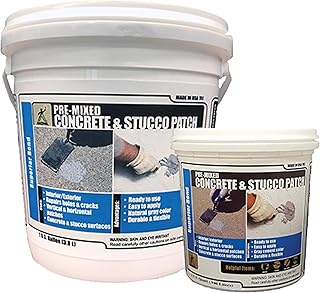
Akona Pre-Mixed Concrete and Stucco Patch is the layered option in this roundup, and it earns its place on a stated layer rule that is the clearest in the list: layers of no more than one quarter inch, with two to four hours between layers. A crack that is half an inch deep takes two layers, and a crack that is three quarters of an inch deep takes three, and each layer is left to dry before the next goes on. The patch hardens within a few hours, and full cure takes a minimum of seven days at sixty five to seventy five degrees Fahrenheit. That slow full cure is the price of a patch that dries through its full depth, and the maker asks for a primer before painting.
The water-based formula goes on with a trowel, and the surface can be worked with a float or sponge to match the grain of the wall. One quart covers about three square feet at one eighth inch thickness, and one gallon covers about twelve square feet, which is plenty for the small cracks on an exterior wall. The patch should be protected from rain for at least twenty four hours after application, and it should not go on when the temperature sits below fifty degrees Fahrenheit. For a crack that needs several layers to fill, this patch is a sound and simple choice, because the layer rule is stated on the data sheet and the texture can be worked to match the wall.
Akona Pre-Mixed Stucco Patch
- Pre-mixed stucco patch in a one quart tub
- Patches cracks and holes up to one quarter inch deep in a single application
- Ready to use, with a trowelable consistency straight from the tub
- Cure time of about two days at sixty five to seventy five degrees Fahrenheit
- Prime before painting, with a high quality exterior grade primer
- Suitable for interior and exterior stucco surfaces
- Clean tools and hands with water while the patch is still wet
Akona Pre-Mixed Stucco Patch is the single-layer option in this roundup, and it earns its place on a stated limit that is simple to follow: cracks and holes up to one quarter inch deep in a single application. A crack that sits within that limit takes one layer and no waiting between lifts, and the patch sets hard in about two days at sixty five to seventy five degrees Fahrenheit. That slow cure is the price of a patch that dries through its full depth before it takes paint, and the maker asks for a primer before painting with a high quality exterior grade primer. The patience pays off in a repair that bonds hard and holds its texture.
The tub holds one quart of ready-to-use patch, and the material goes on with a trowel, with the surface worked by a float or sponge to match the grain of the wall. Deeper damage needs more than one layer, with each layer left to dry before the next goes on. The patch is suitable for interior and exterior stucco, and it cleans up with water while it is still wet, which keeps the wall and the tools clean. For a small crack on a wall that can wait two days for paint, this patch is a sound and simple choice, and the one quarter inch limit is easy to check with a small probe before the tub is opened.
DAP All-Purpose Ready-to-Use Stucco Patch
- Ready-to-use stucco patch in a one quart tub
- Latex emulsion formula with a textured finish
- Repairs cracks, holes and minor defects in interior and exterior stucco
- Apply with a putty knife or trowel, no mixing required
- Water resistant when cured
- Off white in color, paintable once dry
- One quart suits several small crack repairs on a single wall
DAP All-Purpose Ready-to-Use Stucco Patch is the ready-to-use tub in this roundup, and it earns its place on simplicity. The tub opens ready to use, with no water to measure and no powder to mix, and the latex emulsion formula goes on with a putty knife or trowel. A small crack on an exterior wall takes a thin application pressed hard into the crack, and the textured finish blends with the stucco around it. The one quart tub suits several small crack repairs on a single wall, and the tub can be closed and kept for the next crack that appears.
The patch is water resistant when cured, which matters on an exterior wall that faces rain and wind. The latex emulsion bonds well to the old stucco, and the textured body gives the repair a grain that matches the wall. The patch is paintable once dry, and a primer before the topcoat will even out the absorption so the paint dries to one even tone. For a small crack repair, the ready-to-use tub is the fastest route from opening the tub to a finished repair, because there is no mixing, no measuring and no waiting for a powder to wet out. The layer rule is the same as the other ready-to-use patches: thin applications, with each layer left to dry before the next goes on.
Western Blended Products Marvel Fix
- Polymer modified cement-based compound in fifty pound sacks
- Smooth patch and repair material for stucco, concrete and masonry
- Skim coat application at one sixteenth inch, with coverage of about one hundred twenty square feet per bag at that thickness
- Available in gray and white bases
- Shelf life of twelve months in the original unopened container
- Apply with a trowel, with a smooth finish that takes paint well
- Suitable for patching and repairing stucco surfaces on interior and exterior walls
Western Blended Products Marvel Fix is the skim coat option in this roundup, and it earns its place on a stated layer thickness of one sixteenth inch. That thin layer is the right tool for a crack that is shallow and wide, where the repair is more about the surface than the depth, and the smooth finish takes paint well. A fifty pound sack covers about one hundred twenty square feet at one sixteenth inch thickness, which is far more than a single crack needs, so the sack suits a wall with several cracks or a repair that runs along a whole section. The compound is available in gray and white bases, and the white base suits a light colored wall where the patch must not show through the paint.
The patch is trowel applied, and the polymer modification helps the bond to the old stucco, while the cement body gives a hard mineral finish that stands up to weather. The shelf life is twelve months in the original unopened container, and the sack should be stored dry. A skim coat laid thicker than one sixteenth inch will shrink and crack, because the material is made for a thin layer, and the layer rule should be followed exactly. For a shallow wide crack, Marvel Fix gives a smooth finish that blends with the wall around it.
Sashco Mor-Flexx
- Textured elastomeric acrylic latex sealant in ten and a half ounce cartridges
- Repairs crumbly mortar, cracked stucco and textured walls
- Joints up to three inches wide with no slump
- One cartridge yields about twenty six lineal feet with a one quarter inch bead
- Paintable with exterior latex paint after four hours, and one week before oil-based paint
- Skins over in under thirty minutes, with tack free in two to four hours and cure in four to five days
- Apply between forty and one hundred twenty degrees Fahrenheit
Sashco Mor-Flexx closes this list as the flexible option, and it earns its place where a crack moves. Stucco around a wall shifts with the seasons, and a rigid patch in a moving crack will open again. Mor-Flexx looks like mortar and stucco but stretches like rubber, so it stays elastic year after year, and its texture mimics real mortar and stucco. The sealant goes on straight from the cartridge with a caulk gun, with no powder and no mixing, and it cleans up with water. Joints up to three inches wide take the sealant with no slump, and joints deeper than one half inch need a backer rod first, so the sealant sits at the right depth and bonds to the sides rather than to the bottom.
The paint time is four hours with exterior latex paint, and one week before oil-based paint, sealers or stains. Some low-end flat latex paints may crack over Mor-Flexx, so the maker asks for a test in an inconspicuous area first. The sealant skins over in under thirty minutes and is tack free in two to four hours, with full cure in four to five days depending on temperature, humidity and bead size. The cartridge holds ten and a half ounces, and one cartridge yields about twenty six lineal feet with a one quarter inch bead, which covers the cracks on a whole wall from a single cartridge. For a crack that opens and closes with the weather, the bead depth is the layer thickness, and the backer rod is what sets it.
| Product | Main specification | Best suited for |
|---|---|---|
| QUIKRETE FastSet Stucco Patch | Full depth repair, paint after ninety minutes | A deep crack finished and painted in one visit |
| Rapid Set Stucco Patch | One eighth inch to one inch in a single application | A deep crack filled in one pass |
| Akona Pre-Mixed Concrete and Stucco Patch | Layers of no more than one quarter inch, two to four hours between layers | A crack that needs several layers |
| Akona Pre-Mixed Stucco Patch | Up to one quarter inch deep in a single application | A shallow crack filled in one layer |
| DAP All-Purpose Ready-to-Use Stucco Patch | Ready-to-use latex emulsion, one quart tub | Several small cracks with no mixing |
| Western Blended Products Marvel Fix | Skim coat at one sixteenth inch, fifty pound sack | A shallow wide crack that needs a fine finish |
| Sashco Mor-Flexx | Elastomeric sealant, joints up to three inches | A crack that moves with the seasons |
How to choose
Measure the crack before choosing the product
Width and depth decide the product, and both should be measured before the tub is opened. A hairline crack takes a tube, a crack up to one quarter inch deep takes a ready-to-use tub in a single application, and a crack that runs deeper needs a cement patch in lifts or a full depth product. A small probe, a coin or a thin screwdriver will show the depth, and a crack that looks shallow from the outside can run deep once the loose material is brushed out. Filling a deep crack with a thin patch material in one thick coat will shrink, crack and pull away from the edges.
Read the stated layer thickness on the data sheet
The layer thickness is the number that decides whether the patch dries through its full depth or only on the surface. The numbers in this roundup run from one sixteenth inch for a skim coat to one inch for a full depth cement patch, and the right number depends on the product, not on the crack. Read the data sheet, write the layer thickness on the tub with a marker, and work to that number. A patch laid thicker than the maker allows will skin over on the outside while the inside stays soft, and the soft inside will shrink, crack and hollow out.
Decide how many layers the repair will take
The number of layers follows from the depth and the stated layer thickness. A crack half an inch deep takes two layers of a one quarter inch patch, and a crack three quarters of an inch deep takes three. Each layer must be left to dry before the next goes on, and the drying time between layers is stated on the data sheet. A repair that needs three layers takes longer than a repair that needs one, and the schedule should be planned around the layers, not around the hope that a single thick coat will hold.
Decide how soon the wall must take paint
The paint time runs from ninety minutes to a full day across this roundup, and that spread decides the working day. A wall that must look finished by evening needs a fast patch, while a wall that can wait until tomorrow suits a slow cure patch that bonds harder. Read the data sheet, write the paint time on the tub with a marker, and plan the topcoat around that number. Paint laid on early will lift, blister or show a different sheen, and a repair that has to be redone costs more than a repair that waited.
Common mistakes
The most common mistake on a small crack repair is filling a deep crack in one thick coat. A patch laid thicker than the maker allows will shrink as it dries, and the shrinkage shows as a crack down the middle of the repair or as a hollow sound when the patch is tapped. Deep damage needs lifts of no more than one quarter inch, or a full depth product applied as the maker directs, with each lift left to dry before the next goes on. The extra time is the price of a repair that stays put.
The second mistake is painting too soon. The patch feels dry on the surface, the wall has to look finished, and the paint goes on hours early. On an exterior wall that shortcut shows as a pale patch, a lifted edge or a blister that appears days later. The fix costs nothing: wait the full stated paint time, and add time when the wall is cool or damp. A data sheet number is a minimum, not a target, and a patch that has had an extra day will always take paint better than a patch that has had an hour less than the maker asks for.
The third mistake is filling a crack that has not been cleaned out. Loose stucco, dust and paint flakes inside the crack stop the patch from bonding to the sound material underneath, and the repair will fail at the bond line. The crack should be brushed out with a stiff brush, and loose material should be removed until the edges are sound. A crack that is widened slightly at the surface, with a clean V shape, will hold a patch better than a crack that is filled as it stands.
The fourth mistake is using a rigid filler in a crack that moves. Stucco around a wall shifts with the seasons, and a rigid patch in a moving crack will open again at the first change of temperature. A flexible sealant or a patch with some give in the formula suits a crack that opens and closes with the weather, while a rigid cement patch suits a crack in a wall that does not move. The crack should be watched through a season if the movement is in doubt, and the product should be chosen for the movement, not just for the width.
The fifth mistake is skipping the primer. Several patches in this roundup ask for a primer before painting, and the primer is what keeps the topcoat even. A patch that drinks paint at a different rate from the old render will show as a flat spot, and a primer evens out the absorption across the whole repair. The primer should be a high quality exterior grade primer, and it should cover the patch and a small margin of the old render around it.
FAQ
What is a stated layer thickness, and why does it matter?
A stated layer thickness is the maximum thickness the maker allows for a single application of the patch, and it is printed on the product data sheet. It matters because a patch laid thicker than the maker allows will skin over on the outside while the inside stays soft, and the soft inside will shrink, crack and hollow out. A patch laid in lifts of the stated thickness will dry through each lift, bond to the lift below it, and hold its texture. The numbers in this roundup run from one sixteenth inch for a skim coat to one inch for a full depth cement patch.
How many layers does a small crack repair need?
The number of layers follows from the depth of the crack and the stated layer thickness of the product. A crack half an inch deep takes two layers of a one quarter inch patch, and a crack three quarters of an inch deep takes three, with each layer left to dry before the next goes on. A crack that runs up to one inch deep can be filled in a single application with a full depth cement patch that states a range of one eighth inch to one inch. Measure the depth with a small probe before choosing the product, and never lay a thick coat of a thin patch material in one pass.
How long should I wait between layers of stucco patch?
Wait the full time stated on the product data sheet, and no less. The patches in this roundup state times between layers from two to four hours to a full day, and the number assumes moderate temperature and humidity, so add time when the wall is cool or damp. A layer that feels dry on the surface can still be soft underneath, and the next layer laid over a soft layer will trap moisture and fail at the bond line. When in doubt, wait longer.
How long should I wait before painting a stucco patch on an exterior wall?
Wait the full time stated on the product data sheet, and no less. The patches in this roundup state paint times from ninety minutes to a full day, and the number assumes moderate temperature and humidity, so add time when the wall is cool or damp. A patch that feels dry on the surface can still be soft underneath, and paint laid over a soft patch will lift or show a different sheen. When in doubt, wait an extra day.
Do I need to prime a stucco patch before painting it?
Several patches in this roundup ask for a primer before painting, and the primer is worth using on every patch. A primer evens out how fast the patch and the old render drink paint, so the topcoat dries to one even tone. Use a high quality exterior grade primer, cover the patch and a small margin of the old render, and let the primer dry fully before the topcoat goes on. A patch painted without primer will often show as a flat or pale rectangle against the old wall.
Can a flexible sealant fill a crack that a rigid patch cannot?
A flexible sealant suits a crack that opens and closes with the weather, because the sealant stretches with the movement instead of cracking again. The sealant in this roundup fills joints up to three inches wide with no slump, and joints deeper than one half inch need a backer rod first, so the sealant sits at the right depth and bonds to the sides rather than to the bottom. A rigid cement patch suits a crack in a wall that does not move, and a flexible sealant suits a crack that does.
Conclusion
A small crack on an exterior wall is a small job that fails on one number: the layer thickness. The seven mixes in this roundup answer that job in different ways, and the best choice depends on how deep the crack runs and how many layers the repair will take. QUIKRETE FastSet Stucco Patch leads for a deep crack finished and painted in one visit. Rapid Set Stucco Patch leads for a deep crack filled in one pass from one eighth inch to one inch. Akona Pre-Mixed Concrete and Stucco Patch leads for a crack that needs several layers of no more than one quarter inch. Akona Pre-Mixed Stucco Patch leads for a shallow crack filled in one layer. DAP All-Purpose Ready-to-Use Stucco Patch leads for several small cracks with no mixing. Western Blended Products Marvel Fix leads for a shallow wide crack that needs a fine finish at one sixteenth inch. Sashco Mor-Flexx leads for a crack that moves with the seasons.
Whatever mix is chosen, the working rules stay the same. Clean the crack out, measure the width and the depth, read the stated layer thickness on the data sheet, work in lifts of that thickness, let each lift dry before the next goes on, prime before painting, and wait the full stated time before the topcoat goes on. A stucco patch is a small part of the cost of a crack repair and a large part of its success, because every coat above it depends on the bond it makes. Choose by the data sheet, honor the layer thickness, and the crack will disappear into the wall.
Related guides
More from Amazon
Programs that pair well with the guide above. Offers and eligibility are set by Amazon and may change.
Free shipping on eligible items, Prime Video and more. Eligible new members can start with a free trial.
Start a Prime free trialAudiobooks and podcasts to listen to on the go. Eligible new members can start with a free trial.
Try Audible freeAd-free music streaming. Eligible new subscribers can start with a free trial.
Try Music Unlimited freeA free business account with business pricing and bulk-buying tools for work, shop or home office.
Create a business accountAs an Amazon Associate we earn from qualifying purchases.
More ways to save on your next finish
Programs that pair well with the guide above. Offers and eligibility are set by Amazon and may change.
A free business account with business pricing and bulk-buying tools for work, shop or home office.
Create a business accountFast, free shipping on eligible items, plus Prime Video and more. Eligible new members can start with a free trial.
Start a Prime free trialRead from a huge library of eBooks, including how-to guides and cookbooks. Eligible new members can start with a free trial.
Try Kindle UnlimitedAudiobooks and podcasts for the commute, the garage or the kitchen. Eligible new members can start with a free trial.
Try Audible freeAs an Amazon Associate we earn from qualifying purchases. Using these links costs you nothing extra.



Write Your Review
No reviews yet. Be the first to share your experience!