
Key takeaways
- Compare the best stucco patch repair mixes for blending isolated chips, with paintable finishes, sanded texture, and exterior durability for lasting repairs.
As an Amazon Associate I earn from qualifying purchases. This post may contain affiliate links at no extra cost to you.
A chipped patch of stucco draws the eye every time you walk past the wall, even when the damage is small. The chip itself may be no wider than a coin, yet the pale spot where the finish coat broke away stands out against the weathered surface around it. The fix is not a thick coat of paint or a dab of filler from the wrong aisle. A patch that blends needs the right mix, the right sand texture, and a finish that accepts paint in the same way the old wall does. That is why choosing among the best stucco patch repair mixes for blending isolated stucco chips with paintable repair guidance matters more than the size of the repair suggests.
Isolated chips behave differently from long cracks or large holes. The surrounding stucco is sound, the edges of the chip are thin and feathered, and the patch has to bond to a small area without building up a visible mound. A heavy base coat mix will bury the chip under too much material. A smooth paste with no sand will dry flat and glossy while the wall around it stays sandy and matte. The mixes in this roundup were picked because they handle that narrow job: they carry sand that matches common stucco textures, they set firmly enough to hold a thin edge, and they accept latex paint on a schedule the maker states in plain terms. Each product below lists the specs that decide whether a chip disappears or stays visible, so you can match the mix to the wall in front of you rather than guessing at the store.
Best products
QUIKRETE Pre-Mixed Stucco Patch 8650
This ready-to-use tub is the most direct answer for a single isolated chip, and it leads this roundup because it removes the two steps where small patches usually go wrong: mixing and sand matching. The mix comes as an acrylic latex patch with sand already blended in, so the texture that lands on the wall is close to a standard sand finish from the first trowel stroke. You open the pail, stir, and apply, which keeps the working time short and the mess small on a repair that should take minutes rather than an afternoon.
- Ready-to-use acrylic latex patch with a sanded texture
- Repairs cracks and holes up to one quarter inch thick
- One quart pail covers about 3.25 square feet at one eighth inch
- Skin forms in 20 to 40 minutes and the patch hardens in about 2 hours
- Full cure takes up to 3 days
- Paint after 24 hours with latex paint only
- Apply when temperatures stay above 50 degrees Fahrenheit
The paint window is the detail that earns this product its place at the top for chip work. Latex paint can go on after 24 hours, which is a clear and short wait for a patch that has to disappear under a coat of wall color. The sanded finish also takes paint in a way that looks like the surrounding stucco instead of flashing as a smooth spot. One limit deserves attention: the maker caps repairs at one quarter inch thick, so a chip that goes deeper than that needs a first fill with a cement-based mix and this tub as the finish layer. For a shallow chip on a sound wall, though, the tub format keeps the repair tidy, and the leftover material stays usable for the next chip that appears on another part of the wall.
QUIKRETE FastSet Stucco Patch 1139
When a chip has to be patched and painted on the same day, a fast-setting cement mix changes the schedule completely. The FastSet Stucco Patch is a polymer-modified Portland cement mix that reaches final set in 45 to 90 minutes and accepts latex paint after 90 minutes, which is the shortest paint window of any cement-based product in this roundup. That speed suits a chip on a wall that faces the street, where an unfinished grey spot is more visible than the chip it replaced.
- Fast-setting polymer-modified Portland cement patch
- 20 pound pail yields about 0.2 cubic feet
- Covers about 10 square feet at one quarter inch
- Working time of 20 to 30 minutes and final set in 45 to 90 minutes
- Paintable after 90 minutes with latex paint
- Single patch area up to 8 square feet
- Apply between 40 and 100 degrees Fahrenheit
- One-coat application up to three eighths inch, damp cure for 2 days
Speed brings a trade that the buyer should plan around. A working time of 20 to 30 minutes leaves little room for rework, so the wall should be dampened, the tools laid out, and the texture plan decided before water meets the powder. The mix rewards that preparation with a hard, dense patch that holds a thin feathered edge without crumbling. Damp curing for 2 days keeps the surface from drying too fast in sun or wind, which is the step most often skipped on small repairs. For an isolated chip that sits in a visible spot and needs paint the same day, the short wait between patching and painting is hard to match with any ready-to-use tub.
DAP Phenopatch Pre-Mixed Stucco Patch
The DAP Phenopatch tub covers the middle ground between a small tube and a bag of dry mix, and it suits a homeowner who has several chips scattered across one wall. It comes as a ready-to-use heavy paste in quart and gallon sizes, with a polyvinyl acetate vehicle that gives it a thick, workable body. The paste spreads easily with a trowel or a taping knife, and it holds the sand texture on a vertical surface without sliding down while it sets.
- Ready-to-use heavy paste with a polyvinyl acetate vehicle
- Off-white color, mildew resistant and weather resistant
- Quart covers 12 to 18 square feet, gallon covers 48 to 72 square feet
- Paint in about 2 hours with latex paint, 24 hours with oil-based paint
- Apply above 40 degrees Fahrenheit
- No sanding needed, clean up with water
Coverage is the practical advantage here. A single quart covers 12 to 18 square feet, which is far more wall than a chip repair needs, so one tub handles a whole season of small chips on different walls. The paint window of about 2 hours with latex paint is short enough that patching in the morning and painting in the afternoon is a realistic plan. The off-white color dries close to many unpainted stucco finishes, which helps when the patch will sit unpainted for a while. Water clean-up keeps the tools simple, and the mildew resistant and weather resistant formulation suits exterior walls that stay damp after rain.
SikaWall Fiber-47 Scratch and Brown Concentrate
A chip that broke through the finish coat and into the brown coat needs more than a surface paste, and the SikaWall Fiber-47 Concentrate is the base coat option for that deeper repair. It is a blend of Portland cement, lime, and fibers that conforms to ASTM C926, and it was formerly sold under the LaHabra Fiber-47 name. The fiber reinforcement helps the patch hold together across a thin edge, which is the exact failure point of an isolated chip repair where the new material meets the old wall at a feathered line.
- Portland cement, lime, and fiber blend, conforms to ASTM C926
- 80 pound bag, apply up to one half inch in a single application
- Coverage of 100 to 140 square feet at three eighths inch
- Shelf life of 12 months
- Formerly sold as LaHabra Fiber-47
An 80 pound bag is far more material than one chip needs, so this product makes sense when the wall has several chips, when the damage goes deeper than the finish coat, or when the same bag will serve later patch work on the property. The ability to place up to one half inch in a single application means a deep chip can be filled in one pass rather than built up in thin layers that each need their own drying time. The finish coat still goes on top of this base, and that two-layer approach is what makes a deep chip disappear: the base restores the body of the wall, and a sanded finish coat restores the surface that the eye reads. For a shallow surface chip this bag is more than the job needs, but for a chip that took the brown coat with it, the fiber-reinforced base is the right start.
Omega Exterior 2N1 Patch
The Omega Exterior 2N1 Patch is a cement-based patch for chips that sit on walls exposed to weather year after year. It is a fast-setting, non-shrinking mix, and the non-shrinking character matters on an isolated chip because shrinkage is what opens a hairline gap around the edge of a patch and lets water in behind it. A patch that holds its size as it hardens stays tight against the old stucco, and the repair line stays closed through wet and dry seasons.
- Fast-setting, non-shrinking cement-based patch
- 50 pound bags, coverage of about 3 to 4 square feet at one half inch per 10 pounds
- Cure time of 7 to 28 days
- Apply above 40 degrees Fahrenheit
- Natural grey color, shelf life of 1 year
The long cure window of 7 to 28 days is the fact to plan around. The patch sets fast enough to work with, but full curing takes weeks, and paint should wait until the surface has dried out and hardened through. That makes this product a better fit for a chip repair done in a calm stretch of weather than for a rush job before guests arrive. The natural grey color reads as a neutral base under paint, and the coverage rate of about 3 to 4 square feet at one half inch per 10 pounds lets a buyer judge how much of a 50 pound bag a single chip will use. For a chip on a wall that faces driving rain, the cement body and the tight edge are worth the longer wait.
QUIKRETE Base Coat Stucco Pump Grade 1139-86
A chip that covers a wider area, or a cluster of chips close together, can call for a base coat rather than a tub of paste, and the Pump Grade base coat from Quikrete is built for that scale. It is an AR glass fiber reinforced Portland cement stucco that conforms to ASTM C926, and the glass fiber reinforcement adds body to a patch that spans a broader area than a single coin-sized chip. The mix is sold as a scratch, brown, and one-coat base, which gives the repairer room to match the layer the chip actually damaged.
- AR glass fiber reinforced Portland cement base coat
- 80 pound bag yields about 0.75 cubic feet
- Coverage of 20 to 24 square feet at three eighths inch
- Mix with 5.5 quarts of water per bag
- Conforms to ASTM C926, apply within 1 hour of mixing
The working window of 1 hour after mixing is generous for a cement base coat, and it lets a careful repairer place the material, scratch it, and shape the edge without racing the set. The yield of about 0.75 cubic feet per 80 pound bag is enough for a cluster of chips or a patch that reaches across a damaged corner. One point to note is that a base coat is only the first layer: a finish coat with matching sand texture still goes on top before the repair can blend. Used that way, the fiber-reinforced base gives the chip a solid body, and the finish coat gives it the surface the eye compares with the wall around it.
QUIKRETE Stucco Crack Repair
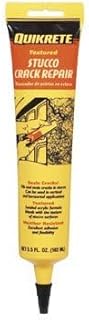
The smallest repair in this roundup is also the simplest to use. The Quikrete Stucco Crack Repair comes in a 5.5 ounce squeeze tube, and the maker lists it in the stucco patch data sheet as the option for smaller projects. A squeeze tube puts the material exactly where the chip sits, with no trowel, no bucket, and no mixing, which is the right scale when the damage is a hairline crack or a chip no bigger than a fingernail.
- 5.5 ounce squeeze tube for small crack work
- Ready to use, sized for narrow cracks and small chips
- Listed in the Quikrete stucco patch data sheet as the small-project option
A tube cannot rebuild a deep chip, and it should not be asked to. Its job is the narrow crack and the shallow surface chip, where a thin bead of material fills the void and the sand in the mix keeps the surface from drying smooth and glossy. The format also suits a repairer who wants to fix one chip without opening a pail or a bag and storing the rest. For a wall with a single small flaw, the tube is the fastest route from noticing the chip to forgetting it was ever there.
| Product | Key specs | Best for |
|---|---|---|
| QUIKRETE Pre-Mixed Stucco Patch 8650 | Ready-to-use acrylic latex, sanded, paint after 24 hours with latex | Single shallow chips that need a fast paintable finish |
| QUIKRETE FastSet Stucco Patch 1139 | Polymer-modified cement, paintable after 90 minutes, 20 to 30 minute working time | Same-day patch and paint on visible walls |
| DAP Phenopatch Pre-Mixed Stucco Patch | Heavy paste, quart covers 12 to 18 square feet, paint in about 2 hours | Several chips across one wall from a single tub |
| SikaWall Fiber-47 Scratch and Brown Concentrate | Cement, lime, and fiber base, up to one half inch in one pass, ASTM C926 | Chips that broke through to the brown coat |
| Omega Exterior 2N1 Patch | Non-shrinking cement patch, cure in 7 to 28 days, natural grey | Weather-exposed chips that need a tight edge |
| QUIKRETE Base Coat Stucco Pump Grade 1139-86 | Glass fiber reinforced base, 0.75 cubic feet per 80 pound bag, ASTM C926 | Clusters of chips or wider damaged areas |
| QUIKRETE Stucco Crack Repair | 5.5 ounce squeeze tube, ready to use | Hairline cracks and fingernail-sized chips |
How to choose
Match the sand texture to the wall
Texture decides whether a patch disappears or stays visible, and sand size is the main variable. A wall with a coarse sand finish needs a mix that carries visible sand grains, while a wall with a fine float finish needs a finer aggregate. Hold a sample of the patch material next to the wall while both are dry, and look at them from a few steps back in daylight. If the patch reads smoother or rougher than the wall, the repair will stay visible even after paint. Products with a stated sanded texture, such as the ready-to-use tubs in this roundup, give a predictable match for common sand finishes, while a finish coat with a graded aggregate lets the repairer tune the texture for an unusual wall.
Pick the set time that fits the size of the chip
A small chip needs a mix that stays workable long enough to shape a feathered edge, while a larger patch benefits from a faster set that holds its shape on a vertical surface. Ready-to-use pastes give the longest working window because there is no chemical set clock running from the moment water is added. Fast-setting cement mixes, with working times of 20 to 30 minutes, suit a repairer who has the wall prepared and the tools ready before mixing. The wrong choice shows up as a patch that stiffens before the edge is feathered, leaving a ridge that catches light and shadow. Match the set time to the repairer's pace rather than to the size of the damage alone.
Check the paint window before you buy
Paint timing is the second most common reason a chip repair stays visible. A patch painted too soon can soften, peel, or show a different sheen from the wall around it. The products in this roundup state their paint windows plainly: 90 minutes for the fast-setting cement mix, about 2 hours for the DAP paste, 24 hours for the ready-to-use acrylic tub. Cement-based patches also need curing time before paint, and a base coat patch needs a finish coat first. Plan the repair around the paint window, not the other way around, and let the patch dry through before the first coat of paint goes on.
Weigh ready-to-use tubs against dry mixes
A ready-to-use tub suits a single chip or a handful of chips because there is no mixing, no leftover powder to store, and no clock running on a batch. A dry mix suits deeper damage, wider areas, and walls where the finish coat has to be built in layers, because the repairer controls the water, the thickness, and the timing. The cost of convenience is a shorter shelf life once the tub is opened and a limit on how thick the material can be placed. The cost of a dry mix is the preparation: measuring water, mixing to a lump-free consistency, and cleaning tools before the material hardens. For one isolated chip, the tub usually wins. For a wall with several chips at different depths, the dry mix earns its place.
Common mistakes
The most common mistake on an isolated chip is patching a dirty wall. Dust, loose sand, and chalky old paint sit between the new material and the old stucco, and the patch bonds to the dust instead of the wall. Brush the chip out, dampen the edges, and let the surface drink a little water before the patch goes on. A dry wall pulls water out of the patch too fast, and the edge dries before it bonds.
A second mistake is building the patch proud of the wall. A mound of material over a chip catches light from every angle and reads as a bump long after the paint dries. The patch should sit flush with the surrounding surface, with the edge feathered thin enough that a fingertip cannot find the line. A damp sponge or a soft brush can ease the edge while the material is still workable, and that single step does more for blending than any later coat of paint.
A third mistake is painting too soon. Fresh patch material holds moisture, and paint over a damp patch can blister or dry with a different sheen. The paint windows in the product specs exist for this reason, and waiting the full stated time costs nothing compared with redoing a peeled patch. A fourth mistake is skipping the finish coat on a deep repair. A base coat patch without a sanded finish coat will always look different from the wall around it, no matter how well it is painted. The finish layer is what the eye compares, so it deserves the same care as the fill beneath it.
FAQ
How do I make a stucco chip patch disappear?
Clean the chip, dampen the edges, and choose a mix whose sand texture matches the wall. Apply the patch flush with the surface, feather the edge thin, and texture the face while the material is still workable. Let it dry through the full stated paint window, then paint the patch and a little beyond it so the color blends across the repair line rather than stopping at it.
How long should I wait before painting a stucco patch?
Follow the maker stated window for the product used. The fast-setting cement mix in this roundup accepts latex paint after 90 minutes, the DAP paste after about 2 hours, and the ready-to-use acrylic tub after 24 hours. Cement base coats need curing time as well, and a finish coat must go on before paint. Waiting the full window avoids blistering and sheen differences.
Can I patch stucco chips in cold weather?
Most products in this roundup need air temperatures above 40 degrees Fahrenheit during application, and the ready-to-use acrylic tub needs temperatures above 50 degrees Fahrenheit. Cold air slows setting and curing, and a patch placed in cold weather can stay soft or fail to bond. Patch on a mild day, keep the wall above the stated minimum while the material sets, and avoid patching when frost is expected overnight.
Should I use a ready-to-use tub or a dry mix for chips?
A ready-to-use tub suits a shallow chip or a handful of small chips because there is no mixing and the sand texture is already matched. A dry mix suits a chip that goes deeper than one quarter inch, a cluster of chips, or a repair that needs a base coat and a finish coat. Match the product to the depth of the damage rather than to habit.
Do I need a bonding agent before patching stucco chips?
A bonding agent helps when the old stucco is smooth, dusty, or painted, because it gives the new material something to grip. On a clean, sound, dampened stucco surface, many patch mixes bond well without one. When in doubt, dampen the chip, remove loose material, and follow the product label for surface preparation. A patch that fails usually fails at the bond line, so preparation deserves more time than the patch itself.
Conclusion
An isolated stucco chip is a small repair with a visible result, and the mix you choose decides whether the wall looks untouched or patched. The ready-to-use acrylic tub leads for shallow chips because its sanded texture and clear 24 hour paint window make blending straightforward. The fast-setting cement mix earns its place when the chip must be patched and painted the same day. The DAP paste covers a wall with several chips from a single tub, while the fiber-reinforced base coats handle chips that broke through to the brown coat. The squeeze tube finishes the smallest flaws with no mixing at all. Pick the product that matches the depth of the chip, the texture of the wall, and the paint schedule you can keep, then prepare the surface, feather the edge, and wait the full paint window. Done that way, the chip stops drawing the eye, and the wall reads as one surface again.
Related guides
More from Amazon
Programs that pair well with the guide above. Offers and eligibility are set by Amazon and may change.
Free shipping on eligible items, Prime Video and more. Eligible new members can start with a free trial.
Start a Prime free trialAudiobooks and podcasts to listen to on the go. Eligible new members can start with a free trial.
Try Audible freeAd-free music streaming. Eligible new subscribers can start with a free trial.
Try Music Unlimited freeA free business account with business pricing and bulk-buying tools for work, shop or home office.
Create a business accountAs an Amazon Associate we earn from qualifying purchases.
More ways to save on your next finish
Programs that pair well with the guide above. Offers and eligibility are set by Amazon and may change.
A free business account with business pricing and bulk-buying tools for work, shop or home office.
Create a business accountFast, free shipping on eligible items, plus Prime Video and more. Eligible new members can start with a free trial.
Start a Prime free trialRead from a huge library of eBooks, including how-to guides and cookbooks. Eligible new members can start with a free trial.
Try Kindle UnlimitedAudiobooks and podcasts for the commute, the garage or the kitchen. Eligible new members can start with a free trial.
Try Audible freeAs an Amazon Associate we earn from qualifying purchases. Using these links costs you nothing extra.



Write Your Review
No reviews yet. Be the first to share your experience!