
Key takeaways
- Small decorative texture panels need a light, quiet compressor that feeds a hopper gun in short, even bursts. Compare seven models, with CFM and tank figures.
As an Amazon Associate I earn from qualifying purchases. This post may contain affiliate links at no extra cost to you.
Our top picks at a glance
3 products from this guide, in the order reviewed below.


As an Amazon Associate we earn from qualifying purchases. Prices and availability can change.
A small decorative texture panel is a different job from a whole wall. The panel is a square metre or two of plasterboard or board, the texture is sprayed in a short burst, and the compressor sits beside the bench while the plasterer steps back to look at the result. The machine does not need to spray for minutes without stopping. It needs to be quiet enough for a small room, light enough to carry to the bench, and able to hold enough air for one panel before it refills. The best air compressors for texture hopper guns for spraying small decorative texture panels are the ones that fit beside a workbench, run quietly, and deliver enough air at 40 PSI for a short, controlled burst of texture.
Panel work changes the way the figures should be read. A big tank is less important here than a quiet pump and a light carry, because a panel takes only a short burst of air and the compressor has minutes to recover while the panel is checked, turned, and prepared for the next coat. What matters is that the compressor can refill its tank in the pause between panels, that it does not deafen the room while it runs, and that it holds a steady working pressure for the few seconds the trigger is open. A hopper gun still needs air, and a small compressor still needs to be read honestly: a 6 gallon pancake machine will spray a panel and then need a pause, while an 8 gallon machine with a higher CFM at 40 PSI will spray a panel and recover faster.
The seven compressors below are all compact machines, from a 6 gallon pancake to an 8 gallon quiet unit, and every figure comes from the maker data sheets or the maker product pages, with gaps marked instead of guessed. The lead pick is the quietest machine in the group, because panel work happens in small rooms where noise is felt more than on an open job site.
Best products
California Air Tools 8010
- 1.0 HP motor, 2.0 HP peak
- 8 gallon steel tank with wheel kit
- 3.10 CFM at 40 PSI, 2.20 CFM at 90 PSI
- 120 PSI maximum pressure
- 60 dBA noise level, oil-free dual-piston pump
- 48 pounds, 8.5 amp draw, 165 second fill from empty
The California Air Tools 8010 leads this roundup because it is the quietest compressor here, and panel work happens in small rooms where a loud pump is hard to live with. At 60 dBA it runs at a conversation level, so the plasterer can spray a panel, step back, and talk to a client in the same room without waiting for the pump to stop. The 8 gallon steel tank holds more air than any of the pancake machines in this group, and the wheel kit lets the machine roll beside the bench instead of being carried.
The air delivery of 3.10 CFM at 40 PSI suits a small panel. A panel takes a short burst of air, and the 8 gallon tank stores enough air for that burst at a steady pressure. The maker states a 165 second fill from empty and a 60 second recovery from 90 PSI to 120 PSI, so the tank is full again in the time it takes to check a panel and load the hopper for the next one. The maker also states a maximum continuous running time of 30 to 60 minutes, which is no problem for panel work, where the pump rests between panels. At 48 pounds this is not the lightest machine here, but the wheel kit carries the weight, and the quiet running is worth the extra pounds in a small room.
DeWalt DWFP55126
- 6 gallon pancake tank
- 2.6 SCFM at 90 PSI, 3.7 SCFM at 40 PSI
- 165 PSI maximum pressure
- Oil-free pump, 75.5 dBA noise level
- 30 pounds, high-flow regulator, two universal couplers
The DeWalt DWFP55126 is the bench-side pancake compressor in this roundup, and it suits a plasterer who wants a light machine that sits flat and stable beside the workbench. At 30 pounds it carries with one hand, and the pancake tank shape keeps it from tipping when the bench is bumped. The oil-free pump needs no oil checks, and the high-flow regulator is the feature that matters for panel work: it lets the plasterer set the working pressure at the gun and hold it steady through a short burst of texture.
The air delivery of 3.7 SCFM at 40 PSI is the highest of the pancake machines in this group, and the 165 PSI maximum pressure stores more air in the 6 gallon tank than a lower-pressure machine of the same size. That combination suits a small panel: the tank holds enough air for one panel, and the regulator keeps the pressure at the gun steady while the panel is sprayed. The two universal couplers let a second hose or a blow gun share the compressor while the hopper gun is connected. For a plasterer who sprays panels on a bench and wants a light, flat machine with a good regulator, the DWFP55126 is a fair choice.
Makita MAC2400
- 2.5 HP maximum, 2.1 HP running
- 4.2 gallon twin-stacked tank
- 4.8 CFM at 40 PSI, 4.2 CFM at 90 PSI
- 130 PSI maximum pressure
- 79 dB noise level, oil-lubricated cast iron Big Bore pump
- 77 pounds, 1730 RPM pump speed, 12.3 amp draw
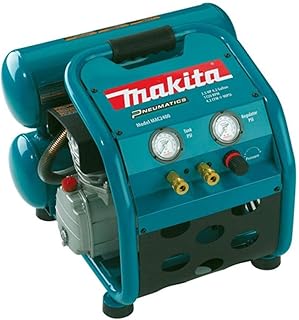
The Makita MAC2400 is the strong twin-stack compressor in this roundup, and it suits a plasterer who sprays panels in a workshop where the compressor is moved often and knocked about. The cast iron pump with the Big Bore cylinder is built for faster recovery, and the maker states 4.8 CFM at 40 PSI, which is the highest air delivery at 40 PSI in this roundup. That figure means the MAC2400 can spray a panel and recover faster than any other machine here, and the roll cage frame protects the pump and the gauges when the compressor is set down on a rough floor or loaded into a truck.
At 77 pounds the MAC2400 is the heaviest machine in this roundup, and the twin-stacked tank holds only 4.2 gallons, so the pump cycles often. That trade is worth it when the panels are sprayed in quick succession, because the high air delivery keeps the tank full between panels. The oil-lubricated pump needs its oil level checked, and the maker states a pump life of 2000 hours. The 130 PSI maximum pressure is the lowest in this group, so there is less stored-air headroom than the 150 PSI machines here. For a plasterer who values air delivery and a protected frame over a light carry, the MAC2400 is a solid pick.
Bostitch BTFP02012
- 6 gallon pancake tank
- 2.6 CFM at 90 PSI
- 150 PSI maximum pressure
- Oil-free pump, 78.5 dBA noise level
- 30 to 31 pounds, high-flow regulator
The Bostitch BTFP02012 is the lightest pancake compressor in this roundup, and it suits a plasterer who carries the compressor from room to room while spraying sample panels. At 30 to 31 pounds it lifts with one hand, and the pancake tank sits flat on the floor beside the bench. The oil-free pump needs no oil checks, and the high-flow regulator lets the plasterer set the working pressure at the gun for a short, controlled burst of texture.
The maker states 2.6 CFM at 90 PSI, and no CFM figure at 40 PSI is published for this model, so the plasterer should check the gun maker's minimum air figure against the 90 PSI number and expect short spraying bursts with pauses while the tank recovers. The 6 gallon tank holds enough air for a small panel, and the 150 PSI maximum pressure gives the tank a useful reserve. The 78.5 dBA noise level is louder than the quiet California Air Tools machines here, so this is a machine for a workshop rather than a lived-in room. For a plasterer who wants the lightest possible compressor for small panels and accepts pauses between panels, the BTFP02012 is a fair choice.
Craftsman CMEC6150
- 6 gallon pancake tank
- 2.6 SCFM at 90 PSI
- 150 PSI maximum pressure
- Oil-free cast iron pump, dual couplers
- 13 piece accessory kit, made in USA
The Craftsman CMEC6150 is the kit compressor in this roundup, and it suits a plasterer who is setting up for panel work and needs the fittings as well as the machine. The 13 piece accessory kit includes the hose and the fittings needed to connect a hopper gun, so the compressor is ready to spray a panel out of the box. The oil-free cast iron pump needs no oil checks, and the dual couplers let a second hose share the compressor while the gun is connected.
The maker states 2.6 SCFM at 90 PSI, and no CFM figure at 40 PSI is published for this model, so the plasterer should check the gun maker's minimum air figure against the 90 PSI number and expect short spraying bursts with pauses while the 6 gallon tank recovers. The 150 PSI maximum pressure gives the small tank a useful reserve for a panel, and the pancake shape sits flat and stable beside the bench. The motor horsepower and the weight are not stated on the product page, so those figures are marked as see product page rather than guessed. For a plasterer who wants a ready-to-spray kit for small panels, the CMEC6150 is a fair choice.
Metabo HPT EC99S
- 2.0 HP direct-drive induction motor
- 4.0 gallon twin-stack tank
- 3.1 CFM at 90 PSI
- 135 PSI maximum pressure
- 81 dB noise level, oil-free pump
- 52.9 pounds, ergonomic carrying handle, 15 amp circuit
The Metabo HPT EC99S is the compact twin-stack compressor in this roundup, and it suits a plasterer who sprays panels in a small room and needs a machine that fits in a corner and carries easily. The two stacked tanks hold 4.0 gallons in a shape that is easy to grip, and the ergonomic carrying handle makes the 52.9 pound carry manageable for one person. The 2.0 HP direct-drive induction motor runs on a standard 15 amp household circuit without tripping breakers, which matters when the panel work happens in a house where the wiring is not generous.
The maker states 3.1 CFM at 90 PSI, and no CFM figure at 40 PSI is published for this model, so the plasterer should check the gun maker's minimum air figure against the 90 PSI number and expect short spraying bursts with pauses while the tank recovers. The 135 PSI maximum pressure gives a reasonable reserve for a small tank, and the oil-free pump needs no oil checks. The 81 dB noise level is louder than the quiet machines here, so this is a machine for a workshop rather than a quiet living room. For a plasterer who wants a compact machine that carries well and fits a small space, the EC99S is a fair choice.
RIDGID OF50150TS
- 1 HP motor
- 5 gallon tri-stack tank
- 4.9 SCFM at 90 PSI and at 40 PSI
- 150 PSI maximum pressure
- Oil-free pump, three quick couplers, four gauges
- Fully adjustable locking regulator, 14.5 amp draw
The RIDGID OF50150TS is the regulator-first compressor in this roundup, and it suits a plasterer who sprays panels that need a precise working pressure. The fully adjustable locking regulator lets the plasterer set the pressure at the gun and lock it, so the pressure does not drift while panels are sprayed one after another. The three quick couplers and four gauges make the air line easy to read and easy to share, and the oil-free pump needs no oil checks.
The maker states 4.9 SCFM at 90 PSI and the same 4.9 SCFM at 40 PSI, which is the second-highest air delivery at 40 PSI in this roundup and more than enough for a small panel. The 5 gallon tri-stack tank holds a modest amount of air, so the pump will cycle between panels, but the high air delivery means the tank refills quickly. The 1 HP motor draws 14.5 amps, so it needs a circuit that can carry that draw without tripping. For a plasterer who wants a precise, lockable regulator and strong air delivery in a compact shape, the OF50150TS is a strong pick for panel work.
| Compressor | Tank and air delivery | Best for |
|---|---|---|
| California Air Tools 8010 | 8 gal; 3.10 CFM at 40 PSI | Quiet panel work in small rooms |
| DeWalt DWFP55126 | 6 gal; 3.7 SCFM at 40 PSI | Light bench-side pancake with good regulator |
| Makita MAC2400 | 4.2 gal; 4.8 CFM at 40 PSI | Highest air delivery for quick panels |
| Bostitch BTFP02012 | 6 gal; 2.6 CFM at 90 PSI | Lightest carry for sample panels |
| Craftsman CMEC6150 | 6 gal; 2.6 SCFM at 90 PSI | Ready-to-spray kit with fittings |
| Metabo HPT EC99S | 4.0 gal; 3.1 CFM at 90 PSI | Compact twin-stack for small spaces |
| RIDGID OF50150TS | 5 gal; 4.9 SCFM at 40 PSI | Precise lockable regulator |
How to choose
Pick quiet first when the room is small
Panel work happens in small rooms, and a loud compressor fills a small room fast. A compressor that runs at 60 dBA, such as the California Air Tools 8010, can run while a client stands in the same room, while a compressor that runs at 81 dB, such as the Metabo HPT EC99S, will be heard through the walls. Check the maker-stated noise figure before buying, and remember that a difference of 10 dB is a large change in how loud the machine feels. If the panels are sprayed in a workshop, noise matters less, and the Makita MAC2400 at 79 dB is acceptable. If the panels are sprayed in a lived-in house, pick the quietest machine that still delivers enough air for the gun.
Read the CFM at 40 PSI for short bursts
A panel takes a short burst of air, and the CFM at 40 PSI tells the plasterer whether that burst will hold a steady pressure or fall away halfway across the panel. The Makita MAC2400 delivers 4.8 CFM at 40 PSI and the RIDGID OF50150TS delivers 4.9 SCFM at 40 PSI, so both can spray a panel and recover quickly. The Porter-Cable and Bostitch pancake machines deliver less, so they need a pause between panels. When the maker publishes no CFM figure at 40 PSI, as with the Bostitch BTFP02012, the Craftsman CMEC6150 and the Metabo HPT EC99S, compare the gun maker's minimum air figure with the published 90 PSI number and allow extra pauses. A panel is short, so a small compressor can still do the job, but only if the plasterer waits for the tank to refill before the next panel.
Choose a regulator that holds its setting
Texture panels show a change in pressure as a change in the texture, so a regulator that drifts will leave one panel looking different from the next. A high-flow regulator, such as the ones on the DeWalt DWFP55126 and the Bostitch BTFP02012, keeps the pressure at the gun steady through a burst. A fully adjustable locking regulator, such as the one on the RIDGID OF50150TS, goes further and locks the setting so it cannot be knocked out of place while the compressor is moved. Before buying, check that the regulator is easy to read and easy to set, and keep it close to the gun so the pressure at the gun is the pressure the plasterer set.
Carry the compressor to the bench, not the panel to the compressor
A panel is easy to move, but a compressor that is light and stable is easier still. The Bostitch BTFP02012 at 30 to 31 pounds and the DeWalt DWFP55126 at 30 pounds carry with one hand, while the Makita MAC2400 at 77 pounds needs two hands and a clear path. A pancake tank sits flat and stable beside a bench, while a twin-stack tank is easier to grip and carry. Walk the path from the van to the bench, including any stairs, and pick a machine that one person can carry along that path without help. A compressor that is left in the van because it is too heavy to carry is no use for panel work.
Common mistakes
The most common mistake with panel work is spraying a panel from a tank that is not full. A tank that starts a panel at 80 PSI will fall to the cut-in pressure before the panel is finished, and the texture will change halfway across the panel. Start each panel with a full tank, and let the pump refill the tank while the panel is checked and turned. A second mistake is holding the trigger open too long. A small compressor cannot sustain a long spray, and holding the trigger open until the pressure falls leaves a weak patch in the middle of the panel. Spray in a short, controlled burst, release the trigger, and let the tank recover before the next burst.
A third mistake is using a hose that is too long for the room. A long, narrow hose drops the pressure between the compressor and the gun, so the gun sees less pressure than the regulator shows. Use a short hose of generous diameter for panel work, and keep the regulator close to the gun. A fourth mistake is forgetting the moisture trap. Water collects in the tank from the air the pump compresses, and that water reaches the gun and leaves spots in the texture. Drain the tank at the end of every panel day, and fit a moisture trap in the air line if the compressor does not have one built in. A fifth mistake is spraying a sample panel with a different pressure than the final panels. Set the regulator once, lock it if the compressor allows it, and use the same setting for every panel, so the sample and the finished panels match.
FAQ
Can a small pancake compressor run a texture hopper gun?
Yes, for a small panel. A pancake compressor such as the DeWalt DWFP55126 delivers 3.7 SCFM at 40 PSI, which is enough air for a short burst of texture on a small panel. The tank will need a pause to recover before the next panel, and the plasterer should spray in short bursts rather than holding the trigger open. A pancake compressor will not keep up with continuous spraying on a whole wall, but a panel is a short job, and a small compressor suits it.
How quiet should a compressor be for panel work in a house?
Quieter is better, and 60 to 70 dBA is a good range for work inside a lived-in house. The California Air Tools 8010 runs at 60 dBA, which is quiet enough to talk over, while the California Air Tools 10020C runs at 70 dBA. A compressor that runs at 81 dB or more will be heard through the walls and may disturb the people in the house. Check the maker-stated noise figure, and pick the quietest machine that still delivers enough air for the gun.
What tank size suits a small decorative texture panel?
A tank of 4 to 8 gallons suits a small panel, because a panel takes only a short burst of air. The California Air Tools 8010 holds 8 gallons and the DeWalt DWFP55126 holds 6 gallons, and both store enough air for a panel with the pump resting while the panel is sprayed. A larger tank is not needed for panel work, and a smaller tank would need the pump to run during the spray. Pick the tank by the size of the panel, and keep the compressor light enough to carry to the bench.
Does the regulator matter for texture panels?
Yes, it matters more for panels than for walls, because panels are compared side by side and a change in pressure shows as a change in the texture. A high-flow regulator keeps the pressure at the gun steady through a burst, and a locking regulator, such as the one on the RIDGID OF50150TS, holds its setting between panels. Set the regulator once, use the same setting for every panel, and check the gauge before each panel.
Should I use an oil-free or an oil-lubricated compressor for panel work?
Both work for panel work, and the choice is about maintenance rather than spraying. An oil-free pump needs no oil checks and suits a plasterer who moves between jobs, while an oil-lubricated pump needs its oil level checked and suits a plasterer who keeps the machine in one workshop. In this roundup the Makita MAC2400 is the only oil-lubricated machine, and the other six are oil-free. Either way, fit a moisture trap in the air line, because water in the air will mark the texture.
Conclusion
Small decorative texture panels reward a compressor that is quiet, light, and able to hold a steady pressure for a short burst. The California Air Tools 8010 leads this roundup with 60 dBA of noise, an 8 gallon tank and 3.10 CFM at 40 PSI, and it is the pick for panel work inside a lived-in house. The DeWalt DWFP55126 brings the lightest bench-side carry with a high-flow regulator, the Makita MAC2400 brings the highest air delivery at 40 PSI for quick panels, and the RIDGID OF50150TS brings a locking regulator that holds its setting from panel to panel. The Bostitch BTFP02012 brings the lightest carry of all, the Craftsman CMEC6150 brings a ready-to-spray kit, and the Metabo HPT EC99S brings a compact twin-stack shape for small spaces. Match the CFM at 40 PSI to the gun, start each panel with a full tank, and keep the regulator setting the same for every panel, and the panels will match.
Related guides
More from Amazon
Programs that pair well with the guide above. Offers and eligibility are set by Amazon and may change.
Free shipping on eligible items, Prime Video and more. Eligible new members can start with a free trial.
Start a Prime free trialAudiobooks and podcasts to listen to on the go. Eligible new members can start with a free trial.
Try Audible freeAd-free music streaming. Eligible new subscribers can start with a free trial.
Try Music Unlimited freeA free business account with business pricing and bulk-buying tools for work, shop or home office.
Create a business accountAs an Amazon Associate we earn from qualifying purchases.



Write Your Review
No reviews yet. Be the first to share your experience!