
Key takeaways
- Seven high capacity texture sprayers for large renovation ceilings, with variable flow settings, long hose reach and hopper size compared for overhead work.
As an Amazon Associate I earn from qualifying purchases. This post may contain affiliate links at no extra cost to you.
A large renovation ceiling is the hardest surface in a plastering job. The operator works overhead, the material falls back toward the face, and the coat must go on evenly across a wide, flat area that shows every uneven patch. A sprayer built for walls can still work on a ceiling, but it needs a flow control that can be turned down for the first thin coat and turned up for the full coat, a hose long enough to reach across the room without moving the machine, and a hopper large enough to hold a full batch so the operator is not climbing down to refill in the middle of a ceiling. The best high capacity plaster texture sprayers for working on large renovation ceilings with variable flow settings are the machines that give the operator that control, with a flow range wide enough to cover both a light finish pass and a heavy base coat.
Variable flow is the feature that decides a ceiling job. A ceiling needs a slow flow for the first pass, because the material must land thin and stick before gravity pulls it down, and it needs a faster flow for the full coat once the first pass has bonded. A machine with only one speed forces the operator to work at a pace that suits neither pass, and the result is either a thin coat that leaves the ceiling showing through or a heavy coat that sags. The machines below all have a flow control that lets the operator set the pace, and the sections below list the maker stated flow figures for each one.
A ceiling job also needs a hopper that can be filled without lifting material overhead, a hose that reaches across the room, and a gun that can be held overhead for long stretches without tiring the operator. The machines in this roundup cover those needs in different ways, from the compact handheld Wagner Power Tex for small ceiling areas to the large Graco RTX 5500PX with its 15 gallon hopper and 100 foot hose. The comparison table after the sections lines the seven machines up on flow, hopper size and hose reach so a contractor can pick the one that fits the ceiling in front of them.
Best products
Graco TexSpray RTX 5500PX
- 15 gallon hopper
- 5.5 gallons per minute maximum flow
- 100 psi maximum fluid pressure
- 9.1 cubic feet per minute air flow at 35 psi
- DC brushless 2.0 horsepower motor, 240 volts
- 100 feet maximum hose length
- RotoFlex HD pump with SmartStart
- Hardened WideTex spray tips
The Graco TexSpray RTX 5500PX leads this roundup because its 5.5 gallons per minute flow is the highest in the group, and its variable flow control lets the operator turn that flow down for the first thin ceiling coat and up for the full coat. The RotoFlex HD pump is a one piece pump with a braided tube, and it is built to move thick textured material without the valves that grain can block. The SmartStart system starts the pump and the compressor when the gun trigger is pulled and shuts them off when the trigger is released, which keeps the machine quiet between passes and gives the operator a soft start that holds back the first burst of material.
The 15 gallon hopper holds enough material for a long run of ceiling, and the 100 foot maximum hose length lets the machine stay near the material supply while the operator works across a large room. The 9.1 cubic feet per minute of air at 35 psi feeds the texture gun, and the DC brushless 2.0 horsepower motor runs on a 240 volt supply. The hardened WideTex tips are built for the heavy use that a large ceiling job brings, and they hold their bore through a full day of spraying. For a contractor who covers large renovation ceilings and wants the widest flow range in the group, the RTX 5500PX is the strongest pick.
Graco TexSpray RTX 2000pi
- 13 gallon hopper
- 2.0 gallons per minute maximum flow
- 100 psi maximum fluid pressure
- 1.5 horsepower, 230 volt motor
- 86 pounds
- SmartStart soft start system
The Graco TexSpray RTX 2000pi is the mid range machine in this roundup, and its 2.0 gallons per minute flow suits a ceiling job where the operator works alone and wants the material to arrive at a pace that matches a single pair of hands. The SmartStart system starts the pump and the compressor when the gun trigger is pulled and shuts them off when the trigger is released, which keeps the machine quiet between passes and gives the operator a soft start that holds back the first burst of material. That soft start matters on a ceiling, because the first spray of a coat sets the tone for the whole surface, and a sudden blast leaves a heavy patch that sags before the finishing tools reach it.
The 13 gallon hopper holds enough material for a run of ceiling without a refill in the middle of a coat, and the 100 psi maximum fluid pressure handles the thick decorative renders used on renovation ceilings. The 1.5 horsepower motor runs on a 230 volt supply, so the machine suits sites with a proper power distribution box. At 86 pounds the RTX 2000pi is a cart machine that stays in one place while the hose does the moving, and the operator plans the ceiling run around the hose reach rather than dragging the machine around the room. For a contractor who covers ceilings in sequence and wants a large hopper with an automatic start and stop, this is a strong pick.
Graco TexSpray RTX 5000PX
- 15 gallon hopper
- 5.0 gallons per minute maximum flow
- 100 psi maximum fluid pressure
- 8.6 cubic feet per minute air flow at 35 psi
- DC brushless 2.0 horsepower motor, 120 volts
- 100 feet maximum hose length
- RotoFlex HD pump with SmartStart
- Hardened WideTex spray tips
The Graco TexSpray RTX 5000PX is the 120 volt version of the large RTX machine, and its 5.0 gallons per minute flow moves a thick ceiling render fast enough for a two person crew. The RotoFlex HD pump is a one piece pump with a braided tube, and it is built to move thick textured material without the valves that grain can block. The SmartStart system starts the pump and the compressor when the gun trigger is pulled and shuts them off when the trigger is released, which keeps the machine quiet between passes and gives the operator a soft start that holds back the first burst of material.
The 15 gallon hopper holds enough material for a long run of ceiling, and the 100 foot maximum hose length lets the machine stay near the material supply while the operator works across a large room. The 8.6 cubic feet per minute of air at 35 psi feeds the texture gun, and the DC brushless 2.0 horsepower motor runs on a 120 volt supply, so the machine works from a standard site outlet without a special distribution box. The hardened WideTex tips hold their bore through a full day of spraying. For a contractor who wants a large ceiling machine on a standard 120 volt supply, the RTX 5000PX is a strong choice.
Titan PowrTex 600DD
- 20 gallon hopper
- 3.0 gallons per minute maximum flow
- 100 psi maximum fluid pressure
- 2 horsepower, 115 volt motor
- 97 pounds
The Titan PowrTex 600DD has the largest hopper in this roundup at 20 gallons, and that capacity is the whole point of the machine on a ceiling job. A 20 gallon hopper holds enough material for a long run of ceiling, and the operator can spray for a full stretch without climbing down to mix and refill. The 3.0 gallons per minute maximum flow is a mid range figure that suits a two person crew, where one person keeps the gun moving overhead and the other follows with the finishing tools. The 100 psi maximum fluid pressure matches the Graco mid range machines, and it handles the thick ceiling renders without straining.
The 2 horsepower motor runs on a 115 volt supply, and at 97 pounds the machine is a heavy cart unit that stays put while the hose reaches across the room. The large hopper changes the rhythm of the job: the mixing happens in long stretches, the spraying happens in long stretches, and the joins between batches fall where the contractor chooses them rather than where the hopper runs dry. For a contractor who covers large ceiling areas and wants the fewest refills in the group, the PowrTex 600DD is the clearest pick.
Graco TexSpray T-MAX 506
- 65 litre hopper
- Aggregates up to 1 millimetre
- 30 metre hose
- SmartControl 3.0
- Airless or air-assisted spraying
The Graco TexSpray T-MAX 506 is a plaster spraying machine built for renovation work, and its SmartControl 3.0 system gives the operator a variable flow control that suits ceiling work. The machine can spray airless or air-assisted, which lets the operator pick the mode that fits the coat: airless for a heavy base coat, and air-assisted for a finer finish pass. The 65 litre hopper holds a full batch of plaster for a long run of ceiling, and the 30 metre hose lets the machine stay near the material supply while the operator works across a large room.
The T-MAX 506 handles aggregates up to 1 millimetre, which suits the fine and medium plasters used on renovation ceilings. The SmartControl 3.0 system keeps the flow steady as the hopper empties, so the spray stays even from the first pass to the last. For a contractor who wants a machine with a modern flow control and the choice between airless and air-assisted spraying on a ceiling job, the T-MAX 506 is a strong choice.
Wagner Power Tex
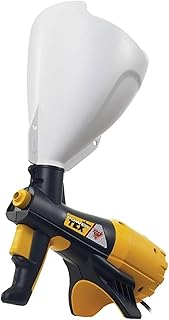
- 1 gallon hopper
- 3 included nozzles
- Built-in air turbine, no separate compressor
- Turbine rated 120 volts, 3.7 amps
- 0.2 gallons per minute flow
- 2 psi maximum pressure
- Hopper adjusts for ceilings or walls
The Wagner Power Tex is the smallest machine in this roundup, and it earns its place because it covers the ceiling work that the large machines cannot reach. A 1 gallon hopper sounds small beside a 20 gallon cart machine, but the Power Tex is a handheld tool that goes up a ladder and into a tight corner, and its light weight makes it easy to hold overhead for a long stretch. The built-in air turbine removes the need for a separate compressor, so the tool is ready as soon as it is plugged in, and the hopper adjusts for ceilings or walls without an adapter.
The 0.2 gallons per minute flow and the 2 psi maximum pressure are far below the cart machines, and that is the point: the Power Tex lays down a light texture coat rather than a heavy render, and it suits the finish passes and the touch-up work on a ceiling job. The three included nozzles cover small, medium and large patterns, so the operator can match the spray to the ceiling finish. For a contractor who needs a light, portable sprayer for ceiling edges, small areas and repairs, the Power Tex is the practical pick, and it works beside a large machine rather than instead of one.
IMER Step 120
- 230 volt, 50 hertz supply
- 2.2 kilowatt motor
- For conventional mortar and premixed plasters
- For fibre-reinforced and refractory mortars
- Hopper and flow: see product page
The IMER Step 120 is a plastering machine built for conventional mortar and premixed plasters, and its range of materials makes it a flexible pick for renovation ceilings. The maker lists the Step 120 for fibre-reinforced mortars and refractory mortars as well as standard plasters, so the machine covers the full range of materials a renovation ceiling job may need. The 2.2 kilowatt motor runs on a 230 volt, 50 hertz supply, and the machine is built for steady, continuous spraying on large surfaces.
The hopper size and the flow figures are not stated in the product document consulted for this roundup, so none are given here, and the contractor should check the product page for those figures before buying. The Step 120 suits a contractor who works with a range of plasters and mortars on renovation ceilings and wants one machine that can move them all. For a flexible ceiling machine that handles conventional, fibre-reinforced and refractory materials, the Step 120 is a strong choice.
| Sprayer | Flow and hopper | Hose reach |
|---|---|---|
| Graco TexSpray RTX 5500PX | 5.5 GPM, 15 gal hopper | 100 ft |
| Graco TexSpray RTX 2000pi | 2.0 GPM, 13 gal hopper | See product page |
| Graco TexSpray RTX 5000PX | 5.0 GPM, 15 gal hopper | 100 ft |
| Titan PowrTex 600DD | 3.0 GPM, 20 gal hopper | See product page |
| Graco TexSpray T-MAX 506 | See product page, 65 L hopper | 30 m |
| Wagner Power Tex | 0.2 GPM, 1 gal hopper | Handheld |
| IMER Step 120 | See product page | See product page |
How to choose
Match the flow range to the ceiling coats
A ceiling needs at least two coats at different flows: a slow flow for the first thin coat, because the material must land thin and stick before gravity pulls it down, and a faster flow for the full coat once the first pass has bonded. A machine with a wide flow range covers both coats, and the operator sets the flow low for the first pass and raises it for the full coat. Check the maker stated maximum flow, and check whether the machine has a flow control that can be turned down to a slow pace. A machine with only one speed forces the operator to work at a pace that suits neither coat, and the result is either a thin coat that leaves the ceiling showing through or a heavy coat that sags.
Check the hose reach against the room
The hose decides where the machine stands, and the machine position decides how much of the ceiling can be covered without moving it. A 25 foot hose suits a single room, a 75 foot hose suits a long room, and a 100 foot hose suits a large open area where the machine stays near the material supply. A longer hose adds drag and makes the material harder to push, so the pump must have the power to move thick render through the full length. Before buying, measure the longest distance from the material supply to the farthest corner of the ceiling, and pick a machine whose stated maximum hose length covers that distance with room to spare.
Check the hopper loading height
A ceiling job means filling the hopper many times, and the loading height decides how hard that work is. A low hopper can be filled from a bucket without lifting material overhead, while a high hopper forces the operator to lift a full bucket above the waist. The IMER machines in this roundup have a loading height of 650 millimetres, which keeps the hopper low enough to fill from a bucket. Check the loading height in the maker figures before buying, and pick a machine that can be filled without straining the back.
Match the power supply to the site
A ceiling machine needs a power supply that matches the site. A 120 volt machine plugs into a standard site outlet, a 230 volt machine needs a proper power distribution box, and a 240 volt machine needs a dedicated circuit. The Graco RTX 5000PX and the RTX 1400si run on 120 volts, the RTX 2000pi and the RTX 5500PX run on 230 and 240 volts, and the IMER machines run on 230 volts. Check the site supply before buying, and pick a machine that matches it, because a machine that cannot be plugged in cannot spray.
Common mistakes
The most common mistake with a ceiling sprayer is running the pump at full flow on the first pass. A high flow throws too much material onto the ceiling, and the coat sags before the finishing tools reach it. Start at a low flow, lay down a thin first coat, and raise the flow only once the ceiling is covered and the operator knows how the material behaves. A second mistake is starting a ceiling with a hopper that is too small for the run. The operator sprays half a ceiling, the hopper runs dry, and the refill leaves a visible line where the fresh material meets the material that has started to set. Plan the run before mixing, work out how much material the ceiling needs, and mix enough to fill the hopper for the whole ceiling.
A third mistake is using a nozzle that is too small for the aggregate in the render. A small nozzle blocks, the pump strains, and the spray comes out in spurts instead of a steady fan. Match the nozzle to the grain size, and keep a larger nozzle on hand for the coarsest mixes. A fourth mistake is leaving material in the hopper and the hose at the end of the day. Render sets hard inside a hose, and a blocked hose costs more time than a proper flush. Flush the hopper, the hose and the gun with clean water as soon as the spraying stops, and run the pump until the water runs clear.
A fifth mistake is spraying a ceiling without checking the surface first. A dusty ceiling, a damp patch, or a loose edge will show through the texture no matter how good the sprayer is. Brush the ceiling down, check that it is dry and sound, and mask the edges before the first pass. The sprayer does the coating, but the preparation decides whether the coating stays on the ceiling.
FAQ
Why does a ceiling need variable flow?
A ceiling needs a slow flow for the first thin coat, because the material must land thin and stick before gravity pulls it down, and a faster flow for the full coat once the first pass has bonded. A machine with a variable flow control lets the operator set the pace for each coat, while a machine with only one speed forces a pace that suits neither coat. The result of a single speed machine is either a thin coat that leaves the ceiling showing through or a heavy coat that sags.
How big a hopper do I need for a large ceiling?
A hopper of 13 gallons or more suits a large ceiling, because it holds enough material for a full ceiling without a refill in the middle of the coat. A 15 gallon hopper covers a medium run, and a 20 gallon hopper covers a long run. Measure the ceiling, work out how much material it needs, and pick a hopper that covers at least one full ceiling with material to spare.
How long a hose do I need for ceiling work?
A 25 foot hose suits a single room, a 75 foot hose suits a long room, and a 100 foot hose suits a large open area. Measure the longest distance from the material supply to the farthest corner of the ceiling, and pick a machine whose stated maximum hose length covers that distance. A longer hose adds drag, so the pump must have the power to move thick render through the full length without the flow falling away.
Can I use a wall sprayer on a ceiling?
Yes, if the machine has a flow control that can be turned down for the first thin coat, a hose long enough to reach across the room, and a hopper that can be filled without lifting material overhead. A handheld sprayer like the Wagner Power Tex also works for ceiling edges and small areas, because it is light enough to hold overhead. Check the hopper adjustment as well, because some machines have a hopper that adjusts for ceilings or walls.
What power supply does a ceiling sprayer need?
It depends on the machine. The Graco RTX 5000PX runs on 120 volts, the RTX 2000pi runs on 230 volts, and the RTX 5500PX runs on 240 volts. The IMER machines run on 230 volts. Check the site supply before buying, and pick a machine that matches it, because a machine that cannot be plugged in cannot spray.
How do I clean a ceiling sprayer?
Flush the hopper, the hose and the gun with clean water as soon as the spraying stops, and run the pump until the water runs clear. Remove the nozzles and clean them separately, and wipe the hopper walls so no render dries on them. A machine with a removable hopper or an access panel makes this faster, because the operator can reach inside the hopper rather than working through the top opening. Never leave render in the machine overnight, because it sets hard and blocks the pump and the hose.
Conclusion
A large renovation ceiling needs a sprayer with a flow control wide enough for both a thin first coat and a full coat, a hopper large enough for a full ceiling, and a hose long enough to reach the farthest corner without moving the machine. The Graco TexSpray RTX 5500PX leads this roundup with its 5.5 gallons per minute flow and its 100 foot hose, and the Titan PowrTex 600DD follows with the largest hopper here at 20 gallons. The Graco TexSpray RTX 2000pi is the mid range pick with an automatic start and stop, the Graco TexSpray RTX 5000PX brings the same large flow on a standard 120 volt supply, the Graco TexSpray T-MAX 506 brings a modern flow control with airless or air-assisted spraying, the Wagner Power Tex covers the edges and the touch-up work, and the IMER Step 120 handles the full range of plasters and mortars. Set the flow low for the first coat, raise it for the full coat, and the ceiling will come out even from the first pass to the last.
Related guides
More from Amazon
Programs that pair well with the guide above. Offers and eligibility are set by Amazon and may change.
Free shipping on eligible items, Prime Video and more. Eligible new members can start with a free trial.
Start a Prime free trialAudiobooks and podcasts to listen to on the go. Eligible new members can start with a free trial.
Try Audible freeAd-free music streaming. Eligible new subscribers can start with a free trial.
Try Music Unlimited freeA free business account with business pricing and bulk-buying tools for work, shop or home office.
Create a business accountAs an Amazon Associate we earn from qualifying purchases.



Write Your Review
No reviews yet. Be the first to share your experience!