
Our Top Picks
As an Amazon Associate I earn from qualifying purchases. This post may contain affiliate links at no extra cost to you.
Our top picks at a glance
3 products from this guide, in the order reviewed below.


As an Amazon Associate we earn from qualifying purchases. Prices and availability can change.
Finishing decorative baseboard details is slow, close work: the installer kneels in one spot for a long time, leaning in to shape a profile, and the knees take the whole weight of the session. The best kneeling pads for plaster installers for finishing decorative baseboard details with high density foam are the pads in this roundup: seven pads with dense foam that holds its shape, compared on foam density, thickness, size, and underside grip. A soft pad feels kind for ten minutes and then presses through to the floor, while a dense pad feels firm at first and stays firm for the whole run of baseboard.
Density is the number that decides whether a pad lasts a session. The Hog Heaven pad in this roundup publishes a foam density of 5.5 to 7.5 lb per cubic foot, and the Ergodyne ProFlex 380 uses high-density NBR foam that the maker says will not compress over time. Thickness matters too: the pads here run from 22 mm to 2 in, and a thicker pad suits concrete or hard tile while a thinner pad suits a short session on a softer floor. The seven pads below cover the range from a thin, light slab to a thick, wide mat, and each one lists what its maker publishes for foam, size, and thickness, so the choice can be made on numbers rather than on a guess.
Every pad in this roundup was checked against its maker's published figures, and where a figure was not published the table says so rather than guessing. The comparison that follows lines the seven pads up by foam and thickness, size, and the job each one suits best, then a buying guide explains which numbers matter for baseboard detail work, the common mistakes that wear a pad out early, and the questions installers ask most. Pick the pad whose density holds its shape, whose thickness suits the floor, and whose size covers both knees, and the baseboard detail will get the time it needs without the knees giving out first.
Best products
Hog Heaven Knee Guard
- 12 in x 22 in x 7/8 in
- Nitrile rubber surface over closed-cell nitrile and PVC foam
- Foam density 5.5 to 7.5 lb per cubic foot
- Certified high-traction by the National Floor Safety Institute
- Built-in handle; closed-cell foam will not absorb liquids
The Hog Heaven Knee Guard leads this roundup because it is the only pad here with a published foam density, and density is the number that decides whether a pad holds its shape through a long baseboard session. The cushion is closed-cell nitrile and PVC foam at 5.5 to 7.5 lb per cubic foot, under a nitrile rubber surface, and the maker certifies the surface high-traction through the National Floor Safety Institute, with a static coefficient of friction of 0.87 dry and 0.85 wet. At 12 in by 22 in by 7/8 in the pad covers both knees with room to shift, and the 7/8 in cushion reduces knee strain without lifting the installer so high that fine baseboard detail becomes hard to reach. The closed-cell foam will not absorb liquids, so wash water and primer stay on the surface, and a built-in handle carries the pad along the wall. For baseboard work, where the installer kneels in one spot for a long time, a dense pad that does not pack down is the right starting point.
Earth Edge Super Cushy Kneeling Pad
- 20 in x 15 in x 2 in
- NBR foam, resists chemicals, grease and oil
- Water-resistant skin, fully washable
- Built-in cut-out carry handle
- At least 20 percent recycled content; made in the USA; SKU ACUSHY
The Earth Edge Super Cushy Kneeling Pad is the thickest pad in this roundup, and thickness is what baseboard detail work demands. At 20 in by 15 in by 2 in it gives the knees, shins, and elbows a generous surface, so an installer can kneel, shift, and lean without sliding off the pad onto a hard floor. The foam is NBR, a nitrile butyl rubber foam that resists chemicals, grease, and oil, and the water-resistant skin wipes clean after a plaster session, which matters when baseboard work throws dust and splashes onto the floor. A built-in cut-out handle carries the big pad to the next room, and the maker builds it in the USA with at least 20 percent recycled content. The 2 in thickness suits long sessions on concrete or tile, where a thin pad would press through to the floor before the first length of baseboard is finished, and the wide surface lets the installer work a whole section without moving the pad.
Gorilla Grip Extra Thick Kneeling Pad
- 17.5 in x 11 in x 1.3 in
- High-density foam
- Water resistant
- Large cushion
The Gorilla Grip Extra Thick Kneeling Pad is the compact high-density option for baseboard work, and compact matters where the floor space in front of a baseboard is narrow. It measures 17.5 in by 11 in by 1.3 in, and the high-density foam gives a firm cushion that holds its shape instead of packing down under the knees. The foam is water resistant, so wash water and primer stay on the surface, and the large cushion covers both knees without crowding. There is no frame and no cover, so the pad drops beside the baseboard and moves along the wall as the detail work travels, and it wipes clean at the end of the day. For an installer who wants a firm, simple pad that fits in a tight space and does not need any setup, this is the straightforward pick, and its small size makes it easy to carry from room to room with one hand.
WORKPRO Extra Thick Kneeling Pad
- 17.5 in x 11 in x 1.5 in
- Soft NBR foam
- 70 percent shock absorbency
- Also sold as a 2-pack
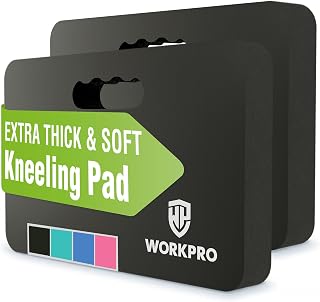
The WORKPRO Extra Thick Kneeling Pad is the soft-foam counterpoint in a high-density roundup, and it belongs here because density alone does not decide comfort. It measures 17.5 in by 11 in by 1.5 in, and the soft NBR foam gives 70 percent shock absorbency, which takes the edge off kneeling on a hard floor for a long baseboard session. The foam is water resistant, so splashes stay on the surface, and the pad is also sold as a 2-pack, which lets an installer keep a dry spare in the van. The compact size fits the narrow strip of floor in front of a baseboard, and the soft foam moulds to small lumps and ridges in the floor instead of rocking on them. For detail work, where the installer kneels still for a long time and shifts weight slowly, a softer foam that spreads the load can feel easier on the knees than a stiff, dense slab.
Klein Tools Kneeling Pad 60135
- 21 in x 14 in, 1 in thick NBR foam
- Built-in handle
- Closed-cell foam resists petroleum
- Silicone-free; will not stay compressed
The Klein Tools Kneeling Pad 60135 brings a trade-tool build to baseboard detail work. It measures 21 in by 14 in with 1 in of NBR foam, and the closed-cell foam resists petroleum, so a pad that sits near solvents and sealers does not soak them up. The built-in handle carries it along the wall, and the foam is silicone-free and will not stay compressed, which means the pad keeps its thickness through repeated kneeling instead of packing down into a thin mat. At 1 in thick it is the thinnest pad in this roundup, and that low profile suits baseboard work, where the installer kneels close to the wall and a tall pad would push the knees too far from the detail. The wide 21 in length covers both knees with room to move, and the closed-cell surface wipes clean of plaster dust at the end of the day. For fine work that needs the knees close to the wall, a low, firm pad is the right tool.
Ergodyne ProFlex 385 Large Kneeling Pad
- Large kneeling pad
- Closed-cell foam
- Water and petroleum resistant
- Room for both knees
The Ergodyne ProFlex 385 Large Kneeling Pad is the wide option for baseboard work, and width matters when the detail runs along a whole wall. It is a large kneeling pad with room for both knees, made from closed-cell foam that is water and petroleum resistant, so wash water, primer, and sealer stay on the surface instead of soaking into the foam. The large size lets the installer kneel square to the baseboard and shift sideways along the wall without sliding off the pad onto the bare floor, which is the movement that strains knees most during a long detail session. There is no frame to set up and no seat to fold, so the pad drops beside the baseboard and stays there, and the closed-cell foam wipes clean when the work is done. For a long run of decorative baseboard, where the installer moves slowly along the wall, a large flat pad is often the simplest and most comfortable choice.
Draper Multipurpose Kneeler Pad 10196
- EVA foam
- 330 mm x 290/355 mm x 22 mm
- Cut-out carry handle for portability and storage
- Lightweight and compact; lifetime warranty
The Draper Multipurpose Kneeler Pad 10196 is the lightest pad in this roundup, and lightness counts when the work moves from room to room all day. It is made from EVA foam, measures 330 mm by 290/355 mm by 22 mm, and has a cut-out carry handle that lets the installer grab it with one hand and hang it on a hook for storage. The pad is lightweight and compact, with no frame and no cover, so it drops beside the baseboard and moves along the wall as the detail work travels. The EVA foam protects the knees on hard surfaces, and the maker backs it with a lifetime warranty. At 22 mm thick it is thinner than the foam slabs in this roundup, so it suits shorter sessions and lighter work rather than a full day on concrete, but for an installer who wants a pad that weighs almost nothing and is always within reach, it is a practical pick.
| Product | Size and thickness | Cover and grip | Best for |
|---|---|---|---|
| Hog Heaven Knee Guard | 12 x 22 x 7/8 in | Nitrile rubber, NFSI high-traction | Smooth floors and long sessions |
| Earth Edge Super Cushy Kneeling Pad | 20 x 15 x 2 in | Water-resistant NBR skin | Wet ground and large knee room |
| Gorilla Grip Extra Thick Kneeling Pad | 17.5 x 11 x 1.3 in | Water resistant foam | Wet patches and wide knees |
| WORKPRO Extra Thick Kneeling Pad | 17.5 x 11 x 1.5 in | Soft NBR foam | Two-pad rotation and spares |
| Klein Tools Kneeling Pad 60135 | 21 x 14 x 1 in | Closed-cell NBR foam | Oils and solvents nearby |
| Ergodyne ProFlex 385 Large Kneeling Pad | Large | Closed-cell foam | Wide stance and both knees |
| Draper Multipurpose Kneeler Pad 10196 | 330 x 290/355 x 22 mm | EVA foam, cut-out handle | Light carry and hanging storage |
How to choose
Foam density and compression
Density decides whether a pad still cushions at the end of a session. A soft foam feels kind at first and then packs down under the knees, while a dense foam feels firm at first and stays firm. The Hog Heaven pad publishes a foam density of 5.5 to 7.5 lb per cubic foot, and the Ergodyne ProFlex 380 uses high-density NBR foam that the maker says will not compress over time. The Gorilla Grip and Harbor Freight style of high-density foam holds its shape the same way, while a soft NBR foam, like the one in the WORKPRO pad, spreads the load by giving way rather than by resisting it. For baseboard work, where the installer kneels still for a long time, a dense foam is the safer pick, because a pad that packs down leaves the knees on the bare floor before the detail is done.
Thickness for long sessions
Thickness decides how far the knees sit from the floor and how long the pad protects them. The pads in this roundup run from 22 mm to 2 in thick, and the thicker pads suit long sessions on concrete or hard tile, while the thinner pads suit short sessions and tight spaces. The Earth Edge pad, at 2 in, is the thickest here and suits a full day on a hard floor, while the Draper 10196, at 22 mm, suits a short session where the pad must be light and easy to carry. A thick pad lifts the knees away from the baseboard, which can make fine detail harder to reach, so balance thickness against the work: pick the thinnest pad that still protects the knees for the length of the session, and read the density figure where the maker publishes one.
Size and knee room
A baseboard pad needs to cover both knees with room to shift, and it needs to fit the strip of floor in front of the wall. The pads here run from 17.5 in by 11 in to 22 in by 15 in, and the wider pads suit installers who kneel square to the wall and shift sideways along it. A pad that is too narrow lets one knee slip off the edge onto the bare floor, and a pad that is too wide will not fit between the baseboard and the furniture in a small room. The Ergodyne ProFlex 385 is the large pad here, with room for both knees and a wide stance, while the Draper 10196 is the compact pad for tight spaces. Measure both knees together on the floor before buying, and pick a pad at least as wide as that measurement.
Cover, grip, and cleaning
Plaster work is dusty work, and a pad that cannot be cleaned will not last. Look for a cover or a foam surface that wipes clean: the Earth Edge pad has a water-resistant NBR skin that rinses with a hose, the Hog Heaven surface wipes clean with soap and water, and the Klein pad uses closed-cell foam that resists petroleum. Grip matters too, because a pad that slides on a smooth floor pushes the installer into the baseboard, and the Hog Heaven pad carries a National Floor Safety Institute high-traction certificate. Check the underside before buying, and pick a pad with a textured or rubber surface rather than a smooth foam bottom. Wipe the pad with a damp cloth at the end of each session, before the dust and splashes set, and let it dry flat.
Common mistakes
Picking soft foam that bottoms out is the first mistake. The pad feels kind for ten minutes and then presses through to the floor, leaving the knees on bare tile for the rest of the session. Fix it by reading the density figure where the maker publishes one, and by choosing a dense foam for any session longer than an hour.
Using too thin a pad on a hard floor is the second mistake. A 22 mm pad on concrete protects the knees for a short job and fails on a long one. Fix it by matching thickness to the floor and the session: 1.5 in to 2 in for concrete, and a thinner pad only for short work on a softer floor.
Kneeling on the edge of the pad is the third mistake. The knees press into the rim, the pad folds, and the cushion is lost. Fix it by centring both knees on the pad and by buying a pad wide enough for both knees with room to shift.
Ignoring the underside is the fourth mistake. A smooth foam bottom slides on polished tile, and the installer spends the session chasing the pad. Fix it by choosing a pad with a textured or rubber underside, and by brushing the floor clear of dust before kneeling.
Storing heavy tools on the pad is the fifth mistake. A toolbox or a bucket left on the pad overnight presses a dent into the foam that does not come back. Fix it by hanging the pad on a hook or laying it flat on a shelf, and by keeping tools off it between jobs.
FAQ
What density counts as high density?
There is no single line, but the figures makers publish give a guide. The Hog Heaven pad in this roundup publishes a foam density of 5.5 to 7.5 lb per cubic foot, and the Ergodyne ProFlex 380 uses high-density NBR foam that the maker says will not compress over time. A foam below about 3 lb per cubic foot is usually soft and packs down quickly, while a foam above 5 lb per cubic foot holds its shape through long sessions. If a maker does not publish a density figure, press the foam with a thumb in the shop: a dense foam pushes back firmly, while a soft foam gives way easily and stays dented.
How thick should a pad be for baseboard work?
For baseboard work on a hard floor, a pad of 1.5 in to 2 in suits long sessions, while a pad of 1 in suits shorter work. The pads in this roundup run from 22 mm to 2 in, and the Earth Edge pad at 2 in is the thickest here. Thickness alone does not decide comfort: a dense 1 in pad can outlast a soft 2 in pad that packs down, so read the density figure where the maker publishes one. A thick pad also lifts the knees away from the baseboard, which can make fine detail harder to reach, so pick the thinnest pad that still protects the knees for the length of the session.
Does high-density foam soften with use?
Good high-density foam should not soften much with use. The Ergodyne ProFlex 380 uses high-density NBR foam that the maker says will not compress over time, and the Klein pad uses foam that will not stay compressed. Cheap foam packs down within weeks, while a dense foam keeps its thickness for a long time. Keep the pad out of strong sun and away from solvents, because both break foam down, and store it flat or hung rather than folded tight, so the foam does not take a set.
Should I use a pad or a kneeler seat for detail work?
A flat pad suits detail work better than a kneeler seat in most cases, because the installer kneels low and close to the baseboard, and a seat frame lifts the knees away from the surface. A kneeler seat helps where the installer must stand up often, because the frame gives something to push on, but for a long run of fine baseboard detail a flat pad is simpler, lighter, and easier to move along the wall. If the detail run is short and the installer stands often, a frame is worth considering; if the run is long, pick a pad.
Can I cut a kneeling pad to size?
Most makers do not design their pads to be cut, and cutting a pad can expose the foam core and leave a rough edge that frays. The pads in this roundup are sold in fixed sizes, and the range runs from 17.5 in by 11 in to 22 in by 15 in, so pick the size that fits the space rather than cutting a larger pad down. If a pad is too wide for a tight space, choose a narrower model, like the Draper 10196, instead of trimming a wide one. Check the maker's guidance before cutting any pad, because a cut edge can void the warranty.
Conclusion
Decorative baseboard work is slow, close, and hard on the knees, and the right pad is the one whose dense foam holds its shape, whose thickness suits the floor, and whose size covers both knees. The Hog Heaven Knee Guard leads this roundup for its published foam density and certified traction, the Earth Edge pad follows for its 2 in thickness and wide surface, and the Gorilla Grip pad follows for its compact high-density foam. The WORKPRO gives a softer foam that spreads the load, the Klein pad gives a low, firm slab that keeps the knees close to the wall, the Ergodyne ProFlex 385 gives a large pad with room for both knees, and the Draper 10196 gives a light pad that weighs almost nothing. Pick the pad whose density holds its shape for the length of the session, keep it clean and dry, store it flat or hung, and the baseboard detail will get the time it needs without the knees giving out first.
Related guides
More from Amazon
Programs that pair well with the guide above. Offers and eligibility are set by Amazon and may change.
Free shipping on eligible items, Prime Video and more. Eligible new members can start with a free trial.
Start a Prime free trialAudiobooks and podcasts to listen to on the go. Eligible new members can start with a free trial.
Try Audible freeAd-free music streaming. Eligible new subscribers can start with a free trial.
Try Music Unlimited freeA free business account with business pricing and bulk-buying tools for work, shop or home office.
Create a business accountAs an Amazon Associate we earn from qualifying purchases.
More ways to save on your next finish
Programs that pair well with the guide above. Offers and eligibility are set by Amazon and may change.
A free business account with business pricing and bulk-buying tools for work, shop or home office.
Create a business accountFast, free shipping on eligible items, plus Prime Video and more. Eligible new members can start with a free trial.
Start a Prime free trialRead from a huge library of eBooks, including how-to guides and cookbooks. Eligible new members can start with a free trial.
Try Kindle UnlimitedAudiobooks and podcasts for the commute, the garage or the kitchen. Eligible new members can start with a free trial.
Try Audible freeAs an Amazon Associate we earn from qualifying purchases. Using these links costs you nothing extra.



Write Your Review
No reviews yet. Be the first to share your experience!