
Key takeaways
- Work out how much material a tadelakt shower wall needs over a waterproofing system, from plaster and membrane to panels and backing, soap, and waste allowance.
As an Amazon Associate I earn from qualifying purchases. This post may contain affiliate links at no extra cost to you.
A shower wall finished in tadelakt looks like a single smooth surface, but the material list behind it is a small system, and each layer is counted in its own unit: plaster by weight, membrane by the gallon, panels by the sheet, and soap by dilution. Getting the quantities right matters more here than on a dry wall, because a shortfall in the middle of the job means stopping while a coat is still wet, and an over-order means bags of lime sitting in a damp room. How much material do you need to apply tadelakt over a waterproofing system on a shower wall with approved backing is a question of arithmetic, and this guide works through it layer by layer, using the coverage figures the makers publish and a typical shower wall as the running example.
The example wall measures 1.5 metres wide and 2.4 metres high, which gives 3.6 square metres, or about 39 square feet, of wall. The same arithmetic works for any other size: measure the wall, work out the area, and run the area through the coverage figure for each material in turn.
Before ordering, check the backing against the plaster maker's approved list, since a panel that the maker has not approved for wet areas can void the guidance that the rest of the system relies on. Foam panels with a fleece face, cement boards, and other boards listed for wet areas all appear on such lists, while plain plasterboard does not. The approved backing also decides the fixing method: foam panels take screws and washers or a bonding adhesive, cement boards take screws into studs, and each fixing adds a small number of screws, washers, and sealant to the order.
Quick answer
For a shower wall of about 3.6 square metres, plan on two buckets of Tierrfino Tadelakt STONE, one gallon of Custom RedGard membrane, two or three Schluter-KERDI-BOARD panels, and one bottle of polishing soap. The plaster covers 2.5 square metres per 12.5 kg bucket, the membrane covers 55 square feet per gallon in two coats, and the panels cover 10.7 square feet each in the 32 by 48 inch size. Add about 10 percent for waste, cuts, and touch-ups, and round every figure up to whole buckets, gallons, and panels, since none of these materials can be bought in part.
| Item | What it does | When to use it |
|---|---|---|
| Tierrfino Tadelakt STONE | Lime plaster for tadelakt, applied 4 to 5 mm thick | Finish coat on the shower wall |
| Custom RedGard | Liquid waterproofing and crack isolation membrane | Sealing the backing before plaster |
| Schluter-KERDI-BOARD | Waterproof foam backer board | Approved backing behind the plaster |
| Kreidezeit Polishing Soap | Olive-oil soap that reacts with lime to repel water | Soaping the finish after polishing |
| Tierrfino Tadelakt Soap | Pure olive soap for saturating tadelakt | First soaping and later care |
Step by step
1. Measure the wall and work out the area
Measure the width of the wall at the floor and at the top, since shower walls are rarely the same at both ends, and take the larger figure. Measure the height from the shower tray or the tub rim to the planned top of the finish. Multiply height by width to get the area, and add the area of any niche or shaped section separately, measuring each face of the recess and adding the faces together. A wall of 1.5 metres by 2.4 metres gives 3.6 square metres, and a niche of 0.3 metres by 0.6 metres with a depth of 0.1 metres adds about 0.3 square metres more, for a total of about 3.9 square metres. Write the total down, because every quantity below comes from it.
2. Work out the plaster from the coverage figure
Tierrfino Tadelakt STONE is listed at an average consumption of 5 kg per square metre, with a 12.5 kg bucket covering 2.5 square metres. Divide the wall area by 2.5 to get the number of buckets: a wall of 3.9 square metres needs 1.56 buckets, which rounds up to two buckets. Mix each bucket with 5.5 litres of water, let the mix rest for at least 24 hours, and apply the plaster at 4 to 5 mm thick. The second bucket covers the sample panel, the touch-ups, and the small extra area that a niche and a shaped corner always add, so the spare is used rather than wasted.
3. Work out the membrane from the gallon coverage
Custom RedGard covers 55 square feet per gallon as a waterproofing membrane in two coats, with a 3.5 gallon pail covering 192 square feet. Convert the wall area to square feet, 3.9 square metres is about 42 square feet, and divide by 55 to get the gallons: 42 divided by 55 is 0.76, which rounds up to one gallon. The membrane also seals the joints, the corners, and the floor-to-wall joint, and the per-coat rate is 110 square feet per gallon for general use and 80 square feet per gallon to the ANSI A118.10 standard, so a single gallon leaves room for a proper second coat and for the extra material the corners take. On a larger wall, the 3.5 gallon pail becomes the better buy.
4. Count the backer panels by the sheet
Schluter-KERDI-BOARD panels in the 32 by 48 inch size cover 10.7 square feet each, so divide the wall area in square feet by 10.7 to get the panel count: 42 divided by 10.7 is 3.9, which rounds up to four panels. The larger 64 by 48 inch panel covers 21.3 square feet and suits a wide wall with fewer joints, while the 96 by 48 inch panel covers 32 square feet and suits a full-height wall in one piece. Choose the panel size that leaves the fewest offcuts, add one spare panel for cuts around the shower controls and the niche, and remember that the panels are cut with a utility knife, so a sharp blade and a straight edge belong on the material list too.
5. Work out the soap and the finishing materials
The soap is used diluted, so the volume needed is small. Kreidezeit Polishing Soap is diluted at one part soap to six parts water, and a small bottle mixed to that ratio covers a shower wall several times over, including the repeat soaping after the first layer has dried. Tierrfino Tadelakt Soap is a pure olive soap used for the first soaping and for later care, and a single bottle serves the same wall for many treatments. The polishing stone is bought once and lasts across many jobs, and the wax goes on in a thin coat, so one tin covers several walls. Allow one bottle of soap, one stone, and one tin of wax for the job, and keep a little soap in reserve for the repeat treatment a couple of months later.
6. Add the waste and cutting allowance
Every layer loses a little material to waste, and the allowance is about 10 percent across the job. Plaster is lost on the trowel, in the mixing bucket, and on the sample panel; membrane is lost on the roller, in the corners, and on the floor-to-wall joint; panels are lost to offcuts around the controls and the niche. Add 10 percent to each figure before rounding up: 3.9 square metres of wall becomes 4.3 square metres for ordering, which still needs two buckets of plaster and one gallon of membrane, but pushes the panel count to five on a wall with a niche. The allowance is the cheapest insurance on the job, since a shortfall in the middle of a wet coat costs far more than a spare bucket.
7. Order the materials and check the delivery
Order the panels first, since they set the shape of the wall, then the membrane, then the plaster, then the soap and the wax. Check each delivery against the list: the plaster buckets should be sealed and dry, the membrane pails should be unopened, the panels should be flat and undamaged, and the soap should be the pure olive soap listed for the finish. Store the plaster in a dry place off the floor, keep the membrane away from frost, and lay the panels flat so they do not bow before fixing. A short check at delivery saves a return trip in the middle of the job.
Tools and materials
Tierrfino Tadelakt STONE
- Lime plaster for tadelakt, article number 390TL5303
- Sold in a 12.5 kg bucket; average consumption 5 kg per square metre
- Coverage 2.5 square metres per bucket at 4 to 5 mm thickness
- Mix 5.5 litres of water per 12.5 kg of powder; rest the mix for at least 24 hours
- Polish with a semi-precious agate stone; finish with pure olive soap
Tierrfino Tadelakt STONE is the finish plaster for the shower wall. The maker lists a 12.5 kg bucket with an average consumption of 5 kg per square metre, which gives a coverage of 2.5 square metres per bucket at the listed thickness of 4 to 5 mm. The mix is 5.5 litres of water per bucket, rested for at least 24 hours before use, and the plaster is polished with a semi-precious agate stone and finished with pure olive soap. The maker also lists a working rate of about 4 square metres per labourer per day, which helps to plan the time as well as the material.
Pros: published coverage and mix ratio make quantities exact; thick application suits wet areas; long rest period gives a workable mix.
Cons: needs a full day of rest after mixing; the 12.5 kg bucket is heavy to lift into a small bathroom.
Custom RedGard

- Liquid waterproofing and crack isolation membrane
- Coverage one gallon per 55 square feet as a waterproof membrane in two coats
- 3.5 gallon pail covers 192 square feet as a waterproof membrane
- Per-coat rates 110 square feet per gallon for general use and 80 square feet per gallon to ANSI A118.10
- Also listed for crack prevention at 100 square feet per gallon and as a pan liner at 40 square feet per gallon
Custom RedGard is the liquid membrane that seals the backing before the plaster goes on. The maker lists a coverage of one gallon per 55 square feet as a waterproofing membrane in two coats, which makes the volume easy to count from the wall area. The membrane is applied with a brush or roller, and the 3.5 gallon pail suits a full enclosure where the per-gallon volume works out lower than buying single gallons. The same product also serves for crack prevention and as a pan liner, so the coverage figure changes with the use, and the waterproofing figure is the one to use for a shower wall.
Pros: clear coverage figures for each use; single product covers membrane, crack, and pan work; widely stocked.
Cons: needs two coats for waterproofing; the coverage falls if the coats go on too thick.
Schluter-KERDI-BOARD
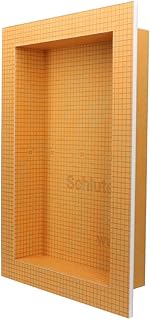
- Extruded polystyrene foam panel with reinforcement and fleece on both sides
- Thicknesses from 3/16 inch to 2 inches (5 to 50 mm)
- Thermal resistance R 2.2 at 1/2 inch thickness
- Panel sizes include 32 by 48 inches, 64 by 48 inches, and 96 by 48 inches
- Cut with a utility knife; printed gridlines guide straight cuts
Schluter-KERDI-BOARD is the approved backing that carries the membrane and the plaster. The foam core is waterproof through its full thickness, and the fleece faces give the membrane, the thin-set, and the basecoat something to grip. Panels fix to studs with the matching screws and washers, or bond to masonry with thin-set, and the joints are sealed with KERDI-BAND. The 1/2 inch panel is the usual choice for a shower wall, with thicker panels used where the wall needs to be built out or where extra insulation is wanted.
Pros: one panel does the work of board plus membrane; light and easy to cut; joints seal with the same system.
Cons: needs the matching screws, washers, and band to stay watertight; foam panels need care around heavy fixings.
Kreidezeit Polishing Soap
- Concentrate based on Corfu olive soap, a pure olive-oil soap
- Dilute one part soap with six parts water; never use undiluted
- Applied shortly after polishing the second tadelakt layer
- Reacts with lime to form lime soaps that repel water and dirt
- Also used for repeat soaping and for cleaning finished surfaces
Kreidezeit Polishing Soap is the ingredient that turns a lime plaster into a water-repellent finish. The concentrate is a pure olive-oil soap, and the maker lists a dilution of one part soap to six parts water. Brushed onto the second coat while the plaster is still firm, the soap reacts with the lime to form lime soaps in the surface, which shed water without closing the plaster off completely. A second soaping after the first layer has dried adds further protection on walls that see heavy use, and the same soap serves later for cleaning.
Pros: pure olive-oil soap with no added colouring or fragrance; published dilution ratio; doubles as a cleaner.
Cons: must be diluted and must not dry on the wall without polishing; tinted finishes can show whitish clouds if the soap is too strong.
Tierrfino Tadelakt Soap
- Pure olive soap for cleaning and saturating Tierrfino Tadelakt STONE
- 100 percent natural, vegetable-based product
- Coats the surface with a light greasy film that resists dirt and damage
- Used for the first soaping and for later care
- Also acts as a surface protection layer
Tierrfino Tadelakt Soap is the pure olive soap used to saturate and protect a tadelakt surface. The maker describes it as a 100 percent natural, vegetable-based product that coats the plaster with a light greasy film, making the surface less open to dirt and to knocks. Brushed onto the polished finish, the soap reacts with the lime and leaves the water-repellent skin that tadelakt is known for, and the same soap serves later for cleaning and for repeat treatments on a wall that sees daily use.
Pros: pure olive soap with no synthetic additives; serves for soaping, cleaning, and care; suits the traditional finish.
Cons: a separate product from the plaster itself; needs dilution and a light hand on pale colours to avoid darkening.
Common mistakes
Measuring only the flat wall and forgetting the niche
A niche adds the area of its sides, its shelf, and its top to the wall, and a shaped corner adds more still. Measure every face of the recess separately and add the faces together, or the plaster runs short halfway through the finish coat. The niche area is small, but it is the part of the wall that takes the most material per square metre because of the cutting and the corners.
Rounding down instead of up
Plaster, membrane, and panels are sold in whole units, and rounding down leaves the job short by the very amount that was cut. Always round up to whole buckets, gallons, and panels, and add the 10 percent waste allowance before rounding. A spare bucket costs little; a stopped coat costs a day.
Using the wrong coverage figure for the membrane
Custom RedGard lists different coverage figures for waterproofing, crack prevention, and pan lining, and the waterproofing figure is the lowest of the three. Use the waterproofing figure of 55 square feet per gallon in two coats for a shower wall, not the crack prevention figure of 100 square feet per gallon, or the membrane goes on too thin and the film never reaches its listed thickness.
Mixing the whole plaster batch at once
A 12.5 kg bucket mixed in one go is heavy, hard to keep workable, and likely to stiffen before the wall is finished. Mix in smaller batches, keep the mix covered, and mix the next batch only when the first is nearly used. The 24 hour rest period applies to the mix, so plan the mixing a day ahead of the application.
Forgetting the soap and wax in the order
The soap and the wax are small items, but the finish cannot be completed without them, and a missing bottle stops the job at the very last stage. Put the soap, the stone, and the wax on the order list with the plaster and the membrane, and check them off at delivery.
FAQ
How much tadelakt does a shower wall of 3.6 square metres need?
Tierrfino Tadelakt STONE covers 2.5 square metres per 12.5 kg bucket, so a wall of 3.6 square metres needs 1.44 buckets, which rounds up to two buckets. Add the niche area and the 10 percent waste allowance, and two buckets still cover the job, with the second bucket supplying the sample panel and the touch-ups.
How much membrane does the same wall need?
Custom RedGard covers 55 square feet per gallon as a waterproofing membrane in two coats, so a wall of about 42 square feet needs one gallon. Allow a little extra for the joints and corners, and choose the 3.5 gallon pail only where the area is large enough to use it, since an opened pail does not keep.
How many backer panels does a shower wall need?
A Schluter-KERDI-BOARD panel of 32 by 48 inches covers 10.7 square feet, so a wall of 42 square feet needs four panels, plus one spare for cuts around the controls and the niche. A larger panel size suits a wide wall with fewer joints, and the panel count falls accordingly.
How much water does the plaster mix need?
Tierrfino Tadelakt STONE mixes at 5.5 litres of water per 12.5 kg bucket, and the mix rests for at least 24 hours before use. Measure the water rather than guessing, since a mix that is too wet slumps and cracks, and a mix that is too dry drags under the trowel.
How much soap does a shower wall need?
Very little. Kreidezeit Polishing Soap is diluted at one part soap to six parts water, and a small bottle mixed to that ratio covers a shower wall several times over, including the repeat soaping after the first layer has dried. One bottle serves the job and the first repeat treatment.
Conclusion
Counting the material for a tadelakt shower wall is a matter of measuring the wall, running the area through the maker coverage figures, adding a waste allowance, and rounding up to whole units. Two buckets of plaster, one gallon of membrane, four or five panels, and one bottle of soap cover a typical wall of about 3.6 square metres, with the niche and the corners counted separately and the spare bucket kept for the sample panel and for touch-ups. Ordered that way, the job runs without stopping for a missing bag, and the finished wall keeps its polished, water-shedding face for years with nothing more than warm water and a little soap to look after it.
Related guides
More from Amazon
Programs that pair well with the guide above. Offers and eligibility are set by Amazon and may change.
Free shipping on eligible items, Prime Video and more. Eligible new members can start with a free trial.
Start a Prime free trialAudiobooks and podcasts to listen to on the go. Eligible new members can start with a free trial.
Try Audible freeAd-free music streaming. Eligible new subscribers can start with a free trial.
Try Music Unlimited freeA free business account with business pricing and bulk-buying tools for work, shop or home office.
Create a business accountAs an Amazon Associate we earn from qualifying purchases.
More ways to save on your next finish
Programs that pair well with the guide above. Offers and eligibility are set by Amazon and may change.
A free business account with business pricing and bulk-buying tools for work, shop or home office.
Create a business accountFast, free shipping on eligible items, plus Prime Video and more. Eligible new members can start with a free trial.
Start a Prime free trialRead from a huge library of eBooks, including how-to guides and cookbooks. Eligible new members can start with a free trial.
Try Kindle UnlimitedAudiobooks and podcasts for the commute, the garage or the kitchen. Eligible new members can start with a free trial.
Try Audible freeAs an Amazon Associate we earn from qualifying purchases. Using these links costs you nothing extra.










Write Your Review
No reviews yet. Be the first to share your experience!