
Key takeaways
- Compare air compressors for texture hopper guns with quick-connect air hose fittings for repeated wall patch jobs, plus CFM, tanks and couplers for quick swaps.
As an Amazon Associate I earn from qualifying purchases. This post may contain affiliate links at no extra cost to you.
Our top picks at a glance
4 products from this guide, in the order reviewed below.
As an Amazon Associate we earn from qualifying purchases. Prices and availability can change.
Repeated wall patch work is a job of constant change. The plasterer sprays a patch, moves the compressor to the next room, swaps the hose from the texture gun to a blow gun to clean the wall, swaps it back, and starts again. Every one of those changes costs time if the fittings are threaded, and every minute spent wrestling with a fitting is a minute the texture is drying on the wall. The best air compressors for texture hopper guns with quick connect air hose fittings for working on repeated wall patch jobs are the machines that make those changes fast: couplers that snap on with one hand, seal at once, and hold air without leaking, on a compressor that delivers enough air to keep the gun spraying through a whole patch.
A quick-connect fitting is a simple idea. A spring-loaded collar snaps the hose plug into the coupler, seals it with an O-ring, and holds it in place until the collar is pulled back to release it. The change takes seconds and one hand, and the air stays in the tank while the hose is off, because the coupler seals itself when the plug comes out. A threaded fitting takes time, two hands, and a wrench, and it leaks air every time it is loosened. On a day with twenty patches and a dozen hose changes, the difference between quick-connect and threaded fittings adds up to real time saved and a texture that is sprayed while it is still fresh.
The seven compressors below were chosen for patch work that moves. Each one has quick-connect couplers or takes standard quick-connect fittings, and the ones with two couplers let a texture gun and a blow gun stay connected at the same time. Each one also delivers enough air to cover a patch, with a tank and a recovery time that fit the pace of repeated work.
Best products
DeWalt D55146

- Motor: 1.6 HP continuous
- Tank: 4.5 gal tank
- Air delivery: 5.2 SCFM at 90 PSI
- Maximum pressure: 200 PSI cut-out, 160 PSI cut-in
- Tank storage pressure: 225 PSI
- Sound level: 78 dBA
- Weight: 83 lbs
- Pump: oil-free
- Power: 120V, 15 A
- Frame: wheels
The DeWalt D55146 leads this group because it pairs a strong air delivery with a high-pressure tank that keeps the gun fed through a whole patch, and it takes standard quick-connect fittings that snap on and off in seconds. It delivers 5.2 SCFM at 90 PSI from an oil-free pump, and the tank stores air at 225 PSI with a cut-out at 200 PSI and a cut-in at 160 PSI. That stored pressure is a reserve the gun can draw on: when the trigger is pulled, the regulator drops the pressure down to working level, and the high tank pressure means the tank holds more usable air than its 4.5-gallon size suggests. The gun sees a steady regulated pressure while the tank drains from 200 down toward 160 PSI, and the pump only needs to run when the tank falls to the cut-in point.
At 83 lbs the D55146 is heavy, though the wheel kit makes it easy to roll from room to room, and the hose comes off with a quick pull of the collar when the machine moves. It draws 15 amps, which is the full load of a standard household circuit, so it should run on its own circuit and with no extension lead if that can be avoided. At 78 dBA it is noisier than the quiet machines, so it is best parked in a hallway with a long hose running to the gun. For repeated patch work, where the gun is used in bursts with pauses in between, the high-pressure storage and the quick hose changes make the D55146 the strongest choice here.
Craftsman CMEC6150
- Motor: 0.8 HP
- Tank: 6 gal pancake tank
- Air delivery: 3.7 SCFM at 40 PSI, 2.6 SCFM at 90 PSI
- Maximum pressure: 150 PSI
- Weight: 30 lbs
- Pump: oil-free
- Power: 120V, 10 A
- Sound level: 82 dB
- Pressure switch: cut-in 120 PSI, cut-out 150 PSI
- Couplers: 2
The Craftsman CMEC6150 is the lightest machine in this group with two couplers, and that combination suits patch work that moves from room to room. Two couplers let the texture gun and a blow gun stay connected at the same time, so the wall can be blown clean and sprayed without swapping hoses at all. When a swap is needed, the quick-connect couplers snap on and off with one hand, and the air stays in the tank while the hose is off. At 30 lbs the CMEC6150 carries with one hand, and the pancake tank sits flat and stable on any floor.
Air delivery is 3.7 SCFM at 40 PSI and 2.6 SCFM at 90 PSI, which is enough for a patch and a small nozzle. The 6-gallon tank stores enough air to cover a patch without the pump starting, and the pressure switch cuts in at 120 PSI and out at 150 PSI, so the tank stays in a narrow band and the pump runs in short, regular cycles. The oil-free pump needs no oil care, and the machine draws 10 amps on a standard circuit. At 82 dB it is the loudest machine here, so it belongs a little further from the work, with a hose running to the gun. For a plasterer who patches a few walls at a time and wants two tools connected at once in a light package, the CMEC6150 is the most practical choice in this group.
California Air Tools 10020C
- Motor: 2.0 HP
- Tank: 10 gal steel tank
- Air delivery: 6.4 CFM at 40 PSI, 5.3 CFM at 90 PSI
- Maximum pressure: 125 PSI
- Sound level: 70 dB
- Weight: 82.5 lbs
- Pump: oil-free dual-piston pump, 1680 RPM
- Power: 110V, 14 A
- Fill time: 120 seconds from empty
- Recovery time: 25 seconds from 95 to 125 PSI
- Duty cycle: 70/30
The California Air Tools 10020C is the strongest air supply in this group, and it suits a plasterer who patches a whole house in a day and wants the gun fed without a pause. It delivers 6.4 CFM at 40 PSI, which is more air than most hopper guns draw, so the tank stays full while the gun sprays and the pump refills in the short pause while the plasterer moves to the next patch. The 10-gallon steel tank stores enough air to cover several patches before the pump needs to run, and the recovery from 95 to 125 PSI takes only 25 seconds, the fastest in this group. The 70/30 duty cycle allows long running periods, which suits a full day of patches.
At 70 dB the 10020C is one of the quieter machines here, and that matters when patch work runs inside an occupied house, where the pump will cycle all day within earshot of the rooms inside. The oil-free dual-piston pump needs no oil care, and the low running speed of 1680 RPM keeps the pump cool during long running periods. The trade-off is weight: at 82.5 lbs this is a machine that rolls on its wheel kit rather than one that gets carried, and the hose comes off with a quick pull of the collar when the machine moves to the next room. It draws 14 amps, so it needs a sound household circuit. For a full day of patches on one floor, the 10020C keeps the gun fed and the hose changes quick.
Rolair JC10 Plus

- Motor: 1 HP
- Tank: 2.5 gal tank
- Air delivery: 2.35 CFM at 90 PSI
- Maximum pressure: 125 PSI
- Sound level: 60 dB
- Weight: 45 lbs
- Pump: oil-less dual-piston pump, 1725 RPM
- Power: 7.5 A
- Fill time: 55 seconds from 0 to 125 PSI
- Frame: roll cage
The Rolair JC10 Plus is the toughest small machine in this group, and it suits patch work that moves through a house under repair. The roll cage protects the tank, the pump, and the fittings, so the machine can be carried from room to room and set down on rough ground without worrying about a dented tank or a cracked coupler. It delivers 2.35 CFM at 90 PSI from an oil-less dual-piston pump, and it fills from empty to 125 PSI in 55 seconds. That air delivery is enough for a small patch and a small nozzle, sprayed in short bursts with pauses while the next patch is prepared.
At 45 lbs the JC10 Plus is light enough to carry with one hand, and the hose snaps off with a quick pull of the collar when the machine moves. At 60 dB it runs at the sound level of a normal conversation, so it can sit in the same room as the work without disturbing anyone else in the house. It draws only 7.5 amps, the lowest in this group, so it runs on any household circuit. The oil-less pump needs no oil checks before work starts. For a plasterer who patches small walls one at a time and needs a machine that can take a knock, the JC10 Plus is the toughest and quietest small compressor here.
Porter-Cable C2002

- Motor: 0.8 HP
- Tank: 6 gal pancake tank
- Air delivery: 3.7 SCFM at 40 PSI, 2.6 SCFM at 90 PSI
- Maximum pressure: 150 PSI
- Weight: 30 lbs
- Pump: oil-free
- Power: 120V, 10 A
- Sound level: 82 dB
- Pressure switch: cut-in 120 PSI, cut-out 150 PSI
The Porter-Cable C2002 is the long-running classic of the 6-gallon pancake class, and it has stayed in workshops for years because it is simple, light, and easy to live with. It delivers 3.7 SCFM at 40 PSI and 2.6 SCFM at 90 PSI, which is enough air for a patch and a small nozzle, and the 6-gallon tank stores enough air to cover a patch without the pump starting. The pressure switch cuts in at 120 PSI and out at 150 PSI, so the tank stays in a narrow band and the pump runs in short, regular cycles that fit the pace of patch work. The oil-free pump needs no oil care, and the machine draws 10 amps on a standard circuit.
At 30 lbs the C2002 carries with one hand, and the pancake tank sits flat and stable on any floor. The quick-connect coupler snaps the hose on and off in seconds, so the machine can be moved from room to room without wasting time on fittings. At 82 dB it is one of the louder machines here, so it is best kept a little further from the work, with a hose running to the gun. The C2002 suits a plasterer who patches a few walls at a time and wants a proven, simple machine at a modest weight, with hose changes that take seconds. It is not the strongest machine here, but it is one of the most dependable.
Makita MAC700
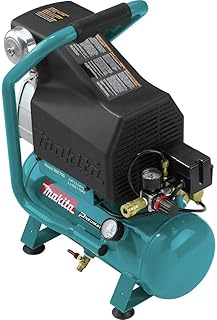
- Motor: 2.0 HP
- Tank: 2.6 gal tank
- Air delivery: 3.8 CFM at 40 PSI, 3.3 CFM at 90 PSI
- Maximum pressure: 130 PSI
- Weight: 52 lbs
- Pump: oil-lubricated cast-iron Big Bore pump, 1730 RPM
- Power: 12.4 A
The Makita MAC700 is the strongest small machine in this group, and it suits a plasterer who patches with a larger nozzle or a thicker mix. It delivers 3.8 CFM at 40 PSI and 3.3 CFM at 90 PSI from a 2.0 HP motor and an oil-lubricated cast-iron Big Bore pump, which is more air than any other machine here in the same size class. That extra air means a patch can be sprayed in one steady pass instead of two short bursts, and the pattern stays even across the whole patch. The 2.6-gallon tank is small, but the pump is strong enough to keep up with a short spray run, and the 130 PSI maximum leaves plenty of headroom above the pressure a hopper gun needs.
At 52 lbs the MAC700 is heavier than the pancake machines, and the oil-lubricated pump needs its oil level checked before work starts. In return it gives a cast-iron pump built for long service and a low running speed of 1730 RPM, which keeps heat down during a day of short spray runs. The quick-connect coupler snaps the hose on and off in seconds, so the machine can be moved from patch to patch without wasting time on fittings. The MAC700 suits a plasterer who wants strong air delivery in a machine that is still light enough to carry with one hand, and who is willing to check the oil in exchange for a pump that does not sag during a spray.
Husky C201H
- Motor: 1.3 running HP
- Tank: 20 gal vertical tank
- Air delivery: 5.2 SCFM at 40 PSI, 4.0 SCFM at 90 PSI
- Maximum pressure: 175 PSI
- Weight: 73 lbs
- Pump: oil-free
- Power: 120V, 15 A
- Fill time: about 7 minutes from empty
- Sound level: 83 dBA
The Husky C201H closes this group with the largest tank here, and it suits a plasterer who patches a whole house from one spot. The 20-gallon vertical tank stores far more air than any other machine in this group, so the gun can spray patch after patch from stored air alone, and the hose rarely needs to come off at all, because the machine stays in one place and the hose runs to each patch. It delivers 5.2 SCFM at 40 PSI and 4.0 SCFM at 90 PSI, which is enough for most hopper guns, and the 175 PSI maximum gives the tank a generous reserve above working pressure. The vertical tank takes up little floor space, which is handy in a crowded hallway, and the oil-free pump needs no oil care.
The trade-off is the fill time: about 7 minutes from empty, which is the longest in this group. The C201H should be started early and left to fill before the first patch, and then it will keep the gun fed for a long run. At 73 lbs it is heavy, though the vertical shape and the wheels make it easy to roll into place. At 83 dBA it is the loudest machine here, so it belongs in a garage or outside with a long hose, rather than in the same room as the work. It draws 15 amps, which is the full load of a standard household circuit. For a plasterer who works from one spot and wants a deep store of air, the C201H is the best tank in this group.
| Product | Tank | CFM at 40 PSI | CFM at 90 PSI | Max pressure | Weight |
|---|---|---|---|---|---|
| DeWalt D55146 | 4.5 gal | – | 5.2 | 200 PSI | 83 lbs |
| Craftsman CMEC6150 | 6 gal | 3.7 | 2.6 | 150 PSI | 30 lbs |
| California Air Tools 10020C | 10 gal | 6.4 | 5.3 | 125 PSI | 82.5 lbs |
| Rolair JC10 Plus | 2.5 gal | – | 2.35 | 125 PSI | 45 lbs |
| Porter-Cable C2002 | 6 gal | 3.7 | 2.6 | 150 PSI | 30 lbs |
| Makita MAC700 | 2.6 gal | 3.8 | 3.3 | 130 PSI | 52 lbs |
| Husky C201H | 20 gal | 5.2 | 4.0 | 175 PSI | 73 lbs |
How to choose
Count the couplers you need
The first question on this job is how many tools need to stay connected. A patch job usually needs two: the texture gun and a blow gun to clean the wall before the texture goes on. A compressor with two couplers lets both tools stay connected at the same time, so the wall can be blown clean and sprayed without swapping hoses at all. A compressor with one coupler needs the hose swapped each time, which takes seconds with a quick-connect fitting and much longer with a threaded fitting. Before buying, count the tools that will be used on the job and choose a machine with enough couplers to keep them all connected, or accept the time that swapping will cost.
Check that the fittings match
Quick-connect fittings are only quick if they match. The couplers on the compressor, the plugs on the hose, and the fittings on the gun all have to be the same style, or the hose will not snap on. Some machines use a universal push-to-connect coupler that takes several plug styles, and some use a single style. Before buying, check the coupler style on the compressor against the fittings already owned. If they do not match, an adapter can be fitted, but every extra joint is a place where air can leak, and a leak wastes air and keeps the pump running. The cleanest set-up is a compressor, a hose, and a gun that all use the same fitting style from the start.
Match the air delivery to the patch
A patch needs only a short spray, so a small compressor can do the job, but the nozzle size still decides how much air the gun draws. A small nozzle draws little air and suits a machine that delivers 2.5 CFM at 90 PSI. A larger nozzle draws more air and needs a machine that delivers 3.5 CFM or more at 40 PSI. The gun's manual states the air it needs, and that figure should be compared with the compressor's delivery at the pressure the gun works at. A compressor that is too small for the nozzle will drain its tank halfway through a patch and leave the second half of the pattern thinner than the first. A compressor that is larger than the nozzle needs is fine, but it costs weight and money that the job does not need.
Think about how the machine moves
Patch work moves from room to room, so the compressor has to move too. A machine that weighs 30 lbs gets carried without a second thought, and its hose snaps off with a quick pull of the collar. A machine that weighs 83 lbs gets rolled on its wheels, and the hose has to be long enough to reach the patch from the hallway. A machine with a 20-gallon tank stays in one place and the hose does all the moving. Before choosing, think about where the patches are and how far the compressor has to travel. The weight on the maker's sheet is the weight of the machine alone, so the hose and the gun add to the load on every trip.
Common mistakes
The most common mistake on repeated patch work is using threaded fittings when quick-connect fittings would save time. A threaded fitting takes time and two hands to change, and it leaks air every time it is loosened. On a day with twenty patches and a dozen hose changes, the time lost to threaded fittings adds up, and the texture dries on the wall while the fitting is changed. Quick-connect fittings snap on with one hand and seal at once, so the change takes seconds and the air stays in the tank.
Another mistake is buying a compressor with only one coupler when the job needs two tools. A plasterer who has to swap the hose between the texture gun and the blow gun for every patch will lose time and patience, and the swap will wear out the fittings faster. A machine with two couplers costs little more and keeps both tools connected all day. A third mistake is using a hose that is too long. A long hose drops the pressure between the compressor and the gun, so the gun sees less pressure than the regulator shows, and the pattern comes out thinner than expected. The hose should be as short as the job allows.
A fourth mistake is ignoring the tank drain. Water collects in the tank every time the pump runs, and a tank that is never drained will rust from the inside and spit water into the air line. Water in the air line spoils the texture and leaves marks on the patch. The drain valve should be opened at the end of each working day, and the tank should be left open overnight to dry out.
FAQ
What is a quick-connect air hose fitting?
A quick-connect fitting is a coupler that snaps a hose onto a compressor with one hand. A spring-loaded collar locks the hose plug into the coupler, seals it with an O-ring, and holds it in place until the collar is pulled back to release it. The change takes seconds, and the coupler seals itself when the plug comes out, so the air stays in the tank while the hose is off. A threaded fitting, by contrast, has to be screwed on and off by hand, takes time and two hands, and leaks air every time it is loosened. Most portable compressors use quick-connect couplers, but the style varies, so the fittings on the hose and the gun should be checked against the couplers on the compressor.
How many couplers do I need for patch work?
Two couplers are the practical number for patch work. One coupler takes the texture gun, and the second takes a blow gun to clean the wall before the texture goes on. With two couplers, both tools stay connected all day and no hose swaps are needed. With one coupler, the hose has to be swapped between the texture gun and the blow gun for every patch, which takes seconds with a quick-connect fitting but still adds up across a day of patches. A compressor with two couplers costs little more than one with a single coupler, and it saves time on every patch.
Do quick-connect fittings leak air?
A quick-connect fitting in good condition does not leak, because the O-ring inside the coupler seals the plug as soon as it snaps in. A fitting will leak when the O-ring is worn, when dirt gets into the coupler, or when the plug is a different style from the coupler. The couplers should be kept clean and the O-rings should be checked from time to time. If a coupler hisses when the hose is connected, the O-ring should be replaced or the plug should be checked for the right style. A small leak at a coupler can waste enough air to keep the pump running all day.
Can I fit quick-connect fittings to a compressor that has threaded outlets?
Yes, a quick-connect coupler can be screwed onto a threaded outlet, and most portable compressors either come with quick-connect couplers or take them as a direct fit. The thread size on the outlet should be checked before buying the coupler, because outlets come in more than one size. Once the coupler is fitted, the hose plugs should match the coupler style. An adapter can bridge a mismatch, but every extra joint is a place where air can leak, so the cleanest set-up is a coupler that fits the outlet directly and plugs that match the coupler.
Why does my compressor keep running while I patch walls?
A compressor runs constantly when the gun uses air faster than the pump can replace it. That usually means the nozzle is too large for the compressor, the regulator is set too high, or a fitting is leaking. Check the gun's stated air need against the compressor's delivery at 40 PSI, lower the regulator to the lowest pressure that gives an even pattern, and check every fitting for a leak. A quick-connect coupler with a worn O-ring can waste enough air to keep the pump running through a whole patch, so the couplers should be checked as well as the hose.
Conclusion
Repeated wall patch work is a job of constant change, and quick-connect fittings are what make those changes fast. The DeWalt D55146 is the strongest choice in this group, with 5.2 SCFM at 90 PSI, a tank that stores air at 225 PSI, and standard quick-connect fittings that snap on and off in seconds. The Craftsman CMEC6150 is the most practical choice for a plasterer who wants two tools connected at once, with two couplers in a 30 lb machine that carries with one hand. The California Air Tools 10020C is the strongest machine for a full day of patches, with 6.4 CFM at 40 PSI, a 10-gallon tank, and a 25-second recovery.
For a plasterer who patches small walls one at a time and needs a machine that can take a knock, the Rolair JC10 Plus weighs only 45 lbs, runs at 60 dB, and carries a roll cage that protects the couplers as well as the tank. For a plasterer who works from one spot and wants a deep store of air, the Husky C201H stores 20 gallons and keeps the gun fed patch after patch. Whichever machine is chosen, the rule stays the same: count the couplers, check that the fittings match, and match the air delivery to the nozzle. A compressor chosen that way will keep the hose changes quick and the texture even from the first patch of the day to the last.
Related guides
More from Amazon
Programs that pair well with the guide above. Offers and eligibility are set by Amazon and may change.
Free shipping on eligible items, Prime Video and more. Eligible new members can start with a free trial.
Start a Prime free trialAudiobooks and podcasts to listen to on the go. Eligible new members can start with a free trial.
Try Audible freeAd-free music streaming. Eligible new subscribers can start with a free trial.
Try Music Unlimited freeA free business account with business pricing and bulk-buying tools for work, shop or home office.
Create a business accountAs an Amazon Associate we earn from qualifying purchases.
More ways to save on your next finish
Programs that pair well with the guide above. Offers and eligibility are set by Amazon and may change.
A free business account with business pricing and bulk-buying tools for work, shop or home office.
Create a business accountFast, free shipping on eligible items, plus Prime Video and more. Eligible new members can start with a free trial.
Start a Prime free trialRead from a huge library of eBooks, including how-to guides and cookbooks. Eligible new members can start with a free trial.
Try Kindle UnlimitedAudiobooks and podcasts for the commute, the garage or the kitchen. Eligible new members can start with a free trial.
Try Audible freeAs an Amazon Associate we earn from qualifying purchases. Using these links costs you nothing extra.



Write Your Review
No reviews yet. Be the first to share your experience!