
Key takeaways
- Compare the best bonding primers for Venetian plaster on repaired gypsum surfaces, with stated drying times, coverage and application notes in one clear guide.
As an Amazon Associate I earn from qualifying purchases. This post may contain affiliate links at no extra cost to you.
Our top picks at a glance
3 products from this guide, in the order reviewed below.


As an Amazon Associate we earn from qualifying purchases. Prices and availability can change.
Repaired gypsum is a surface that lies about its condition. The patch looks flat, the filler feels smooth under the hand, and the wall seems ready for plaster, yet the repair and the original gypsum around it absorb primer at very different rates, cure at different speeds, and move differently as they dry. Venetian plaster is unforgiving about those differences: a coat that dries faster over a patch than over the surrounding gypsum will show a faint outline of the repair in the finished polish, and a primer that is still soft under the plaster will let the finish shift and craze. Choosing the best bonding primers for Venetian plaster for priming repaired gypsum surfaces with stated drying time means picking primers whose makers state their drying times in plain numbers, so the job can be planned hour by hour instead of by guesswork. Every primer in this guide carries a stated drying time from its own data sheet, and the guide is organized around those times, so you can see at a glance which primer fits a one day schedule and which one needs an overnight wait.
A stated drying time is worth more than a vague promise of fast drying, because it tells you exactly when the next coat can go on and when the primer has reached full strength. Touch dry is not the same as ready to recoat, and ready to recoat is not the same as fully cured. A primer that is touch dry in thirty minutes may still need an hour before the plaster goes on, and a primer that can be recoated in one hour may still need seven days to reach full adhesion and hardness. The primers below give all three numbers where the maker states them, and the comparison table at the end of the product section lines those numbers up side by side. That table is the planning tool for the whole job: pick the primer, read its drying time, and build the day around it.
Repaired gypsum also needs a primer that consolidates the repair. Filler and patching compound are softer and more absorbent than the gypsum board around them, and they can stay powdery at the surface even after sanding. A penetrating fixative binds that surface back together, while a quartz primer adds the fine tooth the trowel needs. The primers in this guide cover both jobs, and several of them do both at once. The right sequence is to let the repair cure fully, sand it smooth, clean off every trace of dust, consolidate if the surface is powdery, and then lay on the bonding primer in thin, even coats. Rush any of those steps, and the repair will show through the plaster no matter how good the primer is.
Best products
Novacolor Decofix
Novacolor Decofix is the primer to lead with on repaired gypsum, because its stated drying times are the clearest in this guide and its job is exactly the one a repair needs: deep penetration and even absorption. It is a water based, solvent free microemulsion fixative with high penetration, made with very fine polymers that consolidate chalky walls and surfaces covered with several layers of old paint. By isolating the surface, it improves cohesion and makes absorption uniform, creating a sound anchor for the layers that follow. On repaired gypsum, that means the filler and the board around it start to behave as one surface instead of two.
- Base: water based solvent free microemulsion fixative
- Dry time: touch dry in 30 to 40 minutes, recoat after at least two hours
- Coverage: eight to eighteen square meters per liter per coat
- Application: roller or brush
- Best for: consolidating repaired gypsum and evening out absorption
The maker lists gypsum plaster and plasterboard surfaces among its uses, and the dilution guidance is specific: dilute by fifty to one hundred percent on gypsum and plasterboard, by one hundred to two hundred percent on plasters and chalky walls, and by two hundred to three hundred percent on concrete. New gypsum surfaces should cure for about four weeks before Decofix goes on, and the surface must be dry, dust free and free of mould before application. The two hour recoat time is the number to plan around: prime in the morning, and the wall is ready for its bonding coat or its first plaster coat after lunch. The product carries Indoor Air Comfort Gold certification, and its extremely low VOC emission makes it a sound alternative to traditional solvent based sealers. For a repaired gypsum wall where the drying schedule matters as much as the bond, Decofix is the primer with the clearest stated times and the most direct answer to the repair problem.
Zinsser Bulls Eye 1-2-3
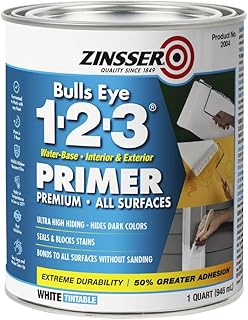
Zinsser Bulls Eye 1-2-3 is the fastest primer in this guide by stated drying time, and it earns its place on repaired gypsum as the primer that lets a one day preparation schedule work. It is a water based all purpose primer, sealer and stain blocker that bonds to glossy surfaces without sanding, and the maker lists plaster, concrete, gloss enamels, hardboard, glass and tile among the surfaces it bonds to. On a repaired gypsum wall, its value is speed: the repair is sanded and cleaned in the morning, the primer goes on, and the plaster can start the same day.
- Base: water based modified acrylic primer
- Dry time: touch dry in 30 minutes, recoat in one hour
- Coverage: 400 to 450 square feet per gallon
- Application: brush, roller or spray
- Best for: fast preparation of repaired gypsum on a one day schedule
Full adhesion and hardness develop in seven days, which is the number that matters for the long term: the plaster can go on after the one hour recoat time, but the primer film keeps hardening underneath, so the wall should not be rushed into heavy use or hard burnishing in the first week. The primer can be tinted to improve hide under darker plaster colors, and it can be thinned with no more than ten fluid ounces of clean water per gallon if needed. It is not meant for floors or for surfaces that stay wet, and it should be topcoated within thirty days. On repaired gypsum, Bulls Eye 1-2-3 is the primer to choose when the schedule is tight and the repair is sound, because its stated one hour recoat time is the fastest honest number in this guide.
INSL-X Stix
INSL-X Stix is a waterborne bonding primer made from urethane modified acrylic, and its stated drying time of three to four hours to recoat makes it the middle ground in this guide: slower than the fastest acrylic primers, faster than the mineral and silicate primers, and strong enough for the hardest surfaces a repaired gypsum wall can present. It is built for glossy paints, tile, glass and pre-coated siding, and it levels to a smooth surface, cleans up with soap and water, and can be top coated with almost any product. On repaired gypsum where the old paint around the repair is a hard gloss enamel, Stix gives a tenacious bond that standard primers cannot match.
- Base: waterborne urethane modified acrylic primer
- Dry time: touch dry in 30 minutes, recoat in three to four hours
- Coverage: 300 to 400 square feet per gallon
- Application: brush, roller or spray
- Best for: repaired gypsum beside glossy enamel paint
The primer has a volume solids content of 40 percent, with a wet film thickness of 4.0 to 5.3 mils drying to 1.6 to 2.1 mils, and it hardens at temperatures as low as 35 degrees Fahrenheit, which helps in cool rooms. It should not be thinned, and full cure takes three to four days. Airless sprayers should run at 2,200 to 2,500 PSI with a 0.013 to 0.017 tip, and the primer is ready for a topcoat in three to four hours. For a repaired gypsum wall where the repair sits beside glossy old paint, Stix is the primer whose stated drying time fits a single working day with a comfortable margin, and whose bond is strong enough for the slickest paint the wall can offer.
Portola Limeproof Undercoat
Portola Limeproof Undercoat is an acrylic primer made with 100 percent acrylic resin, created for use with Portola Lime Wash and designed to give a more consistent appearance and uniform absorption of the lime finish. On repaired gypsum, that even absorption is the trait that matters most, because a patch that absorbs faster than the surrounding gypsum will show the repair as a pale outline in the finished lime plaster. The undercoat can be used over previously painted interior and exterior surfaces, and it is applied with a brush, roller or sprayer, which makes it easy to lay on evenly across a repaired wall.
- Base: acrylic primer made with 100 percent acrylic resin
- Dry time: see product page for drying guidance
- Coverage: 150 to 200 square feet per gallon
- Application: brush, roller or spray
- Best for: even absorption of lime finishes over repaired gypsum
The maker advises two coats of an all purpose stain blocking drywall primer on new drywall or patched walls before the Limeproof Undercoat goes on, and that sequence is the right one for a repair: seal the patch, then even out the absorption, then start the lime finish. Semi gloss painted surfaces should be de-glossed and cleaned before two coats of the undercoat, and a bonding primer may be needed when painting over existing lime wash, because the high pH and chalky nature of lime wash needs a firm grip layer. The undercoat is sold in quart, gallon and five gallon sizes, with one gallon covering 150 to 200 square feet. For a repaired gypsum wall that will carry a lime finish, Limeproof Undercoat is the primer that states its job most plainly: make the wall absorb evenly, so the finish looks like one wall instead of a wall with a repair in it.
Faux Effects Olde Worlde Quartz Priming Coat
Faux Effects Olde Worlde Quartz Priming Coat is a quartz priming coat for rendered mortars, concrete and gypsum plasters, and it is the primer that adds a fine, even tooth to a repaired gypsum wall while also serving as a colored base coat under textured finishes. It forms a thin coating with an attractive matte finish, and it is made for repainting existing textured substrates as well as for priming new ones. On repaired gypsum, that thin matte coat hides the slight difference in texture between the filler and the board, and it gives the trowel a consistent surface to work against from one edge of the repair to the other.
- Base: quartz priming coat for mortars, concrete and gypsum plasters
- Dry time: see product page for drying guidance
- Coverage: see product page for size and coverage details
- Application: brush, roller or spray
- Best for: textured tooth and colored base over repaired gypsum
The priming coat can be used as a colored base coat under a variety of textured finishes, which helps coverage on a repaired wall where the finish color is strong or dark. It is appropriate for interior and exterior surfaces, and it promotes good adhesion while simplifying the application of the coats above it. Because it is a thin coating rather than a heavy build coat, it does not hide the shape of the wall, and the repair still needs to be flat and smooth before it goes on. For a repaired gypsum wall where the finish will be textured and the base color matters, Olde Worlde Quartz Priming Coat is the primer that gives both the tooth and the color base in one coat, and it rolls on easily across a full wall.
Meoded Quartz Primer
Meoded Quartz Primer is a water based, 100 percent acrylic, quick drying textured primer, and its stated drying time of three to five hours makes it the primer to plan a plaster day around. It is made to be the only primer used underneath all Meoded interior and exterior decorative plasters, and the fine quartz texture gives the plaster a uniform surface to grip while helping the trowel draw the plaster more evenly across the wall. On repaired gypsum, that texture is valuable because it bridges the slight difference between the filler and the board, giving the plaster one consistent surface to work on.
- Base: water based, 100 percent acrylic textured primer
- Dry time: three to five hours before plaster
- Coverage: 300 to 500 square feet per gallon
- Application: brush, roller or spray
- Best for: Meoded plaster systems over repaired gypsum
The maker is clear about the order of work. New drywall gets a PVA primer first and is left to dry fully, while a sound flat painted wall can take the Quartz Primer directly after cleaning and repair. Glossy surfaces need a light sanding, a dusting down, and a water based multipurpose primer before the Quartz Primer goes on. On porous surfaces the primer can be diluted with up to one quarter water, and one quart covers between 75 and 125 square feet. The primer is low in volatile organic compounds and cleans up with warm soapy water. For a repaired gypsum wall inside a Meoded plaster system, the three to five hour drying time is the number that sets the day: prime in the morning, and the wall is ready for plaster in the afternoon, with the system primer and the plaster matched by the same maker.
San Marco Atomo
San Marco Atomo is a zero VOC, solvent free micronized fixative and sealer primer for indoor and outdoor mineral surfaces, and it is the primer to use first when a repaired gypsum surface is chalky, dusty or covered with several layers of old paint. Its specially formulated polymers penetrate deeply and consolidate chalky, weathered surfaces, giving lasting durability and a matte finish that optimizes paint adhesion while isolating alkaline substrates. On repaired gypsum, that penetration binds the filler and any loose surface material back to the wall, so the bonding primer above it has a sound, stable face to grip instead of a powdery one.
- Base: zero VOC solvent free micronized fixative
- Dry time: see product page for drying guidance
- Coverage: see product page for size and coverage details
- Application: brush, roller or spray
- Best for: consolidating chalky or multi-layer repaired gypsum before bonding
Atomo is made in Italy by Colorificio San Marco, and it is sold in one liter and five liter sizes for indoor and outdoor use. Its deep penetration is the trait that matters most on a repaired wall with a doubtful surface, because a bonding primer laid over chalk or dust will peel away with the chalk underneath it, while a consolidating fixative locks that material down first. The matte finish it leaves gives an even absorption surface that enhances adhesion and longevity of the coats above. For a repaired gypsum wall where the surface is chalky, patched or layered with old paint, Atomo is the quiet first step that avoids the most expensive kind of failure, and it should be allowed to dry fully before the bonding coat goes on.
| Primer | Base and key trait | Coverage | Stated dry time |
|---|---|---|---|
| Novacolor Decofix | Water based microemulsion fixative | Eight to eighteen square meters per liter | Touch dry 30 to 40 minutes, recoat after two hours |
| Zinsser Bulls Eye 1-2-3 | Water based modified acrylic primer | 400 to 450 square feet per gallon | Touch dry 30 minutes, recoat in one hour |
| INSL-X Stix | Urethane modified acrylic bonding primer | 300 to 400 square feet per gallon | Touch dry 30 minutes, recoat in three to four hours |
| Portola Limeproof Undercoat | Acrylic primer, 100 percent acrylic resin | 150 to 200 square feet per gallon | See product page |
| Faux Effects Olde Worlde Quartz Priming Coat | Quartz priming coat for gypsum plasters | See product page | See product page |
| Meoded Quartz Primer | Water based acrylic with fine quartz texture | 300 to 500 square feet per gallon | Three to five hours |
| San Marco Atomo | Zero VOC micronized fixative | See product page | See product page |
How to choose
Let the stated drying time set the schedule
The first step in choosing a primer for repaired gypsum is to read the drying time and build the day around it. A primer that is ready to recoat in one hour lets the applicator prime in the morning and start plastering the same day, which suits a tight schedule and a single room. A primer that needs two hours gives a comfortable morning of preparation and an afternoon of plastering. A primer that needs three to five hours, or eight to twelve, forces an overnight wait, and that wait is not wasted time: the slower primers in this guide use it to form a stronger bond. Plan the job around the slowest drying product in the system, not the fastest, and keep the room at the temperature the data sheet asks for, because cool air and high humidity stretch every drying time the maker states. A wall that feels dry to the touch is not always ready for plaster, and the recoat time on the data sheet is the number to follow.
Check whether the repair needs consolidation first
Not every repair needs a consolidating primer, but a powdery or chalky repair always does. Rub a finger across the sanded filler: if it picks up a pale dust, the surface is chalky and a bonding primer laid straight over it will peel away with the chalk underneath. A penetrating fixative such as Decofix or Atomo binds that surface back together and gives the bonding primer a sound face to grip. If the finger comes away clean, the repair is sound and a bonding primer or quartz primer can go straight on. That one minute check saves the cost of stripping a failed plaster coat, and it is the most useful test in the whole preparation sequence. Always clean the wall after sanding, because dust in the pores of the filler will block the primer just as surely as chalk will.
Match the primer to the plaster that follows it
A lime plaster wants a mineral or quartz primer that stays breathable and alkaline friendly, while an acrylic plaster is happy over a high adhesion acrylic primer with a fine grit. When the primer and the plaster share a maker, the system has already been matched for absorption, texture and drying order, and the instructions will tell you exactly how long to wait between coats. When they come from different makers, read both data sheets side by side and check three points: the primer must stay breathable enough for the plaster above it, it must leave a fine tooth for trowel work, and it must cure fully before the plaster goes on. A primer that seals the wall completely can trap moisture under a lime plaster, while a primer that stays too absorbent can pull water out of the plaster before it has time to set. Getting this match right is worth more than any single product claim.
Common mistakes
The most common mistake on repaired gypsum is starting the plaster before the repair has cured. Filler and patching compound need time to dry through their full depth, not just at the surface, and a repair that feels dry on top can still be soft underneath. Plaster laid over a soft repair will crack along the edge of the patch as the filler finishes drying beneath it. Always follow the filler maker drying time, and wait longer in cool or damp rooms. A second mistake is skipping the dust check after sanding: the sanding dust sits in the pores of the filler and the board, and a primer laid over that dust bonds to the dust, not to the wall. Vacuum the wall, wipe it down with a damp cloth, and let it dry fully before priming. A third mistake is applying the primer too thickly over the repair in the hope of hiding it; a thick coat dries unevenly, stays soft in the middle, and can wrinkle under the plaster. Thin, even coats at the coverage the maker states are always better. Finally, many repairs fail because the primer was not allowed to reach its stated recoat time: the plaster went on while the primer was still soft, and the two layers moved at different rates as they dried. Following the recoat time on the data sheet avoids all of these failures for the cost of a little patience.
FAQ
How long must a gypsum repair cure before priming?
Follow the filler maker drying time, and add extra time in cool or damp rooms. Most patching compounds need at least a full day to dry through their depth, and deep fills can need two days or more. The surface should feel hard and cool, not soft or damp, and a finger pressed firmly to the filler should leave no mark. New gypsum surfaces should cure for about four weeks before a penetrating fixative goes on, according to the makers of the fixatives in this guide. Rushing this step is the most common cause of cracks that follow the outline of a repair in the finished plaster.
What does touch dry mean compared with recoat time?
Touch dry means the surface feels dry when touched lightly, and it is the earliest sign that the primer is setting. Recoat time is the time after which the next coat can go on safely, and it is always longer than the touch dry time. Full cure is longer still: the time the primer film needs to reach its full adhesion and hardness, which can be three to seven days depending on the product. Plaster can go on after the recoat time, but the wall should not be put into heavy use until the primer has fully cured. Always follow the recoat time on the data sheet, not the touch dry time, when planning the plaster coat.
Can I use a fast drying primer to save a day on the schedule?
Yes, when the repair is sound and the old paint is not glossy, a fast drying primer with a one hour recoat time can save a full day on the schedule. The trade off is bond strength: the fastest primers are acrylic bonding primers, and they grip by adhesion rather than by the chemical bond of a silicate primer or the deep penetration of a fixative. On a sound repair with flat paint, that trade off is fine. On a chalky repair, a glossy wall or a lime plaster system, the slower primer is the safer choice, and the day saved is not worth the risk of a failed finish.
Should I prime the whole wall or only the repaired area?
Prime the whole wall. Priming only the repair leaves a visible difference in absorption between the patch and the surrounding gypsum, and the plaster will dry at different rates across that boundary, showing the outline of the repair in the finish. A full coat of primer evens out absorption across the whole wall, so the plaster dries as one surface. Spot priming can work as a first step on a large repair, but it should always be followed by a full coat over the entire wall before the plaster goes on.
How do I know if the primer has dried enough for plaster?
The wall should feel fully dry and firm everywhere, with no cool or tacky patches, and the stated recoat time on the data sheet should have passed. Press a fingertip firmly to the primer in several places, including over the repair and over the surrounding gypsum: if it feels cool, soft or tacky anywhere, wait longer. In a cool or damp room, add extra hours beyond the stated time. A moisture meter can confirm the wall is dry, but the simplest check is time plus touch, and patience here is far cheaper than stripping a failed plaster coat.
Conclusion
Repaired gypsum rewards the applicator who plans by the clock and prepares by the book. The primers in this guide give you stated drying times you can build a schedule around, from a one hour recoat for a fast acrylic primer to a full day for an insulating primer, and they cover the real range of repairs, from a sound patch beside flat paint to a chalky repair beside glossy enamel. Let the repair cure fully, clean off every trace of dust, consolidate the surface if it is powdery, and lay on the bonding primer in thin, even coats. Give the primer its full stated drying time before the plaster goes on, and the repair will disappear under a Venetian plaster finish that holds its polish for years.
Related guides
More from Amazon
Programs that pair well with the guide above. Offers and eligibility are set by Amazon and may change.
Free shipping on eligible items, Prime Video and more. Eligible new members can start with a free trial.
Start a Prime free trialAudiobooks and podcasts to listen to on the go. Eligible new members can start with a free trial.
Try Audible freeAd-free music streaming. Eligible new subscribers can start with a free trial.
Try Music Unlimited freeA free business account with business pricing and bulk-buying tools for work, shop or home office.
Create a business accountAs an Amazon Associate we earn from qualifying purchases.
More ways to save on your next finish
Programs that pair well with the guide above. Offers and eligibility are set by Amazon and may change.
A free business account with business pricing and bulk-buying tools for work, shop or home office.
Create a business accountFast, free shipping on eligible items, plus Prime Video and more. Eligible new members can start with a free trial.
Start a Prime free trialRead from a huge library of eBooks, including how-to guides and cookbooks. Eligible new members can start with a free trial.
Try Kindle UnlimitedAudiobooks and podcasts for the commute, the garage or the kitchen. Eligible new members can start with a free trial.
Try Audible freeAs an Amazon Associate we earn from qualifying purchases. Using these links costs you nothing extra.



Write Your Review
No reviews yet. Be the first to share your experience!