
Key takeaways
- Compare adhesion promoting bonding primers for Venetian plaster on painted drywall accent walls, with quartz texture, silicate binders and drying guidance.
As an Amazon Associate I earn from qualifying purchases. This post may contain affiliate links at no extra cost to you.
Our top picks at a glance
3 products from this guide, in the order reviewed below.


As an Amazon Associate we earn from qualifying purchases. Prices and availability can change.
An accent wall is the wall everyone looks at. It carries the polished Venetian finish, it catches the light from the window, and it sits behind the sofa or the bed where every flaw is in view. That is what makes the primer under it so important. A painted drywall accent wall is a sealed surface, and a heavy plaster coat needs an adhesion promoting primer to hold it there. Without that grip, the finish can sound hollow when tapped, lift at an edge, or show drag marks where the trowel pulled at a soft base. Choosing the best bonding primers for Venetian plaster with adhesion promoting formula for preparing painted drywall accent walls is therefore the first design decision of the whole project, not an afterthought. The primer decides whether the showpiece wall stays a showpiece.
The six primers below were picked for painted drywall accent walls in particular. Each one is a real product with published maker or retailer specifications, and each one brings a different kind of adhesion to the job. Some are quartz textured, which gives the plaster a mechanical key on a slick painted face. Others are silicate or mineral based, which bond with lime finishes. One is a general bond coat that grips glossy surfaces without sanding, and one is a micronized fixative that consolidates a wall before the primer coat. The differences between them are practical: how they grip, how they dry, how much they cover and which surfaces each maker lists. Read the entries with your own wall in mind, and use the comparison table after the product entries to put the key numbers side by side.
An accent wall also deserves a word about light. A polished Venetian finish changes with the light across the day, and a wall that looks even in flat daylight can show every lap mark under a lamp at night. That is why the primer coat has to be uniform. Roll it at full strength, keep a wet edge, and check the dried coat in raking light before the plaster goes on. The primer is invisible in the finished wall, but its quality is visible in every square foot of the finish.
Best products
Decora DOC Bonding Primer
- Bonding primer for porous and absorbent substrates before Venetian plaster and lime based finishes
- Regulates surface porosity for even absorption and proper adhesion
- Sold in a 5 liter size
- Suitable for use with lime based finishes from the Decora range
Decora DOC Bonding Primer leads this set because it is made to be the bond between a prepared wall and a Venetian plaster finish. The maker describes it as a bonding primer for use on porous, absorbent substrates before applying Venetian plaster and lime based finishes, and notes that it regulates surface porosity to ensure even absorption and proper adhesion of the topcoat. On a painted drywall accent wall, that matters in two ways. Where the paint is sound and sealed, the primer gives the plaster a prepared face to hold. Where the paint has worn thin or the drywall paper shows through, the primer evens out the absorption so the plaster does not set in patches. The maker states plainly that a correctly primed surface is essential for a consistent, professional result with Venetian plaster, and on an accent wall that consistency is the whole point. The 5 liter size suits a full accent wall, and the primer is listed for use with the Decora range of lime based finishes. For an accent wall that has to look flawless from every angle, DOC is the primer to start with.
Violante Primo Strato Mineral Primer
- Mineral primer with crushed marble, lime and quartz
- Coarse texture for maximum adhesion
- Roll on application
- See product page for coverage and drying figures
Violante Primo Strato Mineral Primer is a mineral primer with a base of crushed marble, lime and quartz, and its coarse texture is made for maximum adhesion. On a painted drywall accent wall, that coarse grain breaks up the slick paint face and leaves a tooth that a plaster coat can hold while it is being worked. The primer is applied by roller, which suits a large flat accent wall, and its mineral base shares its chemistry with a lime based finish, which helps the plaster set into a single mass with the base. The maker presents it as a base coat for Venetian plaster with a coarse texture for maximum adhesion. Published specification detail for this primer is limited, so coverage and drying figures should be taken from the product page before ordering. For an accent wall where the finish is a true lime plaster and the grip has to be absolute, Primo Strato is a strong pick.
Spiver Primer S
- Primer for smooth Venetian plaster finishes
- Sold in a 1 liter size
- See product page for coverage and drying figures
Spiver Primer S is a primer made for smooth Venetian plaster finishes, and it fits an accent wall that will carry a polished coat. An accent wall is usually the smoothest wall in the room, and the primer under a polished finish has to leave an even, fine key rather than a heavy grain that could show through the final polish. Primer S is presented as the primer for smooth Venetian plaster finishes, which is the right role on a painted drywall wall that has been sanded flat. The 1 liter size suits a small accent wall or a single feature panel, and the published specification detail available for this primer is limited, so coverage and drying figures should be taken from the product page before ordering. For a small accent wall with a smooth, polished finish, Primer S is a focused option.
Polar Clear Binding Primer
- High-adhesion primer for drywall, plaster, cement, stucco and wood
- Clear base coat for interior and exterior use
- Sold in a 33 fluid ounce size
- See product page for coverage and drying figures
Polar Clear Binding Primer is a high-adhesion primer made for drywall, plaster, cement, stucco and wood, and it earns its place here because adhesion is its whole purpose. A painted drywall accent wall is a closed surface, and a clear binding primer that is made to grip drywall and plaster is exactly what the wall needs before a heavy finish goes on. The primer is described as a high-adhesion primer for drywall, plaster, cement, stucco and wood, for interior and exterior use, and it comes in a 33 fluid ounce size that suits a single accent wall. Its clear base means it does not change the color of the wall underneath, which helps when the plaster coat is a light color and the base needs to stay neutral. Published specification detail is limited, so coverage and drying figures should be taken from the product page before ordering. For an accent wall where the primer has to grip a painted face and stay invisible, Polar Clear is a sound choice.
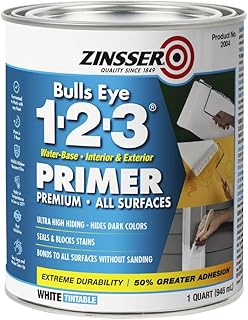
Zinsser Bulls Eye 1-2-3
- Water-based styrenated acrylic primer, sealer and stain blocker
- Bonds to wood, plaster, concrete, gloss enamels, hardboard, glass and tile
- Touch dry in about 30 minutes, topcoat in 1 hour
- Coverage of approximately 400 to 450 square feet per gallon
- Apply between 35 and 90 degrees Fahrenheit
- Volatile organic compounds under 100 grams per liter
Zinsser Bulls Eye 1-2-3 is a water-based styrenated acrylic primer, sealer and bond coat made for priming all surfaces, and it is the general purpose adhesion primer in this set. The maker states that it bonds to wood, plaster, concrete, gloss enamels, hardboard, glass and tile, and that it is designed for interior and exterior surfaces. The performance figures are strong: it sticks to glossy surfaces without scuff sanding, it dries to the touch in about 30 minutes, it can be topcoated in 1 hour, and full adhesion and hardness develop in 7 days. Coverage is approximately 400 to 450 square feet per gallon, and it can be applied between 35 and 90 degrees Fahrenheit with relative humidity under 85 percent. On a painted drywall accent wall, Bulls Eye 1-2-3 is the primer to use when the paint is glossy or the wall carries stains and marks that need sealing before the plaster goes on. It is not a quartz primer, so it leaves no texture of its own, which means it is best used as a first bond coat under a quartz or mineral primer when the plaster needs a textured key.
San Marco ATOMO
- Micronized solvent-free fixative for interior and exterior use
- High penetration formula for consolidating surfaces
- Use on highly chalking surfaces, thin old tempera and deteriorated paint
- See product page for coverage and drying figures
San Marco ATOMO is a micronized solvent-free fixative, and it closes this set as the consolidating primer for an accent wall with problem areas. The San Marco guidance for Stucco Veneziano lists ATOMO for highly chalking surfaces, thin layers of old tempera and deteriorated paints, and for bonding a coat of fixative before the plaster goes on. On a painted drywall accent wall, ATOMO is the primer to use where the old paint is powdery or where the drywall paper has been damaged and needs firming before the bonding primer. Its fine particles penetrate the surface and consolidate it, which gives the bonding primer a sound base to grip. Published specification detail for ATOMO is limited in the sources available, so coverage and drying figures should be taken from the product page before ordering. For an accent wall with chalky or damaged areas, ATOMO is the right first step before the main bonding coat.
| Primer | Base and grip | Dry time | Coverage | Best for |
|---|---|---|---|---|
| Decora DOC Bonding Primer | Bonding primer, regulates porosity | See product page | 5 liter size | Full accent walls with mixed surfaces |
| Violante Primo Strato Mineral Primer | Crushed marble, lime and quartz, coarse texture | See product page | See product page | Maximum grip under lime plaster |
| Spiver Primer S | Primer for smooth Venetian finishes | See product page | 1 liter size | Small accent walls, polished coats |
| Polar Clear Binding Primer | High-adhesion clear base coat | See product page | 33 fluid ounce size | Invisible grip on painted drywall |
| Zinsser Bulls Eye 1-2-3 | Water-based styrenated acrylic bond coat | Touch dry 30 minutes, topcoat 1 hour | 400 to 450 sq ft per gallon | Glossy paint and stained walls |
| San Marco ATOMO | Micronized solvent-free fixative | See product page | See product page | Chalky or damaged areas before priming |
How to choose
Start with the paint film
An accent wall is usually painted, and the paint film decides the primer. Glossy paint needs a primer that grips a slick face, which is where Bulls Eye 1-2-3 earns its place, since the maker states it bonds to gloss enamels without scuff sanding. Flat paint needs a primer that evens absorption, which is where DOC or a quartz primer fits. Chalky or powdery paint needs a consolidating fixative such as ATOMO before the bonding coat. Read the paint first, then pick the primer that lists that paint condition in its own guidance.
Match the primer to the finish
A smooth polished Venetian coat needs a fine, even key, while a medium lime finish needs a deeper tooth. A coarse mineral primer suits a heavy lime coat on an accent wall, because the grain gives the plaster something to hold while it is being worked. A fine quartz primer suits a polished coat, because a coarse grain can show through the final polish. A clear binding primer suits a light colored finish, because it does not change the color of the base. Decide the finish first, then pick the primer grade that matches it.
Think about the light
An accent wall is lit on purpose, and light shows everything. A primer coat with lap marks or thin spots will show through the plaster as uneven color or texture. Roll the primer at full strength, keep a wet edge across the whole wall, and work in steady light so you can see the wet film. Check the dried coat in raking light before the plaster goes on, and touch up any thin area. The extra check takes minutes and saves a wall that would otherwise need a second plaster coat to hide the base.
Plan for the full wall in one session
An accent wall should be primed in one continuous session so the primer film dries as a single coat. A wall primed in two sessions can show a line where the first coat dried and the second began, and that line can show through the plaster. Measure the wall, check the coverage figure on the product page, and make sure you have enough primer open before you start. A 5 liter size suits a full wall, while a 1 liter size suits a small panel. Running out halfway across the wall is the mistake that leaves a visible seam.
Common mistakes
The most common mistake on a painted drywall accent wall is to skip the primer and trust the paint to hold the plaster. Paint is made to hold itself to the wall, not to hold a heavy plaster coat. A bonding primer is the layer that carries the weight of the finish, and skipping it leaves the plaster bonded to a paint film that was never made for the load. Prime the wall, even when the paint looks sound.
A second mistake is to prime over dust and grease. An accent wall collects dust on its surface, and a kitchen or hallway wall can carry a thin film of grease. A primer rolled over dust bonds to the dust, not to the wall, and the plaster will follow the primer off the wall when the bond fails. Wash the wall, let it dry, and then prime. The cleaning takes minutes and makes the primer hold.
A third mistake is to plaster before the primer is fully dry. A primer that feels dry to the touch can still be soft underneath, and a trowel will drag it and mix it into the plaster. Bulls Eye 1-2-3 lists a 30 minute touch dry and a 1 hour topcoat time, with full adhesion developing in 7 days, which is a useful reminder that touch dry and ready are not the same thing. Follow the drying time on the product page and add time in a cool room.
A fourth mistake is to use a standard paint primer where a bonding primer is needed. A general primer evens out a painted wall for another coat of paint, but it does not give a heavy plaster coat the grip it needs on a sealed face. A bonding primer, a quartz primer or a mineral primer is made for that job. The difference is in the texture and the binder, and it shows up only when the plaster goes on, which is too late to fix cheaply.
A fifth mistake is to apply the primer too thin. A thin, starved coat leaves bare paint showing through, and the plaster will bond to paint in those spots instead of to primer. Roll the primer on at full strength, keep a wet edge, and check the wall in raking light after the coat dries. Any thin or missed area should get a second pass before the plaster goes on.
A sixth mistake is to prime in the wrong conditions. A cold room slows drying and can leave the primer soft under the plaster, while a hot room or a wall in direct sun can dry the primer too fast and leave lap marks where one rolled section meets the next. Check the temperature and the humidity before starting, keep the room steady while the primer dries, and avoid priming an exterior wall when rain is expected within a day. A primer that dries at a steady pace gives the plaster a uniform base, and that uniform base is what the finished wall shows.
A seventh mistake is to mix primer and plaster systems without checking compatibility. A mineral primer under an acrylic plaster, or an acrylic primer under a true lime plaster, can work, but the combination should be one the makers accept. Some plaster makers list the primers they stand behind, and some primer makers list the finishes their product suits. When the two lists do not overlap, the bond between them is unproven, and a failure may only show up weeks after the work is done, when the plaster starts to sound hollow or lift at an edge. The safe route is to keep the primer and the plaster in the same system when the maker gives that guidance, and to check both product pages before buying when mixing brands.
FAQ
Do I need an adhesion promoting primer on a painted drywall accent wall?
Yes. Painted drywall is a sealed surface, and a heavy Venetian plaster coat needs an adhesion promoting primer to hold it there. A bonding primer, a quartz primer or a mineral primer gives the plaster a grip that paint alone cannot provide. Without it, the finish can sound hollow, lift at an edge or show drag marks where the trowel pulled at a soft base.
Can I use Zinsser Bulls Eye 1-2-3 alone under Venetian plaster?
Bulls Eye 1-2-3 is a strong bond coat and it grips glossy paint well, but it leaves no texture of its own. For a plaster coat that needs a textured key, use it as a first bond coat and follow with a quartz or mineral primer that leaves the grain the plaster needs. The combination gives both adhesion and texture, which is what a heavy finish requires.
How long should I wait after priming an accent wall before plastering?
Follow the drying time on the product page. Bulls Eye 1-2-3 lists a 30 minute touch dry and a 1 hour topcoat time, with full adhesion developing in 7 days. Quartz primers such as the Artsparx range list a 30 minute touch dry and a full dry in 24 hours. In a cool or damp room, allow extra time. The primer should be fully dry, not just dry to the touch, before the first plaster coat goes on.
Should the primer coat be visible under a light colored Venetian plaster?
A primer that dries white, such as Marcotherm, can show through a very light plaster coat if the plaster is applied thin. A clear primer, such as Polar Clear Binding Primer, does not change the color of the base. When the finish is a light color, a clear primer or a primer tinted to match the plaster is the safer choice. Check the product page for the primer color before buying.
Can I roll the primer on an accent wall or do I need a brush?
Most bonding primers in this guide can be brushed, rolled or sprayed. A roller covers a large accent wall quickly and leaves an even film, which is what the wall needs. Use a brush at edges and corners, keep a wet edge while rolling, and check the dried coat in raking light for thin spots before the plaster goes on.
Conclusion
An accent wall carries the best finish in the room, and it deserves the best primer under it. Decora DOC gives the wall an even bond across mixed surfaces, Violante Primo Strato gives the coarsest mineral grip, Spiver Primer S suits a smooth polished coat, Polar Clear Binding Primer grips without changing the wall color, Zinsser Bulls Eye 1-2-3 handles glossy paint and stains, and San Marco ATOMO firms the chalky areas before the main coat. Prepare the paint, pick the primer that matches the finish, roll it at full strength in one session and let it dry fully before the first plaster coat. The wall will repay that care with a finish that stays bonded, even and beautiful for years.
Related guides
More from Amazon
Programs that pair well with the guide above. Offers and eligibility are set by Amazon and may change.
Free shipping on eligible items, Prime Video and more. Eligible new members can start with a free trial.
Start a Prime free trialAudiobooks and podcasts to listen to on the go. Eligible new members can start with a free trial.
Try Audible freeAd-free music streaming. Eligible new subscribers can start with a free trial.
Try Music Unlimited freeA free business account with business pricing and bulk-buying tools for work, shop or home office.
Create a business accountAs an Amazon Associate we earn from qualifying purchases.
More ways to save on your next finish
Programs that pair well with the guide above. Offers and eligibility are set by Amazon and may change.
A free business account with business pricing and bulk-buying tools for work, shop or home office.
Create a business accountFast, free shipping on eligible items, plus Prime Video and more. Eligible new members can start with a free trial.
Start a Prime free trialRead from a huge library of eBooks, including how-to guides and cookbooks. Eligible new members can start with a free trial.
Try Kindle UnlimitedAudiobooks and podcasts for the commute, the garage or the kitchen. Eligible new members can start with a free trial.
Try Audible freeAs an Amazon Associate we earn from qualifying purchases. Using these links costs you nothing extra.



Write Your Review
No reviews yet. Be the first to share your experience!