
Key takeaways
- Compare seven kneeling pads for plaster installers working near low wall skirting, with honest foam, size, grip and comfort specs for long kneeling sessions.
As an Amazon Associate I earn from qualifying purchases. This post may contain affiliate links at no extra cost to you.
Our top picks at a glance
3 products from this guide, in the order reviewed below.


As an Amazon Associate we earn from qualifying purchases. Prices and availability can change.
Skirting work is knee work. A plaster installer runs a trowel along the bottom of a wall for hours, and the knees stay on the floor for the whole run. A hard floor does not forgive, and after an hour the knees feel every pebble, every tile edge and every grain of dried plaster under the pad. The best kneeling pads for plaster installers for working near low wall skirting are the tools that make that work bearable, and the difference between a good pad and a thin one is the difference between a full day of work and a day cut short by sore knees.
A kneeling pad is a simple tool with a simple job: spread the load across the knee, cushion the hard floor, and stay put while the body moves. The seven products in this roundup cover that job from every angle, from the Klein 60135 tradesman pad built for the trade to the Ergodyne ProFlex 380 standard foam slab, the big Husky pad that covers the most floor, the thick Gorilla Grip and WORKPRO pads for hard floors, the rolling MaxWorks creeper that moves along the wall, and the extra-thick Fiskars pad for knees that ache first.
Choosing a pad means matching it to the floor, the run and the knees. A thick pad suits a concrete floor, a large pad suits a long skirting run, and a rolling creeper suits a job where the installer moves sideways along the wall for hours. A pad that slides on tile is worse than no pad at all, and a pad that soaks up water is a cold, heavy pad by lunchtime. This roundup compares seven products on thickness, size, foam, grip and honest specs, so the pad you buy fits the floor and the job.
Every product below was checked against a real listing with real dimensions and real features, and the comparison table near the end of this roundup lines the seven products up side by side. Where a spec was not published, the table says so instead of guessing. Use this roundup to pick the pad that fits the skirting run, and the knees will last the day.
Knee health is a long game, and a skirting job is won or lost over years, not days. A plaster installer who kneels for hours every day will feel it in the knees within a few years, and the pad is the cheapest protection the trade offers. The pad spreads the load, cushions the hard floor and keeps the knees off the cold concrete, which is what keeps them working year after year. Pair the pad with good habits, like standing up and stretching every hour, alternating which knee takes the weight, and never kneeling on a hard floor without a pad, even for a quick patch. A pad that is used every time is a pad that protects the knees for a career, not just for a day. A second pad in the van covers a crew member or a spare when the first pad is wet, and a pad that is shared between two installers should be wiped clean between uses.
Best products
Klein Tools Kneeling Pad 60135
The Klein Tools Kneeling Pad 60135 is the tradesman pad for a plaster installer who kneels on hard floors all day, and it leads this roundup because it is built for the trade rather than the garden. The pad measures 21 in by 14 in at 1 in thick, made from NBR foam that springs back instead of staying compressed after a long kneel. The closed-cell foam resists petroleum, so drips and spills sit on the surface instead of soaking in, and it is silicone-free, which matters on a plaster job where silicone contamination ruins a finish. A built-in handle carries the pad from room to room and hangs it on a hook at the end of the day. For working near low wall skirting, where the knees stay down for an hour at a time, the Klein pad is the pad that keeps its cushion.
- 21 in x 14 in, 1 in thick NBR foam
- Built-in handle for carrying and hanging
- Closed-cell foam resists petroleum; silicone-free
- Will not stay compressed over time
Ergodyne ProFlex 380 Kneeling Pad
The Ergodyne ProFlex 380 is the standard foam kneeling pad for static kneeling work, and it earns its place because it is a slab of closed-cell NBR foam with nothing to wear out. The pad measures 14 in by 21 in at 1 in thick, and the high-density foam will not compress over time, so the cushion on day one hundred matches the cushion on day one. The foam is water resistant and petroleum resistant, and it is non-conductive and silicone-free, which suits a plaster room where drips and dust are part of the day. A built-in handle makes the pad easy to carry and hang. For a plaster installer working near low skirting for hours, the ProFlex 380 is the pad that stays comfortable without straps or buckles.
- 14 in x 21 in x 1 in
- High-density NBR foam rubber; will not compress over time
- Water resistant and petroleum resistant
- Built-in handle; non-conductive, silicone-free
- Item 18380 black, 18381 orange
Husky Kneeling Pad
The Husky Kneeling Pad is the large soft foam pad from Home Depot, and it belongs here because its size covers both knees with room to spare. The pad measures 22 in by 15 in at 1.5 in thick, which is the biggest flat pad in this roundup, and the soft foam gives a deep cushion on a hard floor. The large surface lets a plasterer shift along a skirting run without lifting the pad every few minutes. The foam is soft enough for long kneeling yet firm enough to hold its shape. For a plaster installer who wants the biggest pad for the least fuss, the Husky pad is the one that covers the most floor.
- 22 in x 15 in x 1.5 in
- Soft foam cushion
- Large size covers both knees
- Home Depot house brand
Gorilla Grip Extra Thick Kneeling Pad
The Gorilla Grip Extra Thick Kneeling Pad is the thick foam pad for hard floors, and it earns its place because its high-density foam absorbs shock without bottoming out. The pad measures 17.5 in by 11 in at 1.3 in thick, a size that fits both knees and still fits in a tool bag. The foam is water resistant, so a damp floor or a spilled bucket does not soak through to the knees. The large cushion also works for elbows when the work drops low. For a plaster installer kneeling on concrete or tile near skirting, the Gorilla Grip pad is the thick cushion that keeps the knees comfortable.
- 17.5 in x 11 in x 1.3 in
- High-density foam
- Water resistant
- Large cushion for knees and elbows
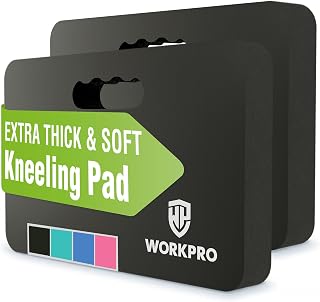
WORKPRO Extra Thick Kneeling Pad
The WORKPRO Extra Thick Kneeling Pad is the thick NBR foam pad for long kneeling sessions, and it belongs here because its cushion is built for hours, not minutes. The pad measures 17.5 in by 11 in at 1.5 in thick, and the soft NBR foam gives 70 percent shock absorbency, which spreads the load across the knee instead of letting it find the hard floor. The pad is large enough for both knees and light enough to carry from room to room. A 2-pack covers a crew or a spare for the van. For a plaster installer working a full skirting run, the WORKPRO pad is the thick cushion that lasts the day.
- 17.5 in x 11 in x 1.5 in
- Soft NBR foam cushioning
- 70 percent shock absorbency
- Also sold as a 2-pack
MaxWorks MaxxHaul 80748 Rolling Knee Creeper
The MaxWorks MaxxHaul 80748 is the rolling knee creeper for a plaster installer who moves along a wall, and it changes the job because the knees never leave the pad. The high-impact ABS frame carries five swivel casters that roll in any direction, so the installer glides along the skirting instead of standing up and kneeling down every few feet. An integrated tool tray holder keeps small tools and parts within reach, which matters under a vanity where the tools must stay close. The compact low-profile design keeps the body at floor level. For a long skirting run or a bathroom floor, the 80748 is the creeper that keeps the work moving.
- High-impact ABS frame
- Five swivel casters
- Integrated tool tray holder
- Compact low-profile design for floor-level work
Fiskars Extra-Thick Kneeling Pad
The Fiskars Extra-Thick Kneeling Pad is the thick pad for knees that need comfort first and features second, and it belongs here because comfort is the whole point of a kneeling pad. The extra-thick cushion spreads the load across the knee instead of letting it concentrate on the kneecap, which is what makes a long skirting session bearable. The thick foam holds its shape through the job and comes back for the next one. For a plaster installer whose knees feel the floor after an hour, the Fiskars pad is the thick cushion that buys comfort first.
- Extra-thick cushion
- Built for knees that ache after an hour
- Thick foam spreads the load
- See product page for dimensions
| Product | Key spec | Best for |
|---|---|---|
| Klein Tools Kneeling Pad 60135 | 21 in x 14 in x 1 in, NBR foam, handle | Best tradesman kneeling pad |
| Ergodyne ProFlex 380 Kneeling Pad | 14 in x 21 in x 1 in, NBR foam, handle | Best standard foam kneeling pad |
| Husky Kneeling Pad | 22 in x 15 in x 1.5 in, soft foam | Best large soft foam pad |
| Gorilla Grip Extra Thick Kneeling Pad | 17.5 in x 11 in x 1.3 in, high-density foam | Best thick budget foam pad |
| WORKPRO Extra Thick Kneeling Pad | 17.5 in x 11 in x 1.5 in, NBR foam, 70 percent shock absorbency | Best thick NBR foam pad |
| MaxWorks MaxxHaul 80748 Rolling Knee Creeper | ABS frame, 5 swivel casters, tool tray | Best rolling knee creeper |
| Fiskars Extra-Thick Kneeling Pad | Extra-thick cushion, comfort first | Best pad for aching knees |
How to choose
Thickness and foam density
Thickness is what spreads the load, and foam density is what keeps the cushion from bottoming out. A 1 in pad suits a short job on a smooth floor, while a 1.5 in pad suits a long day on concrete or tile. High-density foam holds its shape under the knee, while soft foam feels comfortable for an hour and then flattens. The Klein and ProFlex pads use NBR foam that springs back instead of staying compressed, which is why they last. For a full day of skirting work, buy the thickest pad that still fits in the tool bag.
Size and knee room
A pad must cover both knees with room to shift, because a narrow pad forces the knees together and a small pad leaves the shins on the hard floor. The Husky pad at 22 in by 15 in is the biggest flat pad in this roundup, and it covers the most floor. A 17 in pad suits a single knee station, while a 21 in pad suits a long run where the body moves sideways. Measure the space, then pick the pad that covers both knees with room to spare.
Grip and anti-slip
A pad that slides on a smooth floor is a hazard, because the knees slide off the foam and land on the tile. Look for a textured surface or an anti-slip base, and test the pad on the floor before the job starts. A pad with grip on both sides stays put on tile and keeps the knees on the foam. For a bathroom or a kitchen with smooth tile, grip matters as much as thickness.
Water and chemical resistance
A plaster room is a wet room, with water, limewash and plaster dust sharing the floor. A pad that soaks up water becomes heavy and cold by lunchtime, and a pad that absorbs chemicals can irritate the skin. Closed-cell foam resists water and petroleum, which is why the Klein and ProFlex pads use it. For a damp floor, pick a closed-cell pad that wipes clean and dries fast.
Rolling creeper or flat pad
A rolling creeper and a flat pad solve the same problem in different ways. A creeper rolls along the wall, so the installer never stands up and kneels down again, which saves the knees on a long skirting run. A flat pad is simpler, lighter and cheaper, and it fits in a tool bag. For a long run along one wall, a creeper like the MaxWorks 80748 keeps the work moving. For a short job or a tight room, a flat pad is enough.
Carry and storage
A pad that is hard to carry stays in the van, and a pad that stays in the van does no good. A built-in handle makes a pad easy to carry from room to room and hang on a hook at the end of the day. The Klein and ProFlex pads both have handles, which is why they travel well. A pad that folds or stacks stores easily in a van full of tools. Pick a pad that is easy to carry, and it will be there when the knees need it.
Taking breaks and changing position
A good pad helps, but it does not replace breaks and movement. Stand up and stretch every hour, walk around the room, and let the knees straighten out before kneeling down again. Alternate which knee takes the weight, and shift the pad along the wall so the body does not twist to reach. A short break every hour keeps the knees fresh, and fresh knees do better work. Set a timer if the job makes it easy to forget, and take the break when it rings.
Common mistakes
Using a pad that is too thin is the most common mistake on a skirting job. A thin pad feels fine for ten minutes and then the knees find the hard floor. Buy a pad at least 1 in thick, and 1.5 in for a concrete floor or a full day of work.
Letting the pad slide on a smooth floor is a hazard that hurts the knees and the work. A pad that slides leaves the knees on the tile, and the installer spends the day chasing the pad. Pick a pad with grip, test it on the floor, and move the pad with the body instead of letting it drift.
Kneeling on debris is a mistake that a pad cannot fix. A pebble, a screw or a dried lump of plaster under the pad presses straight through the foam and into the knee. Sweep the floor before kneeling, and check the pad for debris every time it is moved.
Ignoring a wet floor turns a good pad into a cold, heavy sponge. A pad that soaks up water stays wet all day, and wet knees ache faster than dry ones. Use a closed-cell pad on a damp floor, wipe the floor dry where possible, and keep a spare pad in the van.
Leaving one pad in one spot for a long run forces the installer to stretch and reach, which strains the back and the knees. Move the pad along the wall as the work moves, and keep the trowel within easy reach. A pad that follows the work keeps the body in a comfortable position.
Storing a pad compressed under a pile of tools flattens the foam and kills the cushion. Store the pad flat or hanging by its handle, and keep heavy tools off it. A pad that is stored properly keeps its cushion for years.
Working through knee pain is a mistake that turns a sore knee into an injured one. Pain is the knee asking for a break, and a plasterer who ignores it will pay for it with days off work. Stop when the knees hurt, stand up, stretch, and let the knees rest before kneeling down again. A day with breaks is a day of good work, while a day that ends in injury is a day lost.
FAQ
How thick should a kneeling pad be for plaster work?
At least 1 in thick, and 1.5 in for a concrete floor or a full day of kneeling. Thicker foam spreads the load across the knee and keeps the hard floor from pressing through. The WORKPRO and Husky pads in this roundup run 1.5 in thick.
Is a gel pad or a foam pad better for kneeling?
Foam is the standard for plaster work, because it is light, dries fast and resists water when it is closed-cell. Gel pads feel soft but are heavy and can leak if punctured. For a trade job, a high-density foam pad is the practical choice.
Can I use a garden kneeling pad for plaster work?
A garden pad works for a short job, but it is often too thin and too soft for a full day on a hard floor. Trade pads like the Klein 60135 and the ProFlex 380 use denser foam that holds its shape longer. For occasional use, a garden pad is fine. For daily work, buy a trade pad.
How do I clean a foam kneeling pad?
Wipe the pad with a damp cloth and let it dry fully before storing it. Closed-cell foam wipes clean easily, and it does not hold water. For dried plaster, brush the surface gently and wipe again. Never store a pad wet.
Do rolling knee creepers damage floors?
No, when the casters are clean. The MaxWorks creepers use swivel casters that roll smoothly on hard floors. Sweep the floor first, because grit under a caster can scratch a polished surface. For a delicate floor, use a flat pad instead.
When should I replace a kneeling pad?
Replace a pad when the foam stays compressed, the surface cracks, or the pad no longer cushions the knee. A good foam pad lasts years with proper storage, but a pad that has flattened under a pile of tools is finished. If the knees feel the floor through the pad, it is time for a new one. Should I wear knee pads as well as using a kneeling pad? A kneeling pad is enough for most skirting work, because the pad spreads the load across the whole knee. Strap-on knee pads help when the job needs kneeling on a rough or uneven floor where a flat pad will not sit, or when the installer moves around too much for a pad to follow. Many plasterers use a flat pad for long runs and strap-on pads for short, moving jobs. Use the tool that fits the job.
Conclusion
A kneeling pad is a small tool that saves the knees, and the seven products in this roundup cover every skirting job. The Klein 60135 leads for trade work, the ProFlex 380 is the standard foam slab, and the Husky pad covers the most floor. The Gorilla Grip and WORKPRO pads bring thickness for hard floors, the MaxWorks 80748 creeper keeps the work moving along the wall, and the Fiskars pad buys comfort for knees that ache first. Pick the pad that fits the floor and the run, keep it clean and dry, and the knees will last the day. A pad that is used every time, paired with breaks and good habits, is the cheapest way to keep the knees working for a career.
Related guides
More from Amazon
Programs that pair well with the guide above. Offers and eligibility are set by Amazon and may change.
Free shipping on eligible items, Prime Video and more. Eligible new members can start with a free trial.
Start a Prime free trialAudiobooks and podcasts to listen to on the go. Eligible new members can start with a free trial.
Try Audible freeAd-free music streaming. Eligible new subscribers can start with a free trial.
Try Music Unlimited freeA free business account with business pricing and bulk-buying tools for work, shop or home office.
Create a business accountAs an Amazon Associate we earn from qualifying purchases.
More ways to save on your next finish
Programs that pair well with the guide above. Offers and eligibility are set by Amazon and may change.
A free business account with business pricing and bulk-buying tools for work, shop or home office.
Create a business accountFast, free shipping on eligible items, plus Prime Video and more. Eligible new members can start with a free trial.
Start a Prime free trialRead from a huge library of eBooks, including how-to guides and cookbooks. Eligible new members can start with a free trial.
Try Kindle UnlimitedAudiobooks and podcasts for the commute, the garage or the kitchen. Eligible new members can start with a free trial.
Try Audible freeAs an Amazon Associate we earn from qualifying purchases. Using these links costs you nothing extra.



Write Your Review
No reviews yet. Be the first to share your experience!