
Key takeaways
- Compare plaster sample board tool kits for limewash colour layers: flexible blades, small trowels and panel sets that help you record accurate colour swatches.
As an Amazon Associate I earn from qualifying purchases. This post may contain affiliate links at no extra cost to you.
Our top picks at a glance
3 products from this guide, in the order reviewed below.


As an Amazon Associate we earn from qualifying purchases. Prices and availability can change.
Limewash colour is a moving target. A wash that looks deep and chalky when wet can dry several shades lighter, and a second coat can shift the tone again in ways that are hard to predict from a tin or a printed chart. That is why decorators and plasterers build sample boards before they touch a wall, and why the tools used on those boards matter as much as the limewash itself. The best plaster sample board tool kits for testing limewash color layers give you the control to lay down thin, even coats on small panels, to repeat the same stroke the same way on every swatch, and to compare pigment loads side by side without the tools getting in the way.
A good kit for this job is not the biggest kit you can buy. Sample boards are small, often no larger than a sheet of paper or a modest offcut of board, and the coats are thin. What you need is a set of small, well-finished trowels with blades that flex just enough to spread a watery wash without ridges, plus a way to hold and move wet panels without smearing them. The kits in this guide were picked for exactly that work: compact trowels in several sizes, polished edges that do not drag lines through a fresh coat, and handles that stay comfortable through a long afternoon of swatch work. Several of them also include wider blades or a hawk-style holder, which helps when you want one large panel that shows a colour at full scale next to your small swatches.
Colour work also rewards consistency. If you change trowels halfway through a set of panels, the texture changes, and texture changes how light hits the surface, which changes how the colour reads. Using one kit across a whole series of panels keeps the application method steady, so the only variable is the limewash itself: the pigment, the dilution, and the number of coats. That discipline turns a pile of painted offcuts into a reliable record you can show a client, pin to a studio wall, or keep as a reference for the next project in the same palette.
This guide compares seven kits that suit limewash colour panels, from three-piece Venetian trowel sets with fine polished blades to a four-piece smoothing spatula set with widths up to 800 mm for full-size panels. Each one is described with the specifications the maker lists, and each section notes where it fits best: thin single coats, layered colour builds, large comparison panels, or quick swatch runs. The buying guide at the end covers blade thickness, panel size, cleaning, and how to set up a simple labelling system so your panels stay useful months after the limewash has dried.
Quick verdict
If you want one kit that covers most limewash colour panel work, start with the Goldblatt 3 Pieces Venetian Plaster Trowel Set. Its three trapezoid blades in graduated sizes handle small swatches and medium panels alike, the 0.7 mm polished stainless steel blades hold a clean edge, and the soft-grip handles make repeated thin coats comfortable. For the thinnest coats and the most delicate colour layering, the 3-Pack Stainless Steel Venetian Plaster Finishing Trowels at 0.3 mm and the Venetian Plaster Japanese Finishing Trowel Set are the flexible options, with wooden handles and pointed or rounded shapes that suit fine detail work on small panels.
When your panels get larger, the Bellota 5906SET earns its place: four smoothing spatulas from 200 mm to 800 mm with a telescopic handle and a carrying case, made for long, even passes across a full-size board. The Lasnten Drywall Finishing Tools Kit adds a different kind of help, an 11-inch trowel paired with a 13-inch aluminium mortar board, so you can carry a small amount of mixed limewash to the panel and keep your working surface tidy. The Goldblatt 3 Pieces Drywall Trowel Set with Wood Handles rounds out the list for broad, flat colour fields, with carbon steel blades in 14, 12 and 8 inches. Between them, these seven kits cover every stage of limewash colour work, from the first pale wash to the final deep coat.
| Product | Key spec | Best for |
|---|---|---|
| Goldblatt 3 Pieces Venetian Plaster Trowel Set | 0.7 mm polished stainless steel, 3 trapezoid blades | All-round limewash colour panels |
| 3-Pack Stainless Steel Venetian Plaster Finishing Trowels 0.3 mm | 0.3 mm polished stainless steel, wooden handles | Very thin colour coats |
| Venetian Plaster Japanese Finishing Trowel Set 3 Pieces | 0.3 mm polished stainless steel, flat, round and pointed shapes | Detail work on small swatch panels |
| Venetian Plaster Trowel Set 2 Pieces | 0.7 mm stainless steel, 8 x 3 in and 10 x 4 in | Simple two-size swatch work |
| Bellota 5906SET Smoothing Spatula Set | 0.3 mm flexible blades, 200 to 800 mm widths | Large full-size colour panels |
| Lasnten Drywall Finishing Tools Kit | 11 in stainless trowel, 13 in aluminium mortar board | Carrying mixed limewash to panels |
| Goldblatt 3 Pieces Drywall Trowel Set with Wood Handles | Carbon steel blades, 14, 12 and 8 in | Broad flat colour fields |
How we chose
The kits in this guide were chosen for the specific demands of limewash colour panels rather than for general wall plastering. Blade finish came first: a polished edge with rounded corners leaves fewer drag lines in a thin wash, and drag lines read as colour streaks once the coat dries. Blade thickness came next, because thin limewash coats need a blade that can flex slightly and lay the wash down without ridges, while still holding enough stiffness to keep the coat even. Sets that offer more than one size earned a place, since colour panels range from small swatches to full boards, and one blade rarely suits both.
Handle comfort mattered too, because colour panel sessions run long: dozens of panels, several coats each, with drying time in between. Handles in soft grip, rubber, or shaped wood reduce fatigue and keep strokes steady from the first panel to the last. Set contents were weighed as well: a kit that adds a carrying case, a telescopic handle, or a mortar board helps keep panels and tools organised, which matters when wet panels are drying in a row and every one needs to stay labelled. Finally, each kit had to be a real, currently listed product with specifications published by the maker or the retailer, so the details in this guide come from product pages rather than from guesswork.
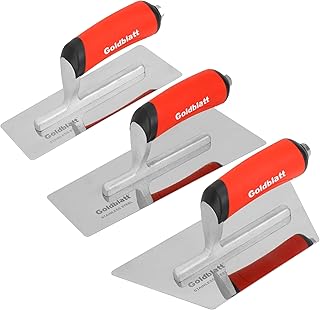
Goldblatt 3 Pieces Venetian Plaster Trowel Set
- Blade thickness: 0.7 mm polished stainless steel
- Blade shape: beveled trapezoid with rounded corners
- Handles: soft-grip ergonomic handles on an aluminum shank
- Sizes: 2-3/4 x 3-5/32 in, 3-5/32 x 3-15/16 in, 4-59/64 x 5-5/16 in
- Pieces: 3
The Goldblatt set is the most balanced kit in this guide for limewash colour panels, and that balance is why it leads the list. Three graduated trapezoid blades cover the full range of panel sizes a colour series needs: the smallest blade lays a neat swatch on a narrow strip, the middle blade suits the standard sample board, and the largest blade spreads a wash across a broader panel without leaving a hard edge where one pass meets the next. The 0.7 mm polished stainless steel blades are stiff enough to keep a thin coat even, yet the beveled edges and rounded corners keep the blade from scoring lines into a fresh wash, which is the most common way a colour panel ends up looking streaky. The mirror finish on the blades resists rust and wipes clean, so dried limewash does not build up and contaminate the next colour. Soft-grip handles keep the hand relaxed through long sessions, and the aluminum shank welded to the blade gives the tool a solid feel without excess weight. For a decorator building a full colour series, this is the kit that stays in the hand from the first pale wash to the last deep coat.
Pros: Three graduated sizes suit small swatches and medium panels; polished beveled blades reduce drag lines; soft-grip handles stay comfortable through long sessions.
Cons: No carrying case is listed with the set; the largest blade is still small for full-size wall panels.
3-Pack Stainless Steel Venetian Plaster Finishing Trowels 0.3 mm
- Blade thickness: 0.3 mm polished stainless steel
- Handles: wooden ergonomic handles
- Shapes: flat trapezoid, round-end, pointed toe
- Sizes: 9.5 x 3.5 in, 9.5 x 3 in, 9.5 x 2.8 in
- Pieces: 3
Thin limewash coats ask for a thin blade, and this three-piece set answers with 0.3 mm polished stainless steel across all three tools. The thinner blade flexes more than a 0.7 mm blade, which helps when you are spreading a watery wash in a single whisper of a coat: the blade follows the panel instead of fighting it, and the wash settles into a flat film rather than a ridged one. Each of the three shapes has a job on a colour board. The flat trapezoid covers the main field of a panel, the round-end shape works along the edges of a swatch without digging in, and the pointed toe reaches into corners and narrow strips where a colour change or a masked edge needs a clean line. Wooden ergonomic handles give a warm, steady grip that suits slow, careful strokes, and the polished blades clean up with a wipe, which matters when you move from one pigment to the next and cannot afford cross-contamination. This is the set to reach for when the colour difference between coats is subtle and the application has to be as quiet as the palette.
Pros: Thin flexible blades suit very thin limewash coats; three distinct toe shapes cover fields, edges and corners; wooden handles give a steady grip for slow strokes.
Cons: Thin blades need a light touch and can flex too much under firm pressure; no case is listed with the set.
Venetian Plaster Japanese Finishing Trowel Set 3 Pieces
- Blade thickness: 0.3 mm polished stainless steel
- Shapes: flat, round and pointed
- Handles: wooden handles
- Blade length: 9.5 in
- Pieces: 3
The Japanese finishing set brings the same thin 0.3 mm blade as the pack above, but with a different shape language that suits small, precise colour panels. The flat blade lays the main wash, the round blade softens transitions between two colours on one board, and the pointed blade draws a clean line where a masked stripe or a narrow test area begins. On a sample board, those transitions are where colour judgement happens: a client looks at how one shade meets the next, and a ragged edge makes the comparison harder to read. The 9.5-inch blades give enough length for smooth, unhurried passes, while the wooden handles keep the grip relaxed during the slow work of building up layered colour. Because the blades are polished and flexible, they leave very little marking on a fresh coat, which keeps each layer honest: what you see is the limewash, not the tool. For decorators who build colour boards with several shades on a single panel, this set is a precise, quiet partner.
Pros: Flat, round and pointed shapes suit multi-shade panels; thin flexible blades leave little marking; long blades support smooth, unhurried passes.
Cons: Aimed at careful detail work rather than broad coverage; wooden handles need drying after washing.
Venetian Plaster Trowel Set 2 Pieces
- Blade thickness: 0.7 mm stainless steel
- Handles: plastic and rubber
- Sizes: 8 x 3 in and 10 x 4 in
- Edges: 90-degree polished edges with round corners
- Pieces: 2
Sometimes two trowels are enough, and this two-piece set proves it for straightforward limewash colour work. The smaller 8 x 3-inch blade handles narrow swatches and small boards, while the 10 x 4-inch blade covers standard sample panels in fewer passes. Both blades are 0.7 mm stainless steel with polished edges and rounded corners, so they spread a wash cleanly without the scoring that can read as a colour defect. Plastic and rubber handles give a secure grip even when hands are damp from limewash work, and the two-size format keeps the decision simple: small panel, small blade; larger panel, larger blade. There is no third shape to reach for, which some decorators will miss on multi-shade boards, but for a clean series of single-colour panels this set is fast, light, and easy to keep clean between colours. It also travels well, since two trowels and no extra parts pack into a small roll or pouch beside the sample boards.
Pros: Simple two-size format speeds up single-colour panel series; polished edges with round corners reduce scoring; light and easy to carry with sample boards.
Cons: Only two shapes, so multi-shade detail work needs another tool; no case is listed with the set.
Bellota 5906SET Smoothing Spatula Set
- Blade thickness: 0.3 mm flexible stainless steel
- Widths: 200, 400, 600 and 800 mm
- Handle: aluminum, ergonomic and impact-resistant
- Extras: adapter, 0.73 to 1.20 m telescopic handle, carrying case
- Pieces: 4
When a colour decision needs a full-size panel rather than a small swatch, the Bellota 5906SET is the kit that makes it possible. Four smoothing spatulas in widths from 200 mm to 800 mm let you lay a limewash coat across a large board in long, continuous passes, which is the only way to judge how a colour behaves at wall scale. The 0.3 mm flexible stainless steel blades are ground, aligned and polished, and the maker lists them as interchangeable, so the same handle serves every width. The included adapter and telescopic handle extend your reach from 0.73 m to 1.20 m, which helps when a tall panel is drying upright and you need to work the top without stretching. An aluminum handle keeps the tool light despite its size, and the carrying case keeps four wide blades protected between sessions, which matters because a nicked edge on a wide blade shows up as a line across the whole panel. For studios that present full-size colour boards to clients, this set turns a large panel from a chore into a clean, repeatable process, and the range of widths means the same kit also handles the smaller boards in the series.
Pros: Four widths up to 800 mm suit full-size colour panels; flexible polished blades lay long even passes; telescopic handle and case add reach and protection.
Cons: The wide blades are more tool than a small swatch needs; the set is heavier to carry than a three-piece trowel set.
Lasnten Drywall Finishing Tools Kit
- Trowel: 11 in stainless steel, impact-resistant
- Mortar board: 13 in aluminum with rotating handle
- Handles: ergonomic grips on trowel and board
- Pieces: 2
The Lasnten kit solves a practical problem in limewash colour work: how to carry a small amount of mixed wash to the panel without drips, spills, or constant trips back to the bucket. The 13-inch aluminum mortar board holds the working amount of limewash, and its rotating handle lets you adjust your grip as you load the trowel, while the 11-inch stainless steel trowel spreads the wash across the panel. That pairing keeps the work tidy, which matters when a dozen panels are drying in a row and a single drip can ruin a finished swatch. The stainless trowel is impact-resistant and glides smoothly, and the aluminum board wipes clean after use. The ergonomic grips on both pieces reduce hand strain during the repeated loading and spreading cycle of a long colour session. This kit will not replace a multi-size trowel set for detail work, but as a companion to one, it keeps the bench organised and the panels clean, and for decorators who mix small batches of many colours, that organisation is worth as much as any blade.
Pros: Mortar board keeps mixed limewash close to the panel; rotating handle adjusts the grip while loading; stainless trowel and aluminum board clean up easily.
Cons: Only one trowel size, so detail work needs a second set; the aluminum board can dent if dropped.
Goldblatt 3 Pieces Drywall Trowel Set with Wood Handles
- Blade material: carbon steel, sandblasted anti-rust finish
- Sizes: 14, 12 and 8 in
- Handles: camel-back wooden handles on aluminum mounts
- Blade edges: flat with beveled edges
- Pieces: 3
Broad, flat colour fields are where this Goldblatt set earns its place. Three carbon steel blades in 14, 12 and 8 inches cover large sample boards in a few steady passes, and the flat beveled edges spread a wash evenly without leaving a ridge at the end of each stroke. The sandblasted anti-rust finish on the blades helps them stand up to the damp work of limewash, though the maker guidance is clear that the blades should be dried after use, and that is a habit worth keeping with any carbon steel tool. Camel-back wooden handles sit comfortably in the hand and give good leverage on a wide blade, while the aluminum mounts hold the blade firmly. For colour panels that need to show a shade across a wide, unbroken field, the 14-inch blade is the right tool, and the 8-inch blade steps in for smaller boards in the same series. This set is the workhorse of the group: less delicate than the thin Venetian sets, and better suited to covering ground quickly when a colour series runs to many panels.
Pros: Large blades cover broad colour fields in few passes; wooden handles give good leverage; sandblasted finish helps resist rust.
Cons: Carbon steel blades must be dried after use; the large blades are too big for narrow swatch strips.
Buying guide
Start with the panel, not the trowel. A colour series usually mixes two panel sizes: small swatches for quick comparisons and larger boards that show a colour at something close to wall scale. Small panels need small blades, in the 8-inch range or below, so the tool fits the work. Large panels need width, either a 12 to 14-inch trowel or a smoothing spatula set with widths up to 800 mm. Buying one kit that covers only one size means buying twice, so look for a set with graduated sizes, or pair a compact Venetian set with a wide-blade set for the big boards.
Blade thickness decides how the wash behaves. A 0.3 mm blade flexes and follows the panel, which suits thin limewash coats and delicate layering, but it needs a light hand and can chatter if pressed hard. A 0.7 mm blade is stiffer, holds a straight edge through the coat, and suits decorators who like a firm, deliberate stroke. Neither is better in the abstract; the right choice follows your hand. If you press firmly, choose the thicker blade. If you work with a light touch and many thin coats, choose the thinner one. Many decorators keep both, using the thin blade for the first pale coats and the stiffer blade for the final coat that sets the colour.
Blade finish is easy to overlook and hard to fix later. Polished edges with rounded corners are the single most useful feature on a colour panel tool, because a sharp square corner scores a line through a fresh wash and that line reads as a streak in the dried colour. Look for blades the maker describes as polished, ground, or mirror-finished, and check the corners in the product description before buying. Stainless steel blades resist rust and clean up with a wipe, while carbon steel blades need drying after every session. Either can serve well, but carbon steel punishes forgetfulness, so be honest about your cleaning habits before choosing it.
Handles deserve the same attention as blades. A colour session can run for hours, with drying breaks between coats, and a handle that cramps the hand will show up as uneven strokes on the later panels. Soft-grip and rubber handles suit long sessions, shaped wood suits slow deliberate work, and plastic and rubber combinations suit damp conditions. Try to hold the style you plan to buy, or at least read the handle description carefully: a handle that looks comfortable in a photograph can still be too slim or too bulky for your hand.
Set contents beyond the blades add real value on a sample board bench. A carrying case protects polished edges between sessions, and a damaged edge is the fastest way to ruin a panel. A telescopic handle helps with tall panels. A mortar board or hawk keeps mixed limewash at hand and off the bench. Count the pieces, but count what they do more: three well-chosen trowels beat six near-identical ones when the work is colour comparison rather than coverage.
Finally, set up the panel system before you buy the tools. Use the same board material for every panel in a series, prime them the same way, and label each one on the back with the pigment, the dilution, and the number of coats while the wash is still wet enough to write beside it. Keep the panels in the same light when you compare them, and let each coat dry fully before judging the colour, since limewash lightens as it dries. The tools in this guide make the application consistent; the labelling and the light make the comparison honest.
FAQ
How many coats should each limewash colour panel carry?
Most colour panels carry two or three coats, with each coat dried fully before the next. A single coat rarely shows the true depth of a limewash colour, while more than three coats can hide the variation that makes limewash attractive. Label the number of coats on the back of every panel so the series stays comparable.
Which blade thickness suits thin limewash coats?
A 0.3 mm blade suits thin coats best, because it flexes and follows the panel without ridging the wash. A 0.7 mm blade suits a firmer stroke and a slightly heavier coat. Many decorators keep both and use the thin blade for early pale coats and the stiffer blade for the final coat.
Can one kit serve a whole colour series?
Yes, provided the kit has more than one size. A three-piece set with graduated blades can cover small swatches and medium panels, and pairing it with a wide-blade set covers full-size boards. Using one kit across the series also keeps the application method steady, so colour differences come from the limewash rather than the tool.
How do I keep colour panels comparable?
Use the same board material and primer for every panel, apply each coat with the same tool and the same stroke direction, and let every coat dry fully before judging it. Compare panels under the same light, and keep a written record of pigment, dilution, and coats for each one.
How should I clean trowels between limewash colours?
Wipe the blade clean with a damp cloth as soon as you finish a colour, then dry it before moving to the next pigment. Dried limewash on a blade can flake into the next coat and mark the panel, and carbon steel blades in particular should be dried after every session to keep rust away.
Do I need a mortar board for sample board work?
Not always, but it helps when you mix many small batches. A mortar board holds the working amount of wash beside the panel, cuts down on trips to the bucket, and keeps drips off drying panels. For a short session with one colour, a small container works; for a long series, the board earns its place.
Conclusion
Limewash colour work rewards patience, consistency, and tools that stay out of the way. The Goldblatt 3 Pieces Venetian Plaster Trowel Set leads this guide because its three graduated blades, polished edges, and comfortable handles suit the full run of panel sizes in a colour series. The thin 0.3 mm sets add delicacy for pale coats and fine layering, the Bellota 5906SET handles full-size boards, and the Lasnten kit and the Goldblatt carbon steel set cover the practical side of the bench, from carrying mixed wash to covering broad flat fields. Choose the kit that matches your panel sizes and your hand, keep your blades clean and your panels labelled, and let each coat dry before you judge it. The colour you see on a well-made sample board is the colour you can promise a client, and that is the whole point of the exercise.
Related guides
More from Amazon
Programs that pair well with the guide above. Offers and eligibility are set by Amazon and may change.
Free shipping on eligible items, Prime Video and more. Eligible new members can start with a free trial.
Start a Prime free trialAudiobooks and podcasts to listen to on the go. Eligible new members can start with a free trial.
Try Audible freeAd-free music streaming. Eligible new subscribers can start with a free trial.
Try Music Unlimited freeA free business account with business pricing and bulk-buying tools for work, shop or home office.
Create a business accountAs an Amazon Associate we earn from qualifying purchases.
More ways to save on your next finish
Programs that pair well with the guide above. Offers and eligibility are set by Amazon and may change.
A free business account with business pricing and bulk-buying tools for work, shop or home office.
Create a business accountFast, free shipping on eligible items, plus Prime Video and more. Eligible new members can start with a free trial.
Start a Prime free trialRead from a huge library of eBooks, including how-to guides and cookbooks. Eligible new members can start with a free trial.
Try Kindle UnlimitedAudiobooks and podcasts for the commute, the garage or the kitchen. Eligible new members can start with a free trial.
Try Audible freeAs an Amazon Associate we earn from qualifying purchases. Using these links costs you nothing extra.










Write Your Review
No reviews yet. Be the first to share your experience!