
Key takeaways
- Compare seven plaster sample board tool kits that stay under seventy-five dollars, with Venetian trowel sets, corner tools and scoops for client finish samples.
As an Amazon Associate I earn from qualifying purchases. This post may contain affiliate links at no extra cost to you.
Our top picks at a glance
3 products from this guide, in the order reviewed below.


As an Amazon Associate we earn from qualifying purchases. Prices and availability can change.
A client who can hold a finished sample board in their hands decides faster than a client who only looks at a photograph. The board shows the real colour, the real texture and the real sheen of a decorative plaster finish, and it answers questions before they are asked. That is why many plasterers keep a small library of sample boards in the workshop, one board for each finish they offer, and why the tools used to make those boards matter as much as the plaster itself. A trowel that leaves lines on a wall leaves the same lines on a board, and a float that drags on a large surface drags on a small one too. Choosing best plaster sample board tool kits under seventy-five dollars for preparing client decorative finish samples is therefore a practical decision about presentation, not only about price: the right kit helps a craftsperson produce neat, repeatable boards that a client can compare side by side and approve with confidence.
Sample boards serve a second purpose that is easy to overlook. They are the record of what was agreed. When a client points at a board and says yes, both sides know exactly which colour, which texture and which level of polish the wall should carry. If the board was made with the same tools and the same number of coats as the wall will receive, the board becomes a reliable reference during the job. That only works when the tools are consistent, and a kit that groups matching trowels, floats and scoops in one purchase makes consistency easier to achieve. Buying tools one at a time often leaves gaps: a good finishing trowel but no corner tool, a fine sponge float but nothing to carry mixed material with. A kit fills those gaps in one step.
Budget matters here because sample boards are working tools, not showroom pieces. A plasterer may need several boards for one client, and a new set of boards for the next project. Spending a large sum on the tools that make them would be hard to defend, especially when the boards themselves are made from offcuts, spare plaster and leftover colourant. The kits in this guide all sit under the seventy-five-dollar cap, and each one was picked because its contents suit small boards: compact trowels that fit a board, blades thin enough for fine coats, and handles that stay comfortable through a long afternoon of repeated passes. None of them needs a large workshop or a large outlay, and all of them can live in a single carry bag beside the sample boards they helped to create.
The seven kits below cover different parts of sample-board work. Some are three-piece Venetian trowel sets built for smooth, polished finishes. One is a corner set for boards that show how a finish turns an edge. One is a scoop and trowel bundle for mixing and moving small batches of plaster. One is a three-piece concrete and masonry set whose larger blades suit boards that demonstrate heavier textures. Together they give a plasterer a way to match the kit to the finish on the board, rather than forcing one tool to do every job. The sections that follow explain what each kit contains, where it fits, and what to watch for before choosing.
Quick verdict
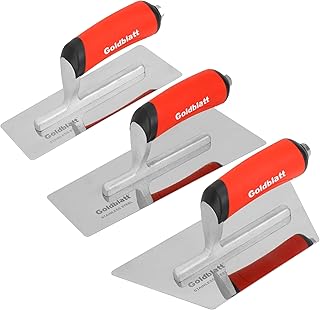
For most plasterers preparing client finish samples, the Goldblatt 3 Pieces Venetian Plaster Trowel Set is the strongest starting point. Its three sizes cover large board areas, tight corners and curved details, and its polished stainless trapezoid blades at 0.03 inches thick are made for the thin coats and firm pressure that Venetian plaster and Marmorino need. The aluminium shank and ergonomic handle keep the tool balanced through repeated passes, and the rounded corners help keep lines off the surface. When a board has to show a client what a polished finish will look like, this set does the core work well.
The YIMITEE 3 Pack Venetian Plaster Trowel Set is the closest alternative, with three sizes from 200 by 80 millimetres to 234 by 110 millimetres, mirror polished blades and wooden handles. It suits plasterers who prefer a wood grip and want a slightly larger middle trowel for boards that carry broader texture. The 3-Pack Stainless Steel Venetian Plaster Japanese Finishing Trowels and the Venetian Plaster Trowel Set 3 PC are the lowest-cost ways into the same kind of work, and both are sensible when several boards need several sets of hands at once, for example when an assistant is learning the motions on practice boards while the lead plasterer finishes client boards.
For boards that must show edges and corners, the XDOVET Drywall Corner Trowel Set earns its place. Its 90-degree internal and external trowels, each 3.1 by 2.4 inches, let a board demonstrate how a finish behaves where two planes meet, which is often where a client looks closest. The Goldblatt Bucket Scoop and Carbon Steel Trowel Bundle solves a different problem: moving small batches of mixed plaster from bucket to board cleanly, with two rustproof scoops and three carbon steel trowels in 14, 12 and 8 inch sizes. Finally, the XDOVET Concrete Tools Set, with a flat trowel and two pool trowels, suits boards that show heavier, more textured finishes. A plasterer who makes only smooth polished samples can stop at the first four kits; a plasterer who shows a full range will want the corner set and the bundle as well.
| Product | Key spec | Best for |
|---|---|---|
| Goldblatt 3 Pieces Venetian Plaster Trowel Set | 3 polished stainless trapezoid blades, 0.03 in thick | Polished Venetian and Marmorino sample boards |
| YIMITEE 3 Pack Venetian Plaster Trowel Set | 3 mirror polished trowels, 200×80 to 234×110 mm | Broad texture boards with a wood handle feel |
| 3-Pack Stainless Steel Venetian Plaster Japanese Finishing Trowels | 3-pack stainless finishing trowels | Low-cost practice and client boards |
| Venetian Plaster Trowel Set 3 PC | 3-piece polished stainless set, aluminium shank | Everyday sample boards on a tight budget |
| XDOVET Drywall Corner Trowel Set | 90-degree internal and external trowels, 3.1 x 2.4 in | Boards that show corners and edges |
| Goldblatt Bucket Scoop and Carbon Steel Trowel Bundle | 2 scoops plus 3 carbon steel trowels, 14/12/8 in | Mixing and moving small plaster batches |
| XDOVET Concrete Tools Set | 3 trowels, flat 11×4 in and pool 14×4, 16×5 in | Heavier textured finish samples |
How we chose
Every kit in this guide was picked against the same four questions. First, does it fit the work of making sample boards? A sample board is usually smaller than a wall, often no larger than a sheet of board offcut, so the tools need to work at that scale. Large trowels can still help when a board is broad, but the kit also needs a smaller tool for edges and detail. Second, does it match the finish it claims to serve? Venetian plaster and Marmorino need thin, flexible blades with rounded corners and a polished face, because any roughness in the blade shows up in the finish. Third, is it honestly under the seventy-five-dollar cap? The maker or retailer listing for each kit was checked, and only kits listed below that cap were included. Fourth, is it a real kit with a real maker behind it, with listed contents and listed dimensions that a buyer can verify before ordering?
Blade thickness received close attention, because it decides how a trowel behaves on a thin coat. The Venetian sets in this guide list blades around 0.03 inches, or 0.7 millimetres, which is the thin, flexible range that lets a plasterer press a coat flat without gouging it. Thicker blades have their place on heavier work, and the XDOVET Concrete Tools Set lists the same 0.7 millimetre thickness on larger blades, which keeps it useful for smoothing rather than only for spreading. Handle design mattered too: sample-board work is repetitive, with many short passes and frequent cleaning, so handles that grip well when damp and do not tire the hand earned extra weight in the comparison.
Material choice was the third filter. Stainless steel dominates this guide because it resists rust, cleans easily and does not mark light-coloured plaster with dark lines. Carbon steel appears in the Goldblatt bundle, where the maker lists a sandblasted and treated finish, and the buyer should dry those blades after use, as the maker advises. Aluminium appears in shanks, mounts and handles, where its light weight helps. Wood handles appear on the YIMITEE set and on the Goldblatt carbon steel trowels, and they suit plasterers who like a warm, firm grip.
Finally, the guide looked at what each kit leaves out, because a kit that covers only one step still leaves the plasterer shopping for the rest. The three-piece Venetian sets cover application and polishing but not corners or carrying material. The corner set covers edges but not broad areas. The scoop bundle covers carrying and spreading but not fine polishing. No single kit in this price range does everything, and the honest advice is to pair two of them: a Venetian set for the finish itself, plus either the corner set or the scoop bundle for the supporting work. The product sections below make those pairings clear, so a buyer can spend once and end up with a complete sample-board setup rather than a drawer of single-purpose tools.
Goldblatt 3 Pieces Venetian Plaster Trowel Set
- 3 trowels: 7-7/8 in, 9-29/64 in and 9-1/4 in
- Polished stainless steel trapezoid blades, 0.03 in (0.7 mm) thick
- Beveled edges and rounded corners
- Aluminium shank with ergonomic soft-grip handle
- For Venetian plaster, Marmorino, microcement and stucco
The Goldblatt set is the most complete answer to the sample-board question in this price range, and it leads this guide because its three sizes map neatly onto the three jobs a sample board demands. The largest trowel lays the base coat across the board in a few passes. The middle trowel works the second coat and begins to close the surface. The smallest trowel, at 7-7/8 inches, reaches into corners and along the board edge, where a larger blade would leave a ridge. That progression matters on a board, where there is nowhere to hide a rough patch and the client will look at the whole surface from close range.
The blade is the heart of the set. The maker lists polished stainless steel at 0.03 inches thick, with a beveled edge that the maker says helps prevent aggregate popping, and rounded corners that keep the blade from scoring the finish. On a sample board, where coats are thin and the plaster is often a fine grade, that combination lets the plasterer press firmly without leaving tramlines. The trapezoid shape gives more coverage per pass than a rectangle of the same length, which helps when a board needs an even base coat before the decorative work begins. The aluminium shank keeps the weight down, and the ergonomic handle suits the short, repeated strokes that board work involves.
Pros: Three useful sizes in one purchase; thin polished blades suit fine coats; rounded corners reduce scoring; handle stays comfortable through long sessions.
Cons: Carbon-free stainless blades need wiping dry after washing; smallest trowel may feel large on very small boards.
YIMITEE 3 Pack Venetian Plaster Trowel Set
- 3 trowels: 200×80 mm, 240×100 mm and 234×110 mm
- Mirror polished stainless steel blades, 0.7 mm thick
- Precision-ground beveled edges with rounded corners
- Wooden handles
- For plaster, stucco, drywall compound and wood filler
The YIMITEE set is the wood-handled alternative to the Goldblatt lead, and its middle trowel is the detail that sets it apart. At 240 by 100 millimetres it is a comfortable size for a standard sample board, wide enough to cover the surface in a few passes and narrow enough to control near the edges. The largest trowel, at 234 by 110 millimetres, is broader rather than longer, which suits boards that carry a heavier texture where the plasterer wants to press a wide area flat in one motion. The smallest, at 200 by 80 millimetres, handles detail and corners.
Mirror polished blades are the right choice for sample boards that will be burnished, because a polished face slides over a setting coat without dragging. The maker lists precision-ground beveled edges, which help the blade meet the plaster at a clean angle, and rounded corners that protect the surface from scratches. Wooden handles give a different feel from the soft-grip handles on the Goldblatt set: firmer, with a shape that suits plasterers who grip the trowel from above and steer with the wrist. Wood also stays pleasant to hold when hands are damp, though it should be dried after washing, as with any wood-handled tool.
Pros: Broad middle trowel suits standard boards; mirror polish suits burnished finishes; wooden handles give a firm, traditional grip.
Cons: Wood handles need drying after washing; the largest trowel is wide for narrow boards.
3-Pack Stainless Steel Venetian Plaster Japanese Finishing Trowels
- 3-pack of stainless steel Venetian plaster finishing trowels
- For smooth, polished walls and art paint plastering
- Stainless steel construction throughout
- Compact sizes for detail and finish work
- For Venetian plaster and decorative plaster finishes
This three-pack is the lowest-cost entry in this guide, and its value shows most clearly when more than one person is making boards. A workshop that needs a set for the lead plasterer and a set for an assistant, or a set that can stay with the sample boards while another set stays with the wall tools, will find the price hard to argue with. The trowels are stainless steel finishing trowels in the Japanese style, which means compact blades shaped for control rather than for covering large areas quickly. On a sample board that is a strength: the plasterer works slowly, watches the surface, and adjusts pressure pass by pass.
The maker lists these trowels for smooth polished walls and art paint plastering, which matches the two finishes clients ask to see most often on sample boards. A polished Venetian sample and a smooth art-paint sample can both be made with this set, and the compact size keeps the blade on the board rather than overhanging the edge. Because the set is inexpensive, a plasterer can also keep one as a dedicated board tool and never lend it to wall work, which keeps its edge clean and its face free of the nicks that wall work can cause. That separation is a small discipline that pays off when a client compares two boards and one of them shows a flaw the other does not.
Pros: Lowest cost in this guide; compact blades suit small boards; easy to keep as a dedicated board set.
Cons: Fewer listed dimensions than the leading sets; compact size is slow on broad boards.
Venetian Plaster Trowel Set 3 PC
- 3-piece set with polished stainless steel blades
- Aluminium shank for a secure blade mounting
- For plastering, Marmorino, microcement and stucco
- Suits finishing, smoothing and polishing work
- Compact multi-piece set for varied board sizes
The second three-piece Venetian set in this guide is the plain, practical choice: polished stainless blades, an aluminium shank, and three sizes that cover large areas, detail corners and curved surfaces. The maker lists it for plastering, Marmorino, microcement and stucco, which covers the finishes most sample boards are made to show. Its role in a workshop is simple. It is the set that lives beside the sample boards, ready whenever a new colour or texture needs a board, without the plasterer having to borrow the wall tools and clean them twice.
For a client sample, the polished blade face matters more than any other single feature, because the board will be viewed closely and any drag mark will be visible. Polished stainless slides cleanly and wipes clean, so the board keeps a consistent surface from the first coat to the last. The aluminium shank keeps the tool light enough for the many short passes board work requires, and the set format means the plasterer can switch sizes without stopping to clean a single trowel between coats. It is not the most refined set in this guide, and the maker lists fewer dimensions than Goldblatt or YIMITEE, but it does the central job at a low cost, and that is exactly what a sample-board kit should do.
Pros: Low cost for a three-piece polished set; light aluminium shank; covers the main sample finishes.
Cons: Fewer listed sizes and dimensions; less detail on blade thickness than the leading sets.
XDOVET Drywall Corner Trowel Set
- 90-degree external and internal corner trowels, each 3.1 x 2.4 in
- Premium stainless steel blades, rivetless construction
- Soft-grip non-slip handle, securely welded
- For drywall, stucco and concrete on inside and outside corners
- Weight: 0.79 lb
Corners are where sample boards often fail to convince a client, because a finish that looks good on a flat board can look ragged where it turns. This set exists for that moment. It contains two trowels: one for the inside corner and one for the outside corner, each 3.1 by 2.4 inches, both set at 90 degrees so they fit the corner properly. Used on a sample board that includes a folded edge or a small return, they let the plasterer show the client that the finish holds its line where two planes meet, which is exactly the detail a careful client inspects.
The maker lists premium stainless steel blades with rivetless construction, which matters on corners because a rivet head can leave a mark in a thin coat. The soft-grip non-slip handle is securely welded, and at 0.79 pounds for the pair the set is light enough to control with one hand while the other steadies the board. Rounded corners on the blades allow smoother application with less sanding afterwards, according to the maker. For a plasterer who already owns a Venetian set, this is the natural second purchase: it does the one job the flat trowels cannot do, and it does it for less than the cost of a single large trowel.
Pros: Covers inside and outside corners; rivetless blades leave no marks; light and easy to control on small boards.
Cons: Only useful where boards include corners; small blades are slow on flat areas.
Goldblatt Bucket Scoop and Carbon Steel Trowel Bundle
- 2 stainless steel bucket scoops, 6.5 in curved contoured blades
- 3 carbon steel drywall trowels: 14×4 in, 12×4 in and 8×3 in
- Soft-grip handles on the scoops; wood handles on the trowels
- Rustproof scoop blades for plaster, paint and mortar
- For drywall, plaster, paint and mortar work
Sample boards start in the bucket, not on the trowel, and this bundle is the only kit in this guide that addresses that first step. The two bucket scoops have 6.5 inch curved stainless blades that follow the curve of a bucket, so mixed plaster comes out cleanly instead of clinging to the sides. That matters when a board needs only a small batch: waste is reduced, the mix stays consistent, and the plasterer is not scraping a large trowel around a bucket rim. The scoops are rustproof, and the soft-grip handles suit the scooping motion.
The three carbon steel trowels cover the spreading work, in 14, 12 and 8 inch sizes, with wood handles. Carbon steel is a different choice from the stainless blades elsewhere in this guide: it is stiff and takes a keen edge, which suits the first coats on a board where the plaster needs to be pushed firmly into the surface. The maker lists the blades as treated against rust, and the buyer should still dry them after washing, as with any carbon steel tool. Paired with a Venetian set, this bundle completes the sample-board workflow from bucket to finished surface, and its combined cost stays well under the cap.
Pros: Solves the mixing and carrying step other kits ignore; three trowel sizes cover spreading; scoops reduce wasted plaster.
Cons: Carbon steel blades need drying after use; trowels are heavier than the stainless Venetian sets.
XDOVET Concrete Tools Set
- 3 trowels: flat 11×4 in and pool trowels 14×4 in and 16×5 in
- 0.7 mm polished stainless steel blades
- Ergonomic rubber and aluminium handles
- For concrete, cement, mortar and drywall
- Weight: 3.08 lb
Not every sample board shows a smooth polished finish. Some clients want to see a heavier texture, a trowelled concrete look, or a rustic limewash effect, and those boards need larger blades that can move more material. This three-piece set answers that need. It contains a flat trowel at 11 by 4 inches and two pool trowels at 14 by 4 and 16 by 5 inches, all in 0.7 millimetre polished stainless steel. The pool trowels, with their rounded ends, are made for sweeping passes that leave a soft, even texture, which is exactly the look a board for a textured finish should show.
The maker lists ergonomic rubber and aluminium handles, which help when the blades are large and the passes are long. At 3.08 pounds for the set, it is the heaviest kit in this guide, and that weight is part of the design: the blades press the material flat under their own mass, so the plasterer uses less arm force. For a workshop that shows both smooth and textured finishes, this set pairs with a Venetian set to cover the full range. On its own it is less suited to fine polished boards, where its large blades would overhang a small board, so it should be chosen when textured samples are part of the offer.
Pros: Large blades suit textured finish boards; pool trowels leave soft, even texture; handles reduce fatigue on long passes.
Cons: Heavy at 3.08 lb; large blades overhang small boards.
Buying guide
Match the kit to the finish on the board
Start from the finish, not from the tool. A polished Venetian or Marmorino board needs thin, polished, flexible blades with rounded corners, because the board will be viewed closely and any line will show. A textured board needs larger blades that can move material and leave an even pattern. A board that shows a corner needs a corner trowel. Write down the finishes you show clients, then check each kit against that list. If a kit does not match any finish on your list, it does not belong in your bag, however low its cost.
Check blade thickness and face before buying
Blade thickness decides how a trowel behaves on a thin coat. Around 0.03 inches, or 0.7 millimetres, is the flexible range that suits fine decorative plaster. Thicker blades resist bending and suit heavier material, but they can leave ridges on a thin coat. The face matters as much as the thickness: a mirror polished face slides over a setting coat, while a rough face drags. When a listing gives both figures, compare them across kits; when it gives neither, treat that as a gap and weigh the kit accordingly. The kits in this guide list their blade figures, which is one reason they were chosen.
Think in pairs, not in single kits
No kit under the seventy-five-dollar cap does every step of sample-board work. The practical approach is to buy in pairs: a Venetian set for the finish, plus a supporting kit for the step the Venetian set does not cover. A plasterer who shows corners pairs the Goldblatt Venetian set with the XDOVET corner set. A plasterer who mixes small batches pairs it with the Goldblatt scoop bundle. A plasterer who shows textured finishes pairs it with the XDOVET Concrete Tools Set. Two kits bought together still sit under the cap in most combinations, and the pair covers the whole workflow from bucket to finished board.
Keep a set for boards only
Sample boards reward clean tools. A trowel that has spent a week on wall work may carry nicks, dried plaster on its edge, or a slightly bent corner, and each of those flaws will appear on the next board. Keeping one set aside for board work only is a simple habit that protects the quality of the samples. Mark the handles, store the set with the boards, and clean the blades after every session. Stainless blades wipe clean with water and a soft cloth; carbon steel blades should be dried promptly. A dedicated board set also saves time, because the tools are always where the boards are.
Size the trowel to the board
A trowel that is longer than the board is hard to control, and one that is much smaller takes too many passes to cover the surface evenly. For a board around the size of a sheet of paper, a trowel near 8 to 10 inches is a good match. For larger boards, a 12 to 14 inch trowel covers the surface faster. The three-piece sets in this guide give that range in one purchase, which is why they lead the recommendations. When buying a single-size kit, measure your boards first and choose the size that fits them, not the size that looks most useful in a photograph.
Compare what is actually in the box
Kit listings sometimes describe a set by its largest tool and leave the rest vague. Before ordering, read the contents list: how many pieces, what sizes, what materials, and whether handles are included. The kits in this guide all list their contents, and the product sections above repeat those lists. If a listing does not say how many trowels it contains or what sizes they are, that is a reason to choose a different kit, because the missing detail may hide a tool that does not fit your boards.
FAQ
How many sample boards can one kit make?
A single kit can make as many boards as the plasterer has time and material for, because the tools do not wear out after one board. The limit is the plaster and colourant, not the trowel. What matters is cleaning: wipe the blades after each board, dry carbon steel promptly, and store the set where the blades cannot knock against other tools. With that care, a kit will serve through many rounds of client samples.
Do I need a different kit for each finish I show?
Not necessarily. A three-piece Venetian set can make boards for several smooth finishes, because the difference between those boards is mostly in the plaster and colour, not in the tool. A corner set or a textured set is only needed when the finish itself demands it, for example a board that turns a corner or a board that shows a heavy texture. Most workshops find that two kits cover their whole range.
Can I use my wall trowels to make sample boards?
Yes, and many plasterers start that way, but there are two drawbacks. Wall trowels are often larger than a board needs, which makes them awkward on small surfaces, and they may carry wear from wall work that shows up on a board. A dedicated board set avoids both problems and costs little, so it is worth the small outlay once sample boards become a regular part of the work.
What size board should I use for client samples?
A board that a client can hold comfortably in both hands is a good starting point, large enough to show colour and texture and small enough to carry to a meeting. The exact size matters less than consistency: make all the boards for one client the same size, so the client compares finishes rather than board sizes. Keep the boards flat, prime them the same way, and apply the same number of coats you would use on a wall.
How do I keep sample boards consistent from one client to the next?
Use the same tools, the same number of coats, and the same drying time for each board. Write the recipe on the back of the board: the plaster, the colourant, the number of coats, and the tool used for the final pass. That record lets you repeat a board exactly when a client asks for a second copy, and it protects you if a client later questions whether the wall matches the sample.
Should sample boards be sealed or waxed like a wall?
Follow the same finishing steps you would use on a wall, because the board should show the client the real result. If the wall will be waxed, wax the board. If the wall will be sealed, seal the board. A board that skips the final step looks different from the finished wall, and that difference can cause a misunderstanding later. Let the board dry fully before the final step, and keep it out of dust while it dries.
Conclusion
Preparing client decorative finish samples is a craft in its own right, and the tools deserve the same care as the plaster. The seven kits in this guide all stay under the seventy-five-dollar cap, and each one earns its place by matching a real step in sample-board work: the Goldblatt Venetian set for polished finishes, the YIMITEE set for a wood-handled alternative, the two low-cost three-piece sets for workshops that need more than one set, the XDOVET corner set for edges, the Goldblatt scoop bundle for mixing and carrying, and the XDOVET Concrete Tools Set for heavier textures. Buying in pairs covers the whole workflow, keeping one set aside for boards protects the quality of the samples, and matching the blade to the finish keeps the boards honest.
A client who approves a board approves a finish, and a board made with the right tools is a promise the wall can keep. Choose the kit that matches the finishes you show, keep it clean and dedicated to board work, and let the samples do the persuading. The cost is small, the tools are simple, and the result is a client who knows exactly what they are getting before the first coat goes on the wall.
Related guides
More from Amazon
Programs that pair well with the guide above. Offers and eligibility are set by Amazon and may change.
Free shipping on eligible items, Prime Video and more. Eligible new members can start with a free trial.
Start a Prime free trialAudiobooks and podcasts to listen to on the go. Eligible new members can start with a free trial.
Try Audible freeAd-free music streaming. Eligible new subscribers can start with a free trial.
Try Music Unlimited freeA free business account with business pricing and bulk-buying tools for work, shop or home office.
Create a business accountAs an Amazon Associate we earn from qualifying purchases.
More ways to save on your next finish
Programs that pair well with the guide above. Offers and eligibility are set by Amazon and may change.
A free business account with business pricing and bulk-buying tools for work, shop or home office.
Create a business accountFast, free shipping on eligible items, plus Prime Video and more. Eligible new members can start with a free trial.
Start a Prime free trialRead from a huge library of eBooks, including how-to guides and cookbooks. Eligible new members can start with a free trial.
Try Kindle UnlimitedAudiobooks and podcasts for the commute, the garage or the kitchen. Eligible new members can start with a free trial.
Try Audible freeAs an Amazon Associate we earn from qualifying purchases. Using these links costs you nothing extra.










Write Your Review
No reviews yet. Be the first to share your experience!