
Key takeaways
- Compare seven stipple brushes under twenty-five dollars for finishing rustic stucco accent panels, judged on firm fiber durability, head size and grip comfort.
As an Amazon Associate I earn from qualifying purchases. This post may contain affiliate links at no extra cost to you.
Our top picks at a glance
5 products from this guide, in the order reviewed below.



As an Amazon Associate we earn from qualifying purchases. Prices and availability can change.
A rustic stucco accent panel gets its character from texture that looks like it grew on the wall rather than being painted onto it, and the stipple brush is the tool that puts that character there. The panel is usually small, often a single feature wall or a framed section, and the finish needs to read as rough and organic from across the room while staying even enough that no single patch draws the eye. That balance is harder than it looks: press too hard and the stipple collapses into flat smears, load too much material and the texture turns to blobs, work too slowly and the coat firms before the pattern is finished. Choosing among the best stipple brushes for decorative plaster under twenty-five dollars for finishing rustic stucco accent panels comes down to fiber durability first, because stucco is abrasive and a cheap brush that sheds or splays after one panel costs more in rework than it saved at the till. This guide compares seven real stipple brushes whose makers list them for stippling, texture, or stucco work, and explains how fiber, head size, and grip change the way a rustic panel turns out. All specifications come from the makers' or retailers' own product pages; anything not published is marked as such.
Quick verdict
The Goldblatt G05116 Stippling Texture Brush leads this group because its black horsehair fiber blend holds a firm dome under pressure, its 6 inch pattern area covers a panel quickly, and its high-impact plastic base with threaded handle compatibility suits both hand work and pole work. The MARSHALLTOWN The Premier Line 846 Single Crows Foot Brush follows as the classic single-pattern choice, with durable white Tampico fibers in a lacquered hardwood block that stands up to abrasive stucco. The Panda Paw 11934 Single Stippling Texture Brush brings a wide white Tampico face for fast coverage of open panels, the MARSHALLTOWN Beaver Tail Brush 6517 adds a long black horsehair head for sweeping stipple across broad areas, and the Goldblatt G05260 Single-Crows Foot Texture Brush gives a second single-pattern option with a different footprint. The HYDE 09880 Texture Brush Large covers large panels from a pole, and the Auhoahsil Stencil Brushes Set 5 Pcs Natural Bristle rounds out the set with five graduated sizes for edges, corners, and detail work. Choose the G05116 when the panel is the main job and the brush must hold its shape; choose the 846 when the panel needs the crisp, repeated mark of a single crows foot head.
| Product | Key spec | Best for |
|---|---|---|
| Goldblatt G05116 Stippling Texture Brush | Black horsehair fiber blend, 6 in pattern area, 2.5 in trim, high-impact plastic base | Main panel work where the brush must hold a firm dome under pressure |
| MARSHALLTOWN The Premier Line 846 Single Crows Foot Brush | White Tampico fibers, clear lacquered hardwood block, threaded handle hole | Crisp single crows foot marks on rustic stucco panels |
| Goldblatt G05260 Single-Crows Foot Texture Brush | Single crows foot texture brush | A second single-pattern footprint for varied panel textures |
| HYDE 09880 Texture Brush Large | Large texture brush, threaded for poles | Large panels worked from the floor with a pole |
| Panda Paw 11934 Single Stippling Texture Brush White Tampico | White Tampico bristles, 14 x 9.2 x 1 in | Fast coverage of open panels with a wide Tampico face |
| MARSHALLTOWN Beaver Tail Brush 6517 | Black horsehair fibers, 13.5 in length | Long sweeping stipple across broad panel areas |
| Auhoahsil Stencil Brushes Set 5 Pcs Natural Bristle | Natural bristle, wood handles, aluminum ferrules, 5 graduated sizes | Edges, corners, and detail stippling around a panel |
How we chose
Fiber durability came first. Rustic stucco is made of sand and aggregate, and every dab drags the bristle across a surface that wears fiber down. A brush that splays after one panel leaves a pattern that changes halfway across the wall, and a brush that sheds leaves bristles embedded in the finish. The group therefore favors fibers that the makers list for texture and masonry work: horsehair blends that keep their dome under pressure, Tampico fiber that resists abrasion, and natural bristle sets that can be rotated as the work moves from field to edge. Head size came second, because a panel is a bounded area and the brush must fit it. A 6 inch pattern covers a panel quickly without overwhelming it, a wide 14 inch face suits open panels, and small graduated heads suit the edges where a wide brush cannot turn. The group spans that range so the reader can match the head to the panel rather than forcing one size onto every job. Grip and handle came third: a panel is finished in one session, and the hand must stay steady for the whole wall. A plastic base with a threaded fitting lets the painter switch between hand work and pole work without changing tools, a hardwood block gives a solid grip for firm dabs, and graduated wooden handles give a comfortable hold for detail work. Load control came last, because a rustic panel needs a stipple that is open and even, and a brush that floods the surface will fill the texture it is meant to create. Deep bristle packs and firm fibers hold a useful load and give it back a little at a time. No tool was handled and no price was compared beyond the budget tier in the keyword; the guide relies on published specifications only.
Goldblatt G05116 Stippling Texture Brush
- Black horsehair fiber blend bristles
- 6 in pattern area; 2.5 in trim length
- High-impact plastic base; threaded handle compatible
- Maker lists it for drywall texturing and specialty painting
The G05116 leads because it is the brush in this group that best survives the job a rustic panel demands. The black horsehair fiber blend is stiff enough to push compound and plaster without folding, yet springy enough to keep the stipple dots separate, and the maker lists the brush for drywall texturing, which is the same dabbing motion a stucco panel needs. The 6 inch pattern area is the right width for a panel: wide enough to cover ground quickly, narrow enough to keep the pattern even from edge to edge. The 2.5 inch trim holds a useful load of material and releases it gradually, so the texture stays open instead of flooding. The high-impact plastic base resists the moisture and alkalinity of a lime-based coat better than a raw wood block, and the threaded fitting accepts a standard handle for high work. The brush has been listed since 2009 and remains in production, which says something about how many painters keep reaching for it. For a rustic panel, use a light, rhythmic dab and let the weight of the brush do the work; pressing hard flattens the horsehair and turns the stipple into a smear, while a light touch leaves the rough, open texture that makes stucco look rustic.
Pros: Horsehair blend holds a firm dome under pressure; 6 inch pattern suits panel widths; plastic base resists wash moisture; threaded fitting suits pole work.
Cons: Stiff fiber can mark a very wet coat if pressed hard; plastic base feels lighter than a hardwood block; see product page for handle length details.
MARSHALLTOWN The Premier Line 846 Single Crows Foot Brush
- Durable white Tampico fibers
- Clear lacquered hardwood block
- Standard threaded hole in the center of the block for a broom handle
- Single crows foot design; made in the USA with global materials
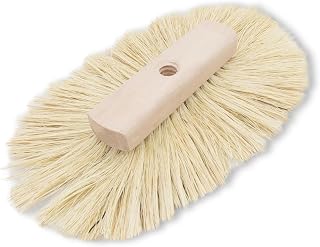
The 846 is the classic single crows foot brush, and its pattern is the reason it suits a rustic panel. A single crows foot head lays one clear, repeated footprint per dab, and that footprint reads as a deliberate, hand-made texture rather than a random stipple. On a rustic panel, that regularity is a virtue: the eye accepts a repeated mark as craft, while a random mark can read as a mistake. The white Tampico fibers are durable and hold their shape under the abrasion of a sanded stucco coat, and the clear lacquered hardwood block keeps the face flat so the pattern stays even across the whole panel. The threaded hole in the center of the block accepts a standard broom handle, which lets the brush reach the top of a tall panel without a ladder. The maker lists the brush for creating a quality textured finish on drywall, and the same firm, even dab that textures drywall will stipple a rustic stucco panel, provided the coat is still workable and the brush is kept damp. Rinse the Tampico well after use, since dried plaster in the fiber will stiffen the bristle and change the footprint on the next panel.
Pros: Single pattern reads as deliberate craft on a rustic panel; durable Tampico resists stucco abrasion; lacquered hardwood block keeps the face flat; threaded hole accepts standard handles.
Cons: Single head covers ground slower than a double head; stiff fiber needs a light touch on wet coats; see product page for block dimensions.
Goldblatt G05260 Single-Crows Foot Texture Brush
- Single crows foot texture brush
- See product page for bristle and block details
Every panel needs a second single-pattern brush, because the first brush will eventually need cleaning, and because two single heads with slightly different footprints let the painter vary the texture across a panel without changing technique. The Goldblatt G05260 is that second brush: a single crows foot head that lays a clear, repeated mark, sized for the same kind of panel work as the 846 but with its own footprint. Use it to break up a large panel into zones, stippling one zone with the 846 and the next with the G05260, so the panel gains a subtle variation that keeps it from looking machine-made. Or keep it as the clean brush while the first is rinsed, so the work never pauses long enough for the coat to firm. The two brushes can also be used together on one panel: the 846 for the main field and the G05260 for the border, where a slightly different mark helps the edge read as a deliberate frame rather than a ragged stop. Keep the load light on both, since a single head floods faster than a double head, and wipe the bristle on a practice board before touching the panel so the first dab does not dump a heavy spot at the start of a zone.
Pros: Second single-pattern footprint adds subtle variation to a panel; suits zone work and border framing; light and easy to control at close range.
Cons: Slower than a double head on large panels; see product page for bristle material, block size, and handle details.
HYDE 09880 Texture Brush Large
- Large texture brush
- Threaded for poles
- See product page for bristle and block details
A large panel finished from a ladder shows it: the stipple density changes where the painter moved, and the top of the panel reads differently from the bottom. The HYDE 09880 avoids that by working from the floor on a pole. Its large head covers a wide band in each pass, and the threaded fitting keeps the brush steady at full reach, so the pressure stays even from the bottom of the panel to the top. That even pressure is what keeps a rustic texture uniform: every dab lands with the same force, so the dots stay the same size across the whole wall. The large head also suits the scale of a rustic finish, since a small head on a big panel forces hundreds of dabs and the hand tires before the pattern is finished, while a large head finishes the panel while the coat is still workable. Use a light load and let the weight of the pole press the bristle; pushing down hard flattens the fiber and turns the stipple into a smear. Rinse well after use and store the brush bristle down so the large face keeps its shape.
Pros: Large head finishes big panels while the coat is workable; threaded for poles, so pressure stays even from floor to ceiling; suits the scale of rustic texture.
Cons: Large head is too wide for narrow panels and tight corners; pole work needs practice to keep pressure light; see product page for bristle material and block details.
Panda Paw 11934 Single Stippling Texture Brush White Tampico
- White Tampico bristles
- 14 x 9.2 x 1 in
- Single stippling texture brush
The Panda Paw 11934 is the widest brush in this group, and width is its advantage on an open panel. At 14 inches across, a single pass covers a band that would take two or three passes with a 6 inch head, and that speed matters because a rustic coat firms quickly in a warm room. The white Tampico bristles are stiff enough to push into a sanded stucco coat without folding, and the single stippling pattern lays an open, even texture that reads as rustic from across the room. The brush is listed as a single stippling texture brush, which means each dab lays one clear field of marks rather than a doubled pattern, and that clarity suits a panel where the texture itself is the decoration. Use it for the main field of an open panel and keep a smaller brush for the edges, since a 14 inch head cannot turn at a corner without overworking the edge. The flat, wide face also makes it easy to keep the density even: the painter can see exactly where the last pass ended and start the next with a small overlap, which keeps the panel uniform.
Pros: 14 inch width covers open panels fast; stiff white Tampico suits abrasive stucco; single pattern reads clearly as rustic texture; easy to keep density even with visible overlaps.
Cons: Too wide for narrow panels and corners; stiff fiber needs a light touch on wet coats; see product page for handle and block details.
MARSHALLTOWN Beaver Tail Brush 6517
- Black horsehair fibers
- 13.5 in length
- Masonry and concrete brush; made in the USA
The Beaver Tail 6517 is the long, sweeping option in this group, and its shape suits a panel that needs a flowing, organic texture rather than a repeated footprint. The black horsehair fibers are long and springy, so the brush can be drawn across the panel in a sweeping dab that leaves a soft, directional stipple, and the 13.5 inch length covers a wide band in each pass. The maker lists it as a masonry and concrete brush, which means the fiber is built for rough, abrasive surfaces, and a rustic stucco panel is exactly that kind of surface. Use it when the panel needs movement: long, overlapping sweeps that follow the shape of the wall, rather than the strict grid of a crows foot head. The horsehair holds a useful load of thin wash and releases it gradually, so the texture stays open and the color stays even. Because the head is long, it suits open panels and struggles in tight corners, so keep a smaller brush for the edges. Rinse the horsehair well after lime work, since dried material in long fiber will stiffen the brush and change the sweep on the next panel.
Pros: Long horsehair head suits sweeping, organic stipple; 13.5 inch length covers wide bands fast; fiber built for rough masonry surfaces.
Cons: Long head struggles in tight corners; needs a smaller partner brush for panel edges; see product page for block and handle details.
Auhoahsil Stencil Brushes Set 5 Pcs Natural Bristle
- Natural bristle; 5 graduated sizes
- Wood handles; aluminum ferrules
- Maker lists it for stencil and stipple work; works with acrylic, oil, and watercolor
A panel is not finished when the field is stippled; it is finished when the edges, corners, and details are done, and that is where a set of graduated brushes earns its place. The Auhoahsil set gives five natural bristle brushes in graduated sizes, so the painter can match the brush to the detail: the largest for the border of the panel, the middle sizes for corners and reveals, and the smallest for touch-ups where the field meets trim. Natural bristle springs back after cleaning and holds a small load well, which is what detail stippling needs, since a flooded detail brush will dump material into a corner and ruin the edge. The wood handles are smooth and comfortable for the fine, controlled dabs that detail work demands, and the aluminum ferrules hold the bristle firmly so the brush keeps its shape through repeated washing. The set works with acrylic, oil, and watercolor, which means it can stipple a tinted wash as well as a plaster coat. Keep the set clean and dry between uses, and rotate the sizes so no single brush carries the whole detail job.
Pros: Five graduated sizes cover every panel detail; natural bristle springs back and holds a small load well; wood handles suit fine, controlled dabs; works across paint types.
Cons: Small heads are slow for field work; natural bristle needs thorough cleaning after lime work; set is a detail tool, not a field brush.
Buying guide
Start with the panel, not the brush. A rustic stucco accent panel is a bounded area, so the first question is how big it is and how rough the coat will be. A small panel under a square meter suits a 6 inch head, which covers the area without overwhelming it. A large open panel suits a wide head from 8 to 14 inches, which finishes the area while the coat is still workable. A panel with many corners, reveals, or trim needs a graduated set for the details as well as a field brush. Measure the panel before buying, and remember that a brush wider than the panel will stipple past the edge and create a new hard line where the pattern stops.
Fiber durability decides whether the brush survives the panel. Stucco is abrasive, so the fiber must resist wear and keep its shape. Horsehair blends hold a dome under pressure and spring back after each dab, which keeps the pattern even across the whole panel. Tampico fiber is stiffer and more abrasion resistant, which suits rough coats, but it can mark a very wet coat if pressed hard. Natural bristle is softer and suits detail work and tinted washes, but it wears faster on a sanded coat. Plastic bases resist wash moisture and alkalinity better than raw wood, while lacquered hardwood blocks give a solid grip and a flat face. No single fiber suits every coat, so the buying decision is really about which fiber matches the coat the reader works with most often.
Head shape decides the texture the panel will show. A crows foot head lays a repeated footprint that reads as deliberate craft, and it suits panels where the texture itself is the decoration. A round head lays a direction-free stipple that suits organic, drifting textures. A long beaver tail head lays a sweeping, directional stipple that suits panels with movement. A rectangular head lays straight bands and suits panels with a strong horizontal or vertical structure. Keep at least two head shapes in the kit: a field brush for the main area and a detail brush for the edges, since no single shape does both jobs well.
Handles decide how long the hand stays steady. A panel is finished in one session, and the hand must stay accurate for the whole wall. A threaded fitting is worth having on any field brush, because a pole keeps the pressure even and the painter off a ladder. A hardwood block gives a solid grip for firm dabs, while a plastic base keeps the weight down on a long session. Wooden handles on detail brushes should be smooth and comfortable, since detail work is slow and the grip must not tire the hand. Check that the pole thread matches the brush before buying, since a loose thread will wobble and change the pattern mid-pass.
Load control is the skill that separates a good panel from a blotchy one. Dip the brush lightly, wipe the bristle on a practice board, and use rhythmic dabs with the same pressure every time. An overloaded brush floods the texture and fills the very marks it is meant to create, while an underloaded brush leaves dry patches that read as bald spots. Work the panel in zones, overlapping each pass slightly, and step back often to read the wall in raking light. If a zone looks darker than its neighbors, it has been double-dabbed, and the fix is to stipple the neighboring zone to the same density while the coat is still workable, not to scrub the dark zone flat.
Cleaning decides how long the brush lasts. Rinse in clean water as soon as the session ends, working the bristle gently with the fingers until the water runs clear. For water-based material, wash with soap and reshape the bristle before drying. For oil-based material, thin the residue first and then wash with soap, following the maker's care notes. Never leave a stipple brush standing on its bristle in a bucket, and never let plaster dry in the fiber, since dried material changes the stiffness and the pattern. Store the brush hanging or bristle down, away from heat, and keep it out of direct sun so the block does not crack. A brush that is cleaned well after every panel will keep its pattern for many panels; a brush that is left dirty will not survive the second one.
FAQ
What makes a stipple brush good for rustic stucco panels?
Fiber durability and head size matter most. The fiber must resist the abrasion of a sanded stucco coat and keep its shape through a whole panel, which is why this group favors horsehair blends and Tampico fiber. The head must fit the panel: a 6 inch pattern for small panels, a wide head for open panels, and graduated sizes for edges and corners. A brush that holds its dome and fits its panel will leave an even, open texture; a brush that splays or overwhelms the panel will not.
Single or double crows foot for a rustic panel?
A single head lays one clear footprint per dab and suits panels where the texture should read as deliberate craft. A double head lays two rows per pass and covers large panels faster, but it can look doubled if the overlap is uneven. For a first rustic panel, a single head is the safer choice, since the pattern is easier to keep even. Use a double head when the panel is large and the coat firms quickly.
How do I keep the stipple even across a whole panel?
Use the same pressure on every dab, keep the load light, and work in zones with a small overlap between passes. Wipe the bristle on a practice board before touching the panel so the first dab of each load does not dump a heavy spot. Step back often and read the panel in raking light, since a density change that is invisible from close range will show from across the room. If a zone looks darker, stipple its neighbors to the same density while the coat is still workable.
Can I use a pole on a small accent panel?
A pole is useful for the top of a tall panel, but it is not needed for a small panel at chest height. Brushes with a threaded hole, such as the 846, the G05116, and the HYDE 09880, accept a standard pole, which keeps the pressure even from the bottom of the panel to the top. For a small panel, hand work gives better pressure control. Keep a pole in the kit for tall work, and use the hand for the detail.
How do I clean a stipple brush after stucco work?
Rinse in clean water right after the session, working the bristle gently until the water runs clear. For water-based material, wash with soap and reshape the bristle, then dry with the bristle pointing down. For oil-based material, thin the residue first and then wash with soap, following the maker's care notes. Never let plaster dry in the fiber, and never store the brush standing on its bristle.
Why does my rustic panel look blotchy?
Blotchiness usually comes from uneven loading, uneven pressure, or a coat that firmed in one area before the rest. An overloaded brush floods some zones and starves others, heavy pressure flattens the stipple into smears, and a coat that firms mid-panel will take the pattern differently on each side of the line. Keep the load light, the pressure even, and the pace steady, and work the panel in one session while the coat is workable.
Conclusion
A rustic stucco accent panel succeeds when the texture looks hand-made and even at the same time, and the brush is what makes that possible. The Goldblatt G05116 leads this group because its horsehair blend holds a firm dome under pressure and its 6 inch pattern fits a panel, while the MARSHALLTOWN 846, the Panda Paw 11934, and the Beaver Tail 6517 give the single-pattern, wide, and sweeping options that different panels demand. The Goldblatt G05260, the HYDE 09880, and the Auhoahsil set fill the remaining gaps for variation, height, and detail. Choose the fiber for the coat, the head for the panel size, and the handle for the height of the work, then practice the rhythm on a board before touching the finish. A panel stippled with a light hand and the right brush will read as rustic craft, not as a patch, and that is the whole point of an accent wall.
Related guides
More from Amazon
Programs that pair well with the guide above. Offers and eligibility are set by Amazon and may change.
Free shipping on eligible items, Prime Video and more. Eligible new members can start with a free trial.
Start a Prime free trialAudiobooks and podcasts to listen to on the go. Eligible new members can start with a free trial.
Try Audible freeAd-free music streaming. Eligible new subscribers can start with a free trial.
Try Music Unlimited freeA free business account with business pricing and bulk-buying tools for work, shop or home office.
Create a business accountAs an Amazon Associate we earn from qualifying purchases.
More ways to save on your next finish
Programs that pair well with the guide above. Offers and eligibility are set by Amazon and may change.
A free business account with business pricing and bulk-buying tools for work, shop or home office.
Create a business accountFast, free shipping on eligible items, plus Prime Video and more. Eligible new members can start with a free trial.
Start a Prime free trialRead from a huge library of eBooks, including how-to guides and cookbooks. Eligible new members can start with a free trial.
Try Kindle UnlimitedAudiobooks and podcasts for the commute, the garage or the kitchen. Eligible new members can start with a free trial.
Try Audible freeAs an Amazon Associate we earn from qualifying purchases. Using these links costs you nothing extra.










Write Your Review
No reviews yet. Be the first to share your experience!