
Key takeaways
- Seven stipple brushes under twenty-five dollars for soft stippled plaster textures, compared by bristle, head size and handle so a budget buys an even finish.
What's inside
As an Amazon Associate I earn from qualifying purchases. This post may contain affiliate links at no extra cost to you.
A soft stippled plaster texture does not need an expensive brush. What it needs is a head that holds texture paint or plaster evenly, releases it in a fine, broken pattern, and keeps that pattern consistent from the first press to the last. The best stipple brushes for decorative plaster under twenty-five dollars for producing soft stippled plaster textures prove the point: every brush in this guide sits inside that budget cap, and every one is a real, working stipple brush listed by its maker for texture work on walls and ceilings.
This guide compares seven budget stipple brushes, from a wide 28-inch-class double block to a compact 4.75-inch round head. The set covers horsehair, tampico and blended fills, round and crowsfoot heads, and hand-held and pole-mounted designs. Nothing here is a cut-down imitation: these are the same kinds of brushes professionals use for stipple work, chosen at prices that leave room in the budget for plaster, primer and a practice board.
Quick verdict
If you want one budget brush for a soft stippled texture, start with the AMES 8-inch Horsehair Stipple Texture Brush ATEXBRUSH08. Its horsehair and poly fill sits in a polypropylene block that takes any handle with a standard Acme thread, and the maker lists it for matching a stipple pattern or adding texture to new surfaces. For a rounder, softer mark, the Magnolia MAG-CF-10 brings white tampico in an 8-inch round crowsfoot head with a marine-grade plywood block.
The Wal-Board 062-012 is the plain tampico crowsfoot brush for straightforward texture work, while the Wal-Board 062-005 is the small round horsehair head for edges and patches. The Marshalltown 846 covers a wall quickly with a 13-inch single crowsfoot head in white tampico hemp, the DQB 11740 brings a 5.5-inch round wood block with a horsehair blend, and the DQB Panda Paw I 11934 finishes the set as a 14-inch single wood block for broad, even passes.
Choose by wall size first. Wide walls reward the Marshalltown 846 and the DQB 11934. Small rooms and detailed work reward the Wal-Board 062-005 and the DQB 11740. Read the sections below for the detail that matches your project.
| Product | Key spec | Best for |
|---|---|---|
| AMES 8 in Horsehair Stipple Texture Brush ATEXBRUSH08 | Horsehair and poly fill; polypropylene block; Acme thread | Matching a stipple pattern on a budget |
| Magnolia MAG-CF-10 Round Crowsfoot Texture Brush | White tampico fiber; 8 x 8 in round head; hardwood plywood block | Soft round-head stippling on a budget |
| Wal-Board Crows Foot Brush 062-012 | Tampico bristles; single or double design; threaded hole | Plain, hardworking tampico texture work |
| Wal-Board Texture Brush 062-005 | Horsehair bristles; 4.75 in diameter; 2.5 in bristles | Edges, corners and small patches |
| Marshalltown Single Crows Foot Texture Brush 846 | White tampico hemp bristles; 13 in; wooden block | Covering a wall quickly by hand or pole |
| DQB Wood Handle Stippling Brush 11740 | 5.5 in round wood block; horsehair and polypropylene blend; 3 in bristle | Round-head stippling with a wood handle |
| DQB Panda Paw I Single Stippling Brush 11934 | 14 in wide wood block; 14 x 9 x 1.5 in; 0.55 lb | Broad, even single-block passes |
How we chose
The shortlist came from the verified stipple brush pool for this program, and the filter was the budget cap in the keyword: every brush below was listed by a retailer at a price inside that cap when its page was opened. That check matters, because a budget guide is only useful if the prices are real. Each brush was then checked against the same questions as the rest of the family: what fiber does the maker list, how wide is the head, how is the block built, and how does the handle attach.
Soft texture was the second filter. A soft stippled finish needs a brush that releases material in a fine, broken pattern rather than a bold, deep one. Horsehair leads here, because it is firm enough to hold a pattern and fine enough to keep it soft. Tampico appears too, in the Magnolia, Wal-Board and Marshalltown heads, because a stiff tampico fill used with a light press lays a soft stipple over a thin coat. Blended fills appear in the AMES and DQB 11740 heads, where polypropylene keeps the head springy while the horsehair does the pattern work.
Head size and shape decided the final order. The set runs from a 4.75-inch round head to a 14-inch single block, so the right head exists for every part of a room: wide heads for the open field, round heads for corners and curves, and middle heads for everything between. Every brush below takes a standard threaded handle or pole, or lists a molded grip, so the whole wall can be worked without changing tools halfway up.
AMES 8 in Horsehair Stipple Texture Brush ATEXBRUSH08
- Bristle material: horsehair and poly fill
- Block: polypropylene block
- Size: 8 x 8 in
- Handle: Acme thread; fits any handle with a standard Acme thread, including standard painter poles
- Design: pre-cut, pre-formed, geometrically designed
The AMES ATEXBRUSH08 leads this set because it is the most direct answer to the keyword: a budget horsehair stipple brush made for matching a stipple pattern or adding texture to new surfaces. The maker lists a polypropylene block with a horsehair and poly fill, pre-cut and pre-formed in a geometric design, and a standard Acme thread that fits any handle with the same thread, including standard painter poles. That thread is the detail that makes a budget brush practical on a real wall: the brush moves from hand work low down to pole work high up without a second tool.
Horsehair is the right fiber for a soft stipple. It is firm enough to carry texture paint or thinned plaster, and fine enough to release it in a tight, even pattern rather than a coarse one. The poly fill in the blend keeps the head springy when the material soaks in, so the pattern stays consistent through a long session. The maker advises conditioning the brush before use by applying a light coat of compound and pressing it against the ceiling until the pattern is uniform, which is good practice for any stipple brush and especially for a first project.
The 8 by 8 inch head covers a wall at a useful pace, and the geometric design of the fill means the pattern repeats cleanly from press to press. Load the brush evenly, press straight in, and lift straight up; the maker notes that the design and texture level can be changed by varying the amount of compound, the pressure applied, or the spacing of the imprint. A practice board settles those three variables before the real wall.
Pros: Horsehair fill gives a soft, even stipple; Acme thread fits standard painter poles; pre-formed geometric design repeats cleanly.
Cons: The head needs conditioning before the first use; 8-inch head is wide for very tight corners.
Magnolia MAG-CF-10 Round Crowsfoot Texture Brush
- Bristle material: white tampico fiber
- Head: 8 x 8 in round crowsfoot
- Block: marine grade hardwood plywood block; fiber staple-set
- Handle: standard threaded handle hole in center; handle not included
The Magnolia MAG-CF-10 is the round-head budget option in this set, and its round format is what makes the stipple soft. The maker lists white tampico fiber staple-set in a marine grade hardwood plywood block, with a standard threaded handle hole in the center. The 8 by 8 inch round crowsfoot head has no corners, so each press blends into the next and the wall reads as one continuous surface instead of a grid of separate marks.
Tampico is stiffer than horsehair, which sounds like the opposite of soft, but used with a light press it lays a fine, open stipple that a thin coat can settle into. The key is pressure: press lightly and the tampico tips leave a soft, broken pattern; press hard and the same head leaves a bold, deep one. That range is useful on a budget project, because one brush can lay the main texture and then soften it with a lighter second pass. The marine grade plywood block is built for wet work, which suits a brush that spends an hour loaded with texture paint.
The handle is not included, so a threaded handle should be on hand before starting. The 8-inch head is a middle size: large enough to cover a wall at a reasonable pace, small enough to work around outlets and trim. For a soft stipple on a whole room, the round head and the light press are the combination to learn first.
Pros: Round head blends presses into one continuous surface; marine grade plywood block suits wet work; white tampico gives a controllable stipple.
Cons: Handle not included; tampico needs a light press or the pattern goes bold.
Wal-Board Crows Foot Brush 062-012
- Bristle material: tampico bristles
- Design: single or double
- Handle: threaded hole in the center of the block
- Use: creating texture on drywall
The Wal-Board 062-012 is the simplest brush in this set, and simple is a virtue on a budget. The maker lists tampico bristles and a threaded hole in the center of the block, with a choice of a single or double design. That choice lets one brush cover two jobs: the single format gives a lighter, more open pattern for a subtle finish, while the double format lays down a denser texture for a bolder wall.
Tampico is a durable natural fiber, and durability is what a budget brush has to prove. A cheap brush that sheds or splays after one wall is no bargain, and the 062-012 avoids that trap with a straightforward build: tampico bristles set in a block with a threaded center hole for a standard handle. The crows foot pattern it lays down is the classic stipple for drywall and plaster, a fan of marks that overlap into a continuous texture.
For a first stipple project, the 062-012 is a sensible starting point. Its pattern is forgiving, its fiber stands up to a sandy texture mix, and its price leaves room in the budget for a practice board and a spare batch of plaster. Pair it with the small round Wal-Board 062-005 from the same maker for edges and corners, and the two cover a room from field to frame.
Pros: Durable tampico fill at a low cost; single or double choice adapts the pattern; simple threaded-handle design.
Cons: Basic design without a lacquered or marine-grade block; pattern depth depends on steady pressure.
Wal-Board Texture Brush 062-005
- Bristle material: horsehair bristles
- Diameter: 4.75 in
- Bristle length: 2.5 in
- Handle: threaded hole for compatibility with a handle
The Wal-Board 062-005 is the small round horsehair brush of this set, and it handles the parts of a room a wide brush cannot. The maker lists horsehair bristles in a 4.75-inch diameter head with 2.5-inch bristles and a threaded hole for a handle. That size is right for the band beside a door frame, the corner where two walls meet, and the patch where an old fixture was removed.
Horsehair gives a firm but fine stipple, which is exactly the soft texture this keyword asks for. The fill holds texture paint well and releases it in a tight, even pattern that blends into the work of a larger brush without a visible change. The 2.5-inch bristle length carries enough material for a solid press while keeping the head easy to control, and the round format lets the brush be rolled slightly at the edge of a patch to feather new texture into old. That feathering is what makes a repair disappear under a finish coat.
A whole wall would take a long time with a 4.75-inch head, so the 062-005 is a supporting brush. Used beside a wide head such as the Marshalltown 846 or the DQB 11934, it finishes the edges properly, and the wall reads as one surface rather than a field with a frame around it. At its price, it is the cheapest way to make a budget stipple job look finished.
Pros: Compact round horsehair head for edges and patches; fine stipple blends into larger brushwork; threaded hole for pole work.
Cons: Too small for covering a whole wall alone; horsehair needs a full rinse or texture paint sets in the fill.
Marshalltown Single Crows Foot Texture Brush 846
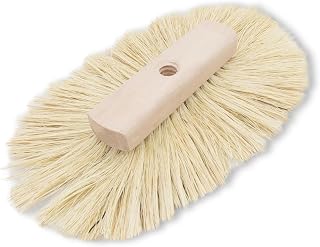
- Bristle material: white tampico hemp bristles
- Size: 13 in
- Block: wooden block
- Handle: hand-held or pole-mounted via the center hole
The Marshalltown 846 is the wide single crowsfoot brush of this set, and width is its argument on a budget. The maker lists white tampico hemp bristles set in a wooden base for hand-held or pole-mounted drywall texturing, with a 13-inch head that creates distinctive decorative patterns on drywall and plaster finishes. A 13-inch head covers a wall in far fewer presses than a small round brush, which keeps the pattern even while the texture paint is still workable.
Tampico hemp is a stiff, durable fiber that holds its shape under pressure, so it pushes material into the surface instead of bending away from it. The maker lists the bristles as securely anchored into a durable wooden block, and the brush can be held comfortably by hand or mounted to a standard pole via the center hole for extended reach on ceilings and high walls. That range means one brush from skirting to ceiling, which matters on a budget because it avoids buying a second tool for the upper half of the wall.
The 846 lays a single crowsfoot pattern, which is more open than a double pattern and suits a soft stipple. Press lightly and the marks stay fine and broken; overlap each press by about a third and the field stays even. A practice board settles the pressure before the real wall, and the wide head rewards a steady rhythm more than a strong arm.
Pros: Wide 13-inch head covers a wall quickly; white tampico hemp suits plaster and drywall; hand or pole use from one brush.
Cons: Wide head needs a steady rhythm to stay even; single pattern is lighter than a double crowsfoot head.
DQB Wood Handle Stippling Brush 11740
- Bristle material: black horsehair and polypropylene blend
- Block: 5.5 in round wood block
- Bristle length: 3 in
- Handle: 1 threaded handle hole; wood handle
The DQB Wood Handle Stippling Brush 11740 is the round wood-block brush of this set. The maker lists a black horsehair and polypropylene blend, staple-set in a 5.5-inch round wood block with a 3-inch bristle and one threaded handle hole. The round wood block sits comfortably in the hand, and the 5.5-inch diameter covers a wall at a pace between the compact Wal-Board head and the wide Marshalltown head.
Horsehair and polypropylene is a forgiving blend for a soft stipple. The horsehair carries the texture paint and lays it down in a soft, broken pattern, while the polypropylene keeps the head springy through a long session. The 3-inch bristle is long enough to hold a good load and short enough to keep the head under control on a vertical surface. The maker lists the brush for creating patterns on finished ceilings and for the swirls and stippled patterns of the Panda Paw line, which matches the soft, organic look this keyword aims for.
The threaded handle hole takes a standard handle for the upper half of a wall, and the wood handle suits hand work low down. The block needs a rinse and a bristle-down dry after use, or texture paint can dry in the staple line and stiffen the fill. Looked after, the 11740 is a durable mid-size round head that handles most of a room on its own, and its price leaves room for the practice board that makes the difference between a good finish and a great one.
Pros: Round wood block with a comfortable hand feel; 5.5-inch head balances coverage and control; horsehair blend suits a soft stipple.
Cons: Wood block needs prompt rinsing and drying; 3-inch bristle carries less material than a longer fill.
DQB Panda Paw I Single Stippling Brush 11934

- Size: 14 in wide; 14 x 9 x 1.5 in
- Weight: 0.55 lb
- Block: wood stippling brush
- Fiber: tampico fiber per the Panda Paw line description
The DQB Panda Paw I 11934 closes this set with a broad single wood block. The maker lists a 14-inch wide wood stippling brush measuring 14 by 9 by 1.5 inches and weighing 0.55 pounds, and the Panda Paw line description lists tampico fiber for these brushes. A 14-inch single head lays a wide, even band of stipple with each press, which suits a soft texture on a broad wall: fewer presses, fewer overlaps, and a more uniform finish.
A single block differs from a double block in the weight of the pattern. One row of fiber lays a lighter, more open stipple than two rows, which is what a soft finish needs. The wide head still covers ground quickly, so the lighter pattern does not cost extra time. The wood block keeps the brush light in the hand at 0.55 pounds, and the size suits both hand work low on a wall and pole work high up.
The 11934 pairs well with the small round Wal-Board 062-005 in this set: the wide single block for the field, the small round head for the edges. Together they cover a room for a modest outlay, and the tampico fiber stands up to repeated use across more than one project. Rinse the head after use and dry it bristle-down, and the brush will be ready for the next wall.
Pros: Wide 14-inch single head covers ground quickly; light wood block at 0.55 lb; single format lays a soft, open stipple.
Cons: Single head lays a lighter pattern than a double block; fiber length is not listed on the retailer page.
Buying guide
Start with the wall, not the brush. Measure the room and note the height, the width and the interruptions: outlets, switches, trim and corners. A wide, open wall rewards a wide head such as the Marshalltown 846 or the DQB 11934, because fewer presses keep the pattern even while the texture paint is workable. A small room or one broken up by trim rewards a compact head such as the Wal-Board 062-005 or the DQB 11740. Most rooms need both, and this set is priced so that a field brush and a detail brush together still sit inside a modest budget.
Fiber choice sets the softness of the finish. Horsehair leads for a soft stipple: it is firm enough to hold a pattern and fine enough to keep it soft, and it appears in the AMES, Wal-Board 062-005 and DQB 11740 heads. Tampico is stiffer and lays a more open mark, which suits a thin coat used with a light press; it appears in the Magnolia, Wal-Board 062-012, Marshalltown 846 and DQB 11934 heads. Blended fills, in the AMES and DQB 11740 heads, add polypropylene for spring when the fill is wet. If the finish will be painted over, a slightly bolder stipple is fine because the paint will soften it; if the stipple is the finish, a finer horsehair head gives a gentler result.
Block construction decides whether a budget brush lasts. Look for a hardwood, lacquered hardwood or marine-grade plywood block, and check that the fiber is staple-set rather than glued only. A threaded center hole is worth having on any brush that will work above shoulder height, and an Acme thread widens the choice of poles: the AMES head lists an Acme thread, and several others list a standard threaded hole. Check whether the handle is included before ordering, because several budget brushes list the handle as sold separately or not included, and a missing handle on the day of the job is a delay.
Technique matters more than price. Load the brush evenly and press straight into the surface, then lift straight up; dragging sideways smears the pattern. Overlap each press by about a third so no bare band shows between marks, and keep a steady rhythm. The AMES maker advises conditioning the brush before use by applying a light coat of compound and pressing until the pattern is uniform, and that advice holds for every brush in this set. Work in sections that stay wet from edge to edge, and feather the boundary of each section with a small round brush before the material starts to set.
A practice board is the best money in a budget project. Mix a small batch, run the pattern, and adjust the load and the pressure until the texture matches the finish you want. Only then start on the wall itself. The board also shows whether the stipple is soft enough: step back to the distance the wall will usually be seen from and look for an even, broken surface rather than bold, separate marks.
Cleaning decides whether a budget brush serves for one wall or for many. Rinse horsehair, tampico and blended fills in warm water right after use, working the material out from the base of the fill toward the tips. Reshape the head while damp and dry it with the bristles pointing down or hanging, so water does not sit in the block. Never leave a loaded brush standing on its bristles, and never let texture paint dry in the fill: dried material stiffens the fiber and the next pattern comes out patchy. Stored dry and clean, even a modestly priced stipple brush will serve for several rooms.
FAQ
Can a budget stipple brush really give a soft, even texture?
Yes, when the fiber and the technique are right. Horsehair and tampico fills in this set are the same kinds of fiber used in dearer brushes, and a soft stipple comes from a light, even press rather than from price. The AMES head and the Wal-Board 062-005 show it well: a fine horsehair fill, an even load and a straight lift give a soft, broken pattern on any wall.
What head size should I choose for a whole room?
For an open wall, a wide head such as the 13-inch Marshalltown 846 or the 14-inch DQB 11934 covers ground quickly and keeps the pattern even. For a small room or one with many interruptions, a compact head such as the 5.5-inch DQB 11740 or the 4.75-inch Wal-Board 062-005 handles the edges. Most rooms need a field brush and a detail brush together.
Do budget stipple brushes include a handle?
Not always. Several brushes in this set list a threaded hole and note that the handle is sold separately or not included. The AMES head lists an Acme thread that fits standard painter poles, and the Marshalltown 846 lists hand or pole use via its center hole. Check the listing before ordering so the handle arrives with the brush.
How do I keep the stipple pattern soft instead of bold?
Use a light press, a thin, even load and a fine fiber such as horsehair. Overlap each press by about a third and lift straight up instead of dragging sideways. A practice board is the place to find the right pressure: run the pattern, let it dry, and check it from the distance the wall will usually be seen from before starting on the real wall.
How should I clean a stipple brush after texture paint?
Rinse in warm water right after use, working the material out from the base of the fill toward the tips. Reshape the head while damp and dry it with the bristles pointing down or hanging. Do not let texture paint dry in the fill and do not store the brush standing on its bristles, because both damage the fiber and spoil the next pattern.
Can I use the same brush for plaster and for limewash?
A stipple brush can do both, but the head must be fully clean between materials, and the fiber should suit a thin wash as well as a thick plaster. The finer horsehair heads in this set, such as the DQB 11740 and the Wal-Board 062-005, handle a wash better than a stiff tampico head. Rinse the brush fully before switching materials.
Conclusion
A soft stippled plaster texture does not need a large outlay. The seven brushes in this set all sit inside the budget cap in the keyword, and each one is a genuine stipple brush with a listed fiber, a real block and a standard handle fit. The AMES ATEXBRUSH08 leads for matching a stipple pattern, with a horsehair fill and an Acme thread that fits standard poles. The Magnolia MAG-CF-10 brings a round tampico head for a soft, continuous surface, while the Wal-Board 062-012 and 062-005 cover field and edges in tampico and horsehair. The Marshalltown 846 and the DQB 11934 cover broad walls quickly, and the DQB 11740 brings a round wood block that balances coverage and control.
Choose by wall size first and fiber second, run a practice pass on a sample board, and keep the press light and the rhythm steady. Clean the brush properly after use and it will serve for more than one room. A small budget buys an even, soft stippled finish when the brush matches the wall and the technique matches the brush.
Related guides
More from Amazon
Programs that pair well with the guide above. Offers and eligibility are set by Amazon and may change.
Free shipping on eligible items, Prime Video and more. Eligible new members can start with a free trial.
Start a Prime free trialAudiobooks and podcasts to listen to on the go. Eligible new members can start with a free trial.
Try Audible freeAd-free music streaming. Eligible new subscribers can start with a free trial.
Try Music Unlimited freeA free business account with business pricing and bulk-buying tools for work, shop or home office.
Create a business accountAs an Amazon Associate we earn from qualifying purchases.
More ways to save on your next finish
Programs that pair well with the guide above. Offers and eligibility are set by Amazon and may change.
A free business account with business pricing and bulk-buying tools for work, shop or home office.
Create a business accountFast, free shipping on eligible items, plus Prime Video and more. Eligible new members can start with a free trial.
Start a Prime free trialRead from a huge library of eBooks, including how-to guides and cookbooks. Eligible new members can start with a free trial.
Try Kindle UnlimitedAudiobooks and podcasts for the commute, the garage or the kitchen. Eligible new members can start with a free trial.
Try Audible freeAs an Amazon Associate we earn from qualifying purchases. Using these links costs you nothing extra.










Write Your Review
No reviews yet. Be the first to share your experience!