
Key takeaways
- Work out the labor for limewashing uneven living room plaster walls, from prep and patching to coats and drying, and plan the job in stages around a small room.
As an Amazon Associate I earn from qualifying purchases. This post may contain affiliate links at no extra cost to you.
A living room with uneven walls is the hardest kind of room to estimate for limewash, because the unevenness changes every part of the job. A flat wall takes a coat of wash in a steady rhythm, but a wall that waves, dips and bulges needs more preparation, more primer, more care with the brush, and more time between coats. The labour is not in the washing itself, it is in the reading of the wall, the levelling of the worst spots, and the slow building of thin coats that follow the surface instead of fighting it. An estimate that counts only the coats will always come up short, and the shortfall will show up as a rushed finish or a job that runs a day over.
how to estimate labor when you limewash interior plaster walls in a living room with uneven walls is best answered by breaking the job into stages and timing each one on its own: measuring and reading the walls, cleaning and repairing, levelling the worst unevenness, priming, mixing and applying the wash, and the drying time between coats. Each stage has its own pace, and the pace depends on the wall, not on the worker. A room with a few gentle waves will take a day of preparation, while a room with deep hollows and old repairs may take two days before a brush full of wash ever touches the wall.
This guide sets out a way to measure the room, judge the unevenness, and build a labour estimate that holds up in practice. The numbers are given as ranges, not as promises, because every living room is different, and the honest estimate is the one that leaves room for the wall to surprise you.
Tools and materials
Romabio Venetian Glaze
- Authentic Italian slaked lime plaster paint
- 1 litre covers about 40 to 100 sq ft of interior drywall undiluted in one coat
- Or 160 to 260 sq ft of masonry diluted
- 2.5 litre covers 100 to 250 sq ft of drywall; 15 litre covers 600 to 1500 sq ft
Venetian Glaze is the lead material for this estimate because its coverage figures let you work out how much wash a living room needs before you start, and the amount of wash is the first labour driver. One litre covers about 40 to 100 square feet of interior drywall undiluted in one coat, or 160 to 260 square feet of masonry when diluted, and a 2.5 litre can will coat a living room while a 15 litre can will cover a whole floor. On uneven walls the coverage falls, because the wash gathers in the hollows and thins on the high spots, so allow a little extra material and a little extra time for the second coat. The glaze is an authentic Italian slaked lime plaster paint, and it goes on thin, so two coats are the normal plan and a third is only needed where the plaster still shows through.
Color Atelier Lime Slurry
- Natural mineral-based finish with fine tactile grain and matte finish
- 5 gallon 32 pound size covers about 150 to 200 square feet in one coat
- Supplied as a dry mineral mixture to be combined with clean water
- Applied by brush, roller or trowel
Lime Slurry earns its place in the estimate because it is a dry mineral mixture that you mix with clean water, and the mixing time is a real part of the labour that is easy to forget. The finish has a fine tactile grain and a matte surface that suits a living room, and the 5 gallon 32 pound size covers about 150 to 200 square feet in one coat. Mixing takes time, the mix must stand before use, and it must be stirred again before each coat, so allow time for mixing at the start of every working day. It can be applied by brush, roller or trowel, but a brush is the best tool on uneven walls, because it follows the surface and works the wash into the hollows where a roller would skip over them.
Cornish Lime Mature Lime Putty
- High calcium lime putty matured for a minimum of four months
- Approximate bulk density 1350 kg per cubic metre
- Available in 10 kg and 25 kg tubs and bulk bags
- Carbonation 1 to 1.5 mm per month
Mature lime putty is the material behind the repairs that uneven walls always need, and it belongs in the estimate because repair time is the largest variable in the whole job. Putty matured for a minimum of four months is fatty, smooth and easy to work, with an approximate bulk density of 1350 kilograms per cubic metre, and it is available in 10 kilogram and 25 kilogram tubs and in bulk bags. Carbonation proceeds at 1 to 1.5 millimetres per month, so a repair needs time to harden before it can be coated, and that time must sit in the estimate as waiting time, not as working time. A putty that is too young will feel gritty and drag, while a putty that has dried out will show hard lumps that tear the finish, so buy from a maker who states the maturing time and keep the tubs sealed.
Calchera San Giorgio Grassello di Calce
- Pure slaked lime putty; CL90S per EN 459-1
- Density approx 1.2 g per cubic cm; pH approx 12
- Maturing 8 to 12 months; packs 20 kg bucket, 160 kg barrel, 1000 kg big-bag
Grassello di Calce from Calchera San Giorgio is the second putty in the estimate, and it is worth listing because its long maturing time of 8 to 12 months makes it one of the smoothest materials for filling the hollows and cracks that uneven walls carry. It is a pure slaked lime putty rated CL90S under EN 459-1, with a density of about 1.2 grams per cubic centimetre and a pH of about 12, and it comes in a 20 kilogram bucket, a 160 kilogram barrel or a 1000 kilogram big-bag. A bucket will cover the repairs in a living room with putty to spare, and the long maturing means the putty spreads cleanly and holds its shape on the trowel. Allow a full day for repairs to firm up before they are rubbed back, and do not coat a repair that is still soft, because the wash will sink into it and show as a dark patch.
Zinsser Bulls Eye 1-2-3
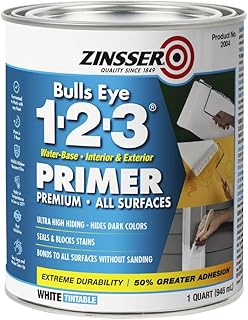
- Water-based styrenated acrylic primer-sealer
- Coverage 400 to 450 sq ft per gallon
- Touch dry 30 min; topcoat 1 h; full hardness 7 days
Bulls Eye 1-2-3 is the primer-sealer in the estimate because its fast drying time changes the labour plan for a living room that must be back in use quickly. It is a water-based styrenated acrylic primer-sealer with coverage of 400 to 450 square feet per gallon, touch dry in 30 minutes, ready for a topcoat in 1 hour, and at full hardness in 7 days. That speed lets you prime in the morning and wash in the afternoon, but it also means the primer must be used with care on a lime wall, because a primer-sealer can block vapour if it is applied too thick. Use it where the wall is sound and needs a quick key, and use a mineral primer where the wall needs to breathe. The fast drying saves hours in the estimate, but only when the wall is right for it.
Meoded Stain Shield
- Natural-look sealer with no added sheen
- Applied after at least 48 hours
- Adds washability and water repellency
- Used on matte finishes
Stain Shield is the sealer in the estimate, and it belongs here because a living room is a working room, and the walls will be touched, leaned on and marked by daily life. It is a natural-look sealer with no added sheen, applied after at least 48 hours, and it adds washability and water repellency to a matte limewash finish. Allow time in the estimate for the sealer coat, and allow the full 48 hours of drying before it goes on, because a sealer applied over a damp wash will trap moisture and cloud the finish. The sealer does not change the look of the wall, but it changes how long the finish lasts, and in a living room that difference is worth the extra half day of labour.
| Item | Key spec | Best for |
|---|---|---|
| Romabio Venetian Glaze | Slaked lime paint; 1 litre covers 40 to 100 sq ft | Coverage planning for the wash |
| Color Atelier Lime Slurry | Dry mineral mix; 150 to 200 sq ft per 5 gallon | Mixing time and adjustable coats |
| Cornish Lime Mature Lime Putty | Matured 4 months; density about 1350 kg per cubic metre | Repairs on uneven walls |
| Calchera San Giorgio Grassello di Calce | CL90S; maturing 8 to 12 months; 20 kg bucket | Smooth filling of hollows |
| Zinsser Bulls Eye 1-2-3 | Coverage 400 to 450 sq ft per gallon; topcoat 1 hour | Fast priming on sound walls |
| Meoded Stain Shield | No added sheen; apply after 48 hours | Sealing a working living room wall |
Step by step
Step 1: Measure the room and count the walls
Measure every wall in the living room, length by height, and subtract the doors and windows, then add the reveals back in, because a window reveal takes as long to wash as a square metre of flat wall. Count the corners, the chimney breast, the alcoves and any built-in shelving, because each one adds brushing time that a flat measurement misses. Write the total area down in square metres, and write the number of corners and reveals beside it, because the estimate is built from both figures. A living room that measures 40 square metres of wall with six corners will take longer than a room with the same area and two corners, and the difference is in the cutting in, not in the rolling of the main areas.
Step 2: Read the unevenness with a straight edge
Hold a long straight edge against each wall in several directions and mark the high and low spots with a pencil, then measure the depth of the worst hollows with a small ruler. A wall that waves by a few millimetres is a normal old wall and needs only a little extra brushing time, while a wall with hollows ten millimetres deep needs levelling work before any wash goes on. Note which walls are worst, because the estimate should give the bad walls more preparation time and the good walls less. This reading takes about an hour in a living room, and it is the hour that makes the rest of the estimate honest, because a wall that has not been read will always surprise the worker halfway through the job.
Step 3: Allow time for cleaning and repairs
Budget a full day for cleaning and repairs in a living room with uneven walls, and do not try to squeeze it into half a day. Brush the walls down, wipe them with a damp sponge, fill the cracks and hollows with mature lime putty, and leave the repairs slightly proud so they can be rubbed back flat when they have set. Let every repair dry fully, then rub it back until it sits flush with the wall and the edge disappears under your fingertip. A repair that you can feel is a repair that the limewash will show, so the rubbing back is not a detail, it is a stage of the job with its own time. If the repairs are deep, allow a second day for them to firm up, because a repair that is coated while it is still soft will sink and show as a dark patch.
Step 4: Allow time for levelling and priming
Where the wall is too uneven for primer alone, allow time for a thin levelling coat and a full day for it to dry, then allow half a day for priming. Stir the primer well, cut in around the ceiling, the skirting and the window frames with a brush, and cover the main areas in sections about a metre wide, keeping a wet edge. On a high suction wall, a second coat of primer is cheaper than a third coat of limewash, so let the first coat dry fully and look at the wall in raking light before you decide. If the primer has dried in patches of different tone, the suction is still uneven and a second coat will pay for itself. In a living room the primer coat is the foundation of the finish, and a wall that is primed evenly will take the limewash at a steady rate.
Step 5: Allow time for mixing and applying the wash
Budget a morning for mixing and a day for each coat of wash, and do not plan two coats in one day. Mix the wash slowly until it is completely smooth, stir it again every few minutes while you work, and keep a clean bucket of water beside you for rinsing the brush. Load the brush lightly, work the wash into the plaster in long, even strokes that cross each other lightly, and keep a wet edge as you move across the wall. On uneven walls the brush must follow the surface into the hollows, and that takes longer than brushing a flat wall, so allow a third more time for the first coat than you would on a flat room. The first coat will look thin and patchy while it is wet, and that is normal, because limewash dries much lighter than it looks in the bucket.
Step 6: Allow a full day of drying between coats
Put a full day of drying between every coat in the estimate, and treat it as part of the job, not as empty time. Limewash dries by carbonation, and that change needs moisture to be present in the coat for days, not hours, so a coat that is rushed will stay soft and powdery. Keep the room at a steady temperature, avoid direct sun on the wet wall, and do not run a heater aimed at the plaster, because fast drying makes limewash chalky and weak. Two coats are usually enough on a well primed wall, and a third coat is only needed where the plaster still shows through or where the colour needs more depth. A living room with three coats and two drying days is a five day job, and the estimate should say so plainly.
Step 7: Allow time for sealing and putting the room back
Allow half a day for the sealer coat and a full day for the room to be put back together, because a living room has furniture, pictures, curtains and light fittings that must all go back on walls that are fully dry. Apply the sealer only after at least 48 hours, work it on thinly with a clean brush, and let it dry fully before anything touches the wall. Move the furniture back only when the final coat is dry and the wall feels dry and at room temperature, with no cool or damp patches. Keep sofas and chairs a few centimetres from the wall for the first week, because furniture pressed against a fresh limewash wall will trap moisture and mark the finish. The last day of the estimate is the day the room becomes a living room again.
Common mistakes
Estimating only the coats
The most common estimating mistake is to count the coats of wash and forget the preparation, the repairs, the priming and the drying time. On an uneven living room wall the preparation can take longer than the washing, and an estimate that counts only the coats will run a day or two over. Break the job into stages, time each stage on its own, and add the stages together. The honest estimate is the one that lists preparation, priming, washing, drying and sealing as separate lines, and the client who sees those lines will trust the total.
Measuring the walls without the reveals
A window reveal, a door frame and a chimney breast all take brushing time that a flat measurement misses, and a living room is full of them. Measure the reveals and the returns as well as the flat walls, and count the corners, because each corner needs cutting in with a brush. A room that measures 40 square metres of flat wall may have another 10 square metres of reveals and returns, and that extra area is a quarter of the job. Measure it, write it down, and put it in the estimate.
Underestimating the repair time
Uneven walls always need more repair than they show at first glance, because a hollow that looks shallow in flat light can be deep in raking light. Allow a full day for repairs, and allow a second day if the repairs are deep, because a repair that is coated while it is still soft will sink and show as a dark patch. The repair time is the largest variable in the whole job, and the estimate should carry a range for it rather than a single figure. A range is honest, and a single figure that turns out to be wrong is not.
Planning two coats in one day
Limewash needs a full day between coats, and a plan that puts two coats in one day will fail, because the second coat will lift the first and the finish will be weak and patchy. Put a drying day between every coat in the estimate, and tell the client plainly that the room will be out of use for those days. A living room with three coats and two drying days is a five day job, and the estimate should say so. Rushing the drying is the fastest way to turn a good estimate into a bad job.
Forgetting the sealer and the furniture
A living room is a working room, and the walls will be touched, leaned on and marked by daily life, so the sealer coat and the time to put the room back together belong in the estimate. The sealer needs at least 48 hours of drying before it goes on, and the furniture should stay a few centimetres from the wall for the first week. Forgetting these stages means the job looks finished a day early and then fails in the first month, and the cost of fixing it is more than the cost of allowing for it.
Giving a single figure instead of a range
Every living room is different, and an estimate that gives a single figure pretends to know more than it can. Give a range for the preparation and a range for the total, and explain what would push the job to the top of the range. A range is honest, it protects the worker and the client, and it leaves room for the wall to surprise you. A single figure that turns out to be wrong will cost trust, and trust is harder to repair than plaster.
FAQ
How long does it take to limewash a living room with uneven walls?
A living room with uneven walls usually takes five to seven working days from start to finish, including preparation, priming, two or three coats of wash with a full day of drying between them, and a sealer coat. The preparation alone can take one or two days, and the drying days are part of the job, not empty time. A room with gentle unevenness will sit at the short end of the range, and a room with deep hollows and old repairs will sit at the long end. The honest answer is a range, not a single day count.
What makes uneven walls slower to limewash?
Uneven walls need more preparation, more repair, more primer and more care with the brush, because the wash gathers in the hollows and thins on the high spots. The brush must follow the surface into every dip, the primer must even out the suction across patched and unpatched areas, and the coats must be thin enough to follow the wall without pooling. Each of these stages takes longer on an uneven wall than on a flat one, and the difference adds up across a whole living room.
How do I measure a living room for a limewash estimate?
Measure every wall, length by height, subtract the doors and windows, and add the reveals and returns back in, because a window reveal takes as long to wash as a square metre of flat wall. Count the corners, the chimney breast and the alcoves, because each one adds brushing time. Write the total area down in square metres, and write the number of corners and reveals beside it, because the estimate is built from both figures. A room with the same area but more corners will take longer, and the difference is in the cutting in.
Should the estimate include drying time?
Yes, drying time is part of the job and it belongs in the estimate as separate days. Limewash needs a full day between coats, and the sealer needs at least 48 hours of drying before it goes on. A client who sees drying days in the estimate understands why the room is out of use, and a client who does not see them will think the job is running late. List the drying days plainly, and the estimate will be trusted.
How much extra material should I allow for uneven walls?
Allow a little extra wash and a little extra primer for uneven walls, because the wash gathers in the hollows and the primer is absorbed unevenly across patched and unpatched areas. A second coat of primer is cheaper than a third coat of limewash, so allow for it in the estimate rather than hoping one coat will do. The extra material is a small part of the total cost, and it is far cheaper than running out halfway through a coat.
When should I add a third coat to the estimate?
Add a third coat when the plaster still shows through after two coats, when the colour needs more depth, or when the wall has very uneven suction that leaves the second coat patchy. Two coats are usually enough on a well primed wall, and a third coat should be a decision made after the second coat has dried and been looked at in daylight. Do not promise three coats before the job starts, but do allow for the possibility in the estimate, so the client is not surprised if the wall needs it.
Conclusion
Estimating labour for limewashing uneven living room walls is a matter of breaking the job into stages and timing each one on its own. Measuring and reading the walls, cleaning and repairing, levelling and priming, mixing and applying the wash, and the drying days between coats all have their own pace, and the pace depends on the wall, not on the worker. Venetian Glaze leads the materials because its coverage figures let you work out how much wash the room needs, and Lime Slurry, mature putty and grassello give you the materials for the repairs that uneven walls always demand. Behind them, a primer-sealer and a natural-look sealer protect the finish in a room that is used every day.
Give the estimate as a range, list the stages plainly, and leave room for the wall to surprise you. The client who sees preparation, priming, washing, drying and sealing as separate lines will trust the total, and the worker who has allowed for the repairs will not have to rush the finish. A living room with uneven walls rewards patience more than speed, and a finish built in thin coats with full drying days will look soft and even for years. Keep the room at a steady temperature, keep the brush clean, and let each coat dry before the next one goes on.
Related guides
More from Amazon
Programs that pair well with the guide above. Offers and eligibility are set by Amazon and may change.
Free shipping on eligible items, Prime Video and more. Eligible new members can start with a free trial.
Start a Prime free trialAudiobooks and podcasts to listen to on the go. Eligible new members can start with a free trial.
Try Audible freeAd-free music streaming. Eligible new subscribers can start with a free trial.
Try Music Unlimited freeA free business account with business pricing and bulk-buying tools for work, shop or home office.
Create a business accountAs an Amazon Associate we earn from qualifying purchases.
More ways to save on your next finish
Programs that pair well with the guide above. Offers and eligibility are set by Amazon and may change.
A free business account with business pricing and bulk-buying tools for work, shop or home office.
Create a business accountFast, free shipping on eligible items, plus Prime Video and more. Eligible new members can start with a free trial.
Start a Prime free trialRead from a huge library of eBooks, including how-to guides and cookbooks. Eligible new members can start with a free trial.
Try Kindle UnlimitedAudiobooks and podcasts for the commute, the garage or the kitchen. Eligible new members can start with a free trial.
Try Audible freeAs an Amazon Associate we earn from qualifying purchases. Using these links costs you nothing extra.










Write Your Review
No reviews yet. Be the first to share your experience!