
Key takeaways
- Primer choice before olive soap decides whether tadelakt holds on a small decorative basin. Compare casein, waterglass, quartz and adhesion primers for the job.
As an Amazon Associate I earn from qualifying purchases. This post may contain affiliate links at no extra cost to you.
Olive soap gives tadelakt its deep sheen and its water-shedding skin, yet the soap can only do its work when the plaster beneath it stays bonded to the basin. The primer chosen before the tadelakt goes on decides that bond. Which primer is compatible before you apply olive soap to tadelakt on a small decorative plaster basin is therefore a question about the substrate first and the soap second: a primer that suits the basin material, the tadelakt system, and the thin soap film that finishes it.
A small decorative plaster basin is a demanding little object. It curves, it has a rim and a foot, and its surface alternates between vertical walls and a shallow bowl. The tadelakt on it is thin, often no more than a few millimetres, so any weakness in the bond shows up fast as a hollow spot, a hairline, or a patch where the soap finish looks dull. The right primer keys the tadelakt to the basin, evens out suction, and keeps the soap layer sitting on a stable, hard surface rather than on a soft or dusty one.
This guide walks through the primer options that makers list for tadelakt work, explains which substrate each one suits, and shows the order of work from a bare basin to a soaped, polished finish. The focus stays on the small decorative basin, where a brush, a small roller, and careful drying matter more than large-area speed. Every figure in this guide comes from a maker data sheet or an application guide that was opened during research, and the sources file for this half-batch lists the exact page for each product.
Quick answer
On a small decorative plaster basin, the primer depends on the substrate. A casein primer suits absorbent mineral plaster and lime render. A potassium waterglass wash pre-hardens soft lime surfaces before the tadelakt goes on. A quartz primer suits smooth, painted, or low-suction surfaces such as drywall and sealed plasterboard. A masonry primer-sealer suits non-absorbent or glossy substrates that need a strong bond. The primer must dry fully before the tadelakt base coat, and the olive soap goes on only after the tadelakt has hardened. No single primer fits every basin, so the choice starts with reading the surface, not with reaching for a favourite tin.
| Primer | What it does | When to use it |
|---|---|---|
| Kreidezeit Casein Primer 145 | Bonds a casein film to absorbent mineral surfaces and evens suction | On lime plaster, lime render, and levelled mineral filler |
| Kreidezeit Potassium Waterglass 607 | Pre-hardens and consolidates a soft lime surface | On soft or dusty lime plaster before the tadelakt base coat |
| Protek Sharktooth Primer | Keys tadelakt to drywall and smooth boards | On new drywall and primed board under Protek Tadelakt |
| Zinsser Bulls Eye 1-2-3 Primer-Sealer | Seals and keys glossy and painted surfaces without scuff sanding | On smooth, painted, and sealed surfaces before the base coat |
| Venezia Stucco Quartz Primer | Primes smooth surfaces for the Venezia tadelakt cycle | On drywall, wood, and smooth surfaces before the base coat |
| Sherwin-Williams Loxon Concrete and Masonry Primer-Sealer | Seals porous masonry and gives a uniform key for the top coat | On mineral plaster, stucco, and masonry that needs sealing |
Step by step
1. Read the basin and name the substrate
Start by identifying what the basin is made of and what sits on its surface. A basin cast in lime plaster or finished in lime render is absorbent, and a drop of water placed on it darkens the surface and disappears within a minute or two. A basin built on plasterboard or drywall is smoother and less absorbent, and a drop of water may sit on the surface for a while before soaking in. A basin that already carries a coat of paint, a sealer, or a glossy finish is the least absorbent of all, and water beads on it rather than soaking in at all. Each of these three cases points to a different primer family, so the water-drop check is worth the minute it takes.
Look closely at the rim and the foot as well as the bowl. The rim is where a trowel edge catches and where a weak bond peels first. The foot is where dust and handling marks collect. Run a clean, dry hand over the whole basin and feel for dust, loose grains, and soft spots. A surface that sheds powder onto the hand needs consolidation before any tadelakt goes on, and that points toward a waterglass wash rather than a plain primer. A surface that feels hard and glassy needs a mechanical key, and that points toward a quartz primer or an adhesion coat. Write down the substrate type and the primer family that matches it before mixing anything, because the rest of the job follows from that one decision.
2. Clean, dry, and dampen the surface
Brush the basin with a soft, dry brush to remove dust and loose grains, working from the rim down into the bowl and then around the foot. A vacuum with a soft brush nozzle helps on a curved surface, since it pulls dust out of the hollows without driving it deeper. Do not use a wire brush on a lime surface, because the wires score the plaster and open up fresh dust. If the basin carries grease, soap residue, or a wax film from an earlier finish, wipe it with a damp cloth and a mild, neutral cleaner, then rinse with clean water and let the surface dry. A greasy film blocks the primer from wetting the surface, and no primer can bond through it.
Let the basin dry until the surface looks even and no dark damp patches remain. Drying time depends on the thickness of the plaster and the air in the room, and a small basin in a warm, ventilated room usually dries within a day. Once dry, dampen the surface lightly with a fine mist of clean water just before priming, so the primer wets the pores instead of sitting on dry dust. The surface should look evenly damp, not wet, and no water should pool in the bowl. A light mist also keeps the primer from drying too fast on a thirsty lime surface, which is a common cause of a patchy bond.
3. Mix and apply the casein primer on absorbent plaster
For an absorbent lime plaster or lime render basin, the casein primer is the standard choice. Kreidezeit Casein Primer 145, article 1103, is a powder based on casein and sodium carbonate. The maker lists a mix of 250 grams of powder in 3 litres of cold water, left to rest for about 30 minutes, then diluted with a further 5 litres of water. That quantity covers 40 to 60 square metres, so a single small batch is far more than a small basin needs; mix only a small fraction of the pack and keep the proportions the same. The primer must be used on the same day it is mixed, and the working temperature should stay above 8 degrees Celsius.
Apply the casein primer with a soft brush, working it into the pores of the plaster with even strokes. On a basin, brush the bowl first, then the rim, then the outside and the foot, so drips fall onto surfaces that still need coating rather than onto finished ones. One even coat is enough. The maker lists a drying time of about 8 hours at 20 degrees Celsius, and the primer film has a diffusion resistance, sd value, below 0.01 metres, which means it stays vapour-open and does not trap moisture behind the tadelakt. Do not rush the drying: a casein film that is still damp when the tadelakt goes on can soften and lose its grip. Leave the basin overnight in a ventilated room and check that the surface feels dry and even before moving on.
4. Pre-harden soft lime with potassium waterglass
When the basin surface feels soft, chalky, or dusty even after brushing, a casein primer alone may not be enough. The surface needs consolidation first, and that is the job of a potassium waterglass wash. Kreidezeit Potassium Waterglass 607 is listed by the maker for pre-hardening tadelakt substrates. The dilution the maker lists is one part waterglass to three parts water, applied to the lime surface and left to dry for at least 24 hours. The waterglass reacts with the lime and hardens the top layer of the plaster, so the tadelakt base coat meets a firm surface instead of a crumbling one.
Apply the diluted waterglass with a brush or a low-pressure sprayer, keeping the coat even and avoiding puddles in the bowl. The surface may look slightly darker while wet and returns to a paler tone as it dries. Do not apply tadelakt over a waterglass wash that is still damp, and do not shorten the 24-hour drying window, because the hardening reaction needs that time. Once the surface is dry and hard to the touch, it can take a casein primer as well if the suction still looks uneven, or it can go straight to the tadelakt base coat when the surface feels uniformly firm. On a small basin the waterglass step adds a day to the schedule, and that day is well spent when the alternative is a tadelakt layer that powders off the bowl.
5. Key smooth surfaces with a quartz primer or adhesion coat
A basin built on drywall, plasterboard, wood, or a painted surface needs a different approach, because the problem is not suction but grip. A quartz primer carries fine mineral grains in a binder, and those grains give the tadelakt something to hold onto. Zinsser Bulls Eye 1-2-3 Primer-Sealer is a water-based styrenated acrylic primer-sealer, listed for glossy surfaces without scuff sanding, with a coverage of about 400 to 450 square feet per gallon and a topcoat time of about one hour. Venezia Stucco Quartz Primer is listed for drywall, wood, or any smooth surface, applied by roller or brush, and it sits in the maker application cycle before the base coat. Protek Sharktooth Primer is the primer listed for Protek Tadelakt, and the maker names new drywall primed with Sharktooth Primer as the ideal substrate for that tadelakt.
When the surface is glossy, sealed, or otherwise non-absorbent, a quartz primer may still not give enough key, and an adhesion coat is the stronger option. Sherwin-Williams Loxon Concrete and Masonry Primer-Sealer is an acrylic primer-sealer listed for concrete and masonry, with a coverage of 200 to 320 square feet per gallon and a recoat time of 24 hours. It is applied as a thin coat that seals the surface and gives the tadelakt a uniform key. Choose the quartz primer for smooth but still slightly absorbent surfaces, and the masonry primer-sealer for glossy or sealed surfaces where a brush coat of primer would sit on top without bonding. In both cases, let the key coat dry fully and check that it feels rough and firmly attached before the tadelakt goes on.
6. Dry the primer, lay the tadelakt, and finish with olive soap
Once the primer is dry, the tadelakt base coat goes on in two thin layers. Kreidezeit Tadelakt, for example, is a dry powder sold in 2.5, 10, and 25 kilogram bags, mixed with 0.25 litres of water per kilogram of powder, rested for 30 minutes, and used within 8 to 10 hours. The maker lists a coverage of 2.5 kilograms per square metre at 2 millimetres, laid in two layers of 1 to 1.5 millimetres each, with a drying time of 2 to 3 days at 3 millimetres and full hardness reached after about 6 months. The plaster has a pH above 12.5 when fresh, so gloves and eye protection belong in the routine. Work the first layer into the primed surface, let it firm up, then lay the second layer and close it with a plastic trowel.
The olive soap comes last, and only after the tadelakt has hardened enough to take a polish. Kreidezeit Polishing Soap Concentrate, article 3502, is based on Corfu soap, which is a pure olive soap. The maker lists a dilution of one part soap to six parts water, never undiluted, at about 100 millilitres of diluted soap per square metre, with a 500 millilitre pack covering about 35 square metres. Brush or spray the diluted soap onto the surface, work it in small circular movements with a polishing stone, and let it dry. A second soap pass can follow after the first layer dries, and the maker lists a window of no later than two days for that repeat. The soap saturates the surface, deepens the colour, and gives the basin the soft sheen that marks a finished tadelakt piece. Note that the maker lists Kreidezeit Tadelakt for splash areas rather than for basins that hold standing water, so a small decorative basin is a display piece and the soap finish suits it; a basin that must hold water day after day calls for a different system and a different conversation with the maker.
Tools and materials
Kreidezeit Casein Primer 145
- Powder primer, article 1103, based on casein and sodium carbonate
- Mix: 250 g powder in 3 L cold water, rest about 30 minutes, then dilute with 5 L water
- Coverage: 250 g covers 40 to 60 square metres
- Drying: about 8 hours at 20 degrees Celsius
- Diffusion resistance, sd value: below 0.01 m, vapour-open
- Minimum working temperature: 8 degrees Celsius; use the mixed primer the same day
The casein primer is the workhorse for absorbent mineral basins. The casein film bonds to lime plaster and lime render, evens out suction across the surface, and leaves a vapour-open layer that does not trap moisture behind the tadelakt. On a small basin, a tiny fraction of a pack is enough, and the small batch size makes it easy to keep the mix fresh. The primer suits the first coat on a basin that has never been sealed, and it is the primer to reach for when the water-drop check shows the surface drinking water quickly and evenly.
Pros: Excellent bond on absorbent lime plaster; evens suction; vapour-open film; a single pack covers a large area.
Cons: Must be mixed fresh and used the same day; needs about 8 hours of drying; not a key coat for glossy or sealed surfaces.
Kreidezeit Potassium Waterglass 607
- Potassium waterglass wash for pre-hardening lime surfaces
- Dilution: 1 part waterglass to 3 parts water
- Drying time: at least 24 hours before the next coat
- Application: brush or low-pressure sprayer, even coat, no puddles
The waterglass wash is a consolidator rather than a primer in the usual sense. It reacts with the lime in a soft or dusty surface and hardens the top layer, so the tadelakt meets a firm substrate. It earns its place on basins that shed powder after brushing, on old lime render that has weathered soft, and on any surface where a fingernail leaves a mark. The 24-hour drying window is part of the product, not a suggestion, and the hardening reaction needs that time to run.
Pros: Firms up soft and dusty lime; simple dilution; works under a casein primer or straight under the tadelakt.
Cons: Adds a full day to the schedule; only suits lime-based surfaces; does not give a mechanical key on smooth, sealed substrates.
Protek Sharktooth Primer
- Primer listed by the maker for Protek Tadelakt
- Ideal substrate named by the maker: new drywall primed with Sharktooth Primer
- Application: brush or roller on drywall and smooth boards
Sharktooth Primer belongs to the Protek tadelakt system, and its job is to prepare board substrates that have almost no suction of their own. New drywall is the classic case: the paper face is smooth, the joints are filled, and a tadelakt base coat laid straight onto it has little to grip. The primer gives the board a uniform, keyed surface so the tadelakt bonds evenly across the whole basin. It is the primer to choose when the basin is built on board and the tadelakt is a Protek product, because the maker pairs the two in the same system.
Pros: Matched to the Protek tadelakt system; suits new drywall; simple brush or roller application.
Cons: A system primer, so it pairs best with Protek Tadelakt; not a consolidator for soft lime; not a substitute for a quartz key on glossy paint.
Zinsser Bulls Eye 1-2-3 Primer-Sealer
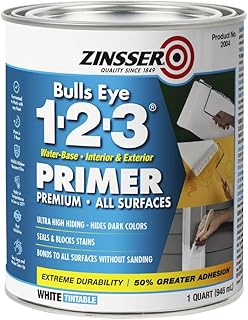
- Water-based styrenated acrylic primer-sealer
- Coverage: about 400 to 450 square feet per gallon
- Touch dry in about 30 minutes; topcoat in about 1 hour; full adhesion in 7 days
Zinsser Bulls Eye 1-2-3 Primer-Sealer is a water-based primer-sealer that bonds to glossy surfaces without scuff sanding, which is exactly the problem on a basin that already carries a coat of paint or a sealer. The maker lists a pH tolerance up to 12.5, so it suits fresh mineral surfaces as well as old paint, and it is applied at temperatures from 35 to 90 degrees Fahrenheit with relative humidity under 85 percent. On a small basin, a quart is far more than needed, and the fast topcoat time keeps the schedule short: the tadelakt base coat can go on about an hour after the primer, once the film feels dry.
Pros: Bonds to glossy surfaces without scuff sanding; fast topcoat time of about one hour; suits fresh mineral surfaces up to pH 12.5.
Cons: Needs the surface clean and dry to bond; not a consolidator for soft lime; the film must be fully dry before the tadelakt goes on.
Venezia Stucco Quartz Primer
- Primer for drywall, wood, or any smooth surface
- Application: roller or brush
- Position in the maker cycle: before the base coat
Venezia Stucco Quartz Primer is the primer that opens the Venezia tadelakt application cycle. It is listed for drywall, wood, and any smooth surface, and it is applied by roller or brush before the base coat goes on. On a small decorative basin, a small roller covers the broad curves and a brush reaches the rim and the foot, so the two tools together give an even film. The primer suits basins built on board or wood where the substrate is sound but smooth, and it keeps the tadelakt system inside a single maker cycle, which makes the drying and compatibility questions simpler.
Pros: Suits drywall, wood, and smooth surfaces; roller or brush application; part of a matched maker cycle.
Cons: Only as good as the surface beneath it; needs full drying before the base coat; not designed for soft or powdery lime.
Sherwin-Williams Loxon Concrete and Masonry Primer-Sealer
- Acrylic primer-sealer for concrete and masonry
- Coverage: 200 to 320 square feet per gallon; 80 square feet per gallon on porous rough stucco
- Touch dry in 4 hours; recoat in 24 hours at 77 degrees Fahrenheit and 50 percent relative humidity
Sherwin-Williams Loxon Concrete and Masonry Primer-Sealer is an acrylic primer-sealer listed for concrete and masonry surfaces, with a pH range of 6 to 13 that suits fresh and old mineral work alike. The maker lists a minimum application temperature of 40 degrees Fahrenheit and a shelf life of 36 months unopened, and new masonry should cure for 7 days before priming. On a small decorative basin, the primer seals a porous or uneven mineral surface and leaves a uniform film for the tadelakt base coat, and the low VOC content, under 50 grams per litre, keeps the working air pleasant in a small room.
Pros: Seals porous masonry and evens suction; suits a wide pH range from 6 to 13; low VOC under 50 grams per litre.
Cons: Needs a 24-hour recoat window; suits mineral surfaces best, so glossy paint still needs a bonding primer such as the Zinsser 1-2-3 in this set; new masonry must cure 7 days first.
Common mistakes
Priming a dusty surface without cleaning it first
Dust is the most common cause of a failed bond, and it is also the easiest to avoid. A basin that looks clean can still carry a fine film of plaster dust, and a primer laid over that dust bonds to the dust, not to the basin. The dust layer then parts from the substrate and takes the tadelakt with it. Brush the basin, vacuum the hollows, and wipe with a damp cloth before any primer goes on. The extra ten minutes at this stage saves a complete rebuild later.
Using a casein primer on a glossy, sealed surface
Casein primer bonds to absorbent mineral surfaces, and it has little to hold onto when the surface is glossy paint or a sealer. The film can dry looking fine and then peel away in sheets when the tadelakt is laid over it. The water-drop check exists to catch this: if water beads on the surface, the substrate needs a quartz primer or a masonry primer-sealer, not a casein primer. Match the primer family to the substrate, and do not let habit choose the product.
Shortening the drying time of the primer
Every primer in this guide has a drying window, and the window is part of the bond. A casein film that is still damp when the tadelakt goes on can soften and lose grip, and a waterglass wash that has not had its 24 hours has not finished hardening the surface. The temptation to push on is strongest on a small job, where the basin looks dry after a few hours. Leave the basin overnight, check that the surface feels dry and even, and only then lay the tadelakt. A day of patience is cheaper than a day of repair.
Applying the soap before the tadelakt has hardened
Olive soap is a finishing material, not a shortcut. The soap goes on after the tadelakt has hardened enough to take a polish, and applying it to a soft surface smears the plaster, closes the pores unevenly, and leaves dull patches that no amount of later polishing removes. The maker lists a drying time of 2 to 3 days for a 3 millimetre tadelakt layer, and the soap should wait until the surface feels firm and cool to the touch. A sample panel made alongside the basin gives a safe place to check readiness without touching the basin itself.
Forgetting that a decorative basin is not a wash basin
A small decorative plaster basin is a display piece, and the maker lists Kreidezeit Tadelakt for splash areas rather than for basins that hold standing water. The soap finish suits the decorative basin, and it also suits splash zones around a sink. It does not turn a plaster basin into a functional wash basin that holds water day after day. Keeping that distinction clear avoids disappointment and avoids blaming the primer for a failure that belongs to the choice of system.
FAQ
Can the same primer be used on the inside and the outside of the basin?
Yes, when the substrate is the same on both sides. Most small decorative basins are a single material throughout, so one primer family covers the whole piece. When the inside carries an old paint or sealer and the outside is bare plaster, the two faces need different primers, and the work should be split into two priming passes with the correct drying time for each.
Does the primer change the colour of the finished tadelakt?
A primer can darken the substrate slightly while wet, and that effect usually disappears as the primer dries. A quartz primer leaves a pale, grainy film that can lighten the first tadelakt layer very slightly where the plaster is thin. The effect is small on a normal two-layer build, and a pigmented tadelakt hides it completely. When the basin will carry an unpigmented, pale finish, a sample panel primed the same way shows the true colour before the basin is committed.
Is a quartz primer needed on bare lime plaster?
No. Bare lime plaster is absorbent, and a casein primer is the better match because it bonds to the plaster and evens suction. A quartz primer on absorbent plaster adds a grainy layer that the tadelakt does not need, and it can make the first layer harder to close smoothly. Save the quartz primer for smooth, painted, or board substrates where grip is the problem.
How long should the primer dry before the tadelakt goes on?
The casein primer needs about 8 hours at 20 degrees Celsius, and an overnight wait is the safe routine. The waterglass wash needs at least 24 hours. Quartz primers and adhesion coats need to dry until the surface feels rough, firm, and evenly dry to the touch, and the maker data sheet for the product in use gives the exact window. Cold or damp air lengthens every drying time, so a basin left in a cool room needs longer than the same basin in a warm, ventilated room.
Can olive soap be applied straight onto the primer?
No. The olive soap is a finish for hardened tadelakt, not a treatment for primer. The order is fixed: primer, then tadelakt base coat, then drying, then soap. Soap applied to a primer film has no plaster to saturate and no surface to polish, and it leaves a sticky layer that attracts dust. The soap only earns its sheen on a hard, closed tadelakt surface.
What happens when the wrong primer is chosen?
The usual result is a bond failure that shows up as hollow spots, peeling, or a dull soap finish. The tadelakt may sound hollow when tapped, or the soap may sit unevenly because the plaster beneath it has parted from the substrate. The repair is to remove the loose plaster, clean the substrate, prime it with the correct product, and lay the tadelakt again. The cost of the repair is far larger than the cost of the water-drop check that would have caught the mistake at the start.
Conclusion
The primer for a small decorative tadelakt basin is chosen by the substrate, not by habit. Absorbent lime plaster takes a casein primer. Soft or dusty lime takes a potassium waterglass wash first, then a primer. Smooth board, wood, or painted surfaces take a quartz primer. Glossy or sealed surfaces take a cement-based adhesion coat. Each primer in this guide has a maker data sheet behind it, a drying window that must be respected, and a substrate it suits best. The olive soap that finishes the basin can only shine on a tadelakt layer that is firmly bonded, and that bond starts with the primer. Read the basin, run the water-drop check, pick the primer family that matches, let it dry fully, and the soap finish will have a sound surface to work on.
Related guides
More from Amazon
Programs that pair well with the guide above. Offers and eligibility are set by Amazon and may change.
Free shipping on eligible items, Prime Video and more. Eligible new members can start with a free trial.
Start a Prime free trialAudiobooks and podcasts to listen to on the go. Eligible new members can start with a free trial.
Try Audible freeAd-free music streaming. Eligible new subscribers can start with a free trial.
Try Music Unlimited freeA free business account with business pricing and bulk-buying tools for work, shop or home office.
Create a business accountAs an Amazon Associate we earn from qualifying purchases.
More ways to save on your next finish
Programs that pair well with the guide above. Offers and eligibility are set by Amazon and may change.
A free business account with business pricing and bulk-buying tools for work, shop or home office.
Create a business accountFast, free shipping on eligible items, plus Prime Video and more. Eligible new members can start with a free trial.
Start a Prime free trialRead from a huge library of eBooks, including how-to guides and cookbooks. Eligible new members can start with a free trial.
Try Kindle UnlimitedAudiobooks and podcasts for the commute, the garage or the kitchen. Eligible new members can start with a free trial.
Try Audible freeAs an Amazon Associate we earn from qualifying purchases. Using these links costs you nothing extra.










Write Your Review
No reviews yet. Be the first to share your experience!